Introduction
“My lower back is sore after swimming”—this phrase is heard almost as frequently among Taiwan’s swimming community as “my shoulder hurts.” Many people assume swimming is a low-impact exercise that is “definitely good” for the lower back. However, if poor swimming posture is maintained over time, swimming can just as easily become a primary culprit behind back pain.
The most common postural issue is excessive lumbar lordosis, commonly referred to as “arching” or “sagging the lower back.” In the water, this posture may appear to make the swimmer more streamlined, but in reality, it places unnecessary stress on the facet joints and intervertebral discs of the lumbar spine.
What Is the “Arching” Posture?
In an ideal horizontal swimming posture, the spine should be in a neutral spine state, with the head, shoulders, hips, and feet roughly maintaining a horizontal line. The arching posture manifests as:
- The abdomen sinks while the hips float upward (creating a downward curve)
- The lumbar spine arches backward (excessive lordosis, typically exceeding 40°)
- The feet drift toward the water surface during swimming, increasing drag
Self-Assessment Methods
| Assessment Method | Description | Normal Standard |
|---|---|---|
| Side-view underwater filming | Ask a coach or swim buddy to film from the poolside | Head, hips, and feet roughly horizontal |
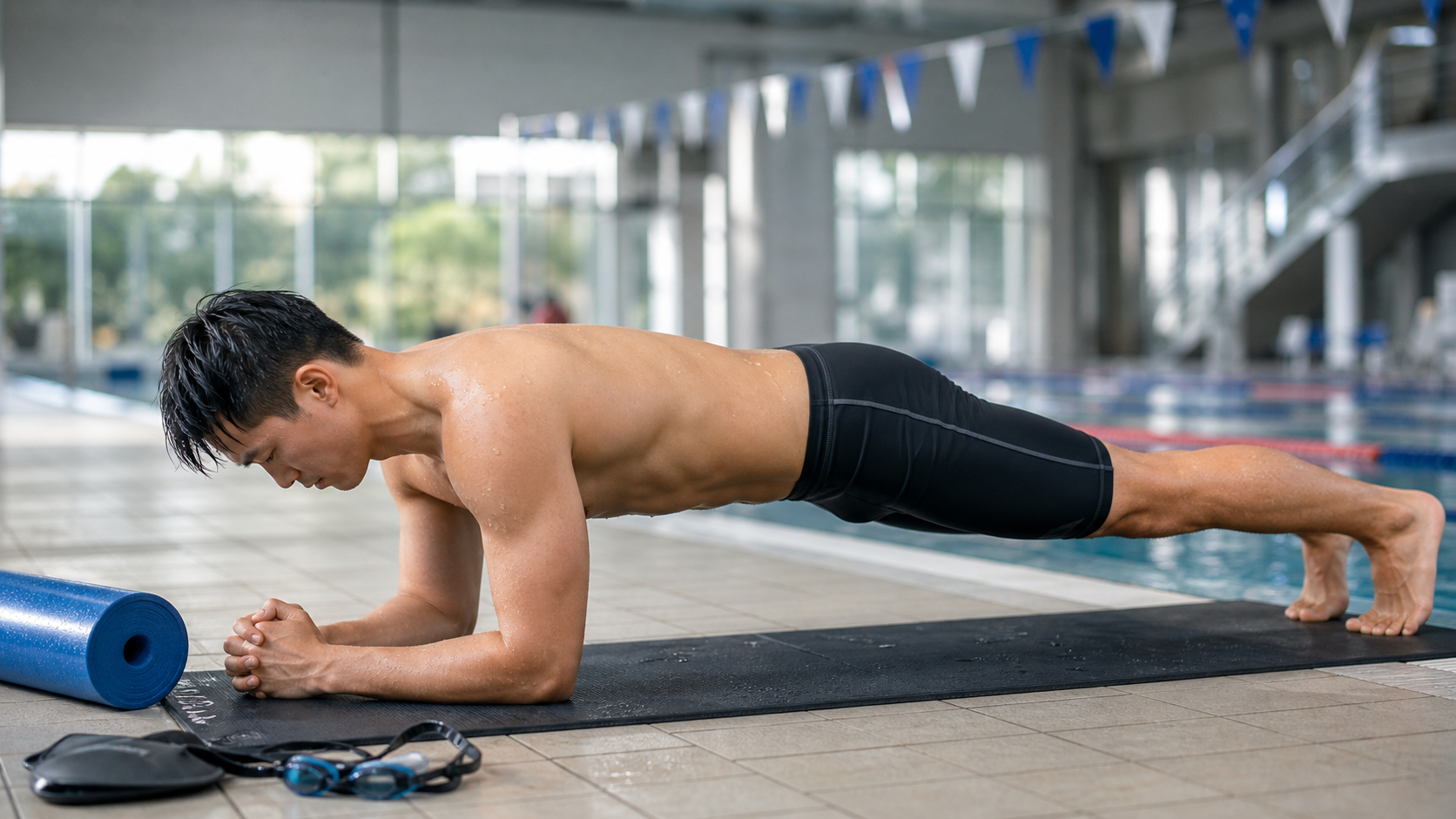
| Floor plank sensation | In push-up starting position, feel the gap between the lower back and the floor | Only a palm should barely fit through |
| Freestyle waterline test | Observe whether the ankles frequently drop more than 10 cm below the waist while swimming | Ankles roughly level with the waist |
| Foam roller supine lie | Lie supine on a roller, check if the lower back is visibly suspended | Lower back lightly touches the roller |
Causes of the Arching Posture
Excessive arching during swimming typically involves multiple factors:
- Weak core muscles: The transversus abdominis, rectus abdominis, and pelvic floor muscles cannot maintain intra-abdominal pressure, leaving the lumbar spine without support
- Tight hip flexors: Prolonged sitting (a common issue among Taiwanese office workers) shortens the iliopsoas muscle, pulling the lumbar spine into lordosis
- Weak gluteal muscles: Insufficient function of the gluteus maximus and gluteus medius prevents maintaining a neutral pelvis
- Compensation during breathing: When breathing during freestyle, swimmers often unconsciously sink their hips to get the mouth higher above the water
- Excessive undulation in butterfly: The dolphin kick undulation originates from the lower back (it should originate from the chest), causing repeated hyperextension of the lumbar spine
Core Training Prescription
The following training program is specifically designed for swimmers. It is recommended to perform it 3 times per week, 20–25 minutes per session, either before or after swim training:
Phase 1: Activation (2 weeks)
- Diaphragmatic breathing training: Lie supine with knees bent. Inhale and let the abdomen rise; exhale and gently tighten the abdomen (feeling the lower back lightly press into the floor). 3 sets × 10 breaths
- Dead Bug: Lie supine with arms and legs raised. Slowly extend one arm and the opposite leg toward the floor without touching it, keeping the lower back pressed to the ground. 10 reps × 3 sets
- Glute Bridge: Lie supine with knees bent. Squeeze the glutes and push the pelvis upward, holding at the top for 3 seconds. 15 reps × 3 sets
Phase 2: Strengthening (4 weeks)
- Plank: Forearm support, maintaining a neutral spine (no sagging lower back). Progress from 20 seconds to 60 seconds, 3–5 sets per session
- Side Plank: Strengthens the obliques and improves lateral stability, which is especially important for rotational control in freestyle. 30–45 seconds × 3 sets
- Bird Dog: Start on all fours. Extend the opposite arm and leg simultaneously while keeping the lower back neutral. 10 reps × 3 sets, performed slowly and with control
Phase 3: Swimming-Specific (Ongoing)
- Superman/Swimmer’s Drill: Lie prone and mimic the coordinated motion of swimming strokes and kicks to strengthen the synergistic action of the erector spinae and glutes
- Suspension core training (TRX): If the gym has TRX equipment, TRX planks and TRX crunches provide advanced challenges
- In-water core awareness: Deliberately tighten the abdomen while swimming (gently contract on exhalation), maintaining a neutral pelvis to translate training gains into movement patterns
Practical Advice
- If lower back pain worsens during swimming, stop immediately and apply ice. Do not push through the pain and continue training
- Physical therapy clinics are widely available in Taiwan. It is recommended to undergo a posture assessment before starting the core training program to confirm whether there are issues such as pelvic asymmetry or scoliosis
- If you feel a “catching” sensation in the lower back during training rather than muscle fatigue, this may indicate a facet joint issue, which feels different from muscle soreness
- Yoga classes (especially yin yoga) are highly beneficial for releasing tight iliopsoas muscles and can be done after swim training
- In the early stages of butterfly training, using fins can help reduce lower back compensation. Remove the assistive device only after the kinetic chain is properly established
Conclusion
The beauty of swimming lies in the fact that it is almost a full-body exercise, but “full-body” also means that postural issues in any segment can be amplified throughout the entire kinetic chain. Building a strong core is not just about swimming faster and more efficiently—it is the fundamental foundation for swimming longer and healthier. Protecting your lower back starts with your core.
Related Reading
- The Effects of Swimming on Chronic Back Pain and Precautions
- Protecting the Lumbar Spine Through Swimming: Posture Recommendations for Swimmers with Spinal Conditions
- Relieving Chronic Back Pain Through Swimming: In-Water Solutions for Spinal Decompression and Core Strengthening
- Swimming and Lumbar Health: Analysis of Butterfly Stroke Back Pain Causes and Complete Core Strengthening Strategies
一日北高/長距離團騎 常見問題補充篇 / 組團或跟團的眉角 / 壯車友容易被瘦車友慢性拉爆 / 原來屁股痛可能是這個原因...? / 風場配速法 / 公路車 / CT Yeh
2 年前
抖肩舞 台灣x日本交流版 (台灣 vs 前橋) 赤城山登山賽 coincidance
8 年前
一日北高常見問題大集合 | 攻略 | 路線 | 訓練 | 補給 | 自行車 單車 | 一日雙城 | 雙塔 | TWB北高360 | 屁股痛
6 年前
下次拍照前要查清楚啦🤣 #cycling
7 個月前
[教學] Premiere 影片 手震 修正 教學 防抖 單眼 影像 GoPro 穩定 Video Stabilization
8 年前
CT 喇低賽) 武嶺牽車 才是王道 西進牽車四小時內秘訣 攝手位置 如何判斷 防抽筋小秘訣
7 年前
風櫃嘴 | 全台最多大砲的單車路線 | 尋寶網攝影師告訴你怎麼擺拍起來才好看 | 熱門攝影地點巡禮
6 年前
CT 喇低賽) 單車 比賽總是沒照片? 攝影師的觀點大公開 姿勢就是力量! 請加速1.25倍收看
7 年前