Introduction
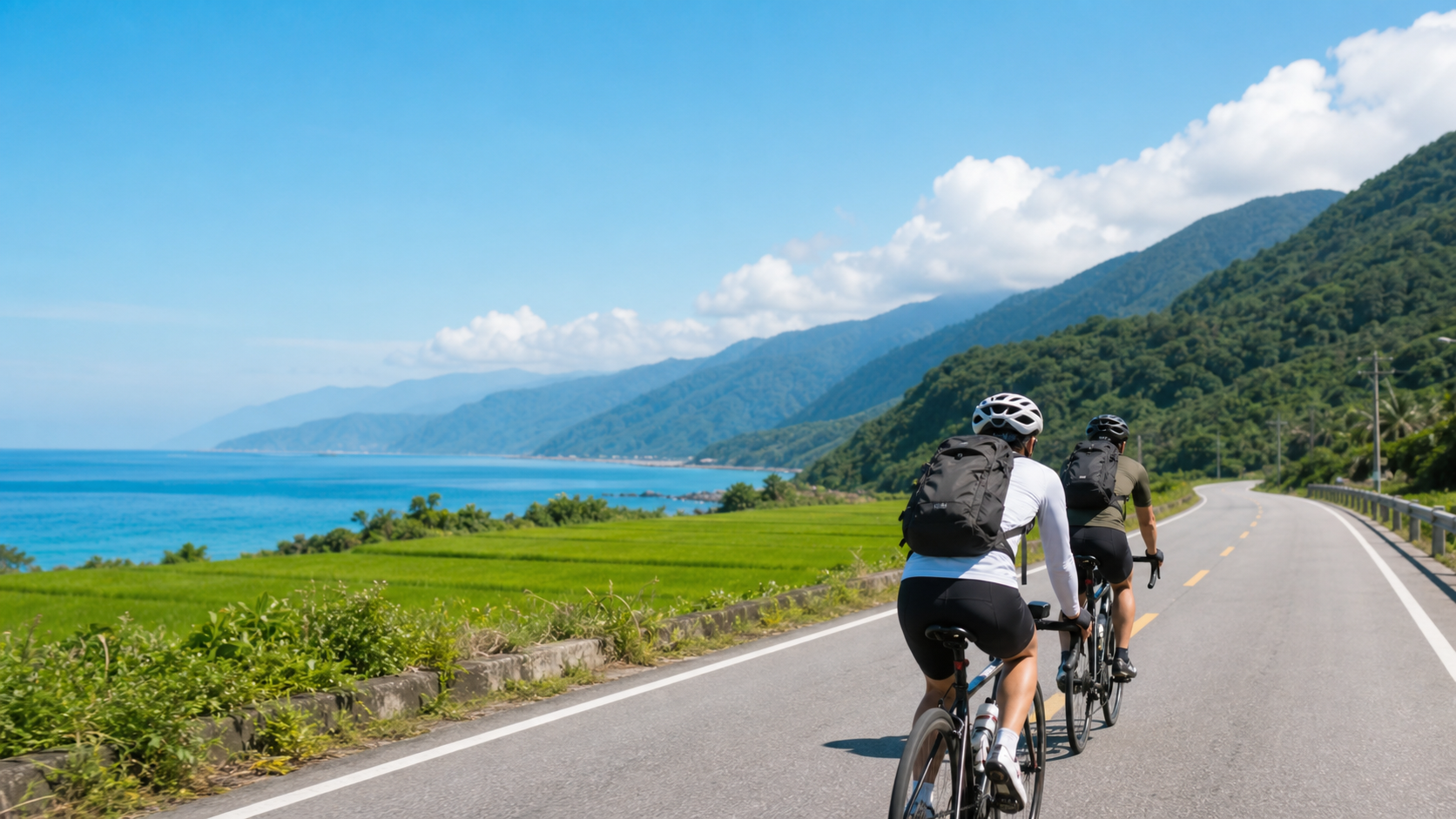
In an era of widespread high-speed rail and fierce competition among budget airlines, “arriving at the destination fastest” has become the default mindset for travel. But a group of Taiwanese travelers chooses to go against the grain—they bring their bicycles on the train to Hualien or Yilan, then travel at a speed of twenty kilometers per hour, letting the smells, sounds, and light of this land slowly seep into their senses. This way of traveling is called “slow travel” (慢遊) by Taiwanese people, and Yilan, Hualien, and Taitung are the best testing grounds for it.
Why Yilan, Hualien, and Taitung Are Ideal for Slow Cycling
Eastern Taiwan has become a mecca for slow cycling thanks to a combination of geographical and cultural factors:
Terrain structure: The Yilan Plain is open with good road conditions, and the Huatung Valley is flat and extends north-south, unlike mountain routes that require tackling numerous climbs, making it perfect for leisurely long-distance riding.
Low development density: Compared to western cities, roads in Yilan, Hualien, and Taitung have less traffic, giving riders ample space to stop, look around, and take things in without constantly worrying about vehicles approaching from behind.
Rich ecological landscapes: Rice paddies, streams, Amis tribal villages, and the winding Xiuguluan River—these landscapes can only be fully appreciated in their layered detail when viewed at cycling speed.
High density of local cuisine: Yilan’s dan-gan noodles, Hualien’s indigenous-style bento boxes, Taitung’s Chishang lunch boxes—the entire Huatung Valley is dotted with countless local delicacies worth stopping to savor.
Recommended Cycling Routes in Yilan
Yilan’s most classic cycling route is the “Yilan Plain Loop Route,” approximately 80 kilometers in total. Starting from Luodong or Yilan City, it connects the Dongshan River Water Park, the Sanxing scallion pancake old street, the area around Taipingshan in Datong Township, and the harbor scenery of Su’ao and Nanfang’ao.
Another route highly regarded by the cycling community is the “Yilan Old Caoling Tunnel Route”—a dedicated bike path converted from a railway tunnel that cuts through the Caoling Mountains separating New Taipei City and Yilan. At 2.2 kilometers long, it is Taiwan’s longest cycling tunnel. The moment you pass through the tunnel, the sudden drop in temperature and the echoing sound of pedaling create a strange yet captivating sense of passage.
The Riding Rhythm of the Huatung Valley
Bicycle travel through the Huatung Valley typically takes 3–5 days as a basic unit, heading south from Hualien City along Provincial Highway 9 or the valley’s cycling path to Taitung, covering approximately 170 kilometers in total.
| Section | Highlights | Recommended Stops |
|---|---|---|
| Hualien City→Fenglin | Open valley scenery, Hakka village culture | Guangfu Sugar Factory, Fenglin tobacco drying sheds |
| Fenglin→Yuli | Golden rice waves (autumn), hot springs | Antong Hot Springs, Yuli Bridgehead Stinky Tofu |
| Yuli→Guanshan | Guanshan Ring-Town Cycling Path | Guanshan bento boxes, Wuling Green Tunnel |
| Guanshan→Taitung City | End of the valley plain, transition to the coast | Chishang lunch boxes, Brown’s Boulevard |
Core Philosophy of Slow Travel
Traveling through Hualien and Taitung by bicycle forces travelers to embrace several fundamental changes:
- Letting go of itinerary control: Weather, road conditions, or an unexpected market or tribal festival can all alter your plans. Only by accepting this uncertainty can you truly enter the “slow travel” state
- Interacting with locals: Chatting with the shopkeeper while refilling water at a convenience store, asking a roadside farmer’s wife for directions, or talking with elderly diners at a street food stall—these chance encounters are often the most profound memories of a journey
- Learning to “do nothing”: Lying on a ridge beside Brown’s Boulevard watching the sky, not taking photos, not scrolling through your phone, simply letting the scenery enter your eyes purely—this ability to “do nothing” is a precious gift that slow cycling gives to travelers
- Returning to bodily awareness: The fatigue in your leg muscles, the wind brushing across your face, the slippery feel of rain-soaked roads—bicycle travel makes the body once again the subject that perceives the world, rather than a passive receiver staring at a screen
Practical Tips
- For bicycle travel in Hualien and Taitung, it’s advisable to avoid the typhoon season in July and August, as well as the return-travel crowds during the Lunar New Year; September–November or March–May are the most ideal times
- Bringing a bicycle on the TRA (Taiwan Railways) requires going to the ticket window in advance; some trains have limits on the number of bicycles, so be sure to confirm beforehand
- Accommodation options in the Huatung Valley are plentiful, ranging from hostels to farmstay B&Bs; advance booking is recommended, as supply cannot meet demand during peak seasons
- Supply points along the route are reasonably frequent, but on some stretches (such as deep in the valley) there may be no shops for up to 20 kilometers, so check the locations of supply points on the map before setting out
Conclusion
Slow cycling through Yilan, Hualien, and Taitung offers a life experience that is becoming increasingly rare in Taiwan: letting time slow down, letting perception return, and truly being “present.” In the rhythm of every pedal stroke, in every moment you stop and look up at the mountains, minds that have been packed airtight by daily life begin to slowly clear. Perhaps that is why people who have cycled through Hualien and Taitung once always want to do it again—because that feeling of clarity is something you simply cannot find in the city.
Related Reading
- Yilan Plain Cycling: Leisurely Routes Through Luodong, Sanxing, and the Dongshan River
- Hualien Cycling: The Pacific Bikeway and the Best of the Huatung Valley
- Cycling Around the Taitung Valley: Slow-Travel Experiences and Attractions Along the Huatung Section
- The Huatung Valley: The Most Beautiful Cycling Stretch from Hualien to Taitung
花東縱谷單車遊 feat. Doris 景點五分鐘快速掃瞄 / 公路車 / CT Yeh
2 年前
2022 環花東挑戰賽 Day2 搭到特快車 高速真空吸引! 台東一路逆風殺回花蓮! 總排 ??| Feiyu Pocket 2s | 公路車 | CT Yeh
4 年前
太平山單車員工旅遊 | 這樣玩CP值最高!| 公路車
5 年前
微東進 太魯閣 蘇花 單車兩日遊 ! 颱風過後路況超刺激 行程大亂 | 最狂的鹹酥雞訂單 | CT Yeh | 4K 高畫質空拍絕景!
4 年前
虎豹潭!日本老師來台一日約騎 台灣車友熱情招待私房路線 / CT Yeh
21 天前
[海外單車] 日本 茨城 霞之浦單車 銀杏 慢遊體驗
7 年前
里佳部落 阿里山單車深度旅遊! | 竹山/草嶺/來吉/奮起湖 | 無敵銀河絕景 全新路線探索! 驚險狀況百出! | 4K沉浸式畫質 | 公路車 | CT Yeh
3 年前
藤枝二集團 單車行 Day1 | 南部小武嶺 | 爬坡爬到罵罵叫 | JJSC | 公路車 | CT Yeh
3 年前