Introduction
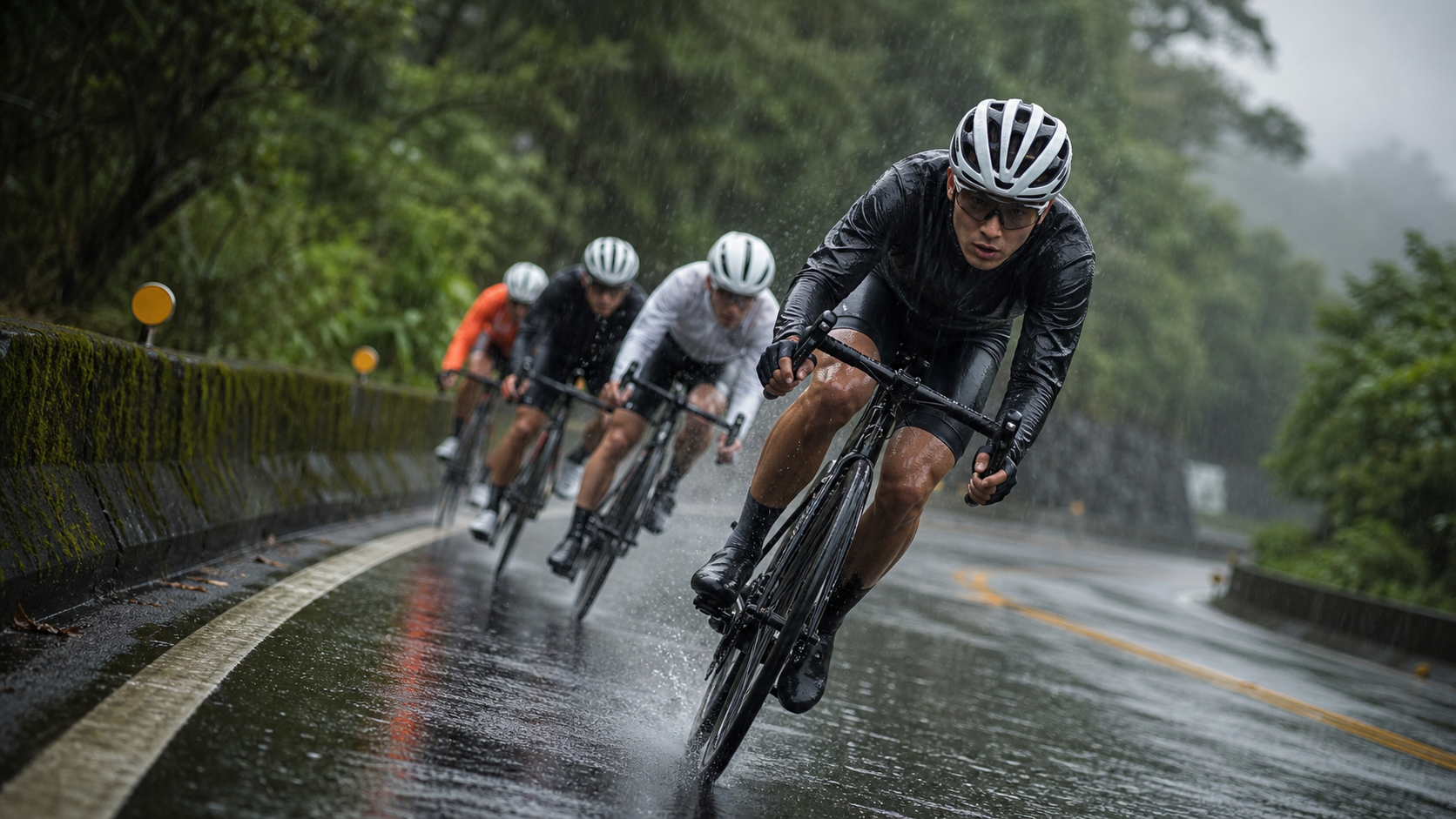
Taiwan’s road racing season spans the plum rain season and autumn typhoon season, making rainy-day racing a challenge nearly every cyclist will eventually face. Many amateur riders become overly cautious in the rain, ironically increasing danger through inconsistent pacing; others maintain their dry-weather riding style and crash. The correct way to ride in the rain isn’t “riding slower,” but “finding the fastest speed under a lower risk coefficient.”
The Physics of Wet Roads
| Condition | Dry | Wet | Impact |
|---|---|---|---|
| Braking distance (60 km/h to stop) | Approx. 18–22 m | Approx. 35–50 m | Braking points must be anticipated much earlier |
| Maximum cornering lean angle (lateral friction coefficient) | 0.8–1.0 | 0.4–0.6 | Cornering speed must be reduced by 20–30% |
| Hazardous surfaces (oil stains, white lines, metal covers) | Manageable | Extremely slippery | Must be actively avoided |
| Tire contact patch | Standard | Determined by tire water displacement | Recommended to lower pressure by 5–10 psi |
Braking Technique Adjustments
Principle 1: Start Braking Earlier
In the rain, riders accustomed to starting braking 30 meters before a corner should extend this distance to 50–60 meters. Decelerating early helps to:
- Avoid emergency braking in the middle of a corner (the most dangerous moment)
- Complete the majority of deceleration before entering the corner, allowing a light brake application to balance the bike through the turn
Principle 2: Use Front and Rear Brakes in Balance
- Dry: Approximately 70% front brake, 30% rear brake
- Wet: Adjust to 55% front brake, 45% rear brake
- Reason: Hard front braking on wet roads easily locks the front wheel and causes a slide; while a locked rear wheel also slides, it is more controllable
Principle 3: Avoid Braking in the Corner
“Brake before entering the corner, maintain speed through the turn, and accelerate after exiting” is the iron rule for cornering in the rain. Applying braking force mid-corner causes the tire’s lateral grip to drop instantly, making it the most common cause of crashes.
Cornering Technique Adjustments
- Reduce cornering speed by 20–30%: Adjust based on road conditions; you don’t always need to reduce by 30%. Feel the tire feedback
- Shift body weight toward the outside pedal: Press down firmly on the outside pedal and shift weight slightly outward to improve stability
- Don’t lean the bike excessively: The optimal lean angle in the rain is 10–15 degrees less than on dry roads
- Look toward the corner exit: Don’t stare at the ground; looking at the exit allows your body to automatically adjust its center of gravity
Identifying High-Risk Surfaces
Common high-risk surfaces on Taiwan’s roads in the rain:
- White lane markings and crosswalks: Extremely low friction coefficient, nearly like an ice rink; actively avoid them before corners
- Metal manhole covers (drainage grates): Taiwan’s older round manhole covers have almost zero friction in the rain
- Joints between old and new asphalt: The friction coefficient is inconsistent at the boundary between old and new pavement, and tires can suddenly lose grip
- Fallen leaves and moss: Common on mountain road corners; pay special attention to darker-colored road surfaces
Equipment Adjustment Recommendations
- Tire pressure: Lower by 5–8 psi compared to dry conditions to increase contact area (carbon rims especially need lower pressure to avoid brake overheating)
- Brake pads: Confirm brake pads haven’t hardened or worn flat; replacing them with new wet-weather brake pads makes a significant difference
- Waterproof clothing: A riding jacket prevents body heat loss; gloves maintain hand sensitivity
- Anti-fog eyewear: Replace dark lenses with clear or yellow lenses to improve visibility
Mental Strategy
In rainy races, many opponents fall behind due to excessive caution, which creates opportunities for you if you’ve proactively adjusted. But the core of the mental strategy isn’t “being bolder,” it’s “being more precise”:
- Accept that being 5–10% slower than on dry days is normal
- Give up the few seconds saved by risky cornering in exchange for the chance to finish safely
- Focus on your own riding; don’t impulsively follow when you see opponents accelerating
Conclusion
Racing in the rain is a dual test of cycling skill and mental maturity. Mastering the physical rules of wet roads and adjusting your riding habits in advance are the keys to completing a race safely and efficiently under adverse conditions. Every training session or race in the rain is a precious opportunity to improve your all-weather riding ability.
Related Reading
- Road Bike Safety in the Rain: Strategies for Slippery Surfaces
- The Complete Guide to Riding in the Rain: The Physics of Braking Distance Changes, Visibility, and Gear Selection
- Rainy Day Cycling Safety Guide: Survival Rules for Slippery Roads
- The Complete Guide to Riding in the Rain: Gear, Technique, and Safety Tips
碟煞公路車 優缺點?換車一年半實際經驗分享 / 公路車 / CT Yeh
2 年前
下雨天就是要改車 #ceramicspeed #bike
1 年前
微雨戰! 2022桃園市長盃錦標賽 無敵交管 沒來玩太可惜了! 羅馬公路太可怕 差點成佛! 公路車 | CT Yeh
4 年前
碟煞公路車 銑面器 !? 原來銑完差這麼多! 降低蹭碟機率! | TIME 公路車 保養小記錄 | CT Yeh
3 年前
CT 喇低賽) 武嶺牽車 才是王道 西進牽車四小時內秘訣 攝手位置 如何判斷 防抽筋小秘訣
7 年前
公路車 BB培林大升級! / 備戰海鷗繞圈賽 Canyon Aerod & TIME 一起改 / MIT大廠 CEMA對鎖式陶瓷培林BB & 導輪 / 公路車 / CT Yeh
2 年前
一個測試有沒有認真練車的方法😂 #公路車
10 個月前
#公路車 #西進武嶺 配速配瓦實驗 坡度分析 四小時內攻略 建大盃 NeverStop #西進武嶺攻略
6 年前