Introduction
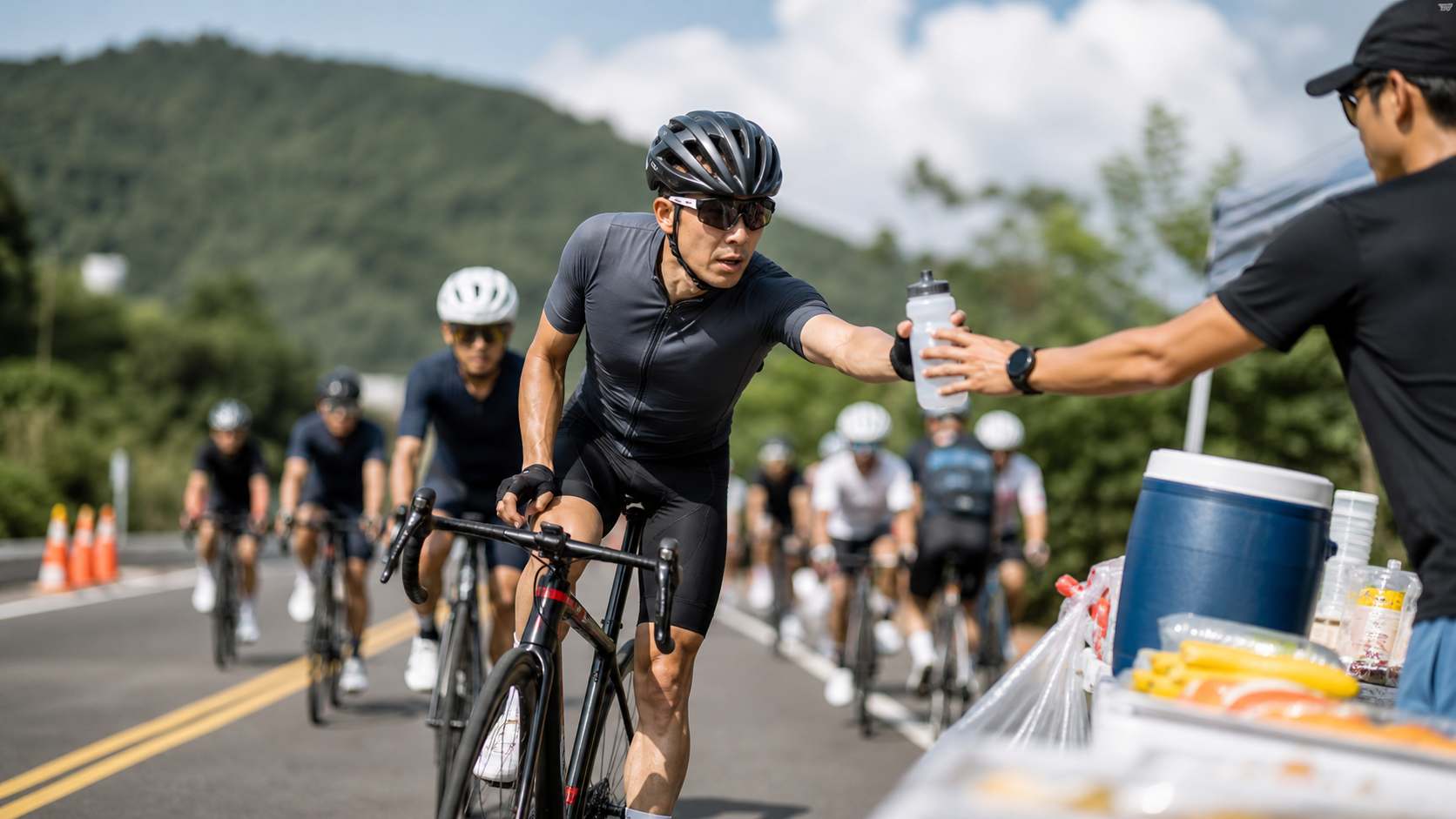
In long-distance cycling races or events in Taiwan (such as major Gran Fondos or round-island challenges), aid stations serve as lifelines for maintaining your energy. However, how much time you spend at an aid station and how to refuel most efficiently are tactical aspects many riders overlook. A “five-minute stop for refueling” and a “slow-down, no-stop refueling” may seem to differ by only a few minutes, but in competitive racing, that gap is often enough to make you miss the peloton or change your final placing.
Time Cost Analysis of Aid Station Behavior
| Refueling Method | Handling Time | Actual Time Lost (Including Deceleration/Acceleration) | Suitable Scenarios |
|---|---|---|---|
| Flying refueling (no stop) | 5–10 seconds | 15–30 seconds | Competitive races, following the group |
| Brief stop (1–2 minutes) | 60–120 seconds | 90–150 seconds | Long-distance events, high hydration needs |
| Full rest (5 minutes) | 5 minutes | 7–10 minutes (including rewarming up) | Ultra-long distances, body needs recovery |
Important reminder: After stopping, restarting does not immediately return you to race speed; it typically takes 2–3 minutes to regain your pre-stop power output. Therefore, the actual time lost is 30–50% more than the stop time itself.
No-Stop Refueling Technique
No-stop refueling requires practice before the race. Here is the standard operating procedure:
- Slow down early: Begin reducing speed 50 meters before the aid station to 15–20 km/h (don’t wait until the last moment)
- One-hand control: Use the hand on the handlebar to stabilize direction while the other hand grabs the supplies
- Pickup technique: Aid station volunteers usually hold food or bottles up to chest height; at the moment of contact, support the item from underneath with your hand
- Re-accelerate: After grabbing the supplies, shift gears and accelerate immediately to make up the distance lost from slowing down
Recommended practice method: During training, have a friend stand by the roadside and toss bottles or food to you, simulating race-day refueling. 3–5 repetitions will make you familiar with the motion.
When to Choose Stopping for Rest?
The decision to stop and rest should be evaluated based on the following conditions:
- Current distance and remaining distance: If you have completed more than 70% of the course, the time cost of stopping is smaller and has limited impact on your final result
- Physical condition: If you experience dizziness, abnormal heart rate, or severe cramping, continuing to ride may pose a safety risk—stopping is the right choice
- Lack of supplies: If your onboard supplies are depleted and you need to replenish large amounts of food and water, a 2-minute stop for a quick refill is better than bonking later
- Mechanical needs: Aid stations usually have mechanical support nearby. If you have minor mechanical issues (loose bolts, slow tire leaks), stopping to resolve them all at once is most efficient
Aid Station Strategies for Different Race Types
Competitive Road Races (C/B/A categories)
- Principle: Never stop, fight for every second of efficiency
- Aid station priorities: water bottles (stay hydrated), energy gels (light and quick)
- Energy bars require chewing and are not suitable for eating in a fast-moving group
Long-Distance Events (100 km and above)
- Principle: Stop at every aid station, but keep it within 60–90 seconds
- Prioritize electrolyte drinks and solid food (bananas, rice balls)
- Use the stop time to quickly stretch your glutes and calves to prevent late-stage cramping
Ultra-Long Distance (200 km+ / all-day rides)
- Principle: Stop for 5 minutes at major aid stations every 50–60 km; this is part of energy management
- Besides replenishing food at aid stations, also check equipment status (tires, shoelaces, whether the saddle height has shifted)
Priority Order for Refueling Items
- First priority: Hydration (electrolyte drinks or water)
- Second priority: Fast carbs (energy gels, jelly, bananas)
- Third priority: Solid food (rice balls, energy bars—suitable for eating when stopped at aid stations)
Practical Advice
- Before participating in a race, check the aid station locations on the route map and plan in advance “which aid stations to stop at and which ones to skip.”
- Bring sufficient supplies of your own (enough to last until the next aid station) and don’t rely on the food available at aid stations, to avoid wasting time waiting in lines.
- Deliberately simulate “flying pickup” during long training rides to ensure your technique is smooth and error-free on race day.
Conclusion
Every decision at an aid station is a calculation between time and energy. In competitive racing, there is no perfect refueling strategy—only “the most rational choice under the current circumstances.” Cultivating sensitivity to your body’s needs, combined with familiarity with the race route, will allow you to make the most cost-effective decision at every refueling stop.
Related Reading
- Ultramarathon Water Station Strategy: Comparing the Efficiency of Mobile vs. Fixed Refueling
- Pacing at Mid-Race Aid Stations: Should You Slow Down at Water Stops
- Team Support Strategy: Timing and Positioning for Drop Bag Delivery
- Cycling Race Refueling Strategy: What to Put in Your Pockets and When to Eat
Live) 備戰2019彰化經典百K 賽前攻略 (已完賽請看新影片
7 年前
#公路車 #西進武嶺 配速配瓦實驗 坡度分析 四小時內攻略 建大盃 NeverStop #西進武嶺攻略
6 年前
西進武嶺 自製新版AI配速表產生器 x 賽前攻略 抱佛腳! 沒有功率計也可以產生配速表嗎?有什麼其他眉角賽前要注意的呢? | 西進武嶺 / 東進武嶺 KOM 攻略 | 公路車 | CT Yeh
4 年前
西進武嶺 免費訓練分析服務 Intervals | 練不夠還是練過頭?你哪一種類型選手?AI模型告訴你! | 備戰神器 | 公路車 訓練 | CT Yeh
4 年前
2019 夏季KOM 5小 完賽心得 準備攻略 東進武嶺 夏季登山王之路 Taiwan KOM Challenge
7 年前
東進武嶺 西進武嶺 AI 配速 上線囉 公路車
5 年前
2022 環花東挑戰賽 Day2 搭到特快車 高速真空吸引! 台東一路逆風殺回花蓮! 總排 ??| Feiyu Pocket 2s | 公路車 | CT Yeh
4 年前
FTL 與 SYB 車隊專訪 西進武嶺 實用攻略分享! 2小時 如何練?!你不知道的眉角!新手準備武嶺必看 EP1 | 實力派女車友 | 精華版 | 公路車 | CTYeh
4 年前