Collective Strategy for Amateur Teams: Timing and Rotation Intervals for Taking Turns at the Front
Introduction
“You take the front, I’ll block the wind for you” is the most common phrase heard in amateur teams, but whether they truly “cooperate efficiently” is what determines the success or failure of a team’s tactics. Professional teams have dedicated tactical analysts and radio communication. Although amateur teams have limited resources, as long as they communicate the rotation rules before the race and strictly execute them during the race, they can create competitiveness far beyond individual riding styles.
The Basic Principles of Paceline Rotation
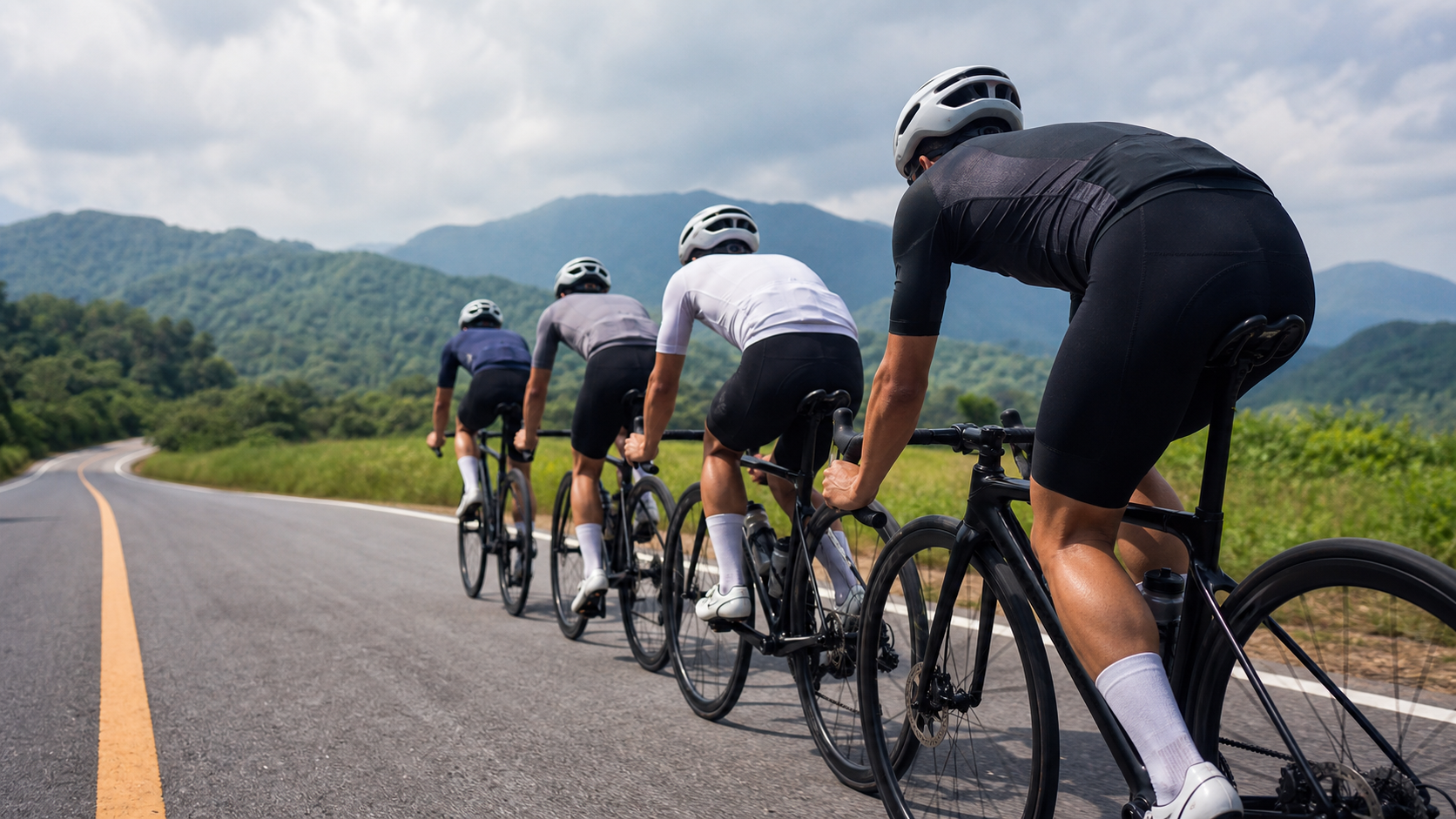
Paceline rotation means multiple riders line up in a single file, with each rider taking a turn at the front for a set period before drifting to the back of the group to rest. The benefits are:
- The lead rider saves about 30–35% of energy compared to riding solo (due to the absence of a drafting effect behind)
- The followers save about 30–35% of energy compared to riding solo
- Overall effect: 15–25% faster than everyone riding on their own
| Number of Riders | Recommended Lead Time per Rider | Suitable Speed |
|---|---|---|
| 2 riders | 1–2 minutes | Any speed |
| 3–4 riders | 45 seconds–1.5 minutes | Medium to high speed |
| 5–8 riders | 30–45 seconds | High speed on flat roads |
| > 8 riders | 15–30 seconds | Race-level speed |
The Standard Rotation Process
Using a 4-rider team as an example:
- The lead rider (A) moves to the right (or the agreed direction) after completing the scheduled time, easing off the pedals to let the riders behind pass in sequence
- The second rider (B) seamlessly takes over as the new lead rider
- A drifts to the back of the line, regulating breathing and recovering energy
- The entire process should be smooth and uninterrupted, especially with no sudden changes in speed at the moment of the handover
Training suggestion: Before an official race, find a straight stretch of road and practice rotation for more than 30 minutes until everyone is clear about their role and timing.
Formation Adjustments for Different Road Conditions
High-Speed Flat Sections
- Standard single-file rotation with 0.5–1 meter gaps
- Each rider leads for 30–60 seconds, maintaining high-speed momentum
Climbing Sections
- The effect of rotation diminishes on climbs (reduced group protection), so adjustments should be made flexibly based on each rider’s climbing ability
- The strongest climber sets the pace in the early part of the climb without needing frequent rotation
- If a teammate falls behind on the climb, the strongest rider at the back should “pull the tail,” meaning helping the dropped rider catch up from the rear of the group
Crosswind Sections
- Switch to an echelon formation, with each rider positioned on the windward side of the rider ahead
- Echelon formation takes up more lateral space, so pay attention to road width and oncoming traffic
- If the road is not wide enough, use a staggered double file instead of a standard echelon
Tactical Role Division During a Race
A well-coordinated amateur team should confirm the following roles before the race:
- Ace: The strongest sprinter or climber on the team, conserving energy in the final 10 kilometers while being protected by teammates
- Domestique: Responsible for setting the pace in the early stages and fetching supplies at feed zones to pass to the Ace
- Chaser: Brings back opponent breakaways to prevent them from building too large a lead
Key principle: The Domestique’s job is to save the Ace’s energy, not to lead the Ace in a sprint—before the final 1 kilometer, the Domestique should drop back behind the Ace, letting the Ace make the final decision.
Common Team Coordination Mistakes
- Inconsistent rotation speed: The rider before goes too fast, and the rider taking over is immediately overtaken, making the entire rotation a waste
- Leading for too long: A rider with good stamina refuses to drop back, expending too much energy and slowing down significantly later
- Lack of communication: Not using hand signals during the race (waving the right hand to signal a rotation), catching the riders behind off guard
- Breaking formation at critical moments: When opponents attack, everyone rides on their own, losing the collective advantage
Practical Advice
- Hold a 10-minute “tactical briefing” before the race to confirm role assignments, rotation signals, and emergency responses
- Establish a “protect the Ace rule”: when the Ace’s energy drops below 30%, other teammates prioritize setting the pace and do not sprint ahead
- Regularly conduct simulated races during training (including rotation practice and sprint simulations) to build cohesion
Conclusion
The essence of team coordination lies in “using the team’s limited collective energy where it matters most.” Amateur teams do not need complex tactics—they only need to execute rotations well on key sections, protect the Ace, and put the strongest rider in the most advantageous position before the finish line. That alone puts them ahead of the vast majority of opponents.
Related Reading
- Paceline Rotation in Team Time Trials: Energy Allocation for 30-Second Pulls
- Wheel-Surfing Techniques for Long-Distance Group Rides: Proper Drafting and Leading to Save 20% of Energy
- Positioning Strategy in Group Sprints: Timing for Taking Pulls and Choosing the Launch Point
- Role Division in Professional Teams: How Domestiques, Sprinters, Climbers, and the Team Leader Serve One Rider
一日北高/長距離團騎 常見問題補充篇 / 組團或跟團的眉角 / 壯車友容易被瘦車友慢性拉爆 / 原來屁股痛可能是這個原因...? / 風場配速法 / 公路車 / CT Yeh
2 年前
Live) 備戰2019彰化經典百K 賽前攻略 (已完賽請看新影片
7 年前
2026 輪霸西濱200K 挑戰VLOG / 第一集團 / 首次參加..經驗不足、膀胱不足 /死守6H內 / AI戰鬥力顯示系統 / 公路車 / CT Yeh
4 個月前
昇陽SYB車隊 & Fuji 菁英選手們的趣味經驗分享,長知識了!市民車友必看~ 一路被拉爆後才給問 | 戀戀197 武嶺 凸台經驗分享 | 公路車 | CT Yeh
4 年前
碟煞公路車 優缺點?換車一年半實際經驗分享 / 公路車 / CT Yeh
2 年前
崇越盃武嶺冠軍高手 賽前JJSC 群峰會精華!對應大數據分析,會有落差嗎?/ feat. JJSC中部公路車約騎 /公路車 / CT Yeh
2 年前
西進武嶺 免費訓練分析服務 Intervals | 練不夠還是練過頭?你哪一種類型選手?AI模型告訴你! | 備戰神器 | 公路車 訓練 | CT Yeh
4 年前
車隊介紹) 台北 一年開團365天 車隊 Apollo Ride 晨騎 好選擇 ( 陽明山 風櫃嘴 冷水坑 平等里 聖人 關渡 大稻埕 ) 找人騎車
7 年前