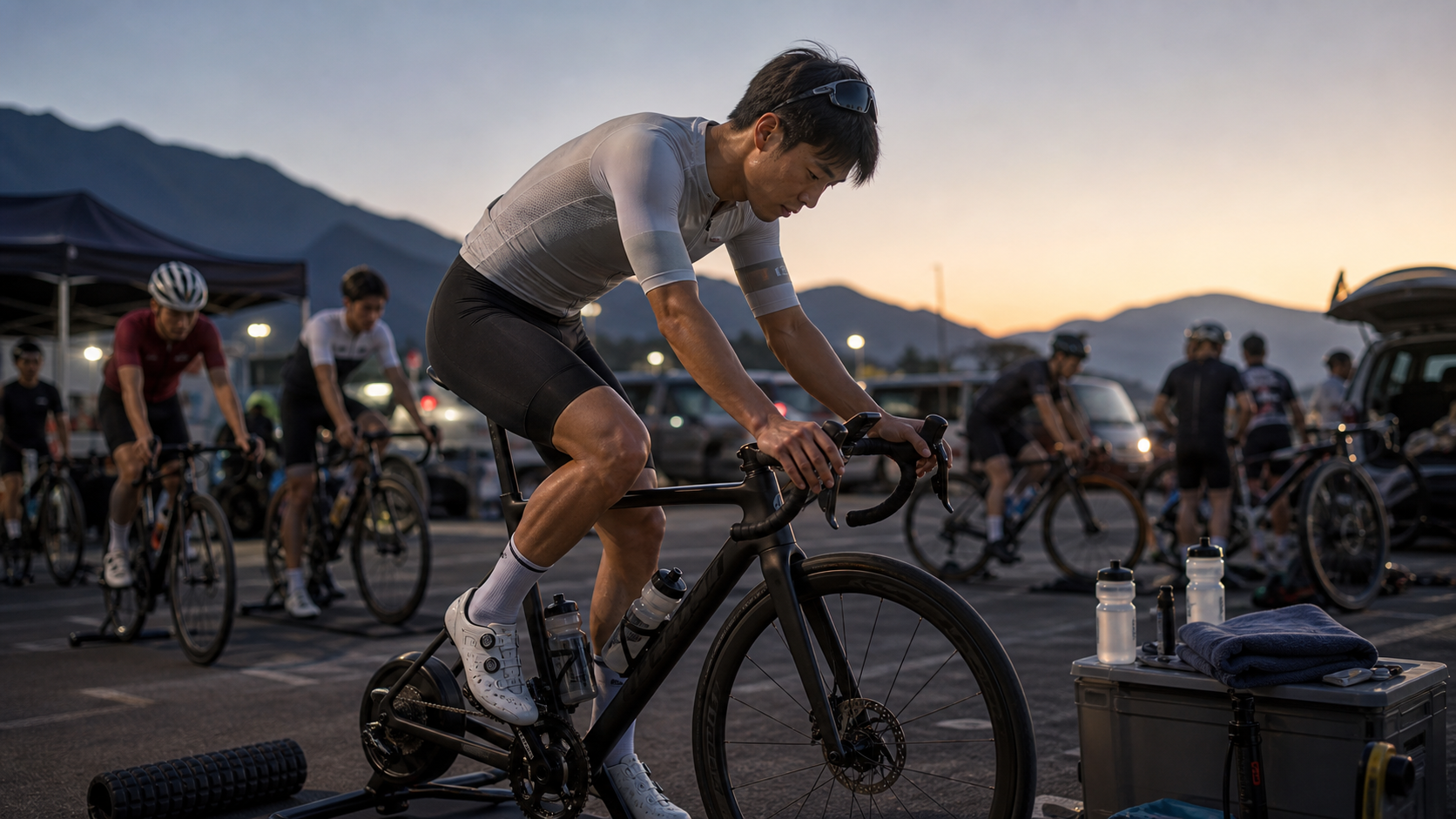
Introduction
Many amateur cyclists still think of warming up as “riding for 10 minutes and waiting before the race,” but sports science research indicates that a well-designed warm-up routine can boost maximum power output by 5–8% at the start of a race, while also allowing oxygen uptake efficiency to peak faster. Road races in Taiwan typically start between 6–8 AM, which means your body needs to transition from a low-metabolic state during sleep to race readiness in a very short time. The quality of your warm-up is therefore even more critical.
The Three Physiological Purposes of Warming Up
| Purpose | Physiological Mechanism | Warm-Up Phase |
|---|---|---|
| Raise body temperature | Muscle contraction efficiency is highest at 37–38°C | First 10–15 minutes |
| Activate the nervous system | Recruiting fast-twitch muscle fibers requires high-intensity stimulation | Short sprints in the middle |
| Prepare the cardiorespiratory system | Heart rate adapts to race intensity in advance, reducing the initial lactate surge | Progressive throughout |
Standard Race-Day Warm-Up Routine (45-Minute Version)
This is a general warm-up routine suitable for most road races:
0–15 minutes: Easy riding (Zone 1–2)
- Relaxed pace, cadence at 85–95 rpm
- Body gradually warms up, heart rate climbs to 120–130 bpm
- This phase should feel “easy and comfortable”—don’t rush to speed up
15–25 minutes: Progressive build (Zone 2–3)
- 3 × 3 minutes at Zone 3 pace, with 1 minute of Zone 1 recovery between intervals
- Heart rate gradually reaches 150–160 bpm
- Confirm breathing rhythm and pedaling coordination
25–35 minutes: High-intensity activation (Zone 5–6)
- 3 × 30-second all-out efforts (as close to race sprint intensity as possible)
- 90 seconds of easy Zone 1 pedaling between each sprint
- This segment activates fast-twitch muscle fibers and “tells” the nervous system what today’s task is
35–45 minutes: Cool-down (Zone 1–2)
- Easy pedaling to bring heart rate down below 120 bpm
- Maintain an activated state before the race start without fully cooling down
Warm-Up Adjustments for Different Race Types
Time Trial (TT) — Requires a Longer High-Intensity Activation
A time trial demands maximum output from the very first second; an insufficient warm-up will make the first 3 minutes of data look particularly poor. Recommendations:
- Add one 5-minute FTP-intensity effort (completed 20 minutes before the start)
- Spend the final 5 minutes cooling down in Zone 1 to ensure you feel “eager to go” at the start
Criterium — Prioritize Explosive Power
Criteriums feature intense pacing from the start, so the warm-up should include more short, high-intensity sprints:
- Increase the 30-second sprints to 5–6 sets
- Simulate the criterium’s “accelerate-recover-accelerate again” rhythm
Gran Fondo Long-Distance Events — Conservative Warm-Up
The purpose of warming up for long-distance events is mainly to get the body warmed up without expending excessive energy:
- Shorten to 25–30 minutes
- Remove the high-intensity sprint segment, replacing it with 2 × 1 minute of Zone 4 pace riding
Warm-Up Time and Environmental Factors
- High temperatures (>28°C): Shorten the warm-up by 5–10 minutes—the body heats up faster, but be sure to hydrate in advance
- Low temperatures (<15°C): Extend the warm-up by 5–10 minutes, wear an extra cycling jacket, and allow more time to reach race heart rate
- High altitude (>1,500 m): Power output at a given heart rate decreases; base warm-up intensity on power, not heart rate
Managing the Time Between Warm-Up and Race Start
You should start the race within 15–20 minutes of finishing your warm-up, or the effects will gradually fade. If the wait is longer:
- Every 10 minutes, do 2–3 rounds of high-cadence pedaling in place (fast pedaling on the saddle for 30 seconds) to maintain activation
- Put on a race jacket to preserve body heat
- Take deep breaths to relax mentally—don’t expend excess energy before the start
Conclusion
Warming up is the first segment of a race, and it’s also the most commonly overlooked part by amateur cyclists. A progressive warm-up routine allows your body and mind to enter race mode before the gun goes off, releasing every bit of ability accumulated through training from the very first pedal stroke—rather than waiting until the first 15 minutes are “warmed up” before actually racing.
Related Reading
- Climbing Warm-Up Strategies: Activating Muscles and the Nervous System Before the Race
- Time Trial Warm-Up Protocol: The Optimal 30-Minute Pre-Race Preparation Process
- The Complete Guide to Road Cycling Pre-Race Warm-Ups: The Standard 60-Minute Pre-Start Routine
- Pre-Swim Warm-Up: Designing a 400–800m Pre-Race Activation Routine
西進武嶺 免費訓練分析服務 Intervals | 練不夠還是練過頭?你哪一種類型選手?AI模型告訴你! | 備戰神器 | 公路車 訓練 | CT Yeh
4 年前
FTL 與 SYB 車隊專訪 西進武嶺 實用攻略分享! 2小時 如何練?!你不知道的眉角!新手準備武嶺必看 EP1 | 實力派女車友 | 精華版 | 公路車 | CTYeh
4 年前
西進武嶺 自製新版AI配速表產生器 x 賽前攻略 抱佛腳! 沒有功率計也可以產生配速表嗎?有什麼其他眉角賽前要注意的呢? | 西進武嶺 / 東進武嶺 KOM 攻略 | 公路車 | CT Yeh
4 年前
東進武嶺 西進武嶺 AI 配速 上線囉 公路車
5 年前
#公路車 #西進武嶺 配速配瓦實驗 坡度分析 四小時內攻略 建大盃 NeverStop #西進武嶺攻略
6 年前
一日北高/長距離團騎 常見問題補充篇 / 組團或跟團的眉角 / 壯車友容易被瘦車友慢性拉爆 / 原來屁股痛可能是這個原因...? / 風場配速法 / 公路車 / CT Yeh
2 年前
Live) 備戰2019彰化經典百K 賽前攻略 (已完賽請看新影片
7 年前
一個測試有沒有認真練車的方法😂 #公路車
10 個月前