文章導覽
Introduction
In Taiwan’s running community, discussions about knee and ankle joint injuries are always lively before and after race season. Taiwan’s mountainous terrain places tremendous stress on knee joints during downhill impact; and with the many potholes and uneven tiles on Taiwan’s urban roads, ankle sprains are also a common occurrence. The market for knee braces and ankle supports is vast, but the questions of “when should I use them” and “do they actually help” linger in many runners’ minds.
Types and Functions of Knee Braces
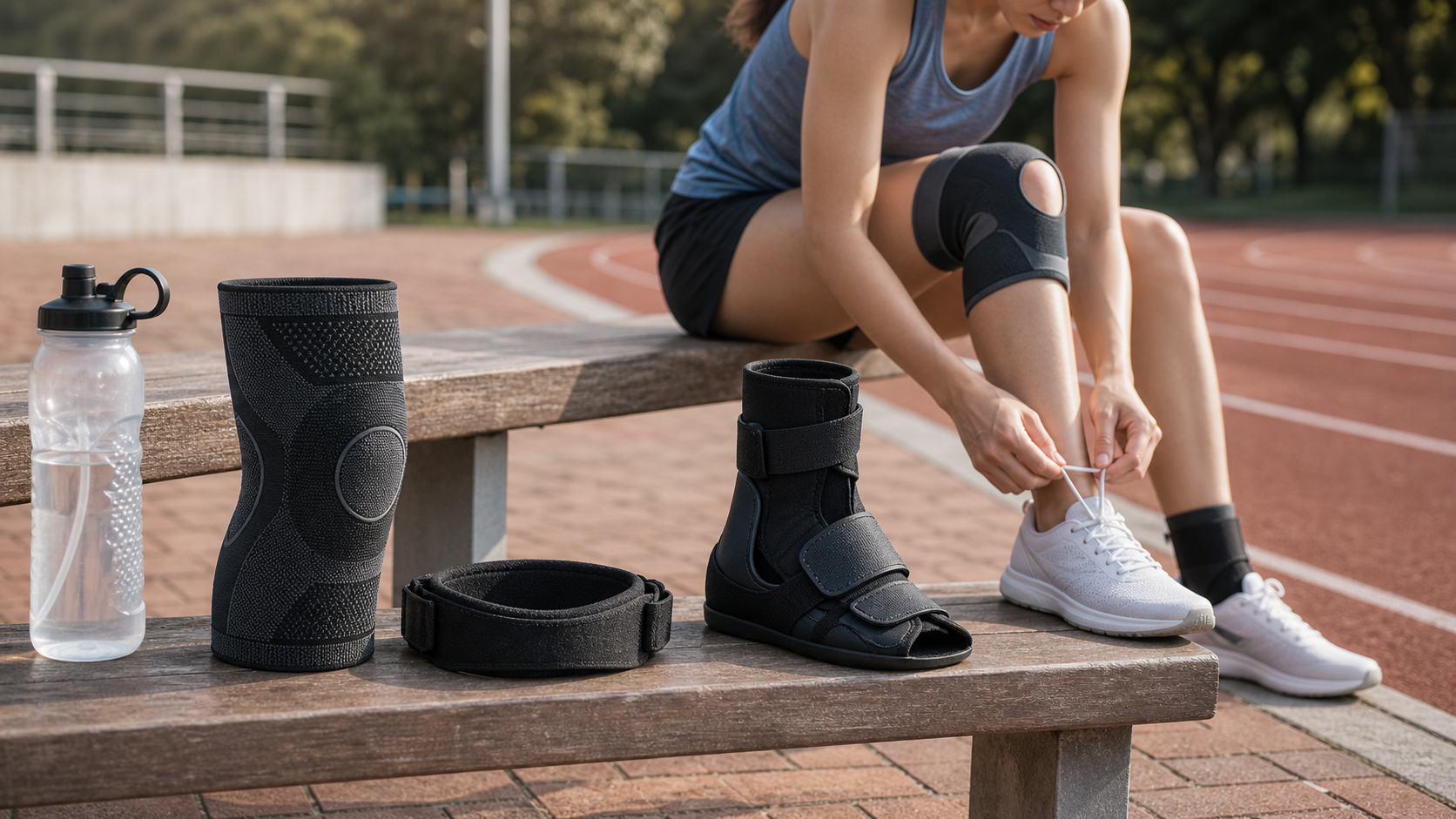
Knee braces for running are mainly divided into three categories:
| Knee Brace Type | Function | Applicable Issues | Material Characteristics |
|---|---|---|---|
| Patellar Band | Stabilizes patellar tracking, reduces pressure on the patellar tendon | Runner’s knee (patellofemoral pain syndrome), patellar tendinitis | Narrow strap design, allows localized compression |
| Full-wrap Knee Sleeve | Full compression and warmth, improves proprioception | Mild instability, osteoarthritis, swelling prevention | Elastic mesh fabric, full knee coverage |
| Functional Hinged Brace | Provides lateral stability and support, limits excessive rotation | Ligament injury recovery phase, severe knee instability | Metal or carbon fiber frame |
Patellar bands are the most commonly used type for running, being lightweight and designed specifically for “runner’s knee,” the most common issue among runners. Users frequently report noticeable pain relief while running with them, but it’s important to note that they provide “symptom management” rather than a cure; long-term reliance should be paired with strengthening exercises.
Types and Functions of Ankle Supports
Ankle injuries are especially common among trail runners in Taiwan. The main types of ankle supports include:
- Compression Sleeve: Provides mild compression and enhanced proprioception, suitable for the late recovery phase of mild sprains or for preventive use
- Figure-8 Wrap: Restricts inversion and eversion movements, suitable for the mid-recovery phase of acute sprains
- Rigid Brace: Strongly limits the ankle joint’s range of motion, suitable for the acute protection phase following ligament tears
When to Use Knee Braces or Ankle Supports
Situations where they should be used:
- With a confirmed injury (such as patellar tendinitis or ankle ligament damage), used under the recommendation of a physician or physical therapist
- During the post-injury recovery phase, in the first 4–8 weeks of returning to running training
- Specific high-risk activities: e.g., when the knee feels unstable during long downhill runs on Taiwan’s mountain roads
- When experiencing mild discomfort but needing to complete a specific race (short-term relief strategy)
Situations where excessive reliance on braces should be avoided:
- Daily training runs with no injury at all (braces cannot improve running performance and may instead cause proprioception to become dependent on the brace)
- Using braces as a substitute for treatment (e.g., ignoring persistent pain, skipping physical therapy)
- Buying a brace type without understanding your own injury (incorrect support direction may worsen the injury)
Common Running Injuries in Taiwan and Recommendations
Runner’s Knee (IT Band Syndrome / Patellofemoral Pain)
- The most common road running injury in Taiwan, primarily caused by excessive downhill training volume
- Brace: A patellar band can be used for short-term relief
- Root treatment: Strengthen the gluteus medius and quadriceps, combined with foam rolling to release the IT band
Plantar Fasciitis
- Brace: Arch-support orthotic insoles are more directly effective than knee braces
- Taiwan recommendation: Superfeet and Spenco insoles are both available at running gear stores in Taiwan
Lateral Ankle Ligament Sprain
- Acute phase (0–3 days): RICE (Rest, Ice, Compression, Elevation), rigid ankle brace
- Recovery phase (2–6 weeks): Elastic ankle support combined with proprioceptive training (balance board)
- Critical warning: Immediately resuming running after an acute sprain is a major cause of chronic ankle instability
Functional Insoles: The Often Overlooked “Foundation Support”
Many runners spend a fortune on knee braces while overlooking the most fundamental piece of gear—the insole. Functional insoles improve arch support and adjust gait alignment, and their effectiveness in preventing knee and ankle injuries often surpasses that of knee braces:
- Flat-footed runners: High arch-support insoles are recommended to improve knee internal rotation
- High-arch runners: Need soft insoles with extra cushioning to absorb impact
- Given Taiwan’s hot and humid climate, washable antimicrobial insole materials are recommended
Practical Advice
- If symptoms do not improve after 2–3 weeks of using a knee brace or ankle support, seek an evaluation from a sports physical therapist
- Before purchasing a brace, confirm your injury type first; different injuries require different support directions
- Using ice therapy (10–15 minutes) after running is more effective than braces in preventing knee and ankle inflammation
- Many physical therapy clinics in Taiwan offer running gait analysis; identifying the root cause of injury offers greater long-term benefit than relying on braces
Conclusion
Knee braces and ankle supports are assistive tools, not substitutes. Using them appropriately when there is a clear injury or high-risk scenario, while actively strengthening the relevant muscle groups, is the right approach for Taiwanese runners facing knee and ankle issues. Let braces help you get through critical training, but true protection comes from strong muscles, good running form, and adequate recovery.
Related Reading
- Road Running Knee Brace and Ankle Support Buying Guide: A Guide to When to Use Preventive vs. Therapeutic Braces
- Running Knee Braces and Kinesiology Tape: A Scientific Analysis of Auxiliary Gear for Preventing Knee Injuries
- Running Knee Brace Selection: When to Use IT Band Taping vs. Knee Support Sleeves
- Road Runners’ Ankle Strengthening: A Complete Plan for Sprain Prevention and Propulsion Improvement