Trail Running Shoes vs. Road Running Shoes: Outsole Grip Requirements for Taiwan's Mountain Trails
Introduction
Mountains cover more than 70% of Taiwan’s land area, making it a rich resource for trail running. From Trail No. 5 in Taichung’s Dakeng, to Qixing Mountain in Yangmingshan, to the trail routes on Wuzhi Mountain in Xinyi District, mountain trail running has become a popular choice for urban runners. However, many runners head into the mountains wearing ordinary road running shoes, and cases of slipping and injury due to insufficient outsole grip on slippery downhill sections or loose gravel slopes are common.
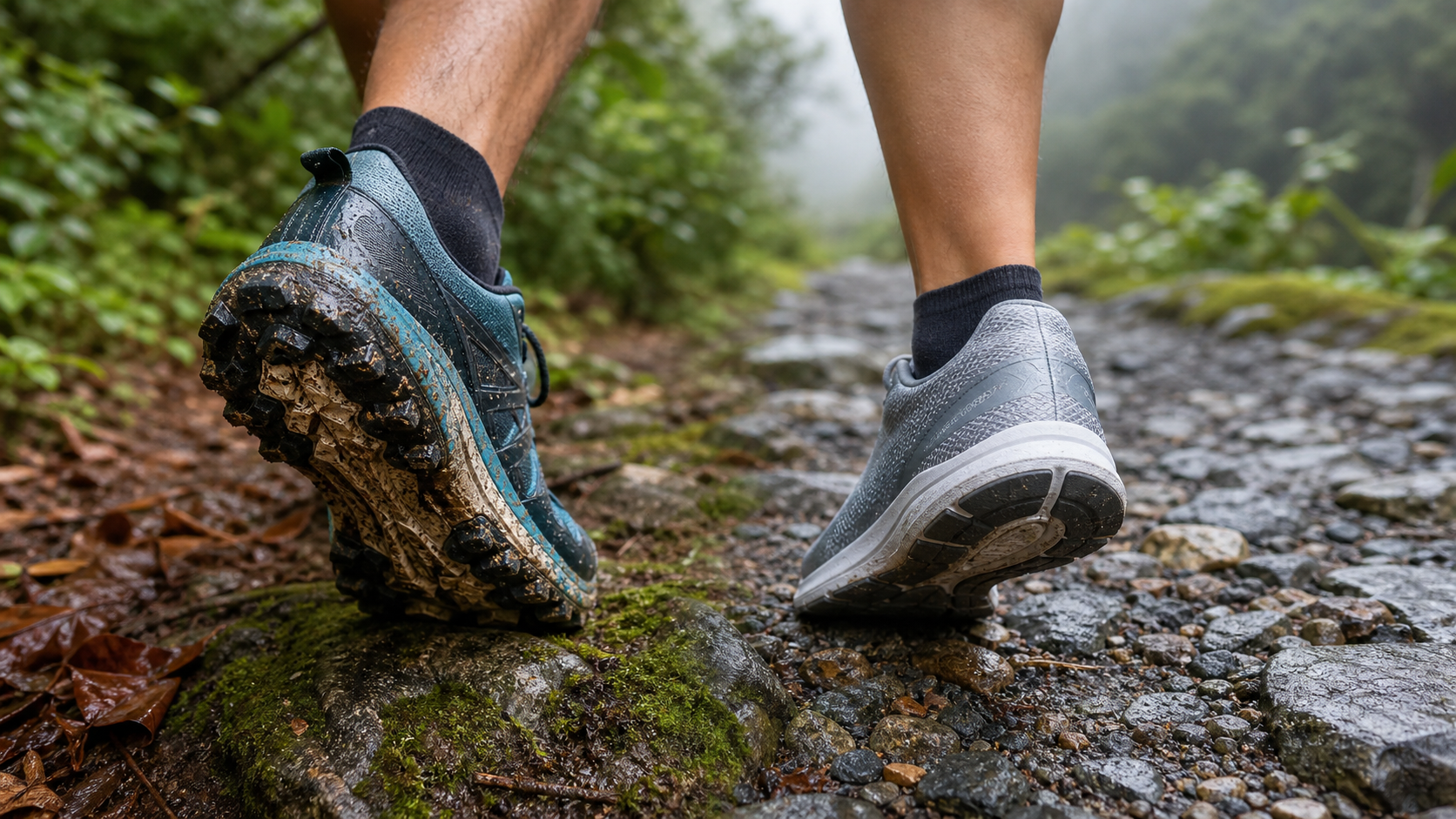
Structural Differences Between Trail and Road Running Shoes
| Feature | Trail Running Shoes | Road Running Shoes |
|---|---|---|
| Outsole Lug Depth | Deep 4–6mm multi-directional lugs for grip | Flat or shallow tread, suited to flat surfaces |
| Midsole Firmness | Firmer, often with a rock plate | Softer, maximizes cushioning |
| Upper Material | Reinforced mesh, tear-resistant, sometimes water-resistant | Lightweight mesh, maximizes breathability |
| Toe Protection | Rubber toe bumper | Lightweight design, no hard shell protection |
| Weight | Heavier (260–350g) | Lighter (180–260g) |
| Downhill Cushioning | Moderate (prioritizes stability) | Good (prioritizes cushioning) |
Ground Characteristics of Taiwan’s Mountain Trails
Taiwan’s mountain trail environment places unique demands on outsoles:
1. The Slippery Trail Problem
Taiwan’s annual rainfall reaches 2,500–3,000mm, so mountain trails stay damp for long stretches, and moss, wet soil, and wet stone slabs are common underfoot. The rubber tread of ordinary road shoes has extremely low friction on wet stone slabs — running on it is like running in slippers.
2. Loose Gravel and Fallen Leaves
Trails in Taichung’s Dakeng, Wulai, and Yangmingshan are often covered in gravel and fallen leaves. The deep lugs of trail shoes can “bite into” uneven surfaces, while the flat soles of road shoes offer almost no purchase on gravel.
3. Muddy Slopes
After the plum rain season and typhoons, mountain trail soil turns soft and muddy. The lug pattern of trail shoes sheds mud and keeps providing grip, while road shoe soles easily get completely coated in mud, becoming a slick, frictionless surface.
4. Stone Slab Paths
Yangmingshan, Taiping Mountain, and other areas have extensive man-made stone slab paths. These surfaces are relatively easy to walk on, and road shoes perform acceptably here — but on moss-covered stone slabs after rain, the deep tread of trail shoes is still needed.
Key Points When Buying Trail Running Shoes
Outsole Lug Depth and Pattern
- For Taiwan’s muddy terrain, a 4–6mm lug depth with a self-cleaning design is recommended
- The direction of the lug pattern affects grip during forward push-off and braking
Rock Plate
Taiwan’s mountain trails have a lot of loose rock, and without a rock plate, the soles of your feet can start to ache from rock impact on longer runs.
Waterproofing Considerations
- For Taiwan’s rainy season, a GORE-TEX or OutDry waterproof version is recommended
- However, waterproof versions are less breathable, and Taiwan’s hot, humid summers can make them stuffy — this trade-off needs to be weighed
Popular Trail Running Shoes in Taiwan:
- Salomon Speedcross 6: The most common trail shoe in Taiwan, with deep lugs well-suited to mud and solid stability
- HOKA Speedgoat 5: Excellent thick-sole cushioning, a good entry point into trail running for runners with knee discomfort
- Altra Lone Peak 7: Zero-drop design with a wide toe box, suited to Taiwanese runners with flat feet
- Merrell Agility Peak 4: Great value for money, a top recommendation for trail running beginners in Taiwan
Mixed-Terrain Race Strategy
Many races in Taiwan (such as Taiwan trail races and UCT ultramarathons) include a mix of road and trail sections — so how should you choose your shoes?
- Trail sections over 60%: Choose trail shoes and tolerate the firmer feel on road sections
- Road sections over 60%: Choose road shoes, but pay special attention to controlling your pace on downhill trail sections
- Hybrid trail/road shoes: Options like the Hoka Torrent or Brooks Cascadia have shallower lugs but still offer road comfort, making them a good choice for beginners on Taiwan’s mountain trails
Practical Tips
- If you’re trying mountain trail running in Taiwan for the first time, start with paved sections like Trail No. 3–5 in Dakeng to get a feel for trail running before tackling pure dirt trails
- After using trail shoes, rinse the mud out of the lug grooves with water and let them air dry before storing, to avoid accelerated wear of the rubber outsole from accumulated mud
- After a typhoon or during the plum rain season, it’s best to wait until trails have dried out before running, which protects the trail ecosystem while also reducing the risk of slipping
Conclusion
In Taiwan’s rich mountain trail environment, trail running shoes are not just a tool for improving performance — they’re a basic safeguard for safety. Choose a pair of trail shoes suited to the characteristics of Taiwan’s mountain terrain, and combine them with gradual, progressive trail training, so you can fully enjoy the pure pleasure of trail running amid Taiwan’s magnificent mountains.
Related Reading
- Trail Running Shoes vs. Road Running Shoes: A Comprehensive Comparison of Grip, Protection, and Cushioning
- Trail Running Shoe Buying Guide: Grip and Protection for Mountain Terrain
- Choosing Trail Running Shoes: Evaluating Outsole Grip, Waterproofing, and Protection
- 2026 Trail Running Shoe Buying Guide: Balancing Grip, Rock Plates, and Waterproofing
半日 小台灣 極限單車路線挑戰實錄
7 年前
單車 一日北高 ( 雙城 ) 肥宅雙人瘋狂行 紀錄片 REACTO
10 年前
日本公路最高登山賽,台灣首位YT挑戰實錄,乘鞍登山賽40週年,賽前篇完整版,請到我的YT收看 #公路車 #cycling
10 個月前
新竹羅平 x 天湖部落 大禹嶺級變態陡坡! 4K超高畫質 空拍 | 公路車
5 年前
太平山單車員工旅遊 | 這樣玩CP值最高!| 公路車
5 年前
台灣登山王之路 KOM 全程參賽4K臨空錄影 PART1 穿越峽谷地形! #東進武嶺 太魯閣 / 燕子口 / 天祥 / 西寶 PART1 (公路車 / CT Yeh)
3 年前
大武山後門26%歡樂陡坡!JJSC南台灣單車行Day2 / 被颱風追著跑 / 公路車 / CT Yeh
2 年前
單車 梅山36灣 坡度介紹 路段介紹 空拍 (相關遊記影片,請參考說明或我的頻道喔,歡迎訂閱)
6 年前