Introduction
Taiwan is a society with long working hours and high stress. According to surveys, the prevalence of anxiety disorders among Taiwanese adults is approximately 10–15%, and depression is around 8–12%, yet the proportion of people who actively seek psychological help remains relatively low. Beyond formal psychotherapy, regular aerobic exercise is one of the most powerful evidence-based adjunct strategies currently available, and among the many forms of exercise, swimming deserves deeper exploration for its mental health benefits due to the unique characteristics of the aquatic environment.
The concept of “Blue Mind,” proposed by marine biologist Wallace J. Nichols, describes a “mild meditative state” that humans enter when in contact with water—thoughts slow down, senses focus, and anxiety recedes. Swimming is one of the activities through which most people can most easily enter this state.
The Scientific Mechanisms Behind Swimming’s Mental Health Benefits
Neurochemical Level
- Endorphin release: Aerobic swimming triggers a substantial release of endorphins, producing the swimming equivalent of a “runner’s high,” which helps with pain tolerance and mood elevation
- Increased serotonin: Regular swimming enhances central serotonin synthesis, which is the target of many antidepressant medications
- Reduced stress hormones: After a single swimming session, cortisol and epinephrine levels drop significantly, with effects lasting 3–5 hours
- Elevated BDNF: Brain-derived neurotrophic factor (BDNF) is the “fertilizer for the brain.” After swimming, BDNF concentrations rise, promoting neurogenesis in the hippocampus (the emotional and memory center)—this is the long-term mechanism behind swimming’s antidepressant effects
Sensory Integration and Focus
Swimming is a highly sensory-focused activity: swimmers must simultaneously coordinate arm strokes, kicking, breathing, and lap counting, leaving the brain with almost no “excess capacity” to process worries. This naturally occurring “mindful state” heavily overlaps with the neural effects of meditation training.
Summary of Key Studies
| Study | Findings | Journal/Year |
|---|---|---|
| Australian adult swimming intervention study | Anxiety scores (GAD-7) decreased by 35% after 12 weeks of swimming | Journal of Behavioral Medicine, 2017 |
| Japanese elderly swimming study | Depression scores (GDS) significantly improved after 6 months of regular swimming | Aging & Mental Health, 2018 |
| UK “Wild Swimming” program | Open-water swimming provided relief for treatment-resistant depression | BMJ Case Reports, 2018 |
| Taiwanese middle-aged cohort study | Those swimming ≥ 3 times per week had stress indices 20% lower than those swimming < 1 time per week | Taiwan Journal of Public Health, 2021 |
The Practice of Aquatic Meditation
“Aquatic Mindfulness” is a practice that combines swimming movements with mindful awareness, particularly suitable for those under high stress or new to meditation:
Practice Methods
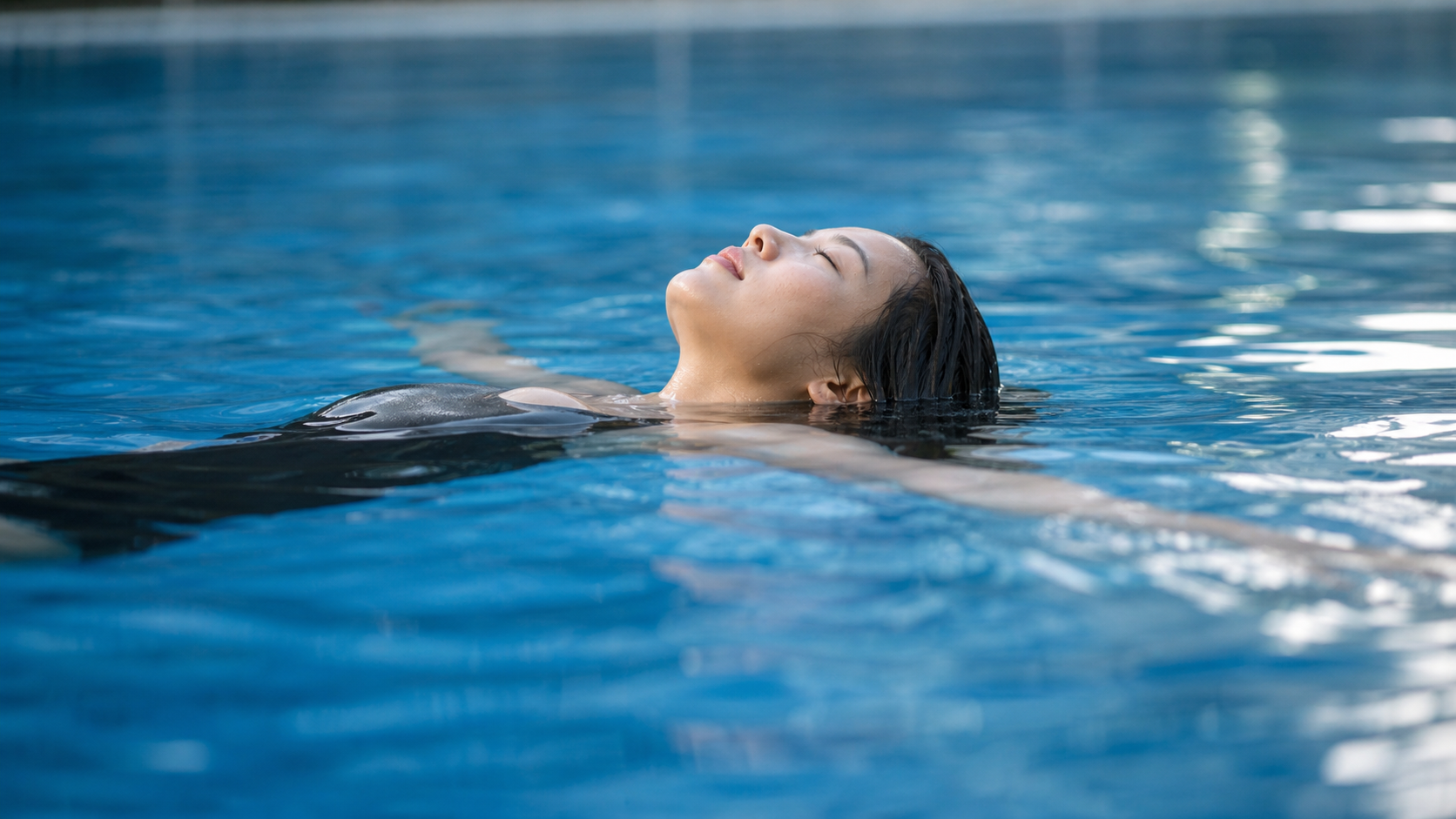
Floating supine contemplation: In the shallow end of the pool or in a jellyfish float position, close your eyes and feel the buoyancy of the water supporting your body, the sensation of water against your skin, and the rise and fall of your breath. Spend 5–10 minutes per session, letting thoughts flow naturally without forcing control.
Rhythmic stroke meditation: While swimming freestyle, use the rhythm of breathing every 3 strokes as an “anchor point,” focusing on this rhythm like a mantra. When distracting thoughts arise, gently bring your attention back to the sensation of stroking.
Water temperature awareness practice: When entering the pool, slowly feel the gradual contact of water temperature from your ankles, knees, abdomen, to shoulders, allowing your senses to be fully present in the moment. This is the simplest introduction to aquatic mindfulness.
The Social Psychological Benefits of Swimming
There is a frequently overlooked mental health dimension in Taiwan’s swimming pool culture: a sense of community belonging. Many regular early-morning swimming groups gradually form close-knit communities over time, greeting each other and offering encouragement. This light social interaction has a significant relieving effect on loneliness and geriatric depression.
Psychological Applications for Special Populations
- Post-traumatic stress disorder (PTSD): The soothing nature of water and the repetitiveness of rhythmic swimming have been shown in some studies to alleviate hyperarousal symptoms of PTSD
- Attention deficit hyperactivity disorder (ADHD): The high level of coordination and focus required in swimming is considered by some researchers to have positive cognitive training effects for adolescents with ADHD
- Menopausal mood swings: Regular swimming can help alleviate menopause-related mood swings by stabilizing serotonin levels
Practical Recommendations
- Try leaving your phone in the locker while swimming, completely disconnecting from digital links, making swimming your true “offline time” of the day
- You don’t have to swim fast or far every time—sometimes swimming 500 meters slowly with mindful awareness provides better psychological relaxation than pushing hard through 2,000 meters
- Taiwan’s hot spring areas (such as Wulai, Jhiben, and Jiaoxi) combine hot spring soaking with swimming, which has a synergistic effect on stress relief
- If using swimming as a mental health tool, it is recommended to maintain a fixed time and a fixed pool—regularity itself has a psychological stabilizing effect
- For those with severe anxiety or depression, swimming can serve as a complementary treatment, but it should not replace professional psychotherapy or medication
Conclusion
Swimming is not just about getting the body moving—it is a space where the mind can breathe. In Taiwan’s high-pressure society, finding a way to truly relax is invaluable. Every time you slip into the water, it is a journey away from the noise and back to yourself. Let swimming become your most familiar mental health prescription—no appointment needed, the poolside is the consultation room.
Related Reading
- Swimming and Stress Management: Practical Methods of Aquatic Meditation and Research on the Mental Health Benefits of Regular Swimming
- The Benefits of Swimming for Mental Health: The Relationship Between Aquatic Exercise and Anxiety and Depression
- The Benefits of Swimming for Mental Health: Relieving Anxiety and Depression
- Stress Relief Through Swimming: Blue Space and Mental Health
西進武嶺 免費訓練分析服務 Intervals | 練不夠還是練過頭?你哪一種類型選手?AI模型告訴你! | 備戰神器 | 公路車 訓練 | CT Yeh
4 年前
水金九不厭五分 10度寒流冷到不願停!feat. 卡卡 / 公路車 / CT Yeh
6 個月前
[防寒衣體驗] 鐵人魂 三鐵 防寒衣試穿會 於松運 深水游泳池 鯨魚池
8 年前
一起升級!海鷗盃LSD團練...JJSC Zone2招待 騎到手抖 / 公路車 / CT Yeh
2 天前