Introduction
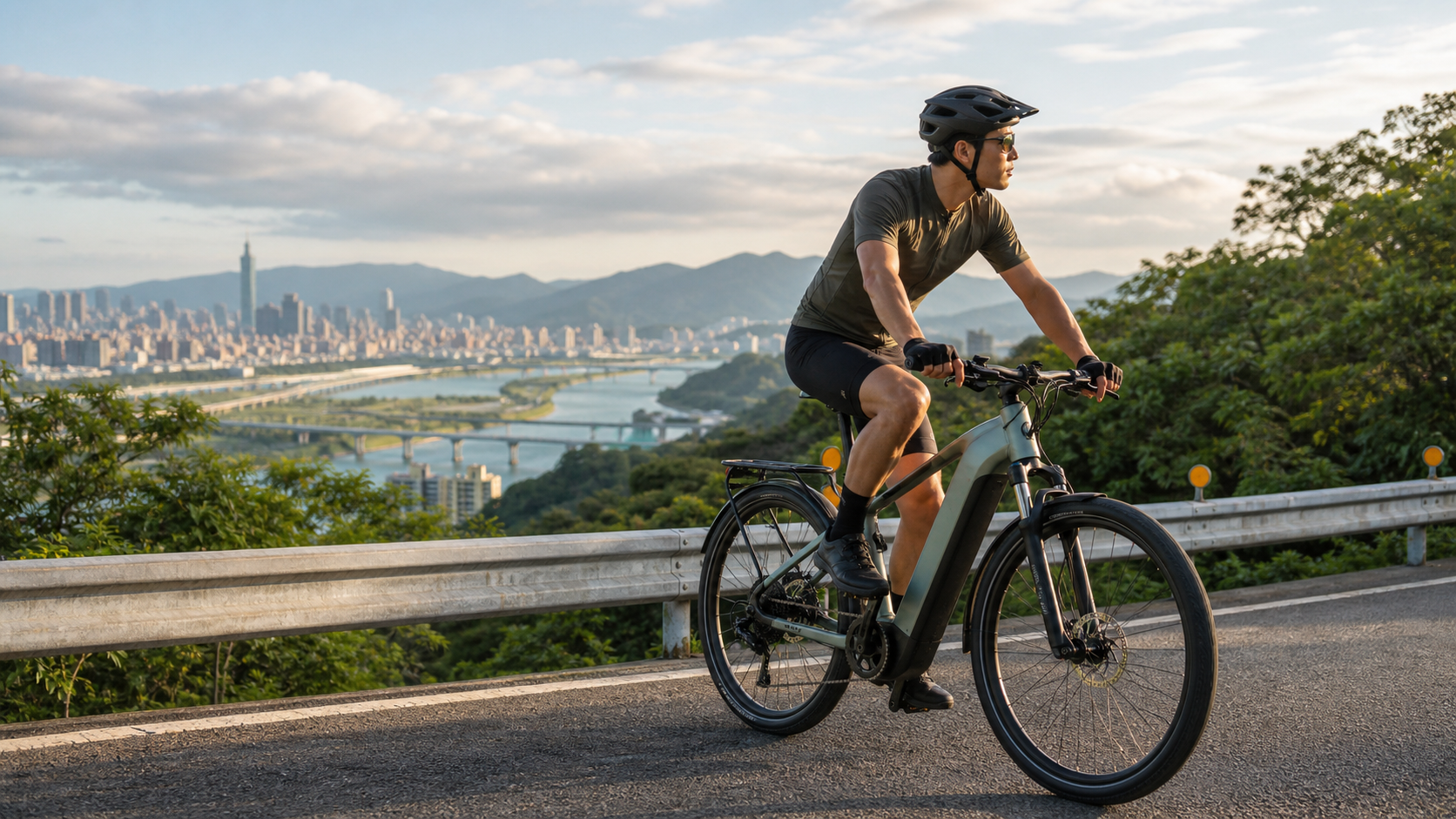
A few years ago, spotting an e-bike on Taiwan’s roads was a rare sight. Today, you can see motor-equipped electric-assist bicycles humming quietly beneath riders’ legs along the Love River bike path, the roads of Yangmingshan, and even Provincial Highway 11 in Hualien. This is more than the emergence of a new product category — it is a major shake-up of the entire cycling culture ecosystem. Who rides? Why do they ride? Where do they go? The answers to these questions are being rewritten as e-bikes become mainstream.
Background: The Rise of Taiwan’s E-Bike Market
Several structural factors underpin the rapid growth of Taiwan’s e-bike market:
Turning manufacturing strength into advantage: Taiwan is a major global supplier of e-bike systems. A significant share of the key components in mainstream e-bike drive systems worldwide — from Bosch, Shimano STEPS, and Brose — are manufactured in Taiwan. This accumulated manufacturing capability gives Taiwanese brands (Giant, Merida) a natural edge in e-bike development.
Demand from an aging society: Taiwan’s population is aging rapidly, and the needs of senior citizens who “can still ride but have limited stamina” align perfectly with the value proposition of e-bikes. Many “new riders” over 50 are rediscovering the cycling lifestyle through e-bikes.
Upgraded commuting needs: In the post-pandemic era, more Taiwanese commuters want to avoid public transportation, and an e-bike’s long-range battery life (50–120 km per charge) makes it a potential alternative to scooters.
Breaking through terrain limits: Taiwan is mountainous, and many riders with average fitness have historically been excluded from mountain routes due to limited climbing ability. E-bike assistance makes that boundary disappear.
Key Market Segments for E-Bikes in Taiwan
| Use Category | Main Demographic | Representative Bike Type | Budget Range |
|---|---|---|---|
| Daily commuting | Urban workers aged 25–45 | Urban commuter e-bikes | NT$30,000–80,000 |
| Leisure riding | Seniors aged 45–65 | Comfort e-bikes | NT$50,000–100,000 |
| Mountain exploration | Mountain bike enthusiasts aged 30–50 | E-MTB (electric mountain bikes) | NT$120,000–300,000 |
| Competitive training | Professional/amateur riders of all ages | E-Road (electric road bikes) | NT$200,000–400,000 |
| Cargo delivery | Delivery riders / commercial use | Cargo e-bikes | NT$80,000–200,000 |
Regulatory Framework: The Legal Status of E-Bikes in Taiwan
Taiwan’s e-bike regulations are relatively well developed, but some gray areas remain:
- Definition of assisted bicycles: E-bikes with motor power under 250W and a maximum assisted speed under 25 km/h are classified under Taiwanese law as “electric-assist bicycles,” enjoying the same road rights as ordinary bicycles and permitted to use bike paths
- E-bikes exceeding these specs: Electric bicycles exceeding the above specifications are regulated as electric vehicles, requiring registration and license plates, and are not permitted on bike paths
- Enforcement gaps: In practice, some over-spec e-bikes still operate on bike paths, with inconsistent enforcement, raising safety concerns
The Cultural Debate: Is an E-Bike “Cheating”?
E-bikes have sparked a cultural debate within Taiwan’s cycling community, centered on one core question: does a distance covered with electric assistance count as a genuine cycling achievement?
The view against assistance (the “pure muscle and bone” camp):
- The core value of cycling lies in the authentic feeling of overcoming difficulty, and electric assistance dilutes that sense of achievement
- If e-bike riders record and display their results on platforms like Strava, it may raise fairness concerns
- Some worry that E-MTBs bring more traffic to mountain trails, placing additional pressure on the ecological environment
The view supporting e-bikes (the “inclusive and diverse” camp):
- The purpose of cycling isn’t competition but exploration, enjoyment, and health — why define its value by whether electricity is used?
- E-bikes allow more people to ride, growing the overall cycling population, which is a positive development for cycling culture
- For seniors or riders with knee injuries, e-bikes let them continue their cycling habit — what is there to criticize about that?
This debate has no settled conclusion in Taiwan, but one thing is certain: as e-bikes become more widespread, this question will increasingly become a core issue that Taiwan’s cycling culture must confront and discuss together.
Practical Advice
- The key to deciding whether an e-bike suits you isn’t age or fitness, but your purpose for riding: if your goal is fitness training, a regular bicycle achieves that better; if your goal is exploring terrain and enjoying the ride, an e-bike is a perfectly reasonable choice
- Prices for e-bikes in Taiwan vary enormously — entry-level models start around NT$30,000, while high-end E-MTBs can reach NT$300,000. Choose based on your actual use case and avoid overinvesting in needs you don’t yet have
- Before buying, understand the real battery range data (manufacturer-listed range is usually the maximum under ideal conditions; actual mountain riding may only achieve half of that)
- Battery maintenance is key to the long-term cost of owning an e-bike — avoid fully draining the battery or storing it at 100% charge for long periods; keeping it within the 30–80% range for daily use can extend battery life
Conclusion
The rise of e-bikes in Taiwan’s market is not a threat to traditional cycling culture but an expansion of it. It brings more people into the world of cycling and extends the scenes of riding from cities to a broader range of terrain and contexts. Whether you are a purist committed to muscle and bone alone, or a newcomer riding an e-bike, you share the same roads, the same mountain views, and the same longing for the freedom of riding — and that longing matters more than what kind of bike you ride.
Related Reading
- Electric-Assist Bicycles (E-bikes): Who Are They Suitable For
- Taiwan’s Electric-Assist Bicycle (E-bike) Trend: Older Generations Rediscover Cycling
- Cycling and the Environment: How Electric-Assist Bicycles (E-bikes) Help Cities Cut Carbon Emissions
- Health Benefits of Electric-Assist Bicycles (E-bikes): Applications for Seniors and Rehabilitation
高雄綠園道鐵路自行車道 / 外地人能輕鬆駕馭 還是整路崩潰? / 2025 全線開通 春節實地探索一次!(附GPS連結)/ 公路車 / CT Yeh
1 年前
多到選擇障礙... 換個單車把帶想一個小時 / BTP / 編織&軟木特有材質超吸睛! / 公路車 / CT Yeh
1 年前
2023自行車展!與環台賽選手一同表演賽 / 全自動AI Fitting?/ TIME新車發表/神秘充電桌等 精華分享 VLOG | CT Yeh | 公路車
3 年前
2025 台北自行車展 逛展VLOG / 新奇商品探索 居然有這些神奇小物 / TT表演賽對戰德國91 / 巧遇 EVA 廷威 AYA 小D 四爺 夏美 松哥 .. / CT Yeh
1 年前
2025 自行車錶排行榜 兩萬車友大數據 / Garmin Bryton 排名會大洗牌嗎? / 全新的碼表前身分析 /公路車 / CT Yeh
1 年前
再快都跟的上!? 單車跟隨攝影機之王 HOVERAir X1 PROMAX 全面實測 / 唯一!8K畫質&自行車專用模式和跟蹤信標&前後避障 / DJI Neo 可參考/ 公路車 / CT Yeh
1 年前
2026 車錶排行榜!誰是最多車友正在使用?練家子最愛哪款?🏆 (2萬名車友數據) / 公路車 / CT Yeh
5 個月前
台中大雪山 膏王領騎 震到都沒畫面了 公路車
5 年前