Swimming Race Start Technique: Details and Improvement Methods for the Grab Start
文章導覽
Introduction
The swim start lasts only a few seconds, yet it can determine the outcome of an entire race. Research shows that from the starting gun to the head entering the water—this “reaction time plus starting action”—elite swimmers are 0.2–0.4 seconds faster than amateurs, which in a 50-meter freestyle is nearly the difference between rankings. Taiwanese junior swimmers often invest significant time in technical training but overlook the high-return phase of the start. This article begins with the grab start, breaking down modern competitive starting techniques.
Two Modern Grab Start Methods in Swimming
| Type | Grip Method | Applicable Events | Characteristics |
|---|---|---|---|
| Traditional Forward Grab Start | Both hands grip the front edge of the block, thumbs pointing down | Short-distance freestyle, backstroke | High stability, suitable for power-oriented swimmers |
| Track Start | One foot forward, hands gripping the front edge | Mainstream across all events | Fast reaction time, forward weight shift |
Currently, the international mainstream is the Track Start, with one foot placed at the front of the starting block and the other foot behind, which helps utilize the rear leg’s push-off force for a quick takeoff. The backstroke start, however, requires pushing off the wall from the water, with a completely different technical logic. This article focuses on prone strokes (freestyle, butterfly, breaststroke).
Technical Breakdown of the Grab Start
Step 1: Ready Position
- Feet positioned front and back about shoulder-width apart, front toes gripping the front edge of the block
- Knees slightly bent, center of gravity leaning forward about 30–40 degrees
- Both hands grip the front edge of the block, four fingers underneath and thumbs on top (Hook Start), or all fingers on top
- Head lowered, gaze toward the starting block, shoulders relaxed
Step 2: Reaction to the Gun
Reaction Time refers to the time from hearing the gun to the feet leaving the block. Elite swimmers typically achieve 0.6–0.7 seconds, while amateurs often exceed 0.8 seconds. Training focus:
- Do not anticipate the start: Starting too early from the crouched position will be judged a False Start
- Trigger on hearing rather than sight: Research shows auditory reaction is 15–20 milliseconds faster than visual reaction
- Train the habit of reacting to the gun: Use electronic starting devices in practice to build the correct gun-response reflex
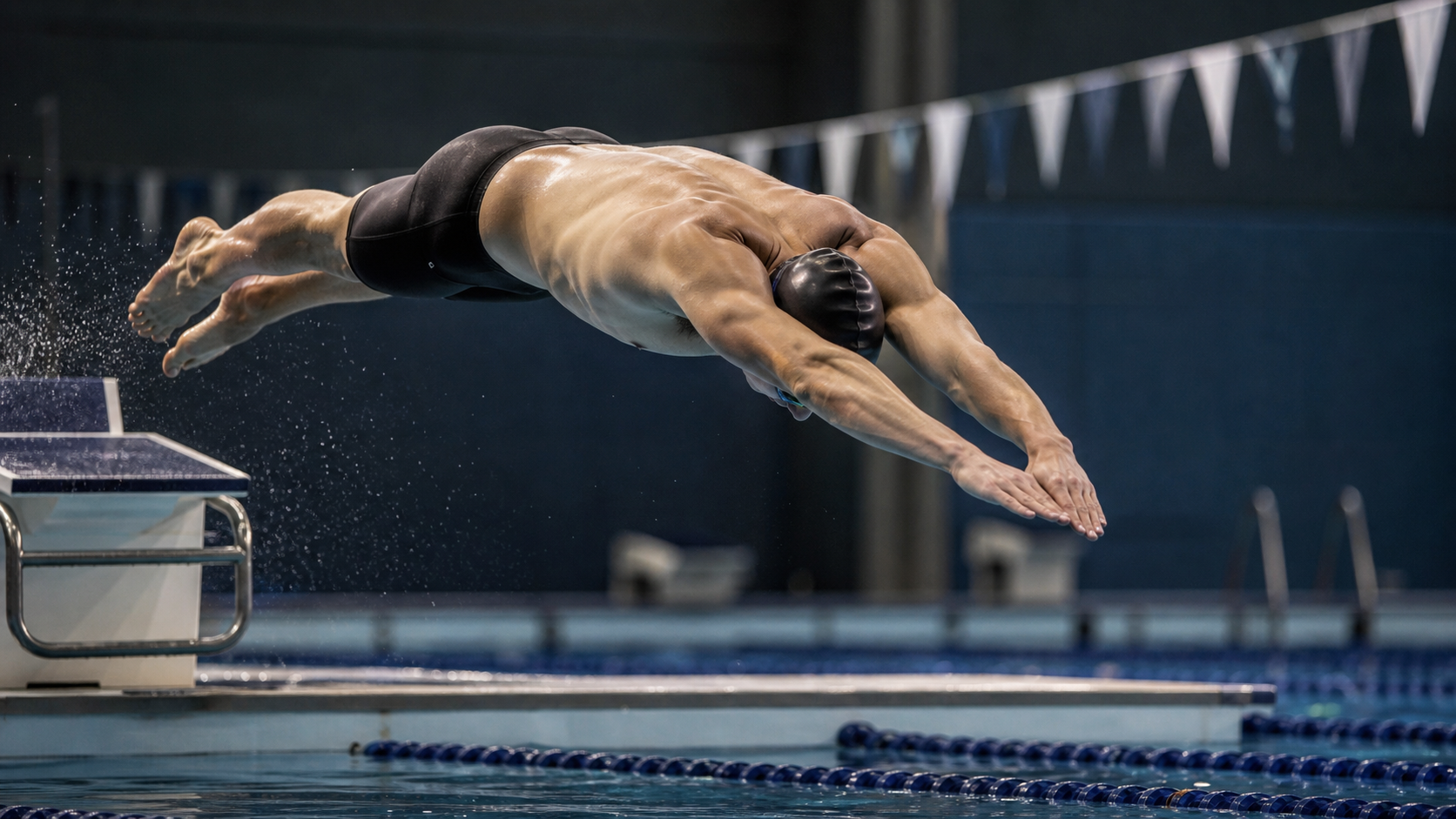
Step 3: Takeoff and Flight
The flight trajectory after pushing off the block affects the entry angle:
- The ideal entry angle is approximately 35–40 degrees; too flat results in high impact on entry, while too steep loses glide distance
- At takeoff, extend the arms forward into a streamlined position, with the head tucked between the arms
- Keep the body tight in the air, avoiding a loose lower back
Step 4: Entry and Glide
- Enter the water hands first, fingers pointing forward, thumbs slightly rotated outward
- After entry, maintain a streamlined body position, using the entry momentum to glide until speed drops to swimming pace
- Glide distance is typically 3–5 meters for freestyle and 2–4 meters for butterfly
- Begin the dolphin kick during the glide, usually 2–4 kicks before surfacing to start the arm stroke
Common Mistakes and Improvements for Taiwanese Swimmers
- Insufficient grip strength on the block: Leads to unstable center of gravity at the start and dispersed push-off force. Improvement: Strengthen grip training and deliberately feel the pressure point of the toes gripping the block during practice
- Takeoff angle too flat: Common among swimmers who fear pain or lack technique, resulting in a loud belly-flop sound on entry. Improvement: Practice starts on land into a sand pit or the deep end of the pool to develop the correct angle sense
- Starting the arm stroke too early after a short glide: Loses the starting advantage. Improvement: Practice the “static glide feel” and use underwater video to confirm whether the glide distance is sufficient
- Backstroke start foot slip: Feet slipping when pushing off the wall. Improvement: Ensure the toes fully hook onto the overflow gutter or starting block, and test wall grip during warm-up
Practical Recommendations
- Video analysis: Having a teammate or coach record the start from the side is the most effective self-correction tool
- Keep 10 start practice reps in every training session: Starting technique requires extensive repetition to build muscle memory
- Simulate race start conditions: Use an electronic starting device in training rather than verbal commands to ensure a realistic gun-response reaction
- Test the start feel in the warm-up pool before competition: Every pool’s starting block height and surface texture differ, so recalibration during warm-up is essential
Conclusion
Starting technique is a competitive advantage underestimated by many swimmers. From the grab start posture, push-off force, to the entry angle, every detail deserves repeated refinement. It is recommended to incorporate start training into the daily routine rather than focusing on it only before competitions. A stable and efficient start can establish both psychological and physical advantages for the entire race.