文章導覽
Introduction
The flip turn is a key technique in freestyle and backstroke races, and it’s also where the gap widens most in short-course events. Many swimmers neglect turn quality in training, only to discover during competition that every turn causes a slight “stall” — and those losses add up. Take the 200m freestyle short course as an example: there are 7 turn opportunities. If each turn is 0.2 seconds slower than your opponent’s, you lose 1.4 seconds over the whole race — enough to drop several places.
The Complete Flip Turn Technical Sequence
| Phase | Distance from Wall | Key Action | Common Mistake |
|---|---|---|---|
| Approaching the wall | 5–7m | Begin the flip after the last complete stroke | The final stroke disrupts rhythm |
| Rotation | 2–3m | Head drops down, rotate 180 degrees quickly | Rotation speed too slow |
| Wall push-off | 0m | Feet plant on the wall, knees bent 90 degrees, push off | Push-off angle too steep or too shallow |
| Streamline glide | 0–4m | Body in streamline position, underwater dolphin kick | Surfacing too early |
Detailed Breakdown of the Flip Turn Technique
1. Mastering the Approach Rhythm
Handling the “last stroke” before reaching the wall is the hardest part of the flip turn. Ideally, a swimmer should judge their takeoff point around 5 meters from the wall, so that when the last stroke finishes, the hand is right at the side of the abdomen, allowing an immediate flip without needing an extra half-stroke.
How to solve the half-stroke problem:
- Use lane markers (flags or T-markers 5m from the wall) as visual cues during practice
- With enough repetition, the body naturally adjusts its stroke count to hit the wall cleanly
- Accept that “every approach will be slightly different” — the key is to initiate the flip quickly
2. The Rotation Itself
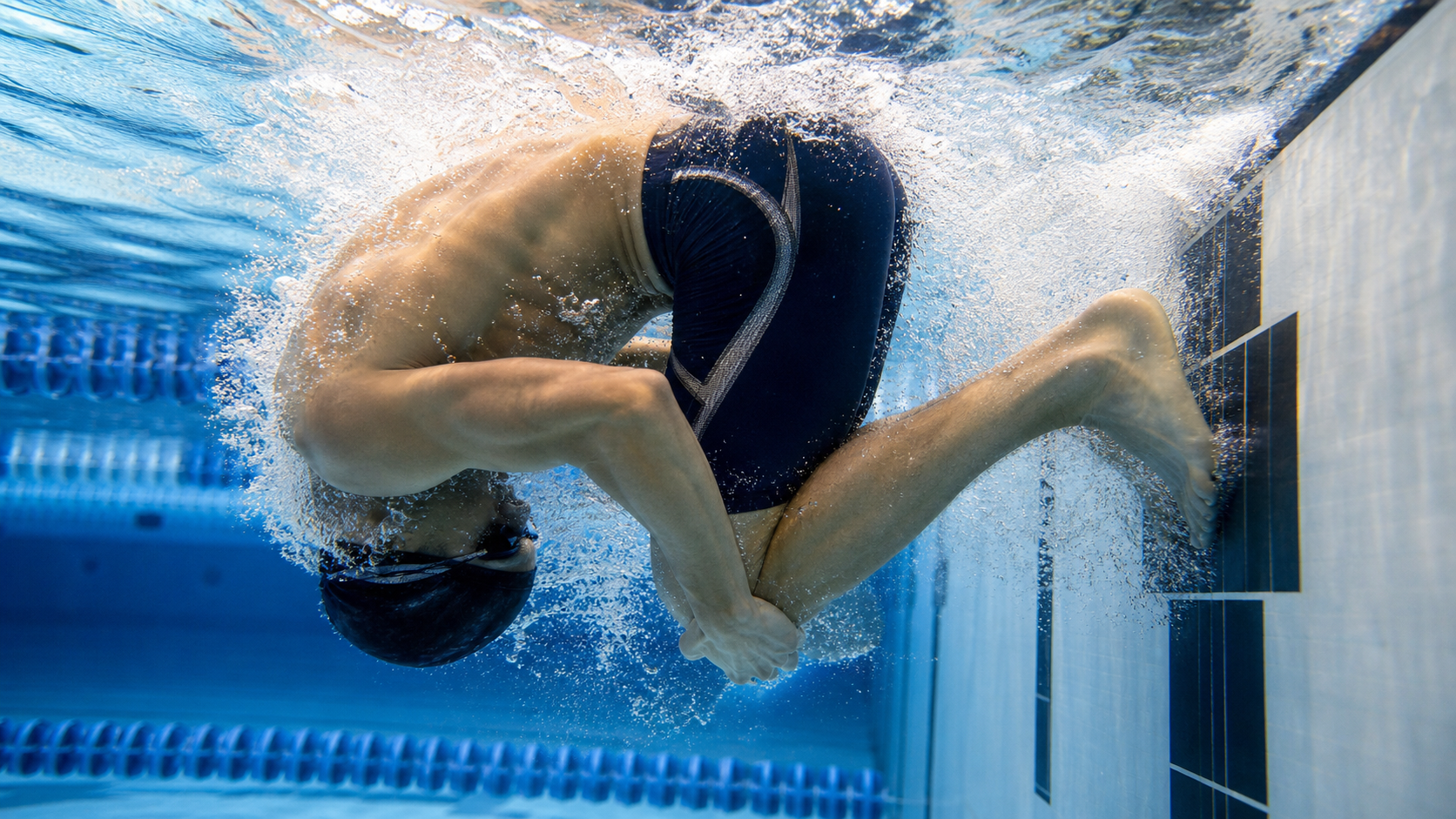
During the rotation, the body should pivot quickly around the core (waist and abdomen):
- Press the head down, tuck the chin to the chest, and initiate the flip
- Press the palms down against the water surface to generate reaction force that speeds up the rotation
- Target time for the full rotation: 0.3–0.4 seconds
- When the rotation completes, the feet should land precisely on the wall, with the knees bent to roughly 90 degrees
3. Push-off Angle and Power
The wall push-off is the power core of the entire turn:
- Ideal push-off depth: 15–20cm below the surface, ensuring the push drives the body forward rather than upward
- Feet parallel or slightly turned outward, adjusted to individual muscle structure
- After pushing off, extend both arms forward, hook the fingers to reduce drag, and keep the back straight
4. Underwater Glide and Surfacing
- After push-off, use the momentum to glide — this only pays off if the glide speed is higher than swimming speed
- Initiate the dolphin kick before the glide speed drops to swimming speed (typically starting after 1.5–2m)
- When surfacing in freestyle, sync with your breathing rhythm — don’t rush to lift your head just to check the clock
Guide to Fixing Common Mistakes
- Turning too early (too far from the wall): Feet can’t reach the wall, forcing a “kick at air” to make up the distance. Fix: Attach a reflective marker on the wall as a visual cue and practice judging the approach distance accurately
- Turning too late (hitting the wall): After the flip, the knees bend more than 90 degrees, losing push-off power. Fix: Deliberately start the flip 1–2 strokes earlier and adjust gradually
- Glide drifting off course: Veering out of the lane after push-off wastes distance. Fix: Make sure both feet apply balanced force during push-off — one foot shouldn’t be stronger than the other
- Surfacing too early: Rushing to start stroking loses glide momentum. Fix: Deliberately delay surfacing in training, using the dolphin kick as the connecting motion
The Psychological Side of Race-Day Execution
Turn quality during competition can sometimes suffer due to nerves:
- Overthinking the turn causes mistakes: Let the turn become an “automatic motion” — during the race, don’t think about it, execute it through muscle memory
- Return to pace rhythm immediately after the turn: Don’t let emotions swing based on how good or bad the turn was — refocus on the next segment right away
- Short-course races have more turns, requiring stronger focus to maintain quality throughout
Practical Tips
- Add “10 consecutive turn repetitions” at the end of every training session to build the habit
- Use side-angle video analysis to check approach distance and push-off angle — this is the fastest way to improve your turn
- Time your turn quality: from the T-marker to surfacing, the ideal value is about 1.0–1.3 seconds (short course)
- Combine with dryland core training to increase rotation speed
Conclusion
The flip turn is “free time” in swimming competition — with polished technique, every turn propels you forward faster than swimming speed, making your opponents watch the gap widen. Every swimmer should treat turn technique as equally important as stroke technique, building it up steadily in daily training so it pays off naturally on race day.
Related Reading
- Refining Swim Turn Technique: Timing the Push-off and Maintaining Streamline in the Flip Turn
- Improving Swim Turn Efficiency: 5 Technical Adjustments for the Flip Turn
- Breaking Down Swim Turn Efficiency: Maximizing Push-off Power and Glide Distance in the Flip Turn
- Advanced Swim Turn Technique: Biomechanical Analysis and Training Methods for the Flip Turn