Introduction
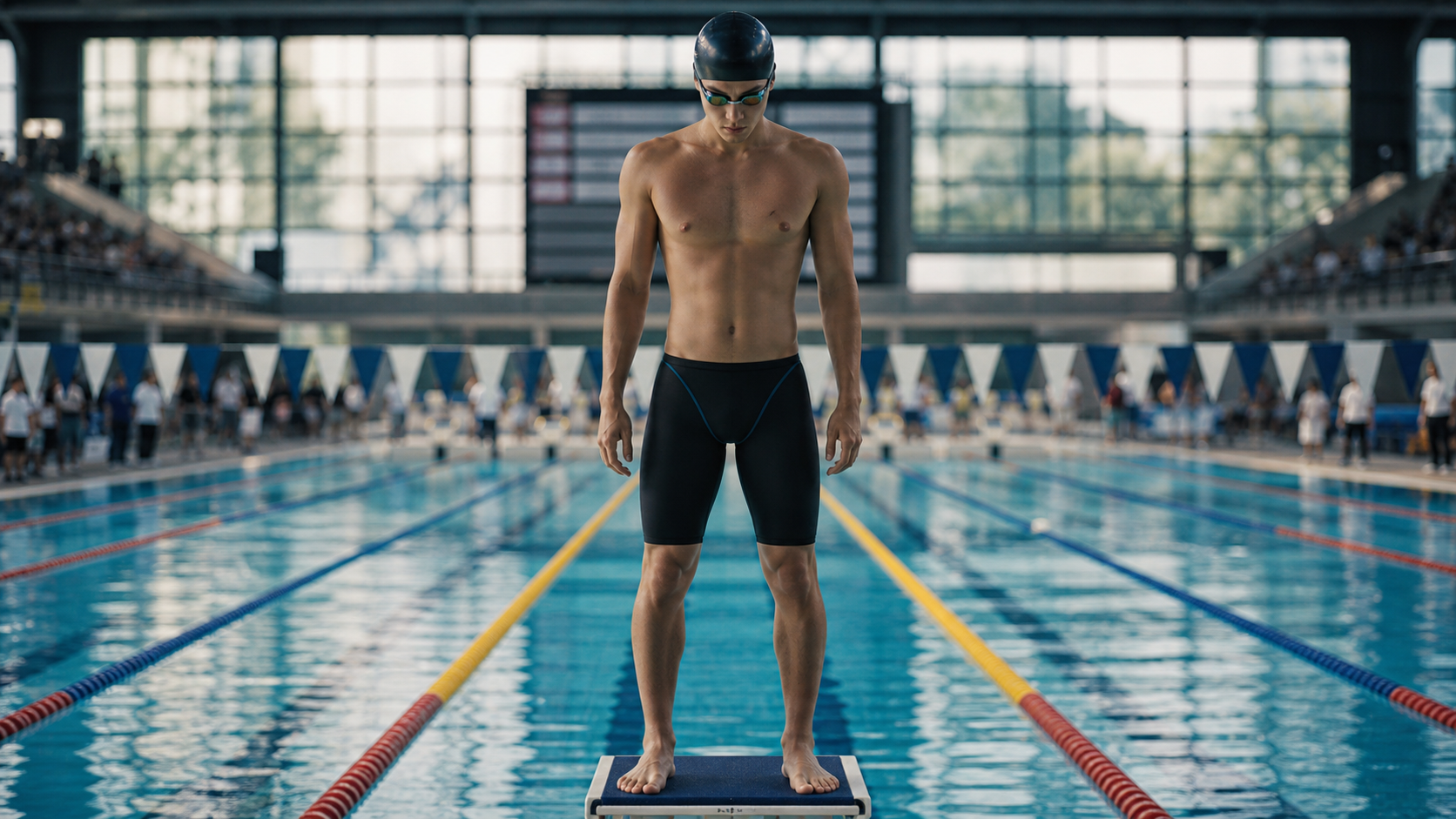
“I swim great in practice, but I choke in competition.” This is the most common lament heard by swimming coaches in Taiwan. The psychological tension triggered by competitive pressure directly affects muscle coordination, breathing rhythm, and decision-making through the nervous system. The few seconds standing on the starting block represent the most concentrated moment of psychological challenge in a race. Mastering the mental and breathing techniques before the dive is key to stabilizing competitive performance under high pressure.
The Physiological Mechanisms of Competitive Tension
When athletes feel nervous, the body activates the “fight or flight” response:
- Increased heart rate, shortness of breath
- Muscle tightness (especially in the shoulders and neck)
- Distracted attention, increased intrusive thoughts
- Shaky hands, gastrointestinal discomfort
Within a moderate range, these responses help enhance performance (the “activation effect”), but excessive tension produces the opposite result. The goal is to keep tension within the optimal zone of “activated but not out of control.”
Pre-Race Breathing Control Techniques
| Breathing Technique | Timing | Method | Effect |
|---|---|---|---|
| Diaphragmatic breathing | While waiting to race | Inhale, expanding the belly for 4 seconds; exhale, contracting the belly for 6 seconds | Activates the parasympathetic nervous system, reduces tension |
| 4-7-8 breathing | 5–10 minutes before the race | Inhale for 4 seconds, hold for 7 seconds, exhale for 8 seconds | Deeply calming, suitable for those prone to excessive tension |
| Pre-race activation breathing | 30 seconds before the start | 5–6 short, quick breaths followed by one deep inhale | Increases blood oxygen, activates the nervous system |
| On-block breathing rhythm | After stepping onto the starting block | Slow exhale, feeling the stability of your feet on the block | Stabilizes center of gravity, focuses attention |
Focus Techniques on the Starting Block
Shifting Focus: From “Outcome” to “Process”
Many athletes step onto the starting block with outcome-oriented thoughts like “What if I swim badly?” or “My opponent is so strong,” which significantly increases anxiety. The recommendation is to shift to a “process focus”:
- “I will maintain a streamlined entry for the first 15 meters”
- “My first turn will be perfect”
- “Keep a breathing rhythm of every 4 strokes”
This shift in focus allows athletes to direct their attention to controllable actions rather than uncontrollable outcomes.
Body Scan
After stepping onto the block, perform a quick “body scan” to progressively relax tense areas:
- Toes: Confirm your grip on the block, consciously feel the surface
- Knees: Slightly bent, not overly tense
- Shoulders: Actively press down to release shoulder and neck tension
- Hands: Grip the block loosely, not with a death grip
- Jaw: Slightly relaxed, avoid clenching your teeth
Mental Rehearsal
Mental rehearsal shouldn’t only happen in the minutes before a race; it should begin during the preparation period:
- 2–3 times per week, visualize the entire race flow with your eyes closed before bed
- Visualize the start, each turn, the pacing sensation, and the final sprint
- Also visualize yourself remaining calm under pressure
Cue Word Technique
Set one or two short phrases as psychological anchors to automatically trigger calm and focus during tense moments:
- For example: “Relax shoulders, steady rhythm”
- Say this phrase before every high-intensity set in training to build a conditioned reflex
- Silently repeat the cue word when on the block during competition to quickly return to the stable state you have in training
Psychological Strategies for Different Personality Types
- Athletes prone to excessive tension: Focus on “lowering activation,” using diaphragmatic breathing and body scans
- Athletes prone to being overly relaxed (careless): Focus on “raising activation,” listening to motivational music and using physical movement to activate before races
- Inexperienced young athletes: Focus on “reducing uncertainty,” participating in more mock races to replace fear with familiarity
Practical Advice
- Establish a fixed pre-competition routine: From arriving at the venue, changing, warming up, to stepping onto the block, standardize every step to reduce anxiety caused by uncertainty
- Accept that nervousness is normal: Tell yourself, “Being nervous means I care about this race, and that’s a good thing,” rather than trying to eliminate the nervousness
- Use formal mental preparation in practice races too: Practice on-block breathing in training races so mental preparation becomes a habit
- Record your mental state after races: Track your results under different mental states to identify your personal “optimal competitive psychological window”
Conclusion
The few seconds on the starting block are the concentrated embodiment of an athlete’s years of training. Technique and fitness determine the ceiling, while mental preparation determines whether you can reach that ceiling under high pressure. Breathing control, focus shifting, and mental rehearsal are skills any athlete can master through systematic training. Start incorporating mental practice into every training session from now on, so that both your brain and your muscles are prepared for competition.
Related Reading
- Managing Pre-Race Tension in Swimming: Analyzing Pre-Race Anxiety from a Sports Psychology Perspective
- Managing Race Tension in Swimming: Lane Choice Psychology and Starting Reaction
- Competition Anxiety Management: Breathing and Relaxation Techniques Before the Start
- Pre-Race Mental Preparation in Swimming: How Top Athletes Find Calm in the Water?
[教學] Premiere 影片 手震 修正 教學 防抖 單眼 影像 GoPro 穩定 Video Stabilization
8 年前
戰略) Zwift Race 如何咬在第一集團 如何評估自己要開多少推力 (請開1.5倍速看)
7 年前
西進武嶺 自製新版AI配速表產生器 x 賽前攻略 抱佛腳! 沒有功率計也可以產生配速表嗎?有什麼其他眉角賽前要注意的呢? | 西進武嶺 / 東進武嶺 KOM 攻略 | 公路車 | CT Yeh
4 年前
CT 喇低賽) 武嶺牽車 才是王道 西進牽車四小時內秘訣 攝手位置 如何判斷 防抽筋小秘訣
7 年前
備戰 戀戀197 賽前關門點分析 西濱團練 #公路車 4K高畫質
6 年前
Live) 備戰2019彰化經典百K 賽前攻略 (已完賽請看新影片
7 年前
FTL 與 SYB 車隊專訪 西進武嶺 實用攻略分享! 2小時 如何練?!你不知道的眉角!新手準備武嶺必看 EP1 | 實力派女車友 | 精華版 | 公路車 | CTYeh
4 年前
2025 海鷗團體繞圈賽 網路直播 超激烈裁判長視角 / EIPC 李廷威、Waypoint 等眾多高手競爭 / feat. 卡密兒主持 / 海鷗繞圈賽
9 個月前