文章導覽
Introduction
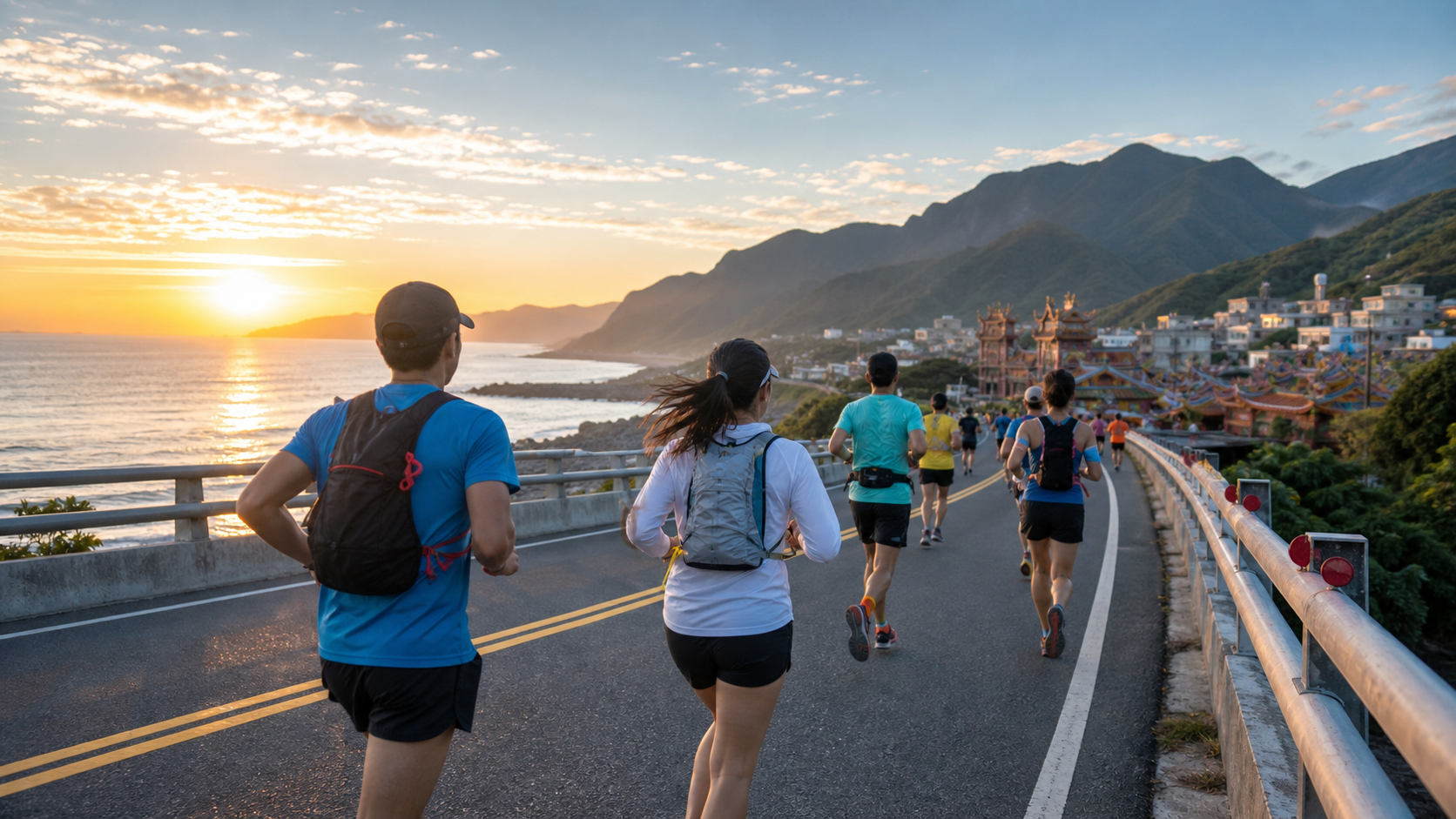
Imagine this: you step onto Hualien’s Pacific coastline at five in the morning, the sound of waves accompanying the dawn light, a straight coastal highway stretching beneath your feet, surrounded by runners from all over Taiwan and the world. Or, you weave through Tainan’s ancient city streets, every step landing on centuries of history, with temple incense and historic architecture as your scenery along the way.
Running Tourism (or Race-cation) is precisely about systematizing these experiences: using participation in running races as the centerpiece, extending into an in-depth exploration of a place. Taiwan may be small in size, but its diversity is astonishing—from coastal plains to mountain valleys, the marathons in every county and city offer a unique perspective.
The Complete Map of Running Tourism in Taiwan
Below is a compilation of representative running events across Taiwan, to help plan your “Run Across Taiwan” checklist:
| County/City | Representative Event | Featured Route | Best Season |
|---|---|---|---|
| Taipei | Taipei Marathon | Prime downtown sections + panoramic bridge views | December |
| New Taipei | Wanjinshi Marathon | North coast mountain-and-sea scenery | March |
| Taoyuan | Taoyuan Marathon | Pond and wetland ecological landscapes | November |
| Hsinchu | Hsinchu City Run | Science City modernity + historic relics | October |
| Miaoli | Miaoli Mountain City Marathon | Hilly terrain, Hakka culture | November |
| Taichung | Taichung Marathon | Urban park green belts | December |
| Changhua | Changhua Tianzhong Marathon | Farmland crisscrossing, temple clusters | November |
| Nantou | Sun Moon Lake Run | Lake and mountain scenery, indigenous culture | September |
| Yunlin | Taiwan Lantern Festival Run | Rural landscapes, Xiluo Bridge | February |
| Chiayi | Alishan Run | Forest railway, mountain air | October |
| Tainan | Tainan Ancient Capital Marathon | Historic districts, temple culture | January |
| Kaohsiung | Kaohsiung Marathon | Love River, 85 Tower, harbor | February |
| Pingtung | Kenting Marathon | Tropical coast, national park | March |
| Hualien | Taroko Gorge Marathon | One of the world’s most beautiful gorges | November |
| Taitung | Taitung Marathon | Rift Valley scenery, indigenous culture | December |
Planning Strategies for Running Tourism
The two-phase itinerary: “Explore before the race, savor after the race”:
The best running-tourism model is to arrive one day before the race, exploring the area at a relaxed pace; then spend half a day or a full day after the race diving into local food and attractions. Take the Hualien Taroko Marathon as an example:
-
Pre-race day (Saturday):
- Arrive at Hualien Train Station in the afternoon, walk into the city center
- Visit the Hualien Harbor fish market in the evening
- Head to Lude Square at night for an indigenous song performance
- Sleep early to prepare for race day
-
Race day (Sunday):
- Complete the 42 km or 21 km course in the early morning
- Enjoy the post-race refreshments at the Taroko Gorge entrance
- Drive into the gorge in the afternoon and visit the Swallow Grotto Trail (an easy stroll to recover your legs)
- Take the evening train back to Taipei, with dinner around Hualien Station before boarding
The “Checklist Collection” Concept of Run-Travel
Many Taiwanese runners have developed a systematic “marathon map” collecting culture:
- Collecting finisher medals from marathons in each county and city, hanging them to fill an entire wall
- Marking completed race locations on a map, building your own “Taiwan runner’s territory”
- Taking on the “Big Six” series: Taroko, Wanjinshi, Tianzhong, Taipei, Kaohsiung, and Taitung
- Some runners challenge themselves to complete official marathon events in every county and city on the Taiwan mainland within a single year
Practical Tips for Running Tourism
Transportation planning:
- TRA or HSR are the main arteries; for Hualien and Taitung, watch for schedule changes during typhoon season
- Many events offer shuttle buses from MRT stations or train stations to the start line—make good use of them
- Post-race transportation: your legs will usually be heavy, so it’s wise to book accommodation near the start/finish line
Accommodation choices:
- Within a 15-minute walk of the start line is ideal
- Confirm whether the accommodation offers luggage storage (for your large bag during the race)
- Choose a quiet room with good soundproofing the night before the race (large events often bring party noise nearby)
Fueling strategy:
- Research the locations and contents of local aid stations in advance (each event’s official website provides detailed information)
- Out-of-town runners are unfamiliar with the local climate, so hydrate more than usual
- Plan a hearty “finisher’s celebration meal” after the race—it becomes part of the run-travel memory
Practical Advice
- When registering for a run-travel event, book accommodation at the same time; for popular events (such as Taroko or Wanjinshi), lodging needs to be reserved more than three months in advance
- Join each event’s runner Facebook community to get local insights on transportation, food, and lodging
- Pack light: run-travel luggage only needs running gear plus one casual outfit—a medium backpack is enough
- Keep a “run-travel diary” recording each event’s weather, race conditions, and post-race meals, building your personal Taiwan runner’s map
Conclusion
Taiwan may be small, but it is a runner’s big world. Every marathon is a window, letting you measure this land at the pace of your own feet and discover corners that tourists never see through a runner’s eyes. As your finisher medals accumulate, the map of this island in your heart grows richer, more three-dimensional, and warmer. Running tourism is, in the end, the most profound travel memory earned through sweat.
Related Reading
- Running Tourism: Exploring Taiwan’s Cities Through Running
- Running Travel (Running Tourism): City Trips Centered on Race Participation
- Combining Running with Travel: Planning Trips to Join Local Races While on Business
- Taiwan Running Race Map: A Look at Representative Marathons Across North, South, East, and West