Bone Adaptation in Running: Risk Factors for Stress Fractures and Bone Density Improvement
文章導覽
Introduction
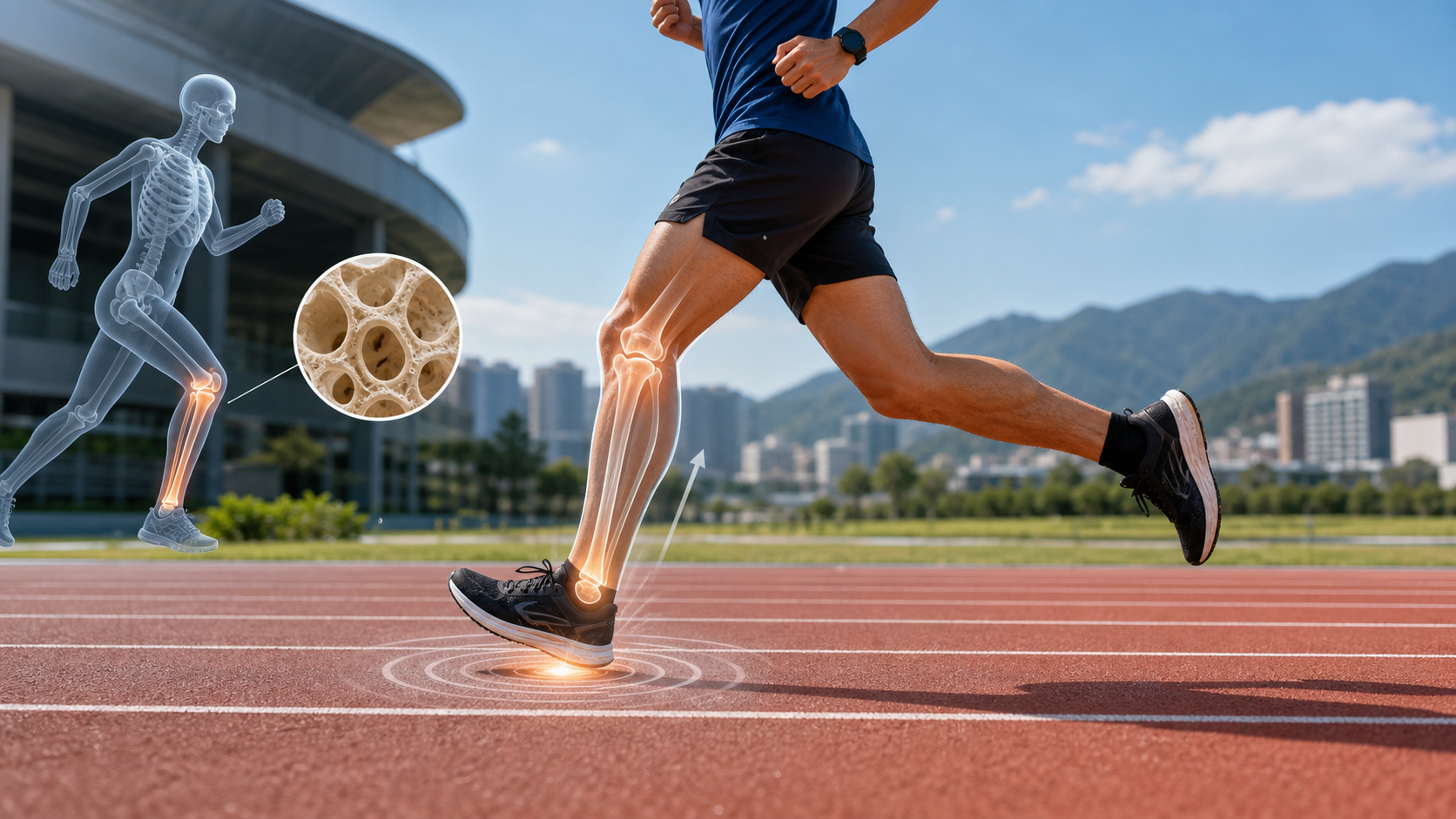
Bones are not static hard tissue, but active organs undergoing continuous dynamic remodeling (Bone Remodeling). Every step of running applies mechanical stress to the bones, and the bones’ adaptive capacity determines whether you gain bone density from running or end up with a stress fracture.
The Basic Mechanism of Bone Remodeling
Two types of cells dominate the remodeling process:
- Osteoclasts: dissolve old bone, the first step of the remodeling cycle.
- Osteoblasts: fill in new bone, increasing bone density.
Mechanical stress (running impact) is sensed by Osteocytes, triggering signal transduction that suppresses osteoclast activation and promotes osteogenesis, ultimately making bones thicker and denser. This mechanism is known as Wolff’s Law—bones strengthen along the direction of stress.
The Bone Benefits of Running
Compared with non-impact sports such as swimming and cycling, running provides stronger bone stimulation because the ground reaction force (GRF) reaches 2–3 times body weight. Research shows:
- Regular runners have significantly higher hip and lumbar spine bone mineral density (BMD) than sedentary individuals, and slightly higher than swimmers.
- Those who start running during adolescence (the peak period of bone density growth) achieve a higher peak bone mass.
- Postmenopausal female runners have a reduced risk of osteoporosis, but adequate calcium intake is required.
Risk Factors for Stress Fractures
| Risk Factor | Description |
|---|---|
| Sudden increase in training volume | Weekly mileage increase exceeding 10% (the 10% rule) |
| Low bone density | Osteoporosis or osteopenia (T-score < -1.0) |
| Insufficient energy supply | Low energy availability (LEA), Relative Energy Deficiency in Sport (RED-S) |
| Menstrual abnormalities | Female athlete triad (Amenorrhea, Osteoporosis, Disordered Eating) |
| Vitamin D deficiency | Common among indoor populations in Taiwan due to insufficient winter sunlight |
| Inadequate calcium intake | Daily requirement of 1000–1200 mg |
| Worn running shoes | Reduced cushioning in the sole, increasing impact transmission |
| Hard surfaces | Asphalt > track > dirt > PU track |
Common High-Risk Scenarios for Taiwanese Runners
Taiwan’s marathon market is thriving, with large numbers of beginners flooding in every autumn and winter. “Starting a race preparation plan only 3 months in advance and rapidly increasing weekly mileage to 60–80 km” is a typical cause of stress fractures. The tibia, metatarsals, and navicular are the most common sites of occurrence.
Common Sites and Symptoms
- Tibia (lower anterior aspect): pain worsens after starting to run, eases with rest, and is severely tender to local palpation.
- 2nd–4th metatarsals: localized swelling on the dorsum of the foot, with dull pain when walking in regular shoes.
- Navicular: deep pain on the dorsal midfoot; its unique location often leads to misdiagnosis, and MRI is the gold standard for confirmation.
The Golden 24-Hour Principle: once a suspected stress fracture appears, stop running completely immediately, seek medical imaging evaluation, and never try to “run it off”!
Strategies to Improve Bone Density
- Progressively increase mileage: strictly adhere to a weekly increase of no more than 10%, and schedule a reduction week after three consecutive weeks of increased volume (the 10% rule).
- Cross-training: incorporate swimming or cycling to replace part of the running during high-mileage weeks, maintaining aerobic fitness while reducing cumulative bone stress.
- Vitamin D supplementation: the recommended daily vitamin D intake for Taiwanese adults is 600–800 IU. Outdoor runners can synthesize it naturally with 15–30 minutes of sun exposure, while indoor populations need supplements.
- Calcium intake: 1000–1200 mg per day, prioritizing food sources (milk, tofu, dried small fish), and supplementing with calcium carbonate or calcium citrate when intake is insufficient.
- Regular shoe replacement: replace running shoes every 500–800 km. In Taiwan’s rainy season, soles wear out faster when wet, so tracking by mileage is recommended.
Conclusion
Running is a double-edged sword for bone strengthening—appropriate impact is the best enhancer for bones, but excessive or improper impact can lead to irreparable stress fractures. By understanding the bone adaptation mechanism, runners can carry respect for their bodies, making every step both an investment and a form of protection.
Related Reading
- Bone Adaptation in Road Running: How Impact Forces Strengthen Bone Density and Reduce Fracture Risk
- Running and Bone Adaptation: The Balance Between Stress Fractures and Bone Density Building
- Bone Density and Stress Fractures in Female Runners: Prevention Starts Now
- Bone Density in Female Runners: The Long-Term Benefits of Regular Road Running for Skeletal Health