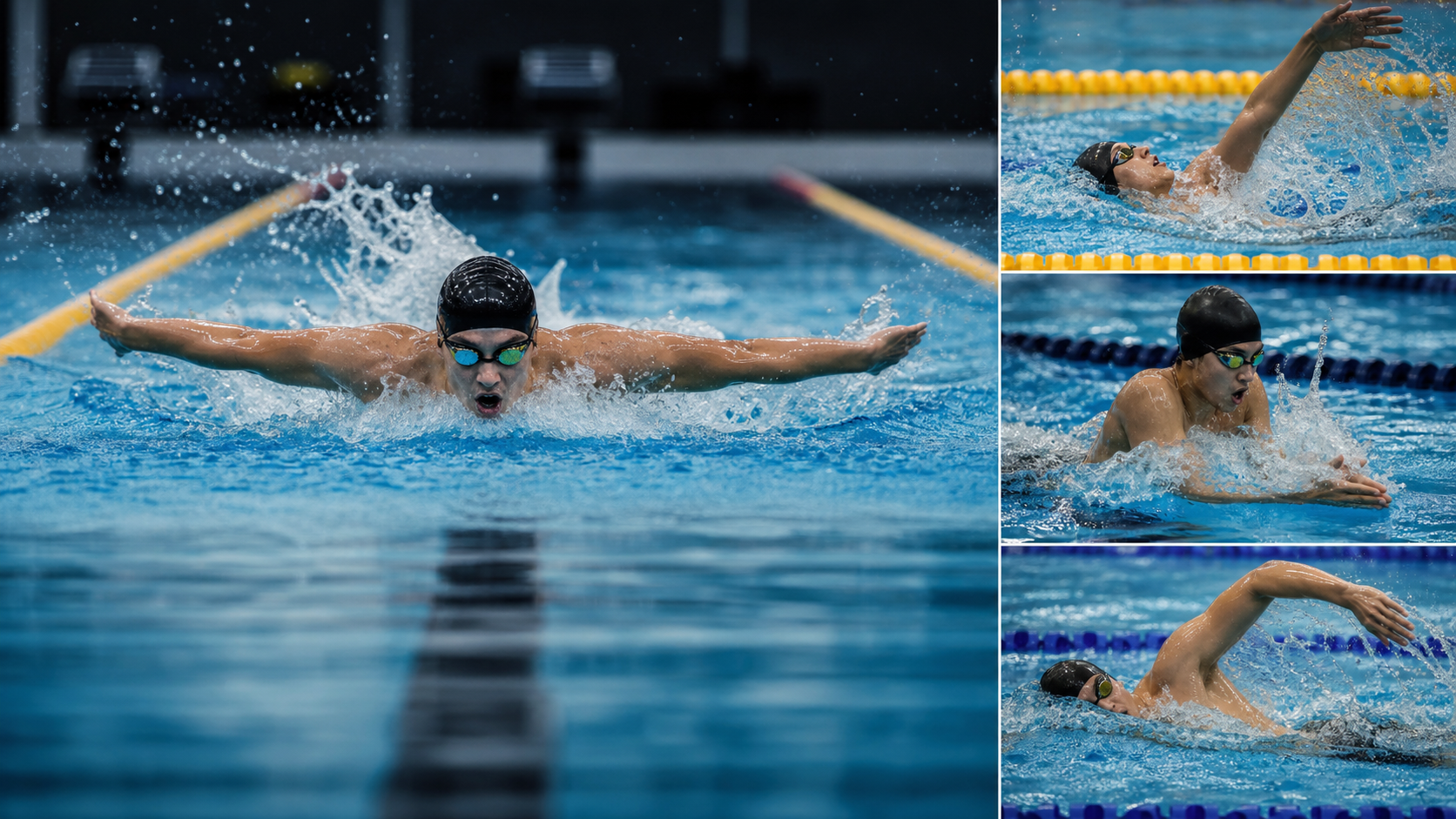
Introduction
The Individual Medley (IM) is the most demanding challenge in swimming, requiring versatility across all strokes. The 200m IM requires swimming 50m each of butterfly, backstroke, breaststroke, and freestyle in that order; the 400m IM requires 100m of each. Each stroke has a distinct technical logic, energy system, and pacing rhythm. How to optimally distribute effort and manage transitions among the four strokes is the key to medley performance. Taiwan’s National Championships and National High School Games both feature the Individual Medley, and this article provides a complete race strategy analysis.
Physiological Characteristics and Pacing Logic of the Four Strokes
| Stroke | IM Position | Primary Energy System | Pacing Strategy | Common Mistakes |
|---|---|---|---|---|
| Butterfly | 1st stroke | High anaerobic output | Don’t go out too fast; preserve endurance | Over-sprinting leads to a late-race collapse |
| Backstroke | 2nd stroke | Aerobic dominant | Maintain a steady rhythm; allow breathing to recover | Unstable technique wastes extra energy |
| Breaststroke | 3rd stroke | Mixed anaerobic | Keep a steady stroke rate; don’t let rhythm fall apart | Gliding too long loses speed |
| Freestyle | 4th stroke | Anaerobic sprint | Go all out; save the final quarter for acceleration | Accelerating too early causes a late fade |
Pacing Strategy for the 200m Individual Medley
Butterfly Segment (1st–50m)
Butterfly is the most energy-draining stroke in the medley, so placing it first is the most logical choice (when energy is at its peak). However, many swimmers get overexcited and push too hard in the butterfly leg, causing a severe collapse in the remaining three strokes. Recommended strategy:
- Swim at 105–108% of your personal best butterfly pace (i.e., slightly slower than your pure butterfly race pace)
- Be conservative for the first 25m, then sprint in the final 25m before transitioning to backstroke
- Use a 2-beat dolphin kick instead of a 4-beat kick to conserve energy
Backstroke Segment (51st–100m)
Backstroke is the “recovery segment” of the medley. Use it wisely to let the fatigue accumulated from butterfly ease somewhat. Strategy:
- Maintain a steady stroke rate—don’t chase speed, but don’t deliberately slow down either
- Breathe every 2 strokes (breathing upward is a natural advantage), fully replenishing oxygen
- 5m before the backstroke-to-breaststroke turn, prepare for the transition turn
Breaststroke Segment (101st–150m)
Breaststroke is a weakness for many swimmers and the hardest segment to pace. The key points are:
- Keep a consistent stroke rate, avoiding “erratic rhythm” in the kick that increases drag
- Don’t glide too long after each pull (keep it within 0.5 seconds)
- The breaststroke-to-freestyle turn (touching the wall with both hands simultaneously) must be practiced in advance
Freestyle Segment (151st–200m)
Freestyle is the final sprint segment. By this point, energy is largely depleted, but you still need to give maximum output:
- Hold back for the first 25m, then accelerate in the final 25m (commonly called the “sprint on empty” phase)
- Breathe every 2 or 3 strokes, adjusting based on your current fatigue level
- Use the wall push-off from the final freestyle turn to carry momentum into the sprint
Additional Considerations for the 400m Individual Medley
The 400m IM takes about 4–5 minutes, making aerobic endurance far more important than in the 200m IM:
- Butterfly 100m: Be conservative for the first 50m, then gradually apply more effort in the second 50m—never go all out from the start
- Backstroke 100m: Rhythm is key; breathe every 4 strokes and distribute effort evenly
- Breaststroke 100m: The gliding rhythm for long-distance breaststroke must be heavily built up in training
- Freestyle 100m: Manage it in three phases: a steady start for the first 25m, maintain through the middle 50m, and go all out in the final 25m
Key Technical Points for Stroke Transitions
- Butterfly → Backstroke: After touching the wall, rotate onto your back and push off—enter the water headfirst, then perform the backstroke push-off
- Backstroke → Breaststroke: The backstroke “rotation turn” allows swimmers to touch the wall without being on their back; practice judging the distance from the “last stroke” to the wall
- Breaststroke → Freestyle: Touch the wall with both hands simultaneously, then flip over and execute the freestyle flip turn
Practical Advice
- Arrange extra training for your weakest stroke: IM results are often dragged down by the weakest stroke; schedule at least one technical session per week targeting that weakness
- Practice stroke transitions: Transition turns (especially backstroke → breaststroke) are a major point loss for many swimmers and need heavy repetition in training
- Train your IM pacing feel: Swim the IM directly and record split times for all four strokes, rather than only practicing the four strokes separately
- Set “target split times” for each segment: Before the race, mentally set target splits for all four segments, and use the pace clock during the race to check for deviations
Conclusion
The Individual Medley is the most comprehensive event in swimming. It demands not only mastery of four strokes but also the ability to make rational pacing decisions under fatigue. From the conservative start in butterfly to the final freestyle sprint, each segment has its own strategic logic. Through systematic four-stroke training, extensive transition-turn practice, and clear segment pacing targets, every swimmer can find their own optimal rhythm in the IM.
Related Reading
- Individual Medley (IM) Strategy: Energy Distribution Across the Four-Stroke Order
- The Art of Pacing the Olympic 400m IM: Rhythm Management in Four-Stroke Transitions
- 200m IM Four-Stroke Transition Strategy: The Art of Order Advantage and Energy Distribution
- Energy Distribution in the Individual Medley (IM): Strength and Weakness Planning Across the Four-Stroke Order
西進武嶺 免費訓練分析服務 Intervals | 練不夠還是練過頭?你哪一種類型選手?AI模型告訴你! | 備戰神器 | 公路車 訓練 | CT Yeh
4 年前
西進武嶺 自製新版AI配速表產生器 x 賽前攻略 抱佛腳! 沒有功率計也可以產生配速表嗎?有什麼其他眉角賽前要注意的呢? | 西進武嶺 / 東進武嶺 KOM 攻略 | 公路車 | CT Yeh
4 年前
2024桃園團體自由車邀請賽!4K環台賽等級拍攝 全賽事精華!/ 集團大摔車 / 60隊菁英好手衝線 / 公路車 CT Yeh
1 年前
武嶺配速表最佳使用方式 #bike
1 年前
#公路車 #西進武嶺 配速配瓦實驗 坡度分析 四小時內攻略 建大盃 NeverStop #西進武嶺攻略
6 年前
一日北高/長距離團騎 常見問題補充篇 / 組團或跟團的眉角 / 壯車友容易被瘦車友慢性拉爆 / 原來屁股痛可能是這個原因...? / 風場配速法 / 公路車 / CT Yeh
2 年前
live) 超越北高 之一日北高12小時 策略
7 年前
Live) 備戰2019彰化經典百K 賽前攻略 (已完賽請看新影片
7 年前