Introduction
One of the most frustrating things during a round-island cycling trip is being forced to stop by the roadside due to a preventable mechanical issue. An under-inflated tire turns every pedal stroke into agony on the climbs of the Suhua Highway; a loose quick-release skewer can be dangerous on the gravel descents of the South Link Road. A 10-minute morning inspection can reduce over 80% of preventable breakdowns.
The Daily Pre-Departure ABC Quick Check
The cycling world has a popular mnemonic called the “ABC Check,” which stands for Air, Brakes, and Chain. This is the most basic morning confirmation:
| Inspection Item | Standard | Quick Assessment Method |
|---|---|---|
| Tire Pressure | Road bike 80–100 psi; touring bike 50–70 psi | Press firmly with the side of your palm; it should be nearly impossible to compress |
| Front and Rear Brakes | Wheel comes to a complete stop when brake lever is squeezed; brake pads 1–2mm from the rim | Push the bike forward and brake hard to feel the stopping power |
| Chain | No rust, not dry, no kinks | Rotate the pedals and listen for any unusual noises |
| Quick-Release/Screws | Front and rear wheel quick-releases are clamped tight; saddle angle is fixed | Grip the wheel and shake it side to side to feel for looseness |
| Light Battery | Front light is bright enough, rear light flashes properly | Test the switches |
Complete 10-Minute Morning Inspection Checklist
Tires and Wheels (3 minutes):
- Visually inspect the tire surface for cuts or embedded debris (glass shards, nails)
- Use a pump with a gauge to confirm pressure readings; don’t rely on guesswork by feel
- Spin the wheels to confirm the rims don’t rub against the brake pads (if there’s a rubbing sound, adjust the brakes or quick-release)
- Quick-release clamp check: if the front wheel quick-release comes loose from the vibrations on the Suhua Highway, the consequences would be disastrous
Brake System (2 minutes):
- Squeeze the brake levers to confirm the travel doesn’t exceed half the distance to the handlebar (if it gets close to the handlebar, the brake pads are worn)
- Visually inspect brake pad wear; if worn past the wear line, replace immediately
- Disc brake models: visually inspect the rotor surface for oil contamination (if present, clean with isopropyl alcohol)
Drivetrain (3 minutes):
- While rotating the pedals, shift through the front and rear derailleurs to confirm every gear shifts smoothly
- Listen to the chain: a dry clicking sound means it needs lubrication; an abnormal clunking sound means the shifting needs adjustment
- Chain lubrication: apply a small amount of dry chain lube each morning before riding on a round-island trip to prevent rust in high-humidity conditions
Frame and Handlebars (2 minutes):
- Confirm saddle height and angle, especially after installing it the night before or when bringing the bike indoors at accommodations
- Handlebar stem bolts: grip the handlebars and apply force side to side; if there’s any looseness, tighten immediately with a hex wrench
- Bottle cage security: vibrations are strong on descents; a water bottle flying off could cause danger
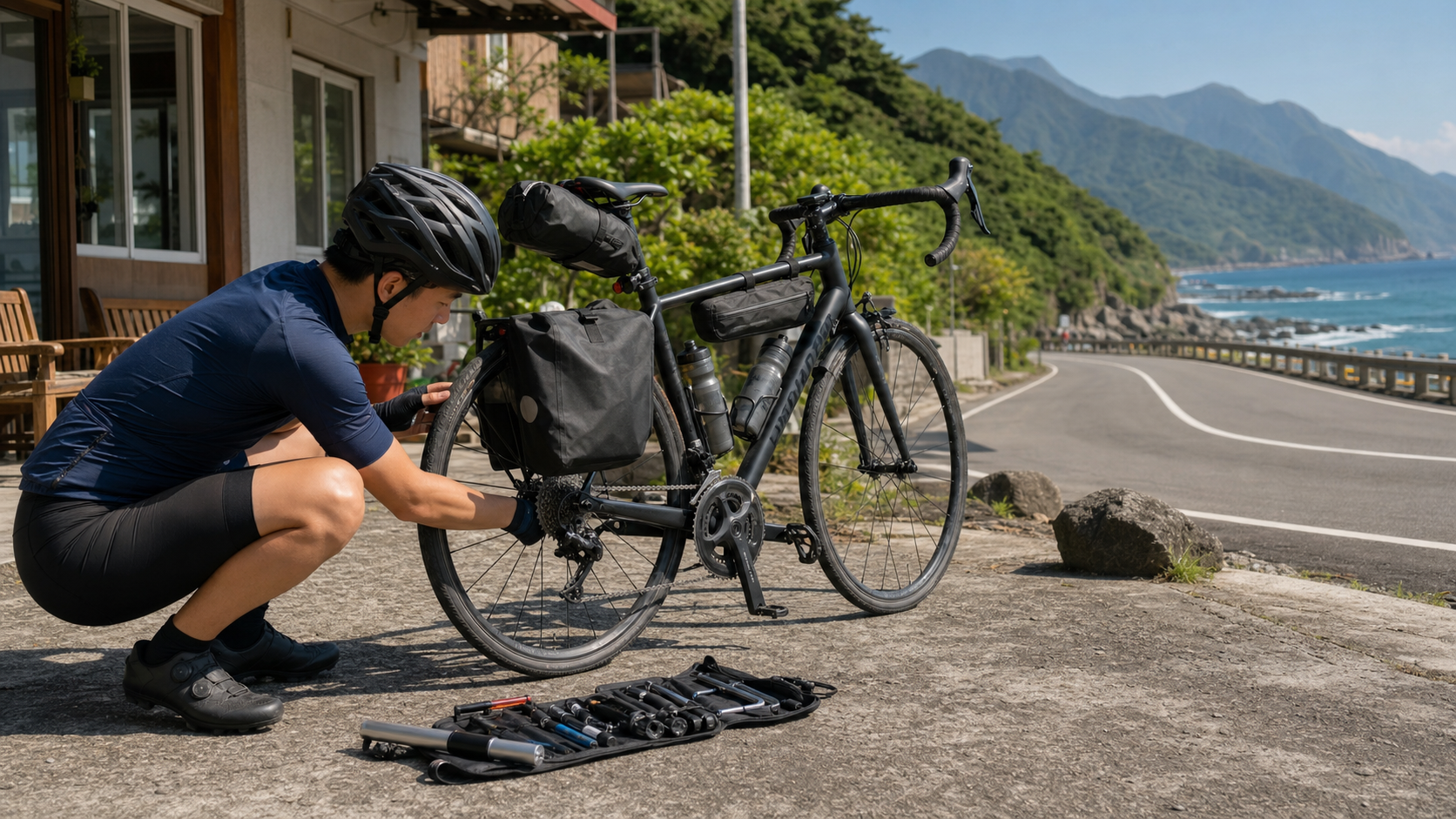
Essential On-Bike Repair Tools
You can’t carry an entire bike shop toolbox on a round-island trip, but the following items are must-haves to carry with you:
- Spare inner tubes ×2: Prioritize replacing tubes over patching; save patching for emergencies
- Patch kit: Patches, tire levers, sandpaper, and glue in one set
- CO2 inflator or mini pump: CO2 is fast and great for racing, but for long-distance touring, a mini pump is recommended
- Multi-tool hex wrench set (3/4/5/6mm): Almost all screws fall within this range
- Chain quick links ×2: A broken chain is the most common serious failure; these are essential
- Chain lube (small bottle): For daily lubrication; choose dry lube (doesn’t attract dirt)
- Duct tape: The all-purpose material; can temporarily repair torn bags, secure broken lights, etc.
Roadside Tire Change SOP
Changing a tire is the most frequently needed skill on a round-island trip; practice until you can do it within 5 minutes before departure:
- Remove the wheel (shift the rear wheel to the smallest cog first)
- Use a tire lever to pry one side of the tire off the rim
- Visually inspect and carefully feel the inside of the tire with your fingers to find the puncture object
- Remove the old inner tube and install the new one
- First press the tire bead back onto the rim by hand; use a tire lever for the final section (be careful not to pinch the new tube)
- Inflate to the recommended pressure and reinstall the wheel
Practical Advice
- Do a “full bike check-up” one week before the trip: take it to a shop for a complete derailleur adjustment and brake cable tension calibration
- Apply chain lube each evening after arriving at your accommodation so the oil can fully penetrate by the next morning
- If you encounter a serious failure far from any city (e.g., a broken rear derailleur), you can shorten the chain and convert it to a single-speed setup to continue riding to the nearest town
- Almost every city and county in Taiwan has a bike repair shop; a quick Google Maps search for “自行車” (bicycle) will help you find one fast
Conclusion
Mechanical maintenance isn’t just a mechanic’s job—it’s a fundamental skill for every serious round-island cyclist. A 10-minute morning inspection every day is taking responsibility for your own safety and showing respect for your riding companions. When you smoothly carve into a descent along the cliff edge of the Suhua Highway, that sense of trust comes from the care you put in every single morning.
Related Reading
- Mechanical Preparation for a Round-Island Trip: Pre-Departure Maintenance Checklist and On-Road Emergency Tools
- Pre-Ride Vehicle Safety Inspection Checklist: A 10-Minute Quick Check
- 20-Point Safety Inspection Checklist Before a Long-Distance Bike Tour
- Dealing with Unexpected Situations on a Round-Island Trip: Flat Tires, Mechanical Failures, and Weather
一日北高前的高裝檢 | 北高 360 | 挑戰11小時的裝備 | 一日雙塔 | 補給
6 年前
一日北高/長距離團騎 常見問題補充篇 / 組團或跟團的眉角 / 壯車友容易被瘦車友慢性拉爆 / 原來屁股痛可能是這個原因...? / 風場配速法 / 公路車 / CT Yeh
2 年前
金門 ! 我騎過最棒的離島了 / 最後可以騎車上金門大橋的機會!?/ 公路車 / CT Yeh
1 年前
一日北高常見問題大集合 | 攻略 | 路線 | 訓練 | 補給 | 自行車 單車 | 一日雙城 | 雙塔 | TWB北高360 | 屁股痛
6 年前
2026紫南宮環線99.9K挑戰Vlog 多視角第一集團 跟看看.. / CT Yeh 公路車
1 個月前
一日北高前的西濱集訓 | 跟著11小時軍團 | 300W踩不動的大逆風 | 輪車破風差幾瓦?
6 年前
用了AirTag 單車就不怕被偷?盲點大測試 結果… |公路車|CT Yeh
5 年前
單車 一日北高 ( 雙城 ) 肥宅雙人瘋狂行 紀錄片 REACTO
10 年前