Cold Water Immersion vs. Contrast Water Therapy: Comparing the Best Recovery Strategies for Cyclists
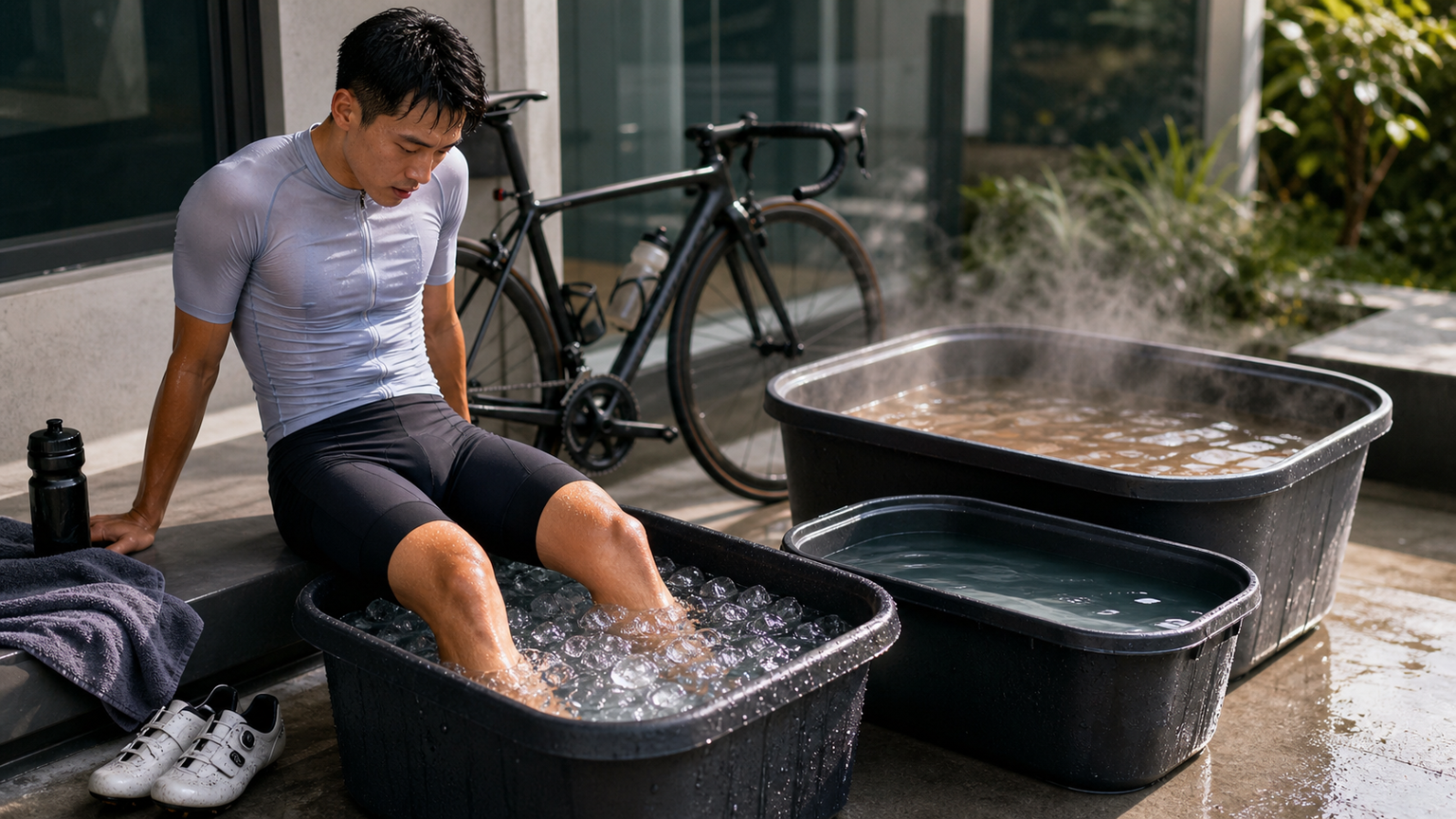
Cold Water Immersion vs Contrast Water Therapy: A Comparison of the Best Recovery Strategies for Cyclists
After every grueling long-distance ride or high-intensity training session, your legs are screaming. It’s an open secret that many professional teams use ice baths for recovery during the Tour de France, but in recent years, Contrast Water Therapy (CWT) has also gained increasing attention. Which method is actually more effective? This article will provide an in-depth comparison of the scientific evidence behind these two water-based recovery strategies.
Cold Water Immersion (CWI)
Principles and Mechanisms
Cold water immersion typically involves submerging the body (at least the lower limbs) in water at 10-15°C for 10-15 minutes. Its recovery mechanisms mainly include:
1. Vasoconstriction and Metabolic Slowing
Cold water causes peripheral vasoconstriction, reducing local blood flow. This lowers the tissue metabolic rate and the spread of the inflammatory response, similar to the principle of applying ice to an acute injury. The inflammatory response triggered by post-exercise muscle microtrauma is suppressed after cold water immersion.
2. Hydrostatic Pressure Effects
The hydrostatic pressure of water applies uniform pressure to the submerged limbs, similar to the effect of wearing compression garments. This helps to:
- Reduce muscle swelling (Edema)
- Promote venous return
- Lower intramuscular pressure
3. Nervous System Regulation
Cold stimulation activates the sympathetic nervous system, promoting the release of norepinephrine, which not only provides analgesic effects but also improves mood and alertness.
4. Reduced Pain Perception
Cold water slows nerve conduction velocity, directly reducing the perception of soreness. This is also a major reason why you “feel” more recovered after cold water immersion.
Research Evidence for CWI
A 2022 systematic review in Sports Medicine analyzed 52 studies:
- DOMS Relief: Small to moderate effect (SMD = -0.55), most pronounced 24-48 hours after training
- Strength Recovery: Beneficial in the short term, but regular long-term use may attenuate muscle adaptations (see discussion below)
- Perceived Recovery: Strong subjective improvement in how athletes feel (which has value in itself)
- Inflammatory Markers: CK (creatine kinase) and IL-6 (interleukin-6) were significantly lower in the CWI group
Optimal Protocol Parameters
| Parameter | Recommended Value | Notes |
|---|---|---|
| Water Temperature | 10-15°C | Below 10°C increases discomfort without added benefit |
| Immersion Duration | 10-15 minutes | No additional benefit beyond 15 minutes |
| Immersion Depth | At least waist-deep | The deeper the immersion, the greater the hydrostatic pressure effect |
| Timing | Within 30 minutes post-exercise | The longer the delay, the poorer the effect |
Contrast Water Therapy (CWT)
Principles and Mechanisms
Contrast water therapy alternates between cold water (10-15°C) and hot water (38-42°C), creating a “vascular pump” effect:
1. Vascular Pumping Effect
Hot water causes vasodilation, while cold water causes vasoconstriction. This alternating “dilation-constriction” cycle acts like a pump, theoretically able to:
- Accelerate blood circulation
- Promote the clearance of metabolic waste
- Increase nutrient delivery to damaged tissues
2. Lymphatic System Stimulation
The alternation between cold and hot may stimulate lymphatic system flow, accelerating the reabsorption of interstitial fluid and reducing post-exercise swelling.
3. Autonomic Nervous System Balance
The alternating stimulation trains the autonomic nervous system to switch between sympathetic (cold) and parasympathetic (hot) states, potentially improving overall neural recovery capacity.
Research Evidence for CWT
- DOMS Relief: Effects comparable to CWI, with some studies showing slightly superior results (SMD = -0.62)
- Strength Recovery: Superior to passive recovery, and unlike pure CWI, it does not appear to interfere with muscle adaptations
- Subjective Experience: Most athletes prefer CWT over pure CWI (because they don’t have to endure cold water the entire time)
- Practicality: Does not require large amounts of ice; can be performed with shower equipment
Optimal Protocol
Standard CWT Protocol (15-20 minutes total):
- Hot water immersion or shower for 2 minutes (38-42°C)
- Cold water immersion or shower for 1 minute (10-15°C)
- Repeat for 4-6 cycles
- Finish with cold water (to constrict blood vessels and reduce swelling)
Advanced Variations:
- Peak competition season: Increase the proportion of cold water (1:1 cold-to-hot ratio)
- Recovery days: Increase the proportion of hot water (2:1 hot-to-cold ratio) to promote relaxation
- Stage races: One CWT session daily + pure hot water immersion before bed
Head-to-Head: CWI vs CWT
Scientific Comparison
| Metric | CWI | CWT | Winner |
|---|---|---|---|
| DOMS Relief | Moderate effect | Moderate effect | Tie |
| Strength Recovery (short-term) | Effective | Effective | Tie |
| Long-term Muscle Adaptations | May interfere | Less impact | CWT |
| Inflammation Control | Stronger | Moderate | CWI |
| Subjective Comfort | Poorer | Better | CWT |
| Practicality | Requires ice/ice bath | Shower is sufficient | CWT |
| Psychological Boost | High (cold stimulation activates) | Moderate | CWI |
The Long-Term Concern: CWI May Blunt Training Adaptations
A landmark study published in the Journal of Physiology in 2015 found that subjects who used CWI after resistance training for 12 consecutive weeks showed significantly smaller gains in muscle mass and strength compared to the passive recovery group.
The reason: the post-exercise inflammatory response (particularly IL-6 and TNF-α) is not entirely harmful—it is a necessary signal for muscle adaptation and remodeling. CWI excessively suppresses these signals, effectively dampening the trigger for “supercompensation.”
Practical Recommendations:
- During the building/base phase (goal: accumulating adaptations): avoid frequent CWI use
- During the competition/stage race phase (goal: rapid recovery for the next event): actively use CWI or CWT
- During high-volume weeks (multiple high-intensity sessions in the same week): CWT is the safer choice
Context-Based Recovery Decisions
Scenario 1: Multi-Day Stage Race
Recommendation: CWI
The primary goal in a stage race is “being able to ride again tomorrow,” and sacrificing adaptations is worthwhile in this context. Perform a 12-minute cold water immersion (12-14°C) within 30 minutes after each stage.
Scenario 2: Two High-Intensity Sessions Per Week
Recommendation: CWT
Contrast water therapy provides recovery benefits without excessively suppressing training adaptations. Use CWT after the first high-intensity session, and decide after the second based on your level of fatigue.
Scenario 3: After Long-Distance Rides in the Base Phase
Recommendation: Passive recovery or warm water immersion
Long rides during the base phase do not cause severe muscle damage, and the body’s natural recovery mechanisms are sufficient. A warm bath combined with proper nutrition is enough.
Scenario 4: Injury Recovery Period
Recommendation: Consult a medical professional
Cold therapy is generally recommended for acute injuries (within 48 hours), but chronic injuries may be better suited to heat therapy. Always follow the advice of medical professionals.
DIY Cold Water Immersion Options
Not everyone has an ice barrel. Here are home alternatives:
- Bathtub method: Fill with cold water, add 5-10 kg of ice, and use a thermometer to confirm 10-15°C
- Shower method: Turn the water to the coldest setting (usually around 15-18°C) and direct it at the lower limbs for 5-10 minutes
- Ice pack method: Wrap large ice packs around the thighs and calves, 15 minutes per area
- Outdoor water: Streams or seawater in autumn and winter (mind safety and water temperature)
Conclusion
Cold water immersion and contrast water therapy are both scientifically supported recovery tools, but there is no “one-size-fits-all” answer. The key is understanding which phase of your training cycle you are in, the urgency of recovery, and your long-term adaptation goals. Use CWI boldly during race season, use it cautiously during the building phase, and rely on CWT as a safe and effective compromise in daily training. Most importantly—do not let recovery modalities replace adequate sleep and good nutrition, the two most fundamental pillars of recovery.
Related Reading
- Hot and Cold Therapy After Swimming: Comparing the Recovery Benefits of Ice Baths and Hot Baths
- Contrast Water Therapy: Applications of Cold and Hot Baths in Sports Recovery
- Cold Water Bath vs. Ice Bath: Key Differences in Temperature and Duration
- The Science of Contrast Baths: A Low-Cost Recovery Method You Can Do in a Taiwanese Bathroom
西進武嶺 免費訓練分析服務 Intervals | 練不夠還是練過頭?你哪一種類型選手?AI模型告訴你! | 備戰神器 | 公路車 訓練 | CT Yeh
4 年前
靠單車減肥35公斤 心得分享與整理
7 年前
2016/05/13 單車 冷水坑下滑
10 年前
CT 喇低賽) 武嶺牽車 才是王道 西進牽車四小時內秘訣 攝手位置 如何判斷 防抽筋小秘訣
7 年前
Insta360/DJI做不到的!如何製作「騎士頭頂瓦數特效」單車影片?CycleDash 完整教學 / 超強批次影片數據疊加軟體
10 天前
水金九不厭五分 10度寒流冷到不願停!feat. 卡卡 / 公路車 / CT Yeh
6 個月前
碟煞公路車 銑面器 !? 原來銑完差這麼多! 降低蹭碟機率! | TIME 公路車 保養小記錄 | CT Yeh
3 年前
#公路車 #Fitting 靠人工智慧APP 幫你調整單車
6 年前