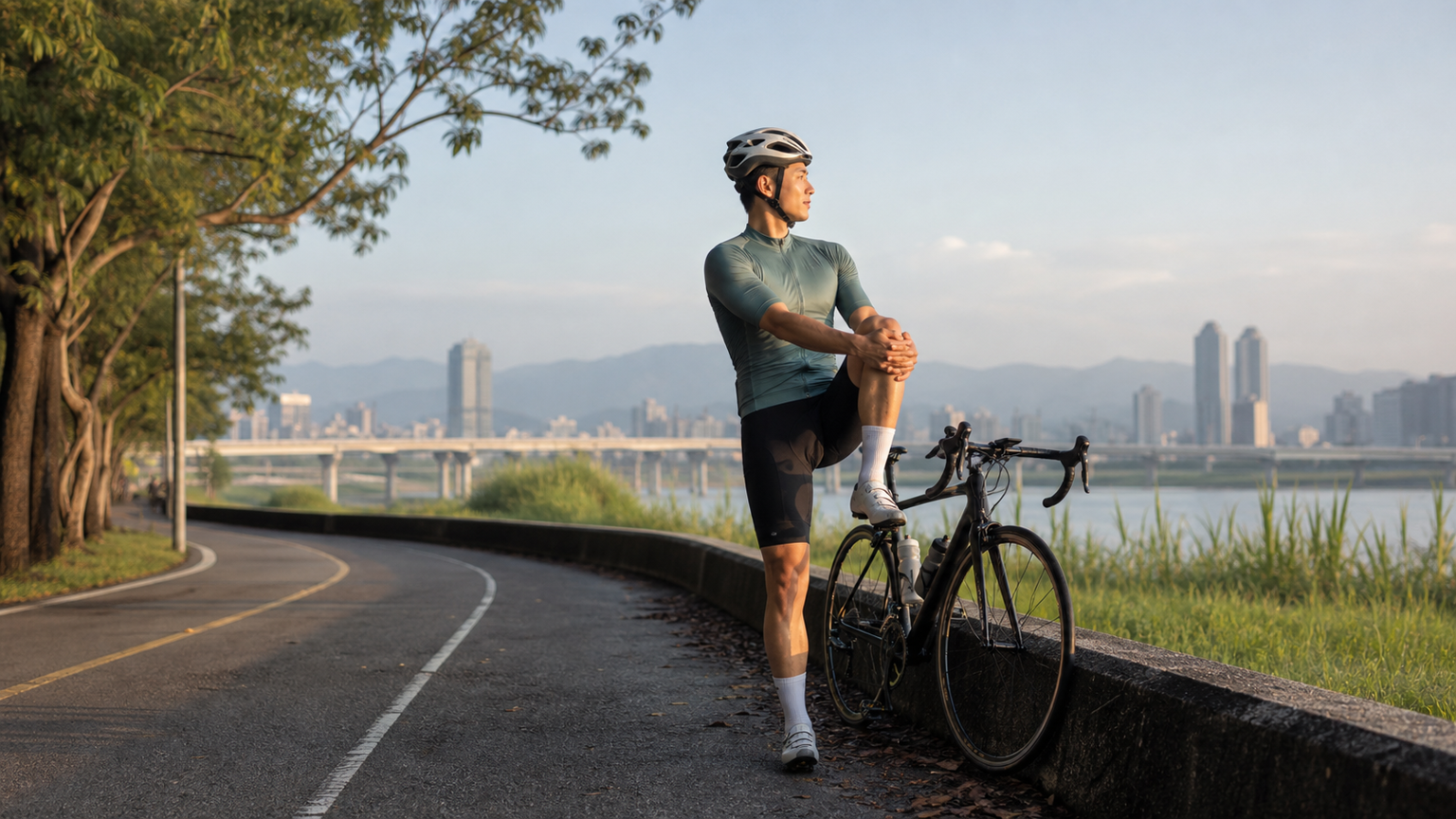
Active Recovery Training Guide: Accelerating Body Repair with Low-Intensity Exercise
“Should I rest completely on rest days, or do some light exercise?” This is a question many cyclists repeatedly wrestle with. Research tells us that appropriate active recovery not only doesn’t add fatigue, but can actually accelerate the body’s repair process. But the key lies in the word “appropriate”—get it wrong, and a recovery day turns into just another training day.
What is Active Recovery?
Active recovery refers to performing low-intensity, low-impact physical activity on rest days following high-intensity training or competition, to promote the recovery of physiological systems. Compared to passive recovery, active recovery uses light exercise to maintain blood circulation and promote the clearance of metabolic waste, while avoiding additional tissue damage.
Active Recovery vs. Passive Recovery
| Characteristic | Active Recovery | Passive Recovery |
|---|---|---|
| Blood circulation | Well maintained | Reduced |
| Lactate clearance rate | Faster | Slower |
| Joint mobility | Maintained | May temporarily decrease |
| Psychological state | Maintains a sense of “moving” | May cause anxiety |
| Calorie expenditure | Low | Extremely low |
| Nervous system recovery | Promotes parasympathetic activation | Natural recovery |
The Scientific Basis of Active Recovery
Blood Flow and Metabolic Waste Clearance
After high-intensity training, metabolic byproducts accumulate in the muscles, including hydrogen ions, inorganic phosphate, and various inflammatory mediators. Low-intensity exercise maintains cardiac output and muscle blood flow, accelerating the clearance of these substances.
A 2018 study in the International Journal of Sports Physiology and Performance compared recovery methods in cyclists after high-intensity intervals:
- Active recovery group (30 minutes of Zone 1 riding): blood lactate returned to baseline within 30 minutes
- Passive recovery group (sitting and resting): required more than 60 minutes to return to the same level
Activation of the Parasympathetic Nervous System
Low-intensity aerobic exercise helps shift the autonomic nervous system from post-training sympathetic dominance (“fight or flight” mode) toward parasympathetic dominance (“rest and repair” mode). This can be observed through changes in heart rate variability (HRV)—HRV typically rebounds faster after active recovery than after complete rest.
Fascial System Hydration
The muscle contractions and stretches produced by light exercise act like “squeezing a sponge,” promoting fluid exchange in the fascial matrix and maintaining fascial suppleness and glide. This explains why the body often feels “stiffer” after a full day of complete rest.
Psychological Benefits
For cyclists accustomed to training every day, complete rest days are often accompanied by anxiety and guilt. Active recovery provides a psychological “middle ground”—you’re still “doing something,” but at an intensity low enough not to interfere with recovery.
The Golden Rules of Active Recovery
Rule One: Intensity Must Be Low Enough
This is the most important—and most frequently violated—principle. Active recovery intensity should be:
- Heart rate: 50-60% of maximum heart rate (Zone 1)
- Power: 40-55% of FTP
- RPE: Perceived exertion of 2-3/10 (“easy enough to sing”)
- Breathing: Effortless nasal breathing throughout
Common mistake: Many riders’ “recovery rides” actually fall into Zone 2 or even Zone 3—that’s not recovery, that’s training. If you find your “recovery ride” average heart rate exceeding 65% of your maximum, you’re riding too hard.
Rule Two: Duration Should Be Moderate
- Optimal duration: 30-60 minutes
- Minimum effective dose: 20 minutes
- Upper limit: 90 minutes (beyond this duration, even at very low intensity, additional metabolic stress is created)
Rule Three: Prioritize Low-Impact Activities
Active recovery days should minimize impact on muscles and joints:
- Cycling (best choice—low impact, precise intensity control)
- Swimming (extremely low impact; water buoyancy reduces gravitational load)
- Yoga (gentle flow style, not hot yoga)
- Walking (30-45 minutes of brisk walking)
- Rowing machine (low resistance, slow rhythm)
Activities to avoid: Running (too much impact for cyclists, may increase DOMS), ball sports (intensity is hard to control), weight training (even light weights carry neurological load)
Active Recovery Workouts for Cyclists
Plan A: Recovery Ride (40-60 minutes)
The most classic form of active recovery, leveraging cycling’s low-impact characteristics.
Time allocation:
0-10 min: Very easy riding, cadence 85-95 rpm, low end of Zone 1
10-30 min: Steady Zone 1 riding, cadence 90-100 rpm
30-40 min: Add 4-5 x 10-second high-cadence spins (110+ rpm, but low resistance)
40-50 min: Return to steady Zone 1
50-60 min: Gradually ease off to very easy to finish

Key metrics:
- Average heart rate < 60% of maximum heart rate
- Average power < 50% of FTP
- Finish feeling "better than when you started"
Plan B: Yoga + Walking (50-70 minutes)
Suitable for recovery days when you want to stay completely off the bike.
Segment 1: Gentle yoga flow (30 minutes)
- Cat-cow pose x 10 reps
- Downward-facing dog, hold 30 seconds x 3
- Low lunge (hip flexor stretch) 45 seconds per side x 2
- Pigeon pose (piriformis stretch) 60 seconds per side
- Supine twist 45 seconds per side
- Corpse pose 5 minutes

Segment 2: Outdoor walk (20-40 minutes)
- Brisk walking, no deliberate acceleration
- Choose a flat route or park
- Can pair with a podcast or music to relax
Plan C: Swim Recovery (30-40 minutes)
An excellent cross-recovery option for cyclists.
Warm-up: Slow freestyle 200m
Main set: Alternate freestyle and breaststroke, 10-second rest every 50m
          Total distance 800-1200m
          Pace: "conversational" effort level
Cool-down: Back float or slow breaststroke 100m

Note: Don't chase speed or distance; the goal is to move muscles in a gravity-free environment
Plan D: Mobility Training (30-40 minutes)
Focuses on common mobility limitations in cyclists.
Dynamic warm-up (10 minutes):
- Hip circles 10 reps per side
- World's greatest stretch 5 reps per side
- Inchworm 5 reps
- Squat hold 30 seconds x 3

Mobility work (15 minutes):
- 90/90 hip internal/external rotation 8 reps per side x 2 sets
- Thoracic spine rotation stretch 8 reps per side x 2 sets
- Ankle mobility (knee-to-wall) 10 reps per side x 2 sets
- Scapular YTWL 8 reps per movement

Balance and proprioception (5 minutes):
- Single-leg stance 30 seconds per side
- Single-leg stance with eyes closed 15 seconds per side
- BOSU ball stance (if equipment is available)
Incorporating Active Recovery into Your Weekly Training Schedule
Sample Weekly Plan
Monday: Rest day → Active recovery (Plan B or D)
Tuesday: High-intensity intervals
Wednesday: Moderate-intensity endurance
Thursday: Active recovery (Plan A)
Friday: High-intensity + strength training
Saturday: Long-distance ride
Sunday: Medium-distance ride or group ride
How to Decide Between Active Recovery and Complete Rest?
Use the following checklist:
Choose active recovery if:
- Morning HRV is within the normal range
- The body feels stiff but not painful
- Sleep quality is acceptable (≥ 6/10)
- Mentally willing to be active
- Less than 24 hours since the last training session
Choose complete rest if:
- Morning HRV is significantly below baseline
- Localized pain or discomfort is present
- Sleep quality is poor (< 5/10)
- Mental fatigue or lack of motivation
- More than 3 consecutive days of high-load training
- Any signs of a cold or illness
Common Mistakes in Active Recovery
- Riding too hard: A recovery ride turns into a training ride—this is the most common problem. Wear a heart rate strap or power meter and monitor strictly.
- Doing it for too long: Once recovery activity exceeds 90 minutes, it is no longer “recovery.”
- Choosing high-impact sports: The intensity and impact of ball sports like basketball and soccer cannot be controlled.
- Neglecting nutrition: Recovery days still require adequate protein intake (1.2-1.6 g/kg) to support muscle repair.
- Doing “active recovery” every day: Sometimes the body simply needs complete rest—don’t be afraid to “do nothing.”
Conclusion
Active recovery is an indispensable part of a training plan. It is not an excuse to slack off, but a smart strategy. Master the art of intensity control—low enough to promote recovery, but not so low as to be completely sedentary—and your body will reward you with faster recovery and better training quality. Remember: the purpose of a recovery day is to make your next high-intensity session better, not to accumulate more training volume.
Related Reading
CT暗黑廚房) 車友必備 宇宙無敵鮮蚵湯 幫助訓練恢復 天然食補 好市多 超肥鮮蚵 破PR
7 年前
靠單車減肥35公斤 心得分享與整理
7 年前
滑雪新手們慘摔學習全紀錄(請開字幕),滑雪好好玩 | Snowboard + Ski | 岩原 スキー場 | 滑雪APP使用 | GoPro Max
6 年前
DJI Osmo Action 6 / 單車運動拍攝實用技巧 公路車 CT Yeh
7 個月前
多機位拍片神器 DJI Action 2 拍出速度張力感 | 類空拍機視角 4陣列麥克風超強降風噪 實測! | 公路車 | CT Yeh
3 年前
摔車後補裝備: 好市多新款單車安全帽& Specialized Romin 北高整路屁股都不痛的坐墊 | 一千元居然有MIPS | CT Yeh | 公路車
4 年前
一日北高/長距離團騎 常見問題補充篇 / 組團或跟團的眉角 / 壯車友容易被瘦車友慢性拉爆 / 原來屁股痛可能是這個原因...? / 風場配速法 / 公路車 / CT Yeh
2 年前
如何把 GoPro 影片 翻轉 批次 轉正?
6 年前