Treadmill vs. Outdoor Running: A Scientific Comparison and Optimal Training Strategy
文章導覽
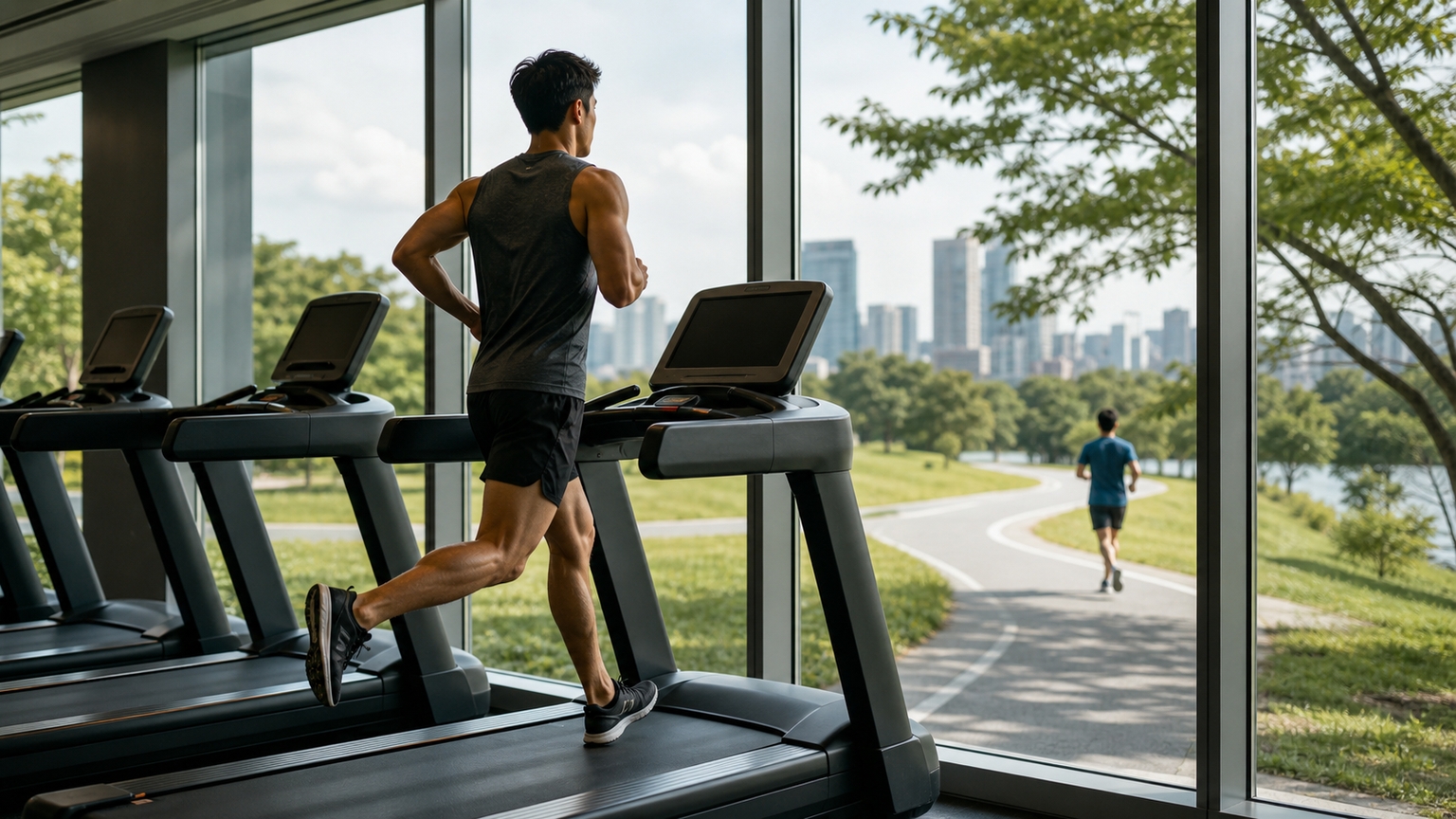
Treadmill vs. Outdoor Running: A Scientific Comparison and Optimal Training Strategy
“Is a 10K on the treadmill the same as a 10K outdoors?” This is probably one of the most common debates on running forums. Some runners insist the treadmill is a “hamster wheel,” while others see it as a lifesaver on rainy days or when air quality is poor. The scientific answer: the two are genuinely different, but each has its own unique training value. This article uses data and research to clarify this age-old debate.
Biomechanical Differences
The Fundamental Difference Between Treadmill and Ground Running
From a physics standpoint, treadmill and outdoor running differ in one essential way:
- Outdoor running: Your body moves forward through space, and your feet push off the ground to generate propulsion
- Treadmill running: Your body stays in place while the belt beneath your feet moves backward
This difference produces several concrete biomechanical effects:
1. Missing Wind Resistance
When running outdoors, you must overcome air resistance. According to the classic study by Jones & Doust (1996), at a pace of roughly 4:00/km, energy spent overcoming wind resistance accounts for about 2-4% of total energy expenditure. The faster you go, the greater the effect.
Solution: Setting the treadmill incline to 1% roughly compensates for the energy cost of the missing wind resistance. This recommendation from the 1996 study is still widely cited today.
2. Reduced Push-off Force
On a treadmill, the backward movement of the belt partially “substitutes” for your push-off. Research shows that during treadmill running:
- Gluteus maximus and hamstring activation is reduced by 5-15%
- Quadriceps and iliopsoas activation is similar or slightly higher
- Calf (triceps surae) activation patterns differ slightly
3. Minor Gait Adjustments
Multiple studies have found gait differences during treadmill running:
- Slightly shorter stride length (about 2-4%)
- Slightly higher cadence (about 1-3%)
- Slightly longer ground contact time
- Slightly lower vertical oscillation
These differences are statistically significant, but most runners can’t actually perceive them.
Comparing Physiological Responses
Heart Rate and Oxygen Uptake
| Metric | Treadmill | Outdoor | Notes |
|---|---|---|---|
| Oxygen uptake (same pace) | Slightly lower | Baseline | Converges once treadmill is set to 1% incline |
| Heart rate (same pace) | Similar or slightly higher | Baseline | Poor heat dissipation may elevate heart rate |
| Core temperature | Higher | Lower | Indoor running lacks convective cooling from wind |
| RPE (perceived exertion) | Higher at the same pace | Baseline | May relate to psychological and thermoregulatory factors |
The Effect of Temperature Regulation:
A hidden downside of treadmill running is heat dissipation. Outdoors, the convective cooling from wind is far more effective than the still air of an indoor space. Studies show that in a windless environment, core temperature rises 25-40% faster than in a environment with airflow.
Recommendation: Placing a fan beside the treadmill and directing it at your body can significantly improve heat dissipation and performance.
Energy Expenditure
At the same pace, the difference in energy expenditure between treadmill and outdoor running is roughly 0-5% (once the incline is set to 1%). For weight loss or general fitness purposes, this difference is negligible.
Advantages of the Treadmill
1. Precise Pace Control
The treadmill’s biggest training advantage is stable pace. This is especially valuable for the following workouts:
- Lactate Threshold Runs (Tempo Runs): These require holding a steady pace for an extended time; the treadmill eliminates interference from terrain, traffic lights, and wind direction
- Marathon Pace (MP) Runs: Practicing the feel of your goal pace, with the treadmill providing precise feedback
- Recovery Runs: Ensures you don’t run too fast on recovery days — many runners unconsciously speed up on easy outdoor runs
2. Incline Training
Runners who live in flat areas can simulate hill training on a treadmill:
- Long climb endurance: Set a 4-8% incline and run at marathon pace for 20-40 minutes
- Hill intervals: 12-15% incline × 2-minute hard effort + 2-minute flat recovery × 6-8 rounds
- Race simulation: Program the treadmill to mimic the elevation profile of your target race course
3. Environmental Control
The treadmill is the better choice in the following situations:
- Poor air quality (AQI > 150): Avoid inhaling harmful particulate matter
- Extreme heat (heat index > 35°C): Reduce the risk of heat injury
- Extreme cold or icy roads: Avoid hypothermia and slipping
- Late-night training: Safety considerations
- Typhoon season: A practical reality for runners in Taiwan
4. Post-Injury Rehabilitation
Treadmill belts typically offer better cushioning than asphalt roads, making them friendlier for runners recovering from stress fractures, knee pain, or plantar fasciitis.
Advantages of Outdoor Running
1. Authentic Biomechanical Stimulus
Outdoor running provides complete push-off training, terrain adaptation, and balance challenges. These are capabilities you need on race day, and they cannot be fully replicated on a treadmill.
2. Mental Toughness Training
The challenge of a running race isn’t purely physical — wind direction, changes in gradient, and the rhythm disruptions caused by other runners all require mental adaptation. Outdoor running naturally includes this “uncertainty,” training your mental resilience.
3. Proprioception and Terrain Adaptation
Running on different surfaces (asphalt, concrete, gravel, dirt) trains ankle proprioception and the stability of smaller stabilizing muscles. This helps prevent sprains and improves running economy.
4. Mental Health Benefits
Research consistently shows that outdoor exercise delivers greater mental health benefits than indoor exercise:
- Greater reduction in anxiety
- More noticeable boost in self-esteem
- Stronger post-exercise sense of well-being
- Higher long-term exercise adherence
Optimal Combination Strategy
Recommended Training Distribution
For most runners, the following distribution captures the strengths of both:
| Workout Type | Recommended Setting | Rationale |
|---|---|---|
| Long Slow Distance (LSD) | Mainly outdoors | Simulates race conditions, builds mental resilience |
| Lactate threshold runs | Treadmill preferred | Precise pace control |
| Interval training | Outdoors (track) preferred | Full push-off training |
| Marathon pace runs | Either | Treadmill is good for learning pace feel |
| Recovery runs | Treadmill preferred | Prevents overpacing, better cushioning |
| Hill training | Treadmill (for flat-area runners) | Precise control of grade and duration |
Treadmill Usage Tips
- Set a 1% incline as your default to compensate for missing wind resistance
- Use a fan aimed at your body to improve heat dissipation
- Don’t hold the handrails — this significantly alters your gait and energy expenditure
- Occasionally cover the speed display to practice pacing by feel
- Bring entertainment: music, podcasts, or videos can substantially lower perceived fatigue
Notes on Transitioning from Treadmill to Outdoor Running
If you’ve relied primarily on the treadmill for an extended period, keep the following in mind when transitioning to outdoor running:
- Reduce your mileage by 5-10% for the first 2-3 weeks
- Your glutes and hamstrings may fatigue faster than expected
- Ankle stabilizer muscles need time to adapt when running on varied surfaces
- Start increasing the proportion of outdoor mileage at least 4-6 weeks before race day
Conclusion
Treadmill and outdoor running aren’t opposing choices — they’re complementary training tools. Smart runners flexibly switch between the two based on weather, training goals, and life circumstances. The worst run is the one you never took — whether you choose the treadmill or the outdoors today, just get out there and run.
Related Reading
- Treadmill vs. Outdoor Running: Biomechanical Differences Between the Two Training Environments and Choice Strategies for Taiwanese Runners
- Treadmill vs. Outdoor: Mechanical Differences, Incline Compensation, and Proper Use
- Strength Differences Between Treadmill and Outdoor Running: The Real Impact of Incline Settings and Wind Resistance
- The Science of the Treadmill: A Guide to Speed Calibration and Transitioning Outdoors