Marathon Post-Race Recovery Timeline: A Complete Guide from Finish Line to the Next Training Cycle
Marathon Recovery Timeline: A Complete Guide from Finish Line to Next Training Cycle
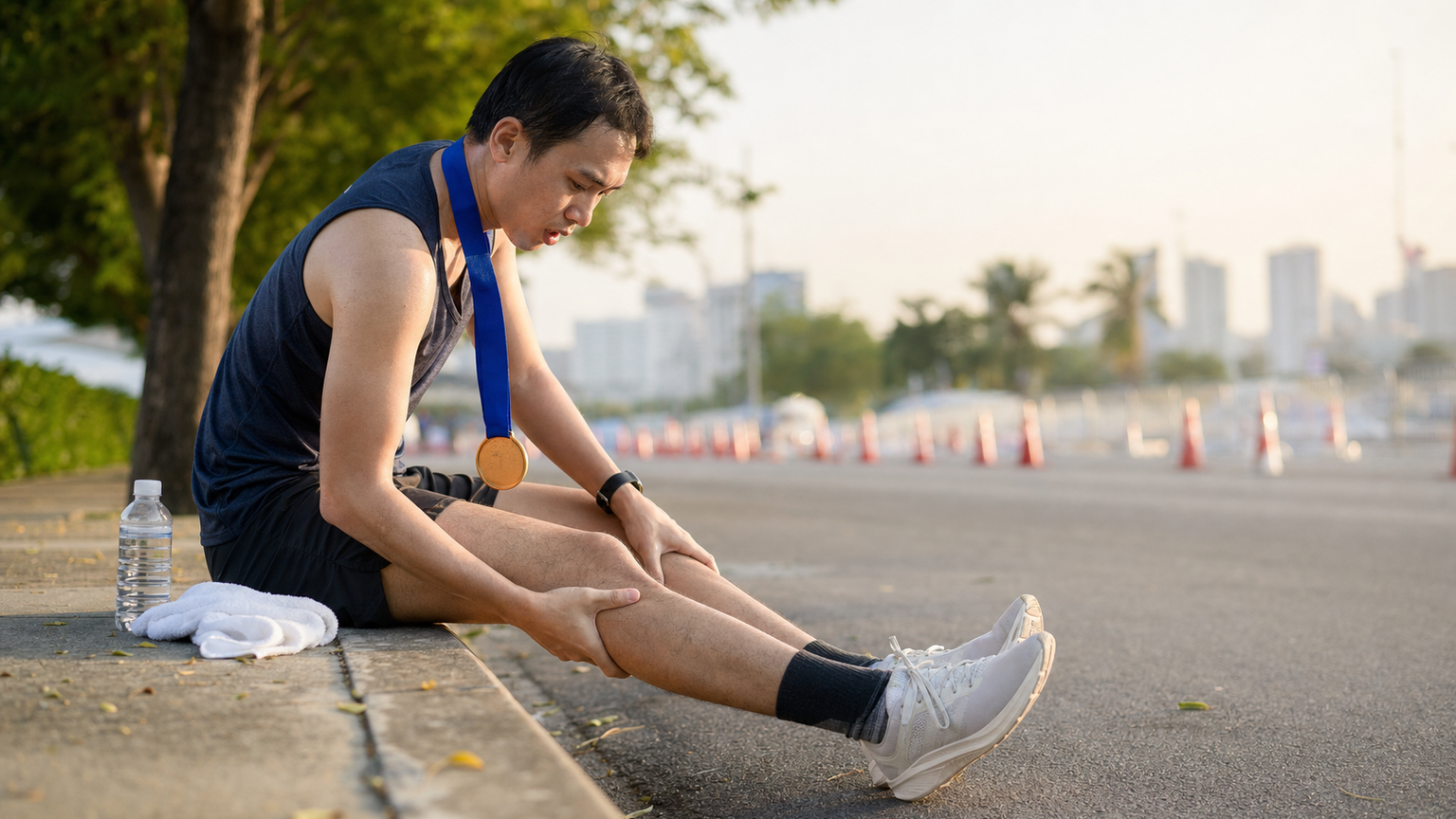
You’ve crossed the finish line, hung your medal, and taken a photo with a beaming smile. The marathon is over—but your body is far from recovered. Most runners underestimate the toll a full marathon takes on the body; resuming training too soon not only delays recovery but can also trigger injuries and overtraining. This article presents the impact of a marathon on various body systems using scientific data, along with a precise recovery schedule down to the day.
The Damage Checklist for a Marathon
Musculoskeletal System
Muscle Micro-tears
Muscle biopsy studies after a full marathon show widespread Z-line structural damage in runners’ quadriceps, gastrocnemius (calf), and gluteal muscles. This is why going downstairs feels like torture after a race.
Key data:
- Serum creatine kinase (CK) levels spike to 5-10 times normal within 24 hours post-race
- CK levels take 7-14 days to fully return to normal
- Full muscle strength recovery takes 14-21 days
Connective Tissue Damage
Tendons, ligaments, and fascia heal much slower than muscle (due to poorer blood supply). Even when muscle soreness disappears, connective tissues may still be in a fragile state.
- Achilles tendon and iliotibial band recovery takes 3-4 weeks
- Cartilage rebound after compression takes 2-3 weeks
Bone Stress
A full marathon involves approximately 35,000-45,000 steps, each bearing 2-3 times body weight in impact. The cumulative force is staggering:
- For a 70 kg runner, total bone impact during a full marathon is approximately 7,000-10,000 tons
- Repair of bone micro-damage post-race takes 2-4 weeks
- Risk of stress fractures is highest 2-6 weeks post-race (because training resumes while bones are not yet fully repaired)
Immune System
Open Window Theory
After high-intensity endurance exercise, immune function temporarily declines, known as the “open window.”
- Natural killer (NK) cell activity drops to its lowest point 2-6 hours post-race
- Salivary immunoglobulin A (sIgA) concentration decline can last 3-5 days
- Risk of upper respiratory tract infections increases 2-6 times within 1-2 weeks post-race
This is why many runners catch a cold within a week after a marathon.
Cardiovascular System
Temporary Cardiac Changes
Studies (including those using cardiac MRI) show:
- Elevated cardiac troponin I (cTnI) post-race suggests temporary cardiac cell stress
- Right ventricular function may temporarily decline 24-48 hours post-race
- These changes typically fully recover within 7-10 days
- For healthy runners, these are normal adaptive responses and do not indicate heart damage
Endocrine System
Cortisol Surge
- Cortisol levels rise 50-100% post-marathon
- Chronic high cortisol inhibits muscle repair, lowers immune function, and disrupts sleep
- Return to normal takes 3-7 days
Testosterone Decline (Males)
- Testosterone levels may drop 30-50% post-race
- Recovery to normal takes 1-3 weeks
- During this period, muscle protein synthesis capacity is reduced
Digestive System
- Gut permeability increases within 24 hours post-race (“leaky gut” phenomenon)
- Gut microbiome composition may temporarily change
- Digestive function recovery takes 3-7 days
Recovery Timeline: Daily Guide
Day 0 (Race Day)
Post-Race 0-2 Hours (Golden Recovery Window)
- Rehydrate immediately: Drink 1.5 liters of fluid for every kilogram of weight lost
- Consume carbs + protein (ratio 3-4:1): Recovery drinks, chocolate milk, rice balls with chicken
- Wear compression socks or compression pants
- Walk slowly for 10-15 minutes (do not sit or lie down immediately)
Post-Race 2-12 Hours
- Continue rehydrating and replenishing electrolytes
- Eat a balanced nutritious meal
- Cold water immersion (15-20 minutes, water temperature 10-15°C) — studies show moderate effect on reducing inflammation
- Get to bed early — sleep is the strongest recovery tool
Days 1-3 (Acute Recovery Phase)
Body Status: Peak DOMS, difficulty going downstairs, walking posture like a robot
Recovery Actions:
- Complete rest, no running
- Walk 20-30 minutes (maintain blood circulation)
- Light swimming or water walking (water buoyancy and pressure aid recovery)
- Nutritional focus: High protein (1.6-2.0g/kg/day), antioxidant-rich foods (berries, dark leafy vegetables), Omega-3 fatty acids
- Adequate sleep: 8-9 hours per night
- Compression gear can be worn continuously
Avoid:
- Do not massage or use foam rollers — muscles are too fragile; deep massage may worsen damage
- Do not use anti-inflammatory drugs (e.g., Ibuprofen) — studies show they may delay muscle repair
- Do not take hot baths — may worsen inflammation
Days 4-7 (Subacute Recovery Phase)
Body Status: DOMS significantly reduced, but muscle strength not yet recovered, immune function still low
Recovery Actions:
- Days 4-5 can begin light cross-training: swimming, cycling (low intensity), yoga
- Days 6-7 can attempt first recovery run: 20-30 minutes, pace 30-60 seconds/kilometer slower than normal easy run
- Purpose of this recovery run is not training but “testing” — stop immediately if any discomfort is felt while running
- Can begin light foam rolling and stretching
- Continue high-protein diet
- Supplement with Vitamin C and zinc (support immune recovery)
Avoid:
- Do not run more than 30 minutes
- Do not engage in any high-intensity exercise
- Avoid crowded places (low immune function)
Week 2 (Tissue Repair Phase)
Body Status: Feels “recovered” on the surface, but deep muscles and connective tissues still repairing
Training Restart:
- Run 3-4 times per week
- Each session 30-45 minutes
- All at easy run pace (below heart rate Zone 2)
- Weekly mileage at 40-50% of normal training volume
- Can include 2 low-intensity cross-training sessions
Key Principle: “Feeling like you can run faster” does not mean “should run faster.” Subjective body sensation often outpaces actual recovery progress at this stage.
Week 3 (Transition Phase)
Body Status: Most physiological indicators near normal, but muscle elasticity and explosiveness may not be fully recovered
Training Adjustments:
- Increase weekly mileage to 60-70% of normal volume
- Can include 1 low-intensity speed stimulus: e.g., 6 × 100-meter strides
- Long run distance limited to 50% of normal long run
- Continue primarily with easy runs
Week 4 (Recovery Training Phase)
Body Status: Physiological recovery essentially complete, can begin normal training transition
Training Plan:
- Increase weekly mileage to 80% of normal volume
- Can include 1 moderate-intensity session: e.g., 20-minute lactate threshold run
- Long run can return to 70% of normal distance
- If all goes smoothly, can participate in a 5K or 10K race by month-end
Weeks 5-6 (Normal Training Recovery)
- If no discomfort occurred during Week 4, can return to normal training volume and intensity
- Recommended to conduct a fitness test (Time Trial or Cooper Test) to assess current fitness level
- Begin planning next training cycle
Factors Affecting Recovery Speed
Positive Factors (Accelerating Recovery)
| Factor | Description |
|---|---|
| Adequate Sleep | Growth hormone is secreted during deep sleep, which is crucial for muscle repair |
| High-Protein Diet | Provides the amino acids needed for muscle rebuilding |
| Moderate Activity | Light walking and swimming promote blood circulation |
| Compression Gear | Reduces swelling and accelerates the elimination of metabolic waste |
| Mental Relaxation | Reduces cortisol levels |
| Running Age and Experience | Experienced runners have better physical adaptability |
Negative Factors (Delaying Recovery)
| Factor | Description |
|---|---|
| Resuming High-Intensity Training Too Early | The most common mistake, which may lead to injury |
| Insufficient Sleep | Directly reduces growth hormone secretion |
| High-Stress Lifestyle | Maintains high cortisol levels |
| Alcohol Consumption | Interferes with protein synthesis, causes dehydration, and reduces sleep quality |
| Age | Runners over 40 typically need 25-50% more recovery time |
| Race Intensity | Recovery time after a full-out PB is longer than after an easy finish |
Psychological Management During Recovery
Post-Marathon Blues
This is a rarely discussed but very common phenomenon. After months of preparation—with clear goals, structured plans, and daily tasks—everything suddenly ends.
Common Symptoms:
- Loss of motivation, no desire to run
- Low mood, feelings of emptiness
- Lack of interest in the next race
- Questioning one’s performance (even if goals were met)
Coping Strategies:
- Acknowledge this is normal—almost all marathon runners have experienced it
- Do not sign up for the next race immediately—give yourself a 2-3 week “gap period”
- Review training and racing: Write a post-race review (what went well, what can be improved)
- Try different sports: Swimming, cycling, hiking, allowing the mind and body to rest from running
- Social Connection: Share the race experience with running club friends, reliving the beauty of the race
When to Set the Next Goal
- After full recovery (weeks 4-6), start thinking about the next goal
- For the next full marathon, allow at least 12-16 weeks between races
- If the goal is a half marathon, the interval can be shortened to 8-10 weeks
- If the goal is 5K/10K, an interval of 6-8 weeks is sufficient
Summary of Empirical Rules
Daniels Recovery Formula: For every mile (1.6 km) of race distance, one day of recovery is needed. A full marathon = 26 days of complete recovery.
Pfitzinger Recovery Principle: No high-intensity training for the first 2 weeks after the race; start adding strides in week 3; start adding tempo runs in week 4.
My Practical Advice: If you are unsure whether you have recovered, you probably haven’t. It is better to rest an extra day than to risk injury. Losing a day of training will not affect your fitness, but an injury could cost you a month.
Conclusion
Marathon recovery is as important as training—sometimes even more so. Training results are realized through recovery, and injuries occur due to insufficient recovery. Give your body the time and resources it needs, and it will reward you with a stronger state. The finisher medal is hung, but the true winners are those who can run the next marathon healthily.
Related Reading
Live) 備戰2019彰化經典百K 賽前攻略 (已完賽請看新影片
7 年前
西進武嶺 免費訓練分析服務 Intervals | 練不夠還是練過頭?你哪一種類型選手?AI模型告訴你! | 備戰神器 | 公路車 訓練 | CT Yeh
4 年前
2019 夏季KOM 5小 完賽心得 準備攻略 東進武嶺 夏季登山王之路 Taiwan KOM Challenge
7 年前
一日北高/長距離團騎 常見問題補充篇 / 組團或跟團的眉角 / 壯車友容易被瘦車友慢性拉爆 / 原來屁股痛可能是這個原因...? / 風場配速法 / 公路車 / CT Yeh
2 年前
2018 田中馬拉松 全程健跑 VR 360 環景錄影 體驗現場狂野加油氣氛! Insta 360
7 年前
一日北高前的高裝檢 | 北高 360 | 挑戰11小時的裝備 | 一日雙塔 | 補給
6 年前
摔車後補裝備: 好市多新款單車安全帽& Specialized Romin 北高整路屁股都不痛的坐墊 | 一千元居然有MIPS | CT Yeh | 公路車
4 年前
一日北高 11小時 賽後心得分享篇 | TWB北高360 | 一日雙城 | 單車 | 公路車
6 年前