The Complete Guide to Bike Fitting Science: From Ergonomics to Competitive Performance
Bike Fitting is the most underestimated yet most impactful investment in cycling. A top-tier carbon road bike worth hundreds of thousands of dollars will fail to deliver its expected performance if the fitting is incorrect, and may even cause chronic injuries to the knees, lower back, and neck. Conversely, even an entry-level bike can see significant improvements in riding comfort and efficiency with proper fitting.
What is Bike Fitting?
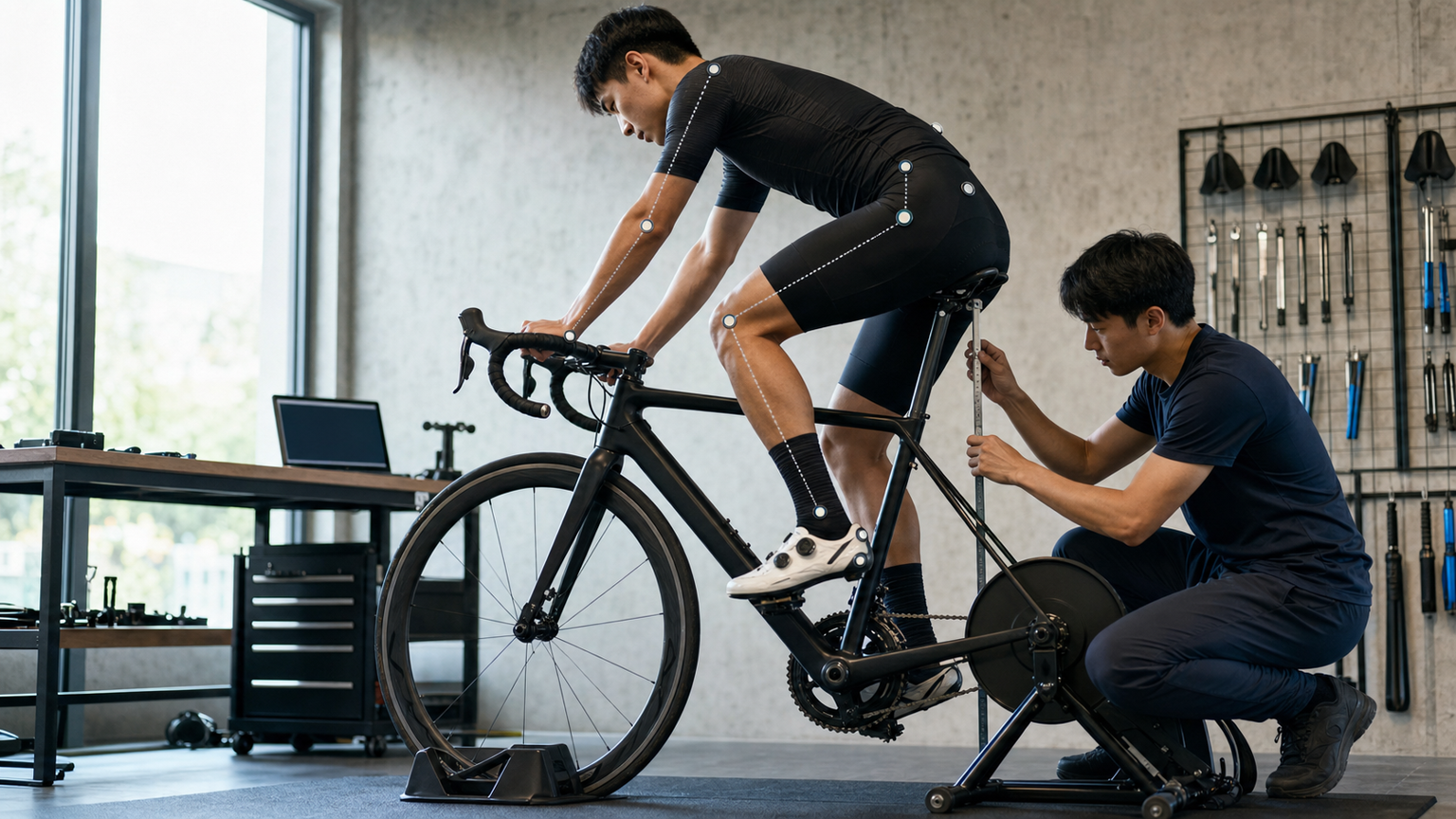
Bike Fitting is the process of adjusting each contact point of a bicycle based on an individual’s physical characteristics (height, leg length, torso length, flexibility, and riding goals). The core philosophy is to make the bike adapt to the rider, not the rider to the bike.
The Three Contact Points
There are three contact points between the bicycle and the rider, and each requires precise adjustment:
- Saddle: Bears 60-70% of body weight, affecting pelvic stability
- Handlebar: Affects upper body posture, wrist pressure, and aerodynamics
- Pedals: Affects knee tracking, pedaling efficiency, and ankle load
The Scientific Basis of Fitting
Biomechanical Principles
Cycling pedaling is a closed kinetic chain movement. For every crank revolution, your hip, knee, and ankle joints operate within specific angular ranges. The core task of fitting is to ensure these joints work within their optimal angular ranges.
Knee Joint Angle:
- At Bottom Dead Center (BDC), the knee joint angle should be between 140-150 degrees
- Angle too large (saddle too high): Causes excessive hamstring extension and pelvic rocking
- Angle too small (saddle too low): Excessive pressure on the knees, increased risk of patellar cartilage wear
Hip Joint Angle:
- At Top Dead Center (TDC), the hip joint angle should be between 65-75 degrees
- Angle too small: Groin compression, restricted breathing
- Angle too large: Gluteal muscles cannot generate power effectively
Ankle Joint Angle:
- Ideal ankle range of motion is approximately 20 degrees
- Excessive toe-down (Plantar Flexion): Overloads the calf muscles
- Excessive heel-drop (Dorsiflexion): Increased stress on the Achilles tendon
Aerodynamic Considerations
At speeds above 30 km/h, aerodynamic drag accounts for 70-90% of total resistance. Fitting must not only consider biomechanical efficiency but also balance aerodynamics.
- Lower frontal area: Lowering handlebar height reduces wind resistance
- Sustainable comfort: Overly aggressive positions cannot be maintained for long periods
- Individual balance point: Each person’s optimal aero position depends on core strength and flexibility
Key Fitting Parameters
Saddle Height
The most fundamental and important parameter. It is measured as the distance from the center of the bottom bracket to the top of the saddle.
Common Formulas:
- Hamley Formula: Saddle height = Inseam length × 0.883 (starting point reference only)
- Holmes Method: Targets a knee angle of 25-35 degrees (measured at BDC)
- Dynamic Assessment: Observe whether the pelvis rocks during pedaling and make incremental adjustments
Saddle Setback
Affects the relative position of the knee to the pedal. The traditional KOPS rule (Knee Over Pedal Spindle)—where the front of the knee should be directly above the pedal spindle at the 3 o’clock position—is a common starting point, but modern fitting places greater emphasis on dynamic assessment.
- Forward position: Beneficial for high-cadence pedaling, suitable for flat-road riders
- Rearward position: Beneficial for high-power output, suitable for climbers
- Note: Adjusting the fore-aft position also affects the effective saddle height
Handlebar Drop and Reach
Drop: The vertical distance from the top of the saddle to the top of the handlebar
- Recreational riding: 0-2 cm
- Sport riding: 2-5 cm
- Competitive riding: 5-10 cm
- Professional riders: 8-15 cm
Reach: The horizontal distance from the front of the saddle to the center of the handlebar, determining the degree of upper body extension. Reach is influenced by the frame’s Reach value, stem length, and handlebar Reach value combined.
Cleat Position
Often overlooked but extremely critical:
- Fore-aft position: The first metatarsal head (ball of the big toe) should be above or slightly behind the pedal spindle
- Lateral position: Affects Q-Factor and should match natural standing stance width
- Angle: Should match the natural outward rotation of the foot, typically 5-15 degrees of external rotation
- Float: The rotational range allowed by the cleat, recommended at 4.5-6 degrees
Comparison of Mainstream Fitting Systems
Retul Fitting
Technology: 3D motion sensors + Vantage pressure analysis pad
Features:
- LED sensors placed at key body positions, with 8 tracking points
- Real-time 3D motion analysis, accurate to 0.1 degrees
- Combined with saddle pressure distribution mapping to optimize saddle selection
- Globally standardized process, data comparable across shops
Best for: Riders seeking data precision, budget NT$5,000-8,000
GURU Fit System
Technology: Dynamic fitting bike + real-time adjustment
Features:
- Adjust while riding on the GURU dynamic fitting bike
- No need to own a bike beforehand
- Adjustment parameters are immediately reflected in riding feel
- Ideal for determining optimal frame size before purchasing a bike
Best for: Riders preparing to buy a new bike, budget NT$3,000-6,000
Traditional Manual Fitting
Technology: Goniometer + spirit level + experience
Features:
- Relies on the fitter’s experience and visual assessment
- Lower cost, but quality depends on the fitter’s expertise
- Suitable for basic adjustments and fine-tuning
Best for: Entry-level riders with limited budgets, budget NT$1,500-3,000
Common Fitting Issues and Solutions
| Symptom | Possible Cause | Adjustment Direction |
|---|---|---|
| Pain in front of knee | Saddle too low or too far forward | Raise saddle / Move saddle back |
| Pain behind knee | Saddle too high or too far back | Lower saddle / Move saddle forward |
| Pain on outside of knee | Incorrect cleat angle | Adjust cleat rotation angle |
| Neck pain | Handlebar too low or too far | Raise handlebar / Shorten stem |
| Numb hands | Excessive weight on hands | Raise handlebar / Move saddle forward |
| Perineal numbness | Ill-fitting saddle or incorrect angle | Replace saddle / Adjust saddle angle |
| Lower back pain | Insufficient core strength or excessive Reach | Shorten Reach / Strengthen core |
| Numb feet | Cleats too far forward or shoes too tight | Move cleats back / Adjust shoe laces |
The Best Timing for Fitting
- Before purchasing a bike: Determine the most suitable frame size
- When a new bike arrives: Precisely set all contact points
- When pain occurs: Identify the root cause and correct it
- When physical condition changes: Weight loss, improved flexibility, return from injury
- When switching bike types: Transitioning from a road bike to a time trial or Gravel bike
- Once a year: The body changes over time, so regular fine-tuning is recommended
Conclusion
Bike Fitting is not a one-time expense but an ongoing process of optimization. A good fitting is worth far more than upgrading to a carbon wheelset or titanium bolts. It is recommended that every serious rider undergo at least one professional fitting, then continue to feel and fine-tune during daily rides. Your body will thank you.
Related Reading
#公路車 #Fitting 靠人工智慧APP 幫你調整單車
6 年前
Fitting訓練兩用功率車 ! Thinkrider ST900 完整實測!/ 坡度升降 / 鄰居測試/ smart bike/公路車/ CT Yeh
2 年前
靠單車減肥35公斤 心得分享與整理
7 年前
單車AI教練!全新 ChatGPT4o 幫你分析訓練成果!排武嶺課表,分析騎車姿勢! 太神了! / 公路車 / CT Yeh / feat. 緯緯
2 年前
單車 一日北高 ( 雙城 ) 肥宅雙人瘋狂行 紀錄片 REACTO
10 年前
3D 列印車褲墊 / 舒適改善? / 無痕 x 分區壓縮 / ATK & Decider系列 / JE22黑科技 / #公路車 #CTYEH
11 個月前
高雄綠園道鐵路自行車道 / 外地人能輕鬆駕馭 還是整路崩潰? / 2025 全線開通 春節實地探索一次!(附GPS連結)/ 公路車 / CT Yeh
1 年前
2025 自行車錶排行榜 兩萬車友大數據 / Garmin Bryton 排名會大洗牌嗎? / 全新的碼表前身分析 /公路車 / CT Yeh
1 年前