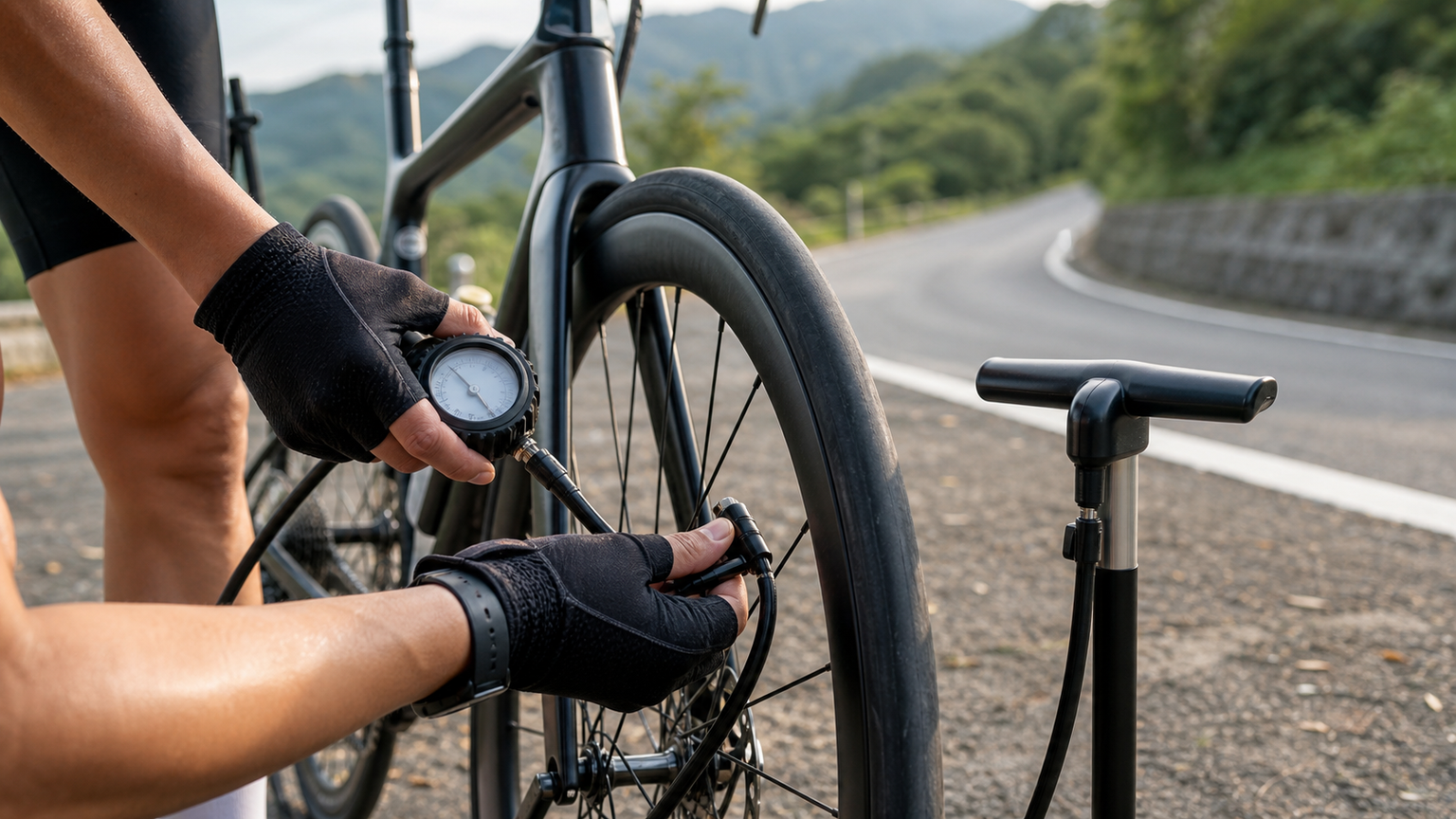
Tire Pressure Science: The Complete Guide to Finding Your Optimal Tire Pressure
Tire pressure is the easiest variable to adjust on a bike, yet it’s also the most overlooked. Many riders habitually pump their tires to the maximum, believing “harder equals faster.” However, recent scientific research has completely debunked this myth—moderately lowering tire pressure is not only more comfortable, but also faster.
Debunking the “Harder Equals Faster” Myth
Traditional Belief vs. Scientific Fact
Traditional belief: Higher tire pressure → Less tire deformation → Lower rolling resistance → Faster speed
Scientific fact: On real-world surfaces (not smooth drum rollers), excessively high tire pressure prevents the tire from absorbing road vibrations, wasting energy in the form of “Suspension Loss” through the rider’s body.
Research from French tire brand Mavic and FLO Cycling shows that on rough surfaces, lowering tire pressure by 10-20 psi can reduce total resistance (rolling resistance + suspension loss) by 2-5%.
The Two Facets of Resistance
-
Rolling Resistance: Energy loss from tire rubber deformation. In smooth drum tests, higher tire pressure does indeed result in lower rolling resistance.
-
Suspension Loss: Energy consumed as road vibrations transmit through the tire and frame into the rider’s body, where body tissues absorb the vibration. This is a major factor that has long been overlooked.
Key finding: Under real-world road conditions, the “sweet spot” of tire pressure is the optimal balance between rolling resistance and suspension loss—and this point is typically 10-30 psi lower than what most riders habitually use.
Factors Affecting Optimal Tire Pressure
1. Rider Weight (Including Gear)
Weight is the most important factor in determining tire pressure. Heavier riders need higher pressure to prevent pinch flats and excessive rim impacts.
2. Tire Width
Wider tires can provide adequate support at lower pressures, which is why 28-32mm tires are now common on modern road bikes.
3. Road Surface Quality
- Smooth asphalt: Can use higher tire pressure
- General roads: Medium tire pressure
- Rough surfaces / cobblestones: Requires significantly lower tire pressure
- Gravel: Low tire pressure provides traction and comfort
4. Tire Type
- Clincher: Standard choice, with a more limited pressure range
- Tubeless: Can safely run lower pressures, currently the trend
- Tubular: Pressure characteristics fall between the two
5. Front vs. Rear Wheel Differences
Since weight distribution during riding is approximately 40% front / 60% rear, the front tire should run 5-10% lower pressure than the rear. This improves front-wheel traction and handling.
Recommended Tire Pressure Reference Chart
25mm Clincher
| Rider Weight | Front (psi) | Rear (psi) |
|---|---|---|
| 55 kg | 72 | 78 |
| 60 kg | 75 | 82 |
| 65 kg | 78 | 85 |
| 70 kg | 82 | 90 |
| 75 kg | 85 | 93 |
| 80 kg | 88 | 97 |
| 85 kg | 92 | 100 |
| 90 kg | 95 | 105 |
28mm Clincher
| Rider Weight | Front (psi) | Rear (psi) |
|---|---|---|
| 55 kg | 62 | 68 |
| 60 kg | 65 | 72 |
| 65 kg | 68 | 75 |
| 70 kg | 72 | 78 |
| 75 kg | 75 | 82 |
| 80 kg | 78 | 85 |
| 85 kg | 82 | 90 |
| 90 kg | 85 | 93 |
28mm Tubeless
| Rider Weight | Front (psi) | Rear (psi) |
|---|---|---|
| 55 kg | 55 | 60 |
| 60 kg | 58 | 63 |
| 65 kg | 60 | 66 |
| 70 kg | 63 | 70 |
| 75 kg | 66 | 73 |
| 80 kg | 70 | 76 |
| 85 kg | 73 | 80 |
| 90 kg | 76 | 83 |
32mm Tubeless (Gravel / Endurance)
| Rider Weight | Front (psi) | Rear (psi) |
|---|---|---|
| 55 kg | 42 | 46 |
| 60 kg | 44 | 48 |
| 65 kg | 46 | 51 |
| 70 kg | 48 | 54 |
| 75 kg | 51 | 56 |
| 80 kg | 54 | 59 |
| 85 kg | 56 | 62 |
| 90 kg | 58 | 64 |
Practical Tips for Tire Pressure Adjustment
Use a High-Quality Pressure Gauge
The accuracy of built-in gauges on inexpensive pumps can vary by as much as ±10 psi. It’s recommended to invest in a standalone digital gauge (such as the Topeak SmartGauge D2), which offers accuracy of ±0.5 psi.
Temperature Compensation
- Tire pressure increases by approximately 2-3 psi for every 10°C rise in air temperature
- In winter, inflate 2-5 psi higher at room temperature; pressure will naturally drop once outdoors
- Prolonged high-speed riding also heats up the tires, causing pressure to rise slightly
Gradual Adjustments
Don’t change too much at once. Start from your current pressure and lower it by 5 psi at a time, feeling out the difference. Keep a log of ride feel and speed data at different pressures.
Make Use of Online Calculators
SRAM / Zipp Tire Pressure Calculator (sram.com/tirePressureGuide) is currently the most recommended free tool—simply input your weight, tire width, rim inner width, and road surface type to get recommended pressures.
Silca Professional Tire Pressure Calculator is also an excellent option, taking an even more comprehensive set of factors into account.
Tire Pressure Strategies for Special Situations
Riding in the Rain
Lower tire pressure by 5-10 psi. Lower pressure increases the tire’s contact patch, improving wet-surface traction. On slippery roads, grip matters more than rolling resistance.
Long-Distance Riding / Island Circumnavigation
Slightly lower tire pressure to increase comfort. Over long rides, improved comfort translates into reduced fatigue, which ultimately shows up as a better average speed.
Racing
Adjust according to course characteristics:
- Flat time trials: Slightly higher pressure is acceptable (roads are usually better)
- Climbing races: Standard pressure is fine
- Standard road races: Slightly lower pressure for better handling in the final sprint
- Classic cobbled races: Significantly lower pressure (refer to pro rider setups at Paris-Roubaix)
Frequently Asked Questions
Q: Can tubeless tires really run lower pressure?
Yes. Tubeless systems have no inner tube, so pinch flats cannot occur, allowing you to safely run 10-15 psi lower than clinchers. Combined with sealant that automatically repairs small punctures, tubeless has become the top choice for riders seeking optimal tire pressure.
Q: How do I know if my tire pressure is too low?
The following signs indicate pressure may be too low:
- The tire feels like it’s “squirming” when cornering
- A noticeable “dragging sensation” when accelerating
- A feeling of the rim hitting the road surface
- Excessive wear marks on the tire sidewall
Q: Do carbon rims require special attention to tire pressure?
Yes. Carbon rims typically have a recommended maximum pressure limit (many brands cap it below 100 psi), and exceeding it can damage the rim. Additionally, carbon rims can cause tire pressure to rise sharply under high temperatures (such as during long descents with braking), so always follow the manufacturer’s recommendations.
Conclusion
Optimizing tire pressure is free speed. Spending 10 minutes adjusting your tire pressure may be more effective than spending NT$30,000 on component upgrades. Remember: the optimal pressure varies from person to person—there is no one-size-fits-all number. Use a calculator as your starting point, fine-tune through actual riding, and find your own sweet spot.
Related Reading
- The Science of Bicycle Tire Pressure: It’s Not About Harder Equals Faster—Find Your Optimal Pressure
- Bicycle Pumps and CO2 Inflators: The Complete Guide to Tire Pressure Management
- The Science of Road Bike Tire Selection: How Tread, Pressure, and Material Affect Rolling Resistance and Grip
- MTB Tire Pressure and Traction: A Complete Selection Guide from Pressure to Tread Pattern
單車胎壓觀察到的有趣現象,SRAM Quarq TyreWiz 2.0 無內胎胎壓計 / 裝了有哪些幫助? / Tubeless / 公路車 / CT Yeh
1 年前
#公路車 #Fitting 靠人工智慧APP 幫你調整單車
6 年前
再一組! 全碳幅條 碟煞/無內胎輪組 開箱! 到底好騎嗎? UNAAS X40 | 公路車 | CT Yeh
4 年前
鉅齒紋輪組!? ControlTech MEG-T50 EVO 碳纖維幅條輪組/ 功率對比實驗 / 公路車 / CT Yeh
2 年前
Nepest NOVA 碳條輪組:輕量、空力、舒適一次滿足!/ 公路車 / CT Yeh
7 個月前
碟煞公路車 銑面器 !? 原來銑完差這麼多! 降低蹭碟機率! | TIME 公路車 保養小記錄 | CT Yeh
3 年前
2025 自行車錶排行榜 兩萬車友大數據 / Garmin Bryton 排名會大洗牌嗎? / 全新的碼表前身分析 /公路車 / CT Yeh
1 年前
2026 車錶排行榜!誰是最多車友正在使用?練家子最愛哪款?🏆 (2萬名車友數據) / 公路車 / CT Yeh
5 個月前