The Complete Guide to Buying Mixed-Terrain Tires: Best Choices from Gravel Roads to Forest Trails
文章導覽
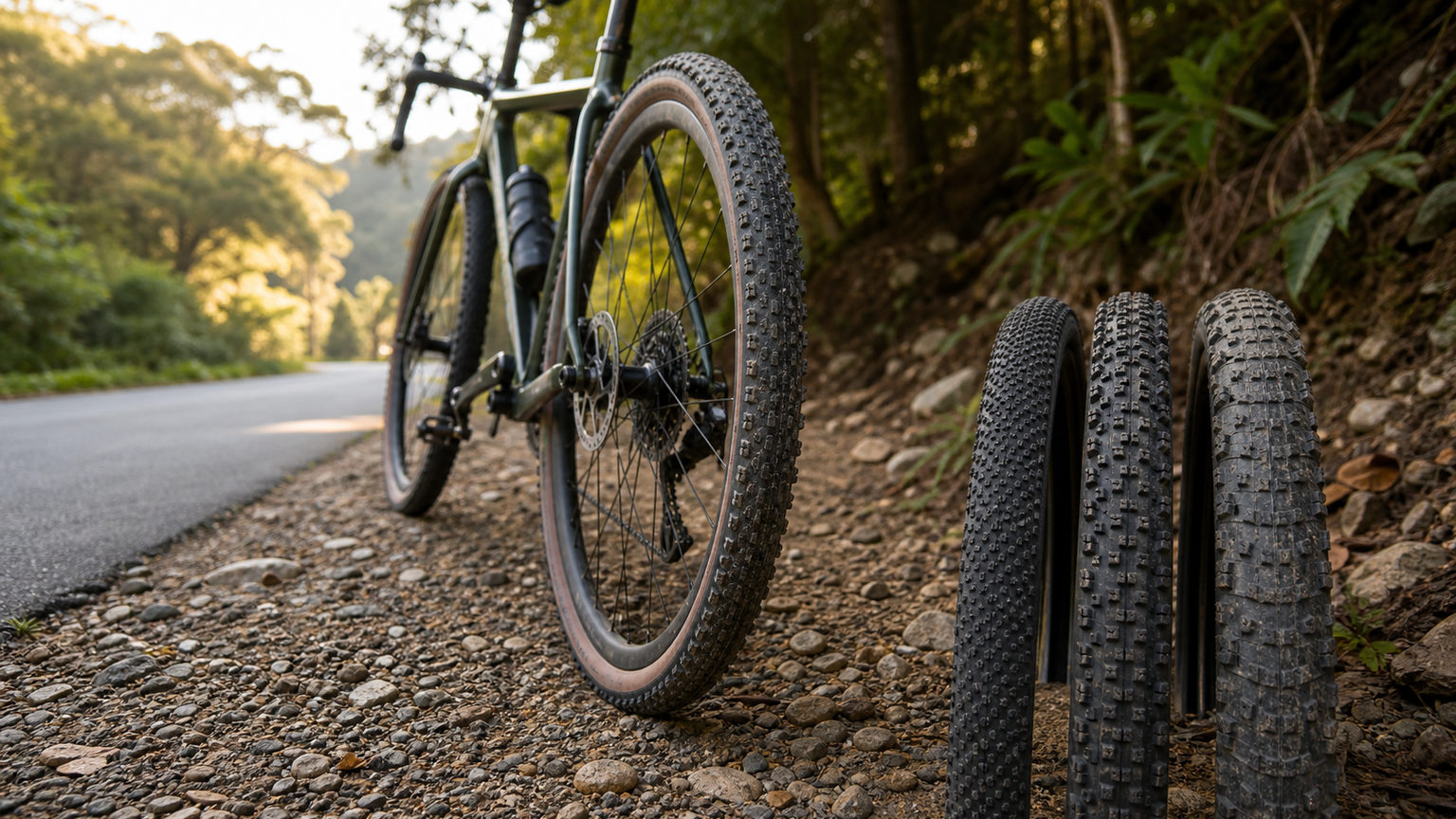
Mixed-Terrain Tire Buying Guide: The Best Choices from Gravel Roads to Trails
In the world of gravel riding, no component affects the riding experience more than tires. The same bike fitted with different tires can transform from a leisurely gravel cruiser into a trail beast. This article will analyze tires from every angle to help you find the best partner for different mixed terrains.
Tire Width: Is Wider Always Better?
35-38mm: Light and Fast Gravel Tires
This width range is the entry-level choice for gravel tires, suitable for routes that are primarily paved with occasional gravel sections.
Advantages:
- Low rolling resistance, minimal speed loss on asphalt
- Lighter weight, better acceleration
- Suitable for most road bikes upgraded for gravel use
Best for: Riverside bike paths, well-compacted gravel roads, light farm roads
40-45mm: All-Rounder Gravel Tires
This is currently the mainstream width in the gravel tire market and the standard specification for most gravel bikes straight from the factory.
Advantages:
- Good performance on both paved and unpaved surfaces
- Generous air volume allows lower tire pressure for increased comfort
- Wide selection available, with most major brands’ flagship products concentrated in this range
Best for: Mixed routes, moderate gravel roads, dry trails, bikepacking trips
47-50mm: Off-Road Gravel Tires
A width approaching the mountain bike realm, suitable for hardcore gravel riding primarily on unpaved surfaces.
Advantages:
- Excellent cushioning and traction
- Can handle more demanding road conditions
- Reduced risk of flats
Best for: Technical trails, loose gravel roads, muddy surfaces, rocky sections
Tread Design: Reading the Language of Tires
Slicks and File Treads
Nearly no tread in the center, or only fine file-like patterns. These tires are designed to maximize contact area on hard surfaces and reduce rolling resistance.
Representative products include the Panaracer GravelKing Slick and Specialized Pathfinder Pro. They perform excellently on dry, compacted gravel roads, but traction noticeably falls short on loose surfaces or in wet conditions.
Best for: Dry, hard surfaces; speed-prioritized gravel riding
Semi-Knobby
Lower center tread for rolling efficiency, with taller knobs on the shoulders for cornering grip. This is the most popular gravel tread design, striking a good balance between speed and traction.
The WTB Riddler, Maxxis Receptor, and Continental Terra Speed all fall into this category. The low center tread doesn’t create much resistance on asphalt, while the taller shoulder knobs bite into the ground when cornering on gravel.
Best for: Mixed routes; exploratory rides on uncertain terrain
Full Knobby
Prominent knobs across the entire tread surface provide all-around traction. The Maxxis Ravager, WTB Raddler, and Schwalbe G-One Bite are representatives of this category.
These tires show noticeably increased rolling resistance and noise on asphalt, but their performance on loose gravel, mud, and technical sections is unmatched. If your routes are primarily unpaved, this is the safest choice.
Best for: Routes primarily on unpaved surfaces; wet conditions; technical terrain
Mud-Specific Treads
Widely spaced, tall knobs designed specifically for muddy conditions. The large gaps between knobs allow mud to shed automatically, preventing the tire from being packed with mud and losing traction.
Taiwan’s winter and rainy seasons frequently bring muddy sections, so keeping a set of mud tires is essential equipment for serious gravel riders.
Best for: Rainy days, muddy trails, winter riding
Casing Construction: TPI and Puncture Protection
TPI (Threads Per Inch)
TPI is a measure of casing density. High TPI (e.g., 120 TPI) means finer weaving, resulting in a softer tire with better ground compliance and lower rolling resistance, but weaker puncture resistance. Low TPI (e.g., 60 TPI) is tougher and more puncture-resistant, but relatively stiffer and heavier.
- Racing choice: 120 TPI, for maximum performance
- Daily training: 60-90 TPI, a balance of durability and performance
- Bikepacking long-distance: 60 TPI, for maximum durability
Puncture Protection Layers
Most gravel tires incorporate a puncture protection layer in the casing. Common technologies include:
- Schwalbe Smart Guard: A thick puncture protection belt
- Continental ShieldWall: Integrated sidewall and tread protection
- Maxxis SilkShield: Lightweight puncture protection layer
- WTB SG2: Dual-layer puncture protection design
Tubeless Systems: Standard Equipment for Gravel
If you take gravel riding seriously, a tubeless system is almost an essential upgrade. The advantages of tubeless systems are particularly significant on mixed terrain:
Advantages
- Lower tire pressure: Without tubes, there’s no fear of snakebites, so you can safely run lower pressure. A 40mm tire in a tubeless setup can run at 28-35 psi, greatly improving comfort and traction
- Self-sealing: The sealant inside the tire automatically seals small punctures, letting you ride on gravel roads without stopping to repair
- Weight reduction: Eliminates the weight of inner tubes (typically 80-120g per tire), and since it’s rotating weight, the benefit is even more pronounced
- Lower rolling resistance: Without friction between the tube and tire, rolling resistance can drop by 2-4 watts
Tubeless Setup Recommendations
- Sealant amount: 60-90ml per tire (depending on tire size)
- Sealant replacement: Top up or replace every 2-3 months
- Recommended pressure (using a 40mm tire and 70kg rider as an example):
- Front wheel: 30-33 psi
- Rear wheel: 33-36 psi
- Can drop another 3-5 psi on gravel sections
Tire Recommendations for Taiwan’s Terrain
Taiwan’s gravel routes have their own unique characteristics. Here are recommendations for common scenarios:
Northern Taiwan (Yangmingshan, North Coast Farm Roads)
Surfaces are typically compacted gravel mixed with some asphalt, with occasional steeper climbs. A 40-42mm semi-knobby tire is recommended, balancing efficiency and grip for both climbing and descending. With heavy winter rain, it’s advisable to keep a spare set of deeper-tread tires on hand.
Central Taiwan (Forest Roads, Farm Roads)
Central mountain forest roads vary widely, from compacted gravel to loose dirt. A 42-45mm full-knobby tire is recommended to provide sufficient confidence on technical sections.
Eastern Taiwan (Rift Valley, Coastal Farm Roads)
Eastern routes are mostly long-distance mixed surfaces, with gravel sections typically in better condition but covering long distances. A 40mm semi-knobby tire is recommended to maintain efficiency over long-distance cruising.
Southern Taiwan (Hengchun Peninsula, Qishan Area)
The southern climate is dry, and gravel surfaces are mostly hard-packed. A 35-40mm file tread or semi-knobby tire will suffice, and speed-focused riders can even opt for slicks.
Advanced Technique: Mixing Front and Rear
Many experienced Gravel riders use different tire combinations for the front and rear:
- Front wheel: Choose full-knob tires with better grip to ensure controllability during cornering
- Rear wheel: Choose mixed-tread tires with lower rolling resistance to improve pedaling efficiency
This combination is particularly effective on mixed routes. The front wheel is responsible for handling safety, while the rear wheel is responsible for power transfer—the two have inherently different needs.
Conclusion
There is no one-size-fits-all answer when choosing Gravel tires. The best tire is always the one that best suits your riding routes. We recommend starting with 40-42mm mixed-tread tires, as this is the safest and most versatile starting point. As you accumulate riding experience, you will naturally develop your own tire preferences.
One final reminder: don’t skimp on your tire investment. Tires are the only connection between you and the ground. Good tires bring not just performance gains, but also a sense of security and riding confidence. On gravel roads, confidence often matters more than speed.
Related Reading
- Best Gravel Wheelsets of 2026: The Perfect Companion for Gravel Roads
- Gravel Wheelset Buying Guide: Rim Width, Spoke Count, and Tire Compatibility
- Gravel Bike Beginner’s Guide: The Perfect Balance Between Road Bikes and Mountain Bikes
- The Complete 2026 Gravel Bike Guide: Why Gravel Bikes Are Taking the World by Storm