Gravel Bikepacking Gear List: Lightweight Packing Techniques and Essential Gear Picks
文章導覽
Gravel Bikepacking Gear List: Lightweight Packing Techniques and Essential Gear Picks
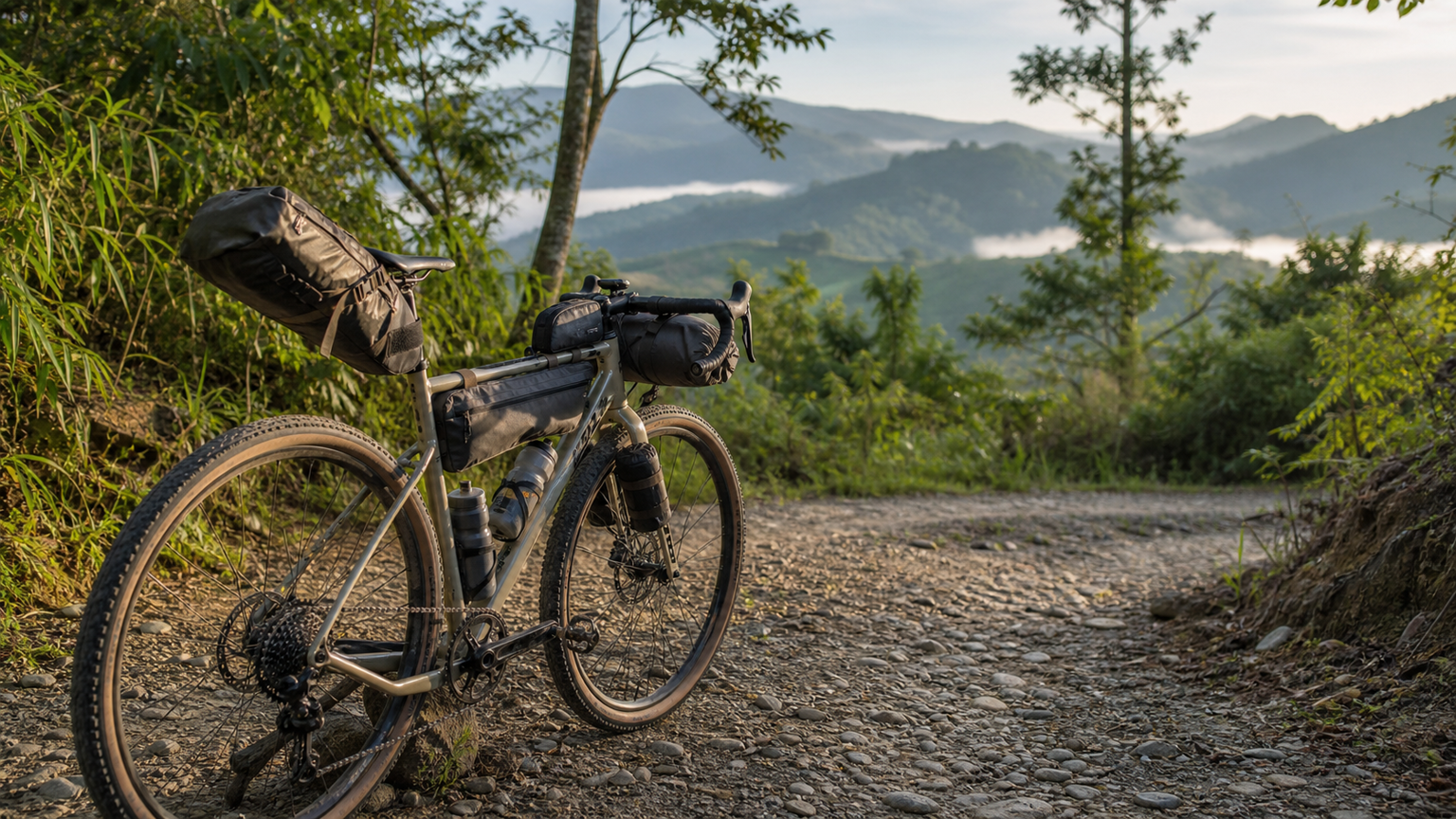
The first time you see a fully loaded gravel bike disappear at the end of a forest trail, the urge to “do that too” is hard to shake. Bikepacking — multi-day adventure travel carried entirely on your bike — is one of the most captivating extensions of gravel riding. This article shares a complete gear list and packing philosophy.
The Bag System: Your Mobile Warehouse
Seat Pack
The seat pack is the core storage space of bikepacking, typically ranging from 8 to 16 liters.
Recommended picks:
- Apidura Expedition Saddle Pack 14L: A classic, excellent waterproofing, high stability
- Ortlieb Seat-Pack 11L: German quality, fully waterproof, IP64 rated
- Topeak BackLoader 10L: Great value, good for beginners
Packing tips: The seat pack is best for light but bulky items like sleeping bags and spare clothing. Put heavier items at the bottom (near the seatpost) and lighter items toward the tail, which reduces sway from the raised center of gravity.
Important reminder: Don’t overpack the seat pack too full or too heavy, or it will seriously affect handling stability on rough gravel. Keep it under 3 kg.
Frame Pack
Mounted in the frame’s main triangle, this is the best place for heavy items because it sits closest to the bike’s center of gravity.
Recommended picks:
- Apidura Expedition Frame Pack: Available in multiple sizes to fit different frames
- Revelate Designs Tangle: Triangular design that maximizes use of frame space
- Rockbros Frame Pack: An extremely good-value entry option
Packing tips: Put heavy items (tools, water, food) in the frame pack. Weight in this position has the least impact on handling. If you’re using a full-size frame pack, remember to leave room for at least one bottle cage.
Handlebar Pack
A cylindrical bag mounted on the handlebar, typically 7 to 15 liters.
Recommended picks:
- Apidura Expedition Handlebar Pack 14L: Comes with a waterproof inner bag, easy to mount and remove
- Ortlieb Handlebar-Pack 9L: Compact design that doesn’t interfere with handling
- Restrap Bar Bag: British handmade, extremely durable
Packing tips: The handlebar pack is well suited for cylindrical items like tents and sleeping pads. Be careful not to overload it — an overly heavy handlebar pack will seriously affect steering responsiveness. Keep it under 2.5 kg.
Top Tube Pack
A small bag mounted on top of the top tube, used for items you need to access frequently while riding.
Good for: phone, energy gels, snacks, sunscreen, small camera
Fork Pack / Cargo Cage
Using the mounting bosses on the fork, a cargo cage can hold a water bottle or a small dry bag.
Recommended: Salsa Anything Cage, Blackburn Outpost Cargo Cage
Camping Gear: The Art of Going Light
Tent / Tarp
Lightweight options (1-person tent, 1–1.5 kg):
- Naturehike Cloud Up 1: About 1.3 kg, excellent value
- Big Agnes Copper Spur HV UL1: About 0.9 kg, a top lightweight pick
- Sea to Summit Alto TR1: About 1.1 kg, excellent ventilation
If weather allows, a tarp is an even lighter option, with weight as low as 300–500g.
Sleeping Bag / Quilt
Taiwan’s bikepacking season is mainly spring and autumn, when nighttime temperatures in lowland and low-elevation mountain areas are typically between 15–25°C.
- Spring/autumn (15–25°C): A thin synthetic sleeping bag or travel quilt, 400–600g
- Winter, low elevation (8–15°C): A down sleeping bag with a comfort rating of 5–10°C, 500–700g
- High elevation (below 5°C): Not recommended for bikepacking beginners, as gear weight increases substantially
Sleeping Pad
- Inflatable pad: Thermarest NeoAir XLite (about 350g), comfortable but with puncture risk
- Foam pad: Thermarest Z Lite Sol (about 410g), puncture-proof but bulkier
- Folding foam: Can be strapped to the outside of the seat pack
Clothing System: The Philosophy of Multi-Use Layers
The clothing principle for bikepacking is “layers” — a layered system where each piece serves multiple purposes.
Basic Clothing List
- Riding kit: The one you wear, worn daily while riding
- Wind jacket: A lightweight windproof shell (about 100g), essential for descents and early mornings
- Thin warm layer: Merino wool long sleeve or a thin fleece (about 200g)
- Rain jacket: A lightweight waterproof shell (about 150–200g), a must for Taiwan’s mountains
- Camp clothes: A clean, lightweight set to change into at camp while your riding kit dries out
- Socks: 2 pairs — one for riding, one for camp
- Buff: A multi-functional headwear piece that doubles as a neck gaiter, headband, or face covering
Clothing Packing Tips
- Use compression sacks to reduce clothing to the smallest possible volume
- Put camp clothes at the very bottom of the waterproof bag (you’ll need them last)
- Keep the rain jacket in the most accessible spot (top tube pack or top of the handlebar pack)
Cooking System: Simplicity Is Beauty
Minimalist Approach (Good for 1–2 Days)
Skip the stove entirely and rely on convenience stores and roadside food. Taiwan’s density of convenience stores is a huge advantage for bikepacking — even in fairly remote areas, you can usually find a resupply point within 30–50 km.
Lightweight Cooking Setup (Good for 3+ Days)
- Stove: MSR PocketRocket 2 or BRS-3000T (about 25g)
- Pot: A 550ml titanium pot (about 90g), for boiling water for instant noodles or rehydrated rice
- Cutlery: A titanium spork (about 20g)
- Gas canister: A 110g small canister, good for about 8–10 cooking sessions
Electronics and Navigation
- Bike computer/GPS: Garmin Edge or Wahoo, loaded with offline routes
- Power bank: 10,000mAh (about 180g), enough to last 2–3 days
- Phone: Backup navigation, emergency contact, and photo documentation
- Bike lights: Front and rear lights — bring them even if you don’t plan to ride at night, in case your schedule runs long
Weight Management: Complete Gear List
Here’s a reference weight list for a 2–3 day bikepacking trip:
| Category | Items | Weight |
|---|---|---|
| Bag system | Seat pack + frame pack + handlebar pack + top tube pack | 1.2 kg |
| Camping | Tent + sleeping bag + sleeping pad | 2.5 kg |
| Clothing | All clothing including compression sacks | 1.0 kg |
| Cooking | Stove + pot + gas canister | 0.4 kg |
| Electronics | Power bank + charging cable | 0.3 kg |
| Tools | Repair tool kit | 0.5 kg |
| Water & food | 2L water + 1 day of food | 2.5 kg |
| Total | About 8.4 kg |
The Golden Rules of Packing
- Keep weight low and centered: The heaviest items go in the frame pack, followed by the bottom of the seat pack
- Keep frequently used items accessible: Rain jacket, food, and phone should be reachable without dismounting
- Layer your waterproofing: Even if a bag claims to be waterproof, wrap important items in an additional dry bag
- Balance left and right: Keep the load on both sides of the fork as symmetrical as possible
- Test ride before departure: Once fully loaded, test ride for at least 30 minutes to confirm stability and comfort
Conclusion
Gear choices for bikepacking are always a trade-off between “bringing more just in case” and “bringing less to stay light and fast.” My advice: on your first trip, it’s fine to bring a bit more than you need, then review what you never actually used once you’re back. Every trip is a chance to refine your gear list further.
Remember, the essence of bikepacking isn’t about how light or expensive your gear is — it’s about the sense of freedom that comes from pedaling your way to somewhere far away. Take the gear you have, pick a route, and go.
Related Reading
- Gravel Long-Distance Touring: Bag System Choices and Weight Distribution Strategy for Bikepacking
- Bike Touring Gear List: The Packing Philosophy Behind a Week of Bikepacking Luggage
- Getting Started with Bike Camping: A Bikepacking Gear List and Recommended Routes in Taiwan
- Essential Tool Kit for Your Seat Pack: Building Your Road Bike First-Aid Kit