文章導覽
Gravel Bike Fit and Frame Geometry Fully Explained: Finding Your Golden Ratio
Gravel bike frame geometry is an art of balance. Design too close to a road bike and you lose stability on gravel; design too close to a mountain bike and you sacrifice efficiency on pavement. Understanding each geometry parameter helps you choose the bike that best matches your riding style and dial in the optimal setup.
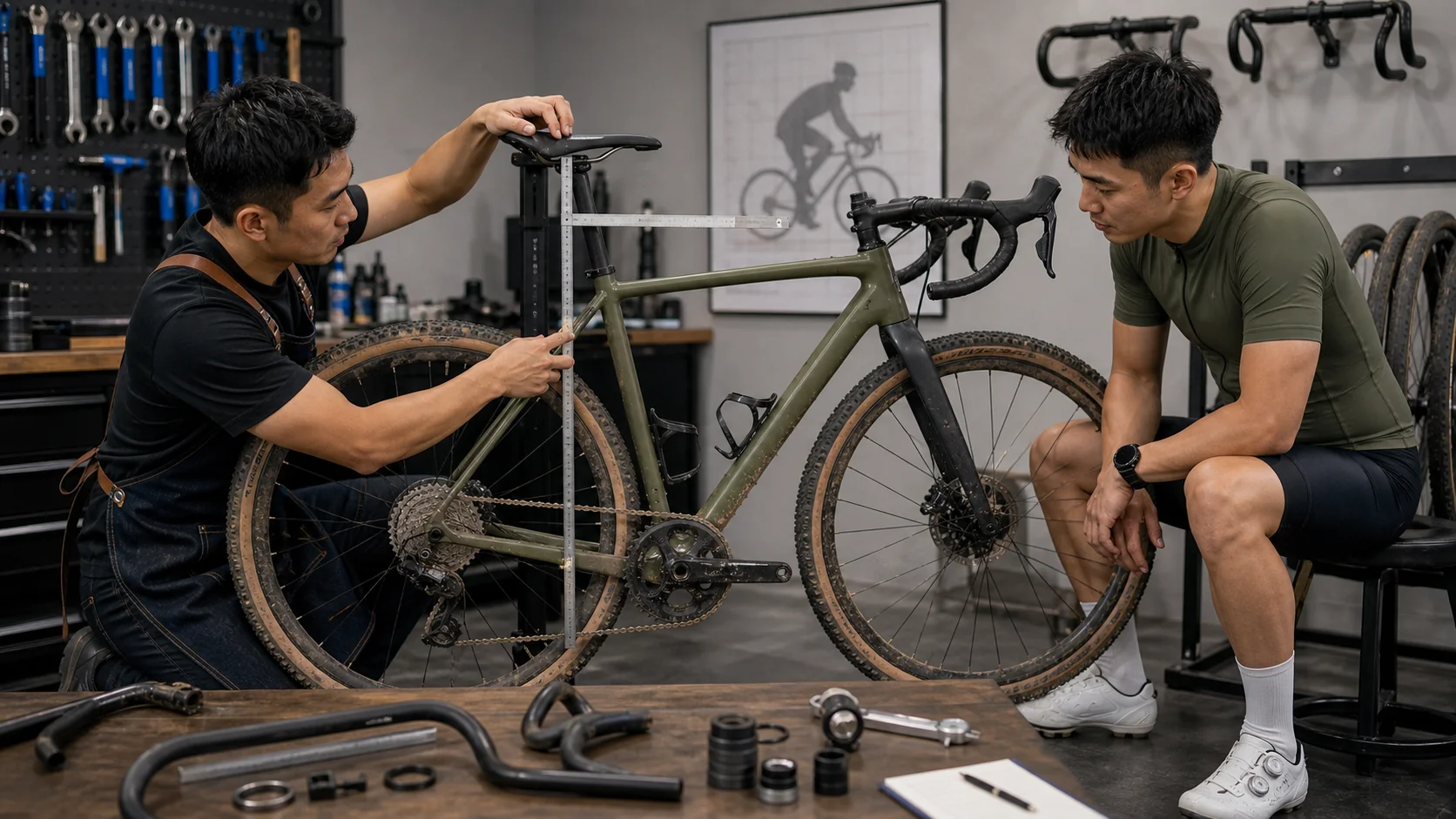
Core Geometry Parameters
Stack and Reach: The Frame’s Skeleton Dimensions
Stack is the vertical distance from the bottom bracket center to the top of the head tube. Reach is the horizontal distance from the bottom bracket center to the top of the head tube. Together, these two numbers define your basic riding position.
Gravel bike characteristics:
- Compared to a road bike of the same size, a gravel bike typically has a taller Stack and shorter Reach
- A taller Stack means a more upright riding position, which is more comfortable over long rides
- A shorter Reach means you don’t need to lean drastically forward to control the front end
Typical value comparison (using a size M frame as an example):
| Parameter | Road Bike | Gravel Bike |
|---|---|---|
| Stack | 540-560mm | 570-600mm |
| Reach | 380-395mm | 370-385mm |
| Stack/Reach Ratio | 1.40-1.44 | 1.50-1.58 |
The higher the Stack/Reach ratio, the more upright the riding position. When choosing a bike, you can use this ratio to quickly gauge a gravel bike’s positioning: below 1.50 leans race-oriented, above 1.55 leans toward comfort.
Head Tube Angle
The head tube angle determines steering responsiveness and high-speed stability.
- 71-72 degrees: Close to a road bike, sharp steering, suited to fast-paced gravel riding mostly on pavement
- 70-71 degrees: Standard gravel setup, balancing responsiveness and stability
- 69-70 degrees: Leans off-road, excellent high-speed stability, suited to technical sections and long-distance bikepacking
The effect of head tube angle is linked to fork offset (also called rake). Together they determine the Trail figure.
Trail: The Key Code to Handling Feel
Trail is the distance between the front wheel’s contact patch and the extended steering axis line. It’s the single most important number determining how a bike feels to handle.
- Trail 55-65mm: Standard gravel setup, stable and predictable
- Trail 65-75mm: High stability, suited to loaded riding and high-speed gravel descents
- Trail 50-55mm: Sharp handling, suited to routes with dense technical cornering
Generally, a larger Trail value makes the bike more stable going straight, but low-speed cornering requires more effort. A smaller Trail value makes steering sharper, but at high speed it may feel less stable.
BB Drop
The distance the bottom bracket center sits below the line connecting the front and rear axles.
- 70-75mm: Standard gravel setup, low center of gravity, good stability
- 65-70mm: Leans road-bike-like, higher pedaling efficiency but slightly less stability
- 75-80mm: Leans toward bikepacking, extremely low center of gravity, stable when loaded
BB Drop affects more than just stability — it also affects the risk of pedal strike while cornering. A larger BB Drop means the inside pedal is closer to the ground when cornering. On gravel, this usually isn’t an issue (you don’t lean into corners as hard as on a road bike), but it’s worth watching for during high-speed cornering on pavement.
Chainstay Length
Chainstay length affects rear-wheel stability, acceleration, and tire clearance.
- 420-430mm: Short chainstays, agile acceleration, suited to race-oriented gravel
- 430-440mm: Standard gravel setup, balances stability and agility
- 440-460mm: Long chainstays, high stability, suited to loaded riding and larger tires
Longer chainstays give the rear wheel better stability, and the rear wheel is less likely to lift when climbing. But overly long chainstays can make the bike feel sluggish, with slower acceleration response.
Wheelbase
The distance between the front and rear axles — the combined result of all other geometry parameters.
- 990-1010mm: On the shorter side, agile handling
- 1010-1040mm: Standard gravel, a balance of stability and agility
- 1040mm and above: Long wheelbase, extremely high stability, suited to bikepacking
Adjusting Your Riding Setup
Fit Principles
A gravel bike’s fit differs from a road bike’s in a few key ways:
- A taller front end: Recommended 1-3cm taller than a road bike setup, to reduce neck strain from prolonged head-down riding
- A shorter stem: 10-20mm shorter than a road bike, to increase handling responsiveness and stability
- A wider handlebar: Gravel-specific flare bars are typically 2-6cm wider than road handlebars
Saddle Height and Fore-Aft Position
Saddle height is calculated the same way as on a road bike (inseam length x 0.883), but it’s recommended to lower it by 3-5mm on gravel to leave more body cushioning room for rough terrain.
For saddle fore-aft position, it’s recommended to keep a neutral-to-slightly-rearward setting, shifting your center of gravity slightly back so it’s easier to move your weight rearward on gravel descents.
Stem Length and Angle
Stem length:
- Race gravel: 80-100mm
- All-road gravel: 70-90mm
- Bikepacking: 60-80mm
A shorter stem provides quicker steering response and more confidence on technical gravel sections. But too short a stem can leave the front wheel underweighted, causing the front to wander on climbs.
Stem angle: A stem with 6-17 degrees of positive rise, combined with spacers, lets you fine-tune front-end height. For gravel riding, it’s recommended to keep at least 10-15mm of spacer space below the stem, leaving room for future fine-tuning.
Tire Pressure Setup
Tire pressure is the parameter in gravel bike setup that’s easiest to adjust and has the most noticeable effect.
Basic formula (tubeless setup):
- Front (psi) = rider weight (kg) x 0.40 - 2
- Rear (psi) = rider weight (kg) x 0.40 + 2
Surface adjustment:
- Mostly tarmac: +3-5 psi
- Packed gravel: base value
- Loose gravel/dirt: -3-5 psi
For example, a 70kg rider on mixed terrain using 40mm tubeless tires:
- Front: 70 x 0.40 - 2 = 26 psi
- Rear: 70 x 0.40 + 2 = 30 psi
Frame Geometry Recommendations by Style
Race Gravel
Suited to gravel racing and riders chasing speed.
Geometry characteristics:
- Head tube angle 71-72 degrees
- Trail 55-60mm
- Short chainstays 420-430mm
- Stack/Reach ratio 1.48-1.52
Representative models: Cervelo Aspero, 3T Exploro RaceMax, Canyon Grail CF
All-Road Gravel
Suited to most gravel riders, capable of handling a wide variety of terrain.
Geometry characteristics:
- Head tube angle 70.5-71.5 degrees
- Trail 60-67mm
- Chainstays 430-440mm
- Stack/Reach ratio 1.52-1.56
Representative models: Specialized Diverge, Trek Checkpoint, Giant Revolt Advanced
Adventure / Bikepacking Gravel
Suited to long-distance touring and bikepacking.
Geometry characteristics:
- Head tube angle 69.5-70.5 degrees
- Trail 65-75mm
- Long chainstays 440-460mm
- Stack/Reach ratio 1.55-1.60
Representative models: Salsa Cutthroat, Surly Midnight Special, Kona Sutra
Conclusion
Frame geometry is the soul of a gravel bike. The numbers alone won’t tell you everything, but understanding them helps you express what you need more precisely, whether you’re choosing a bike or dialing in your fit.
In the end, the best setup is the one that lets you forget the bike exists — when you’re riding on gravel and no longer need to think about handling, and can simply enjoy the scenery and the adventure, that’s the moment you’ve found your golden ratio.
Related Reading
- Introduction to Road Bike Geometry: What Stack, Reach, and Frame Angles Mean
- Reading Bicycle Frame Geometry Data: Stack, Reach, and Head Tube Angle
- Gravel Bike vs Road Bike: A Complete Breakdown of the Differences and Buying Guide
- The Complete Guide to Frame Sizing: How Stack and Reach Determine Your Riding Position