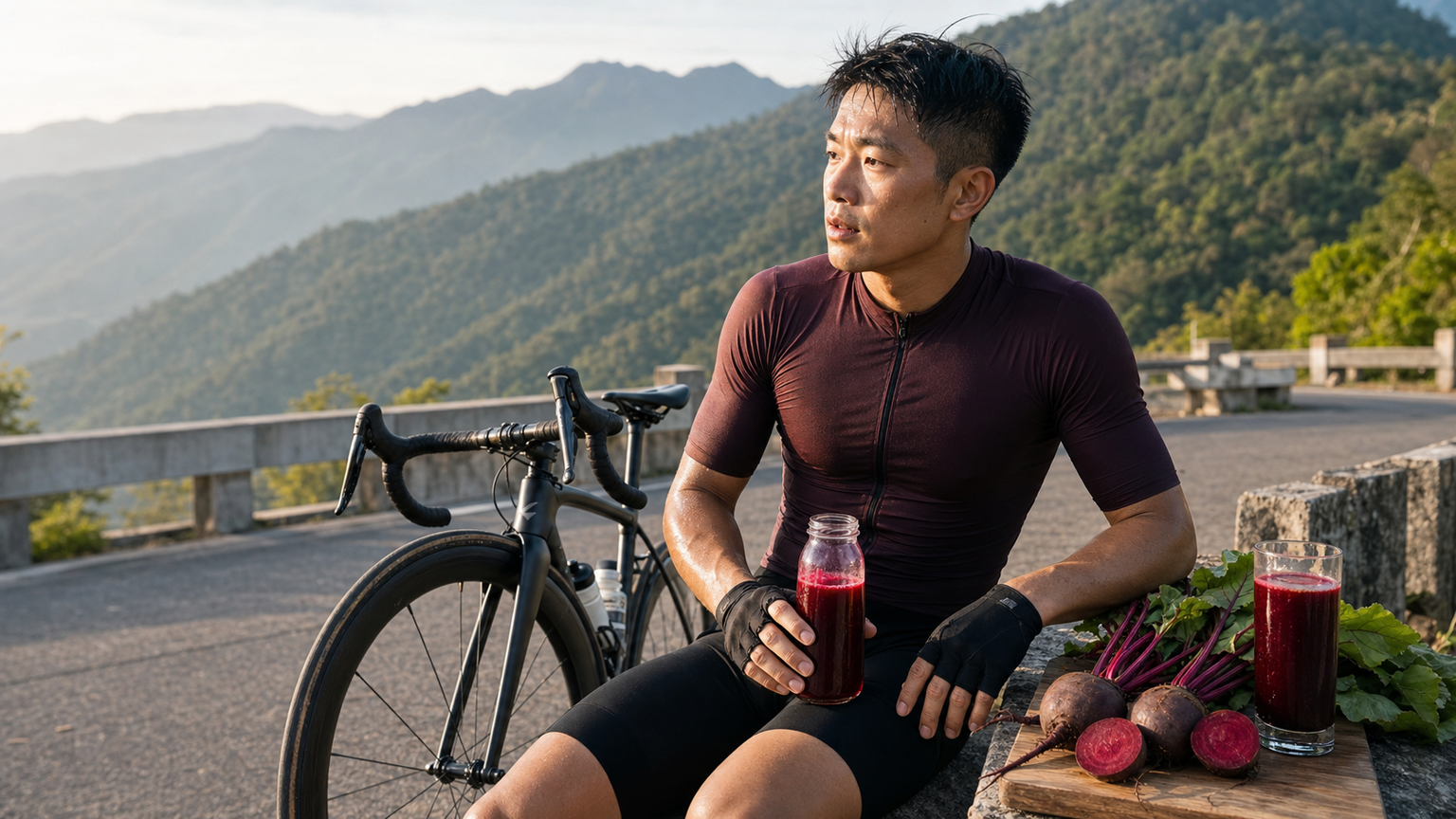
Beetroot Juice and Nitrate Supplementation: A Natural Performance Enhancer for Cycling
Introduction
Among all legal sports supplements, beetroot juice may have the richest body of research evidence over the past decade. Since the first landmark study was published in 2007, more than 300 papers have explored the effects of nitrate on exercise performance. For cyclists, a glass of deep-red beetroot juice may be the simplest, cheapest, and safest legal performance-enhancing strategy.
The Mechanism of Action of Nitrate
The Nitric Oxide (NO) Production Pathway
The magic of beetroot juice comes from its high concentration of inorganic nitrate (NO3-). After ingestion, nitrate undergoes the following conversion process:
- Oral bacterial reduction: Commensal bacteria at the back of the tongue reduce nitrate (NO3-) to nitrite (NO2-)
- Conversion in the gastric acid environment: Nitrite is partially converted to nitric oxide (NO) in the acidic environment of the stomach
- Blood circulation: Unconverted nitrite enters the bloodstream
- Tissue utilization: In low-oxygen environments (such as muscle tissue during exercise), nitrite is further reduced to nitric oxide
Important reminder: Using antibacterial mouthwash will kill the reducing bacteria in the oral cavity, completely blocking this pathway. Avoid mouthwash containing chlorhexidine within 2 hours before and after beetroot juice supplementation.
Physiological Effects of Nitric Oxide
Nitric oxide is a potent vasodilator and cellular signaling molecule that produces the following benefits during exercise:
Vasodilation and Increased Blood Flow
- Dilates blood vessels in exercising muscles, increasing the delivery of oxygen and nutrients
- Improves microcirculation, particularly in fast-twitch muscle fibers (Type II fibers)
Reduced Oxygen Cost of Exercise
- This is the most surprising finding. Nitrate supplementation can reduce oxygen consumption during submaximal exercise by 3-5%
- Possible mechanisms include: improved mitochondrial efficiency (P/O ratio) and enhanced calcium handling in muscle contraction
Enhanced Muscle Contractile Force
- Nitric oxide promotes calcium release from the sarcoplasmic reticulum
- The effect is particularly pronounced during high-frequency contractions (such as sprinting)
Delayed Fatigue
- Improves clearance of metabolic waste during high-intensity exercise
- May reduce the rate of phosphocreatine (PCr) depletion in muscle
Specific Benefits for Cycling Performance
Time Trial Performance
Multiple studies show improvements in cycling time trial performance with nitrate supplementation:
- 4 km time trial: Performance improved by 2.7-2.8% (Lansley et al., 2011)
- 16.1 km time trial: Performance improved by 2.8%, with power output increased by 6 watts (Cermak et al., 2012)
- 50-mile time trial: Performance improved by 0.8% in experienced riders (Porcelli et al., 2015)
High-Intensity Interval Capacity
- Peak power increased by 3-5% in repeated sprint tests
- Time to exhaustion during high-intensity exercise extended by 12-16% (in constant-load exhaustive tests)
High-Altitude Performance
The benefits of nitrate are more pronounced in hypoxic environments, because the conversion of nitrite to nitric oxide is more active under low-oxygen conditions. Studies show benefits of up to 3-5% in exercise tests simulating an altitude of 2,500 meters.
An Important Nuance: The Influence of Training Status
This is an important factor that is often overlooked. Elite athletes typically derive less benefit from nitrate supplementation than recreational athletes:
- Recreational to moderately trained riders: Most pronounced benefits (2-5% improvement)
- Highly trained amateur riders: Benefits exist but are smaller (1-3%)
- Elite/professional riders: Benefits are most uncertain (0-2%), and higher doses may be required
The reason may be that elite athletes already have a highly developed nitric oxide synthase (NOS) pathway and rely less on the nitrate-nitrite pathway.
Optimal Supplementation Protocol
Dosage Recommendations
- Acute supplementation (single dose before competition): 6-8 mmol nitrate (approximately 500 mg NO3-)
- Chronic supplementation (consecutive days): 6-8 mmol daily for 3-7 days
- Elite athletes: May need to increase to 8-16 mmol to observe benefits
Nitrate Content of Common Sources
| Source | Nitrate Content | Notes |
|---|---|---|
| Concentrated beetroot juice (70ml shot) | ~6-7 mmol | Most common form used in research |
| Fresh beetroot juice (500ml) | ~5-8 mmol | Larger volume |
| Beetroot powder (1 scoop/5g) | ~2-4 mmol | Convenient but lower concentration |
| Spinach (200g) | ~4-6 mmol | Food source |
| Arugula (100g) | ~4-7 mmol | High-nitrate vegetable |
| Lettuce (200g) | ~2-4 mmol | Everyday vegetable |
Timing of Supplementation
Single acute dose:
- Consume 2-3 hours before competition or training
- Plasma nitrite concentration peaks 2-3 hours after ingestion
- Effects last 4-6 hours
Multi-day loading protocol (recommended for important races):
- Begin daily supplementation of 6-8 mmol 5-7 days before the race
- Take an additional dose 2-3 hours before the start on race day
- Studies show that chronic supplementation may be more effective than a single acute dose
Strategies to Enhance the Effect
Pairing with caffeine:
- The two have different mechanisms of action and can be combined additively
- Caffeine does not interfere with nitrate metabolism
Pairing with carbohydrates:
- Nitrate does not affect carbohydrate absorption or utilization
- Beetroot juice can be safely incorporated into a pre-race carbohydrate loading plan
Avoid taking large amounts of vitamin C at the same time:
- High doses of vitamin C (>500mg) may excessively accelerate the conversion of nitrite in the stomach, reducing the amount of nitrite that enters the bloodstream
- The vitamin C content in normal food is not a concern
Frequently Asked Questions and Precautions
Discoloration of Urine and Stool
The betanin in beetroot will turn urine pink and stool dark red. This is completely normal and is not blood in the urine. The effect subsides within 24-48 hours after stopping intake.
Interference from Mouthwash
As mentioned earlier, mouthwash containing antibacterial agents will kill the commensal bacteria in the oral cavity that reduce nitrate to nitrite. While using beetroot juice, switch to plain water or a mouthwash without chlorhexidine. Similarly, fluoride toothpaste is generally not a problem.
Gastrointestinal Tolerance
A small number of people may experience bloating or diarrhea after drinking concentrated beetroot juice. Recommendations:
- Try it for the first time on a training day, not on race day
- If gastrointestinal discomfort occurs, try splitting the dose or switching to beetroot powder
- Some people find that switching to high-nitrate foods (spinach, arugula salad) works better
Long-Term Safety
Nitrate from food sources is safe. Numerous epidemiological studies show that high vegetable intake (high in nitrate) is associated with a reduced risk of cardiovascular disease. However, it is important to distinguish nitrate from food sources from the nitrite additives in processed meats—the latter may produce nitrosamines when cooked at high temperatures.
Practical Recommendations
Beetroot Juice Protocol for Important Races
- 7 days before the race: Begin drinking 1 serving of concentrated beetroot juice daily (70ml, ~6 mmol NO3-)
- 3 days before the race: May increase to 2 servings per day (if gastrointestinal tolerance is good)
- Race day: Drink 1-2 servings 2.5-3 hours before the start
- During the race: For long-distance events, an additional serving can be taken midway
DIY High-Nitrate Meals
If you don’t like the taste of concentrated beetroot juice, you can achieve similar effects through your diet:
- Breakfast: Beetroot + apple + ginger juice (homemade)
- Lunch: Arugula + spinach salad with beetroot
- Dinner: Roasted beetroot with whole grains
Conclusion
Beetroot juice is currently one of the most well-evidenced natural sports ergogenic aids. For most cyclists, the correct dosage and timing can deliver a 1-5% performance improvement, with an extremely high safety profile. It’s not a magic potion, but when you’ve already built a solid foundation of training, nutrition, and recovery, that extra 1-3% could be exactly what you need to break your personal best.
Related Reading
- The Mechanisms Behind Beetroot Juice Improving Cycling Performance: The Power of Nitric Oxide
- Beetroot Juice and Nitrate: A Scientifically Validated Natural Performance Enhancer
- The Exercise Science of Nitrate and Beetroot: The Nitric Oxide Pathway, Endurance Effect Sizes, and Dosing Timing Fully Explained
- The Science of Beetroot Juice: Can Nitrate Supplementation Really Boost Endurance
CT暗黑廚房) 車友必備 宇宙無敵鮮蚵湯 幫助訓練恢復 天然食補 好市多 超肥鮮蚵 破PR
7 年前
一個測試有沒有認真練車的方法😂 #公路車
10 個月前
2021 96聯賽 桃園市長盃 4K多視角實況 當天選手瓦數/推力比/均速/時間 即時數據分析 | 公路車 | CT Yeh
5 年前
洗單車神器 吹水機! 實際洗車用用看 暴力洗鍊條大法 | 公路車 | CT Yeh
4 年前
iPhone內建一秒變長腿🤣 車友必備#cycling
2 年前
小野田真的存在!日本赤城山爬坡公路賽 台灣首發團完全實錄 | 頭文字D真實賽道! | 看完東奧自行車賽後好想再去騎一次啊! | 公路車 | CT Yeh
4 年前
一日北高/長距離團騎 常見問題補充篇 / 組團或跟團的眉角 / 壯車友容易被瘦車友慢性拉爆 / 原來屁股痛可能是這個原因...? / 風場配速法 / 公路車 / CT Yeh
2 年前
秘境雪場 日本 八甲田 冰樹探險與滑雪體驗 ft. Q老師 & 運動生活
7 年前