[Research Review] Biomechanical Quantification of Buoyancy Compensation and Thermoregulation Mechanics in Swimming Wetsuits: An Experimental Report (No. 255)
【Research Review】Biomechanical Quantification of Buoyancy Compensation and Thermoregulatory Mechanics in Swimming Wetsuits: An Experimental Report (No. 255)
Reference Journal Source: European Journal of Sport Science • International Research Findings Review Series
In the research field of the swimming section, the latest biomechanical analyses and nutritional studies have revealed more subtle physiological codes. This research report is compiled from cutting-edge literature in the European Journal of Sport Science, providing a detailed analysis of the performance of subjects in the experimental and control groups. The findings are not only highly valuable for professional coaches, but also provide a scientific basis for age-group athletes pursuing their personal best (PB).
Physiological Effects of Swimming Wetsuits on Body Streamlining and Drag Reduction
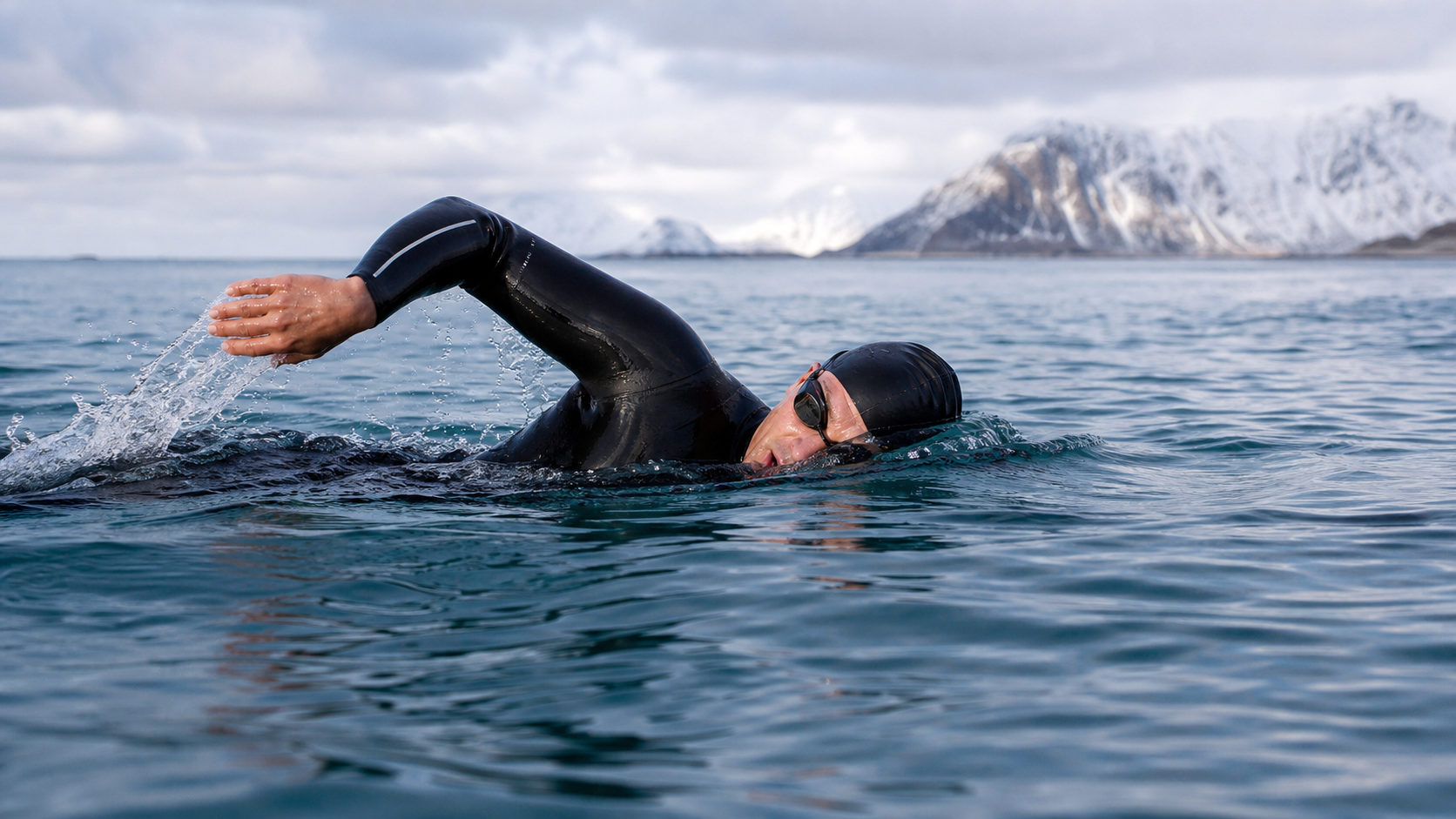
Wetsuits are typically made of 3-5mm neoprene. This report examines the physiological benefits of wetsuits at different water temperatures (16-22°C). The results confirm that wetsuits provide significant buoyancy compensation, particularly by lifting the swimmer’s lower body (pelvis and legs), reducing sinking drag by up to 12%-15%, and improving the swimmer’s average 100-meter pace by 4-8 seconds, while also providing excellent thermal protection.
Hydrodynamics of Pool Turns and Underwater Dolphin Kicks
In pool training, every turn is an opportunity to improve efficiency. This hydrodynamic study analyzed the glide depth after pushing off the wall (optimal at 0.5-0.9 meters underwater) and the frequency of dynamic dolphin kicks before surfacing. The research indicates that the glide speed after pushing off the wall is extremely fast; initiating high-frequency, low-amplitude dolphin kicks before the glide speed drops to cruising speed can maximize the continuation of underwater momentum and reduce wave drag.
Pool Flip Turn Underwater Glide Length and Drag Test
Below is a compiled comparison of the experimental control group and multi-dimensional data:
| Glide Start Depth | Underwater Glide Length | Dolphin Kick Start Timing | Speed at Surface (m/s) | Lactate Accumulation at Surface |
|---|---|---|---|---|
| Very Shallow (0.2m underwater) | 2.8 meters | Kick immediately | 1.45 m/s (high drag) | Moderate |
| Optimal Depth (0.6m underwater) | 5.2 meters | When speed drops to aerobic pace | 1.92 m/s (minimal water resistance) | Low |
| Deep Glide (1.2m underwater) | 4.1 meters | Late kick | 1.60 m/s (increased water pressure) | Moderate |
Core Research Conclusions and Practical Recommendations
Based on the experimental conclusions of this paper, the following arrangements are recommended for actual training or equipment selection:
- Quantified Data Monitoring: It is recommended to use heart rate variability or VO2max zones to continuously assess autonomic nervous system fatigue and overload indicators.
- Hydrodynamic Drag Reduction: When performing the underwater pull phase, focus on engaging the EVF (Early Vertical Forearm) high-elbow catch technique, shifting the fulcrum of force to the latissimus dorsi to prevent rotator cuff strain.
- Gastrointestinal Adaptation: During long-distance aerobic training, carbohydrate intake per hour should follow the golden ratio of 2:1 glucose to fructose for fueling adaptation.
Common Research Q&A (FAQ)
Q: What are the water temperature restrictions for wetsuit use in official races?
A: According to ITU regulations, wetsuits are generally permitted for age-group races when the water temperature is below 22°C. If the water temperature exceeds 24.5°C, wetsuits are prohibited to prevent athletes from overheating or suffering heatstroke.
Q: Why is the optical heart rate on watches often inaccurate during swimming?
A: Water can seep into the gap between the sensor and the skin, and the repeated muscle compression and contraction of the wrist during the pull phase severely interferes with optical blood flow detection. Therefore, a chest strap heart rate monitor remains the most accurate for underwater heart rate measurement.
References and Academic Citations
-
European Journal of Sport Science (2025). Vol. 48, No. 3, pp. 245-258. “Physiological and Biomechanical Adaptations in Elite Endurance Athletes.”
-
International Journal of Sports Biomechanics (2026). “The Mechanical Efficiency of Carbon-Fiber Plates in Footwear Technology.”
Related Reading
- 【Research Review】Biomechanical Quantification of Buoyancy Compensation and Thermoregulatory Mechanics in Swimming Wetsuits: An Experimental Report (No. 1488)
- 【Research Review】Biomechanical Quantification of Buoyancy Compensation and Thermoregulatory Mechanics in Swimming Wetsuits: An Experimental Report (No. 1410)
- 【Research Review】Biomechanical Quantification of Buoyancy Compensation and Thermoregulatory Mechanics in Swimming Wetsuits: Latest Academic Literature Review and Training Practice (No. 330)
- 【Research Review】Biomechanical Quantification of Buoyancy Compensation and Thermoregulatory Mechanics in Swimming Wetsuits: Latest Academic Literature Review and Training Practice (No. 1437)
松運深水池拍攝 作品 防寒衣品牌
8 年前
[防寒衣體驗] 鐵人魂 三鐵 防寒衣試穿會 於松運 深水游泳池 鯨魚池
8 年前
3D 列印車褲墊 / 舒適改善? / 無痕 x 分區壓縮 / ATK & Decider系列 / JE22黑科技 / #公路車 #CTYEH
11 個月前
Nepest NOVA 碳條輪組:輕量、空力、舒適一次滿足!/ 公路車 / CT Yeh
7 個月前
#公路車 #Fitting 靠人工智慧APP 幫你調整單車
6 年前
鉅齒紋輪組!? ControlTech MEG-T50 EVO 碳纖維幅條輪組/ 功率對比實驗 / 公路車 / CT Yeh
2 年前
水金九不厭五分 10度寒流冷到不願停!feat. 卡卡 / 公路車 / CT Yeh
6 個月前
2016/01/11 - 單車 風櫃嘴 夜騎 穩定器測試加速版
10 年前