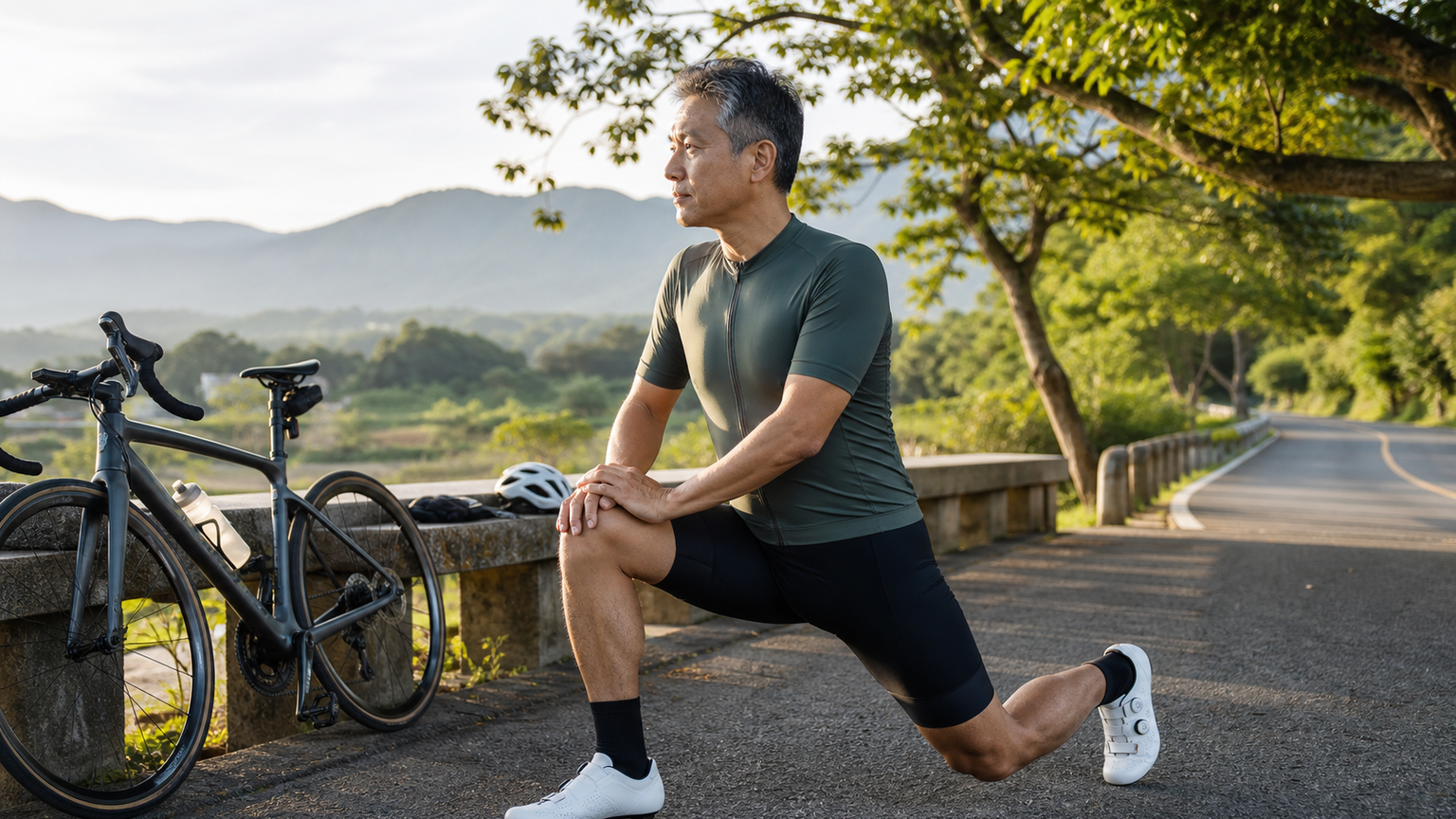
A Middle-Aged Rider’s Guide to Joint Protection: Riding Longer Matters More Than Riding Faster
Introduction: Your Joints Are Irreplaceable Parts
Cycling is widely recognized as a low-impact sport, far friendlier to joints than running. However, this doesn’t mean cycling is completely free of joint problems. Especially after turning forty, years of accumulated riding posture issues, muscle imbalances, and natural joint degeneration can cause various pains to gradually surface.
The good news is that the vast majority of cycling-related joint problems are preventable and improvable. The key lies in understanding the root causes and taking proactive protective measures.
The Most Common Joint Problems Among Cyclists
Knee Problems
The knee is the most vulnerable joint for cyclists. Common issues include:
Patellofemoral Pain Syndrome (Anterior Knee Pain)
- Symptoms: Pain around or below the kneecap, worsening when climbing or descending
- Common causes: Saddle too low, knee collapsing inward during pedaling, muscle imbalance between the inner and outer quadriceps
Iliotibial Band Syndrome (Lateral Knee Pain)
- Symptoms: A burning or stinging sensation on the outside of the knee after riding for a period of time
- Common causes: Incorrect pedal width (Q Factor), weak gluteus medius, incorrect cleat angle
Pes Anserine Tendinitis (Medial Knee Pain)
- Symptoms: Pain below the inner side of the knee
- Common causes: Over-pronation, cleat setup issues
Hip Joint Problems
- Tight Hip Flexors: Prolonged riding posture shortens the hip flexors
- Piriformis Syndrome: Tight deep gluteal muscles compressing the sciatic nerve
- Acetabular Labral Tear: Wear from deep hip flexion caused by long-term riding
Neck, Shoulders, and Wrists
- Cervical Spine Strain: Prolonged looking up at the road ahead causes neck strain
- Ulnar Nerve Compression (Handlebar Palsy): Long-term pressure on the wrist
- Shoulder Joint Tightness: Scapular displacement caused by riding posture
Lower Back
- Lumbar Disc Pressure: Prolonged forward-leaning posture increases pressure on the intervertebral discs
- Sacroiliac Joint Dysfunction: Imbalance in pedaling force between the two sides
Bike Fitting: The First Line of Defense for Joint Protection
Among all joint protection strategies, proper Bike Fitting is the most important. A poorly set-up bicycle applies incorrect pressure to your joints with every pedal stroke. At 80-90 RPM, a 3-hour ride amounts to over 14,000 repetitions.
Key Fitting Parameters
Saddle Height
Saddle height has the most direct impact on the knees:
- Too low: Increases patellofemoral joint pressure, easily causing anterior knee pain
- Too high: Causes the pelvis to rock side to side, increasing hip and lower back strain
- Recommendation: At the bottom of the pedal stroke, the knee bend angle should be approximately 25-35 degrees
Saddle Fore-Aft Position
- Affects the positional relationship of the knee during pedaling
- When the pedal is at the 3 o’clock position, the knee should be roughly directly above the pedal spindle
- A saddle positioned too far forward increases knee pressure
Handlebar Height and Reach
- Handlebars that are too low or too far away increase strain on the neck, shoulders, and wrists
- As you age, moderately raising the handlebar height is a wise choice
- Don’t sacrifice comfort just to “look pro”
Cleat Setup
- Cleat angle affects the rotational tracking of the knee
- Float allows natural knee movement
- It is recommended to use cleats with 4.5-6 degrees of float
Important Reminder: Riders over forty are advised to get a professional Bike Fitting every 1-2 years. Your body changes with age; a setup that was suitable last year may need adjustment this year.
Strength Training: Building a Protective Shield for Your Joints
Strong muscles are the best protection for your joints. Here is a strength training plan for joint protection tailored to cyclists:
Knee-Protecting Muscle Groups
Quadriceps Strengthening
- Wall Sit: 3 sets × 30-60 seconds
- Bulgarian Split Squat: 3 sets × 10 reps/leg
- Leg Extension Machine (small range): 3 sets × 15 reps
Hamstrings
- Romanian Deadlift: 3 sets × 10 reps
- Swiss Ball Leg Curl: 3 sets × 12 reps
- Nordic Hamstring Curl (advanced): 3 sets × 5-8 reps
Hip-Protecting Muscle Groups
Gluteus Maximus
- Glute Bridge: 3 sets × 15 reps
- Single-Leg Glute Bridge: 3 sets × 10 reps/leg
- Squat: 3 sets × 10-12 reps
Gluteus Medius (extremely important but often neglected)
- Side-Lying Leg Raise: 3 sets × 15 reps/leg
- Clamshell: 3 sets × 15 reps/leg
- Mini Band Lateral Walk: 3 sets × 15 steps/direction
Core Stability
- Plank: 3 sets × 30-60 seconds
- Side Plank: 3 sets × 20-30 seconds/side
- Dead Bug: 3 sets × 10 reps/side
- Bird Dog: 3 sets × 10 reps/side
Training Frequency
2-3 times per week, 30-40 minutes per session is sufficient. Consistency matters more than volume.
Mobility and Flexibility
Pre-Ride Dynamic Warm-Up (10 minutes)
- Leg swings forward and backward: 15 reps per leg
- Hip circles: 10 circles per leg/direction
- High knees: 20 reps
- Walking lunges: 10 steps
- Easy spinning on the bike for 5 minutes
Post-Ride Stretching (15 minutes)
Hold each stretch for 30-60 seconds, no bouncing:
- Quadriceps Stretch: Standing or side-lying, pulling the rear foot
- Hamstring Stretch: Seated forward fold or supine leg raise
- Hip Flexor Stretch: Half-kneeling hip thrust forward
- Piriformis Stretch: Supine figure-four, pulling the knee
- Thoracic Rotation: Side-lying “open book” movement
- Neck Stretch: Slow lateral flexion and rotation
Add Yoga or Pilates Weekly
Classes highly beneficial for middle-aged riders:
- Yin Yoga: Long-duration static stretching targeting connective tissue
- Pilates: Core stability and body control
- Restorative Yoga: Extremely relaxing, promotes nervous system recovery
Joint Protection Strategies While Riding
The Importance of Cadence
High gear, low cadence is the number one enemy of your joints. Especially when climbing:
- Maintain a cadence of 75-95 RPM
- Do not drop below 65-70 RPM when climbing
- If you run out of gears, don’t hesitate to switch to a larger cassette
- Consider using a Compact (50/34) or Sub-compact (48/32) crankset
Gradual Mileage Progression
Follow the 10% Rule: increase your total weekly riding volume by no more than 10% over the previous week.
Stand Up When Appropriate
Prolonged seated riding puts continuous pressure on the hips and lower back:
- Stand up and pedal for 30-60 seconds every 20-30 minutes
- Occasionally stand up and stretch on long descents
- Change hand positions to distribute pressure on the wrists and shoulders
Nutritional Supplements and Joint Care
Supplements Supported by Science
- Omega-3 Fatty Acids: 2-3 grams daily, has anti-inflammatory effects
- Vitamin D: Many people are deficient; it affects bone and muscle function. It is recommended to get a blood test before supplementing.
- Collagen: 10-15 grams daily, taken with Vitamin C, may aid cartilage repair
- Curcumin: Natural anti-inflammatory; choose a formulation with high bioavailability
Dietary Recommendations
- Consume a variety of colorful fruits and vegetables daily (antioxidants)
- Eat fish rich in Omega-3 at least twice a week
- Reduce refined sugar and alcohol (pro-inflammatory factors)
- Maintain adequate hydration (joint lubrication requires water)
When to See a Doctor?
Please consult a sports medicine specialist promptly in the following situations:
- Pain persists for more than 2 weeks without improvement
- The joint feels like it is locking or catching
- Noticeable swelling appears
- Pain affects daily activities (walking, climbing stairs)
- Pain is present even during nighttime rest
Conclusion
Joint protection is not an emergency measure to be taken only when problems arise; it is a long-term investment that should be integrated into your daily training. A proper Bike Fitting, regular strength training, post-ride stretching and recovery, and respect for your body’s signals—these seemingly simple things will determine whether you can still easily get on your bike at sixty or seventy years old.
Riding longer matters much more than riding faster. Take good care of your joints, and they will accompany you through countless wonderful riding days.
Related Reading
- The Complete Guide to Knee Protection for Cyclists: Common Injuries and Prevention Strategies
- Knee Protection for Cyclists: Knee Joint Structure and Injury Mechanisms
- Don’t Tolerate Knee Pain: Prevention and Management of Common Cycling Knee Injuries
- Occupational Hazards for Cyclists: Preventing Knee, Lower Back, and Neck Pain
碟煞公路車 銑面器 !? 原來銑完差這麼多! 降低蹭碟機率! | TIME 公路車 保養小記錄 | CT Yeh
3 年前
一日北高常見問題大集合 | 攻略 | 路線 | 訓練 | 補給 | 自行車 單車 | 一日雙城 | 雙塔 | TWB北高360 | 屁股痛
6 年前
一日北高/長距離團騎 常見問題補充篇 / 組團或跟團的眉角 / 壯車友容易被瘦車友慢性拉爆 / 原來屁股痛可能是這個原因...? / 風場配速法 / 公路車 / CT Yeh
2 年前
靠單車減肥35公斤 心得分享與整理
7 年前
再一組! 全碳幅條 碟煞/無內胎輪組 開箱! 到底好騎嗎? UNAAS X40 | 公路車 | CT Yeh
4 年前
高雄綠園道鐵路自行車道 / 外地人能輕鬆駕馭 還是整路崩潰? / 2025 全線開通 春節實地探索一次!(附GPS連結)/ 公路車 / CT Yeh
1 年前
碟煞公路車 優缺點?換車一年半實際經驗分享 / 公路車 / CT Yeh
2 年前
#公路車 #Fitting 靠人工智慧APP 幫你調整單車
6 年前