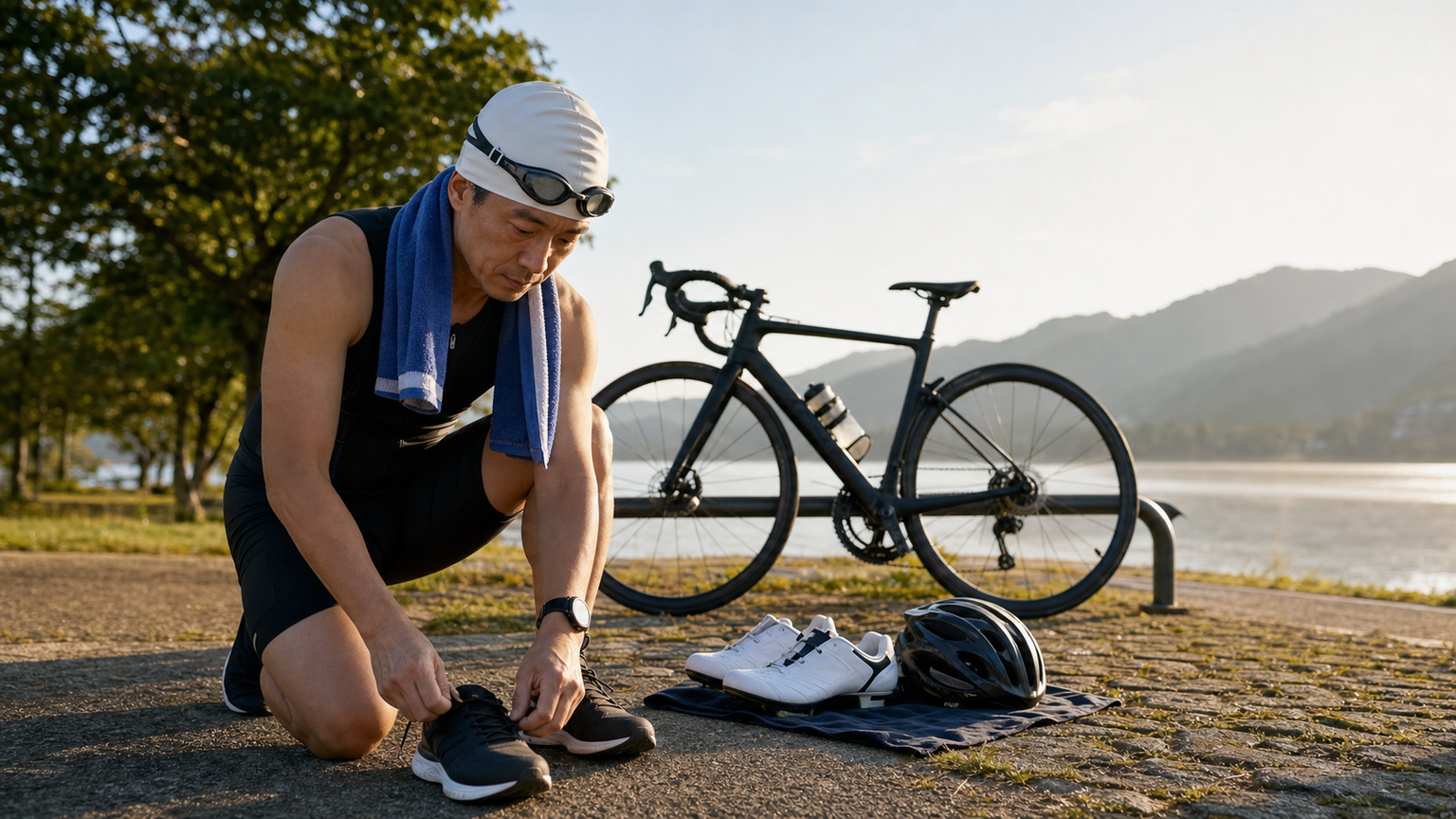
Masters Triathlon Beginner’s Guide: It’s Never Too Late to Start at Forty
Introduction: Why Triathlon Is Especially Suited for Middle-Aged Athletes
If you’re an experienced cyclist looking for a new challenge, triathlon might be the perfect choice. And starting triathlon after forty isn’t just not too late—in some ways, it’s even an advantage.
Why?
- Endurance is a strength in middle age: Triathlon is an endurance sport, and endurance capacity declines far less with age than explosive power
- Multi-sport training reduces injury risk: Alternating between three different sports reduces overuse injuries from a single activity
- Mental maturity is a weapon: Triathlon demands excellent pacing ability and mental resilience, which are exactly the strengths of middle-aged athletes
- You already have a cycling foundation: Cycling is the longest leg of a triathlon, so you’re already ahead of the game
According to statistics, the average age of triathletes worldwide is approximately 40 years old, and the Masters category is often one of the most heavily contested divisions.
Choosing Your First Race
Triathlon Distance Options
| Race Type | Swim | Bike | Run | Estimated Time | Suitable for Beginners? |
|---|---|---|---|---|---|
| Super Sprint | 400m | 10km | 2.5km | 45-75 minutes | Best entry point |
| Sprint | 750m | 20km | 5km | 1-1.5 hours | Recommended for beginners |
| Olympic Distance | 1.5km | 40km | 10km | 2-3.5 hours | Intermediate goal |
| Half Ironman (70.3) | 1.9km | 90km | 21.1km | 4.5-7 hours | Advanced goal |
| Full Ironman (140.6) | 3.8km | 180km | 42.2km | 9-17 hours | Long-term goal |
Advice for cyclists: Start with the sprint distance. Your cycling ability is more than enough to handle 20km comfortably; the main challenge lies in the transition to swimming and running.
Swimming: The Biggest Challenge for Most Cyclists
Why Swimming Intimidates Cyclists
When cyclists transition to triathlon, swimming is usually the most anxiety-inducing discipline:
- Breathing rhythm is completely different from cycling
- Fear of the water (especially in open water)
- Higher technical barrier; not as intuitive as running
- Lack of efficiency in the water leads to excessive energy expenditure
Swim Training Roadmap from Zero
Phase 1 (Weeks 1-4): Water Acclimatization
- Goal: Swim 100 meters continuously in a pool without stopping
- 3 sessions per week, 30 minutes each
- Focus: Breathing rhythm and relaxation
- Use a kickboard for kick drills
- Plenty of floating and gliding exercises
Phase 2 (Weeks 5-8): Technique Building
- Goal: Swim 400 meters continuously
- 3 sessions per week, 45 minutes each
- Introduce full freestyle stroke
- Technique drills such as single-arm and catch-up drills
- Begin simple intervals: 4×50m with 30 seconds rest between each
Phase 3 (Weeks 9-16): Endurance and Efficiency
- Goal: Swim 750 meters or more continuously
- 3 sessions per week, 45-60 minutes each
- Increase continuous swimming distance
- Interval training: 6-8×100m with 20 seconds rest between each
- Begin bilateral breathing practice
- Try open water swimming (with safety measures in place)
Key Swimming Techniques
The most common mistake cyclists make when transitioning to swimming: trying to swim fast with brute force instead of focusing on technique.
In swimming, technique accounts for over 80% of efficiency. Here are the most important points:
- Body position: Stay horizontal; don’t let your hips and feet sink
- Rotation: Use core rotation to drive the arms, not just the shoulders
- Catch: Push water backward after your hand enters, not downward
- Kick: A light kick is sufficient; its purpose is to maintain body position, not generate propulsion
- Breathing: Rotate your head to the side to breathe; don’t lift your head up
Running: The Challenge of Transitioning from Cycling
The “Brick Legs” Phenomenon
When you transition from cycling to running, your legs will feel like they’re filled with lead—this is the famous “brick legs” phenomenon. It happens because cycling uses different muscle patterns than running, and your body needs time to switch.
Running Training Considerations
For middle-aged cyclists, the impact from running is what needs the most careful handling:
- Progress gradually: Start with the “run-walk method” (run 2 minutes / walk 1 minute)
- Surface selection: Run on grass, dirt trails, or a treadmill as much as possible to reduce impact on hard surfaces
- Shoes: Invest in a pair of running shoes suited to your foot type and gait (get a gait analysis at a specialty running store)
- Frequency: No more than 3 sessions per week to give bones and connective tissue time to adapt
- Weekly progression: Increase total weekly mileage by no more than 10%
Beginner Running Plan (8 Weeks)
Weeks 1-2: Run 1 min / walk 2 min × 10 sets, 30 min total, 3x per week
Weeks 3-4: Run 2 min / walk 1 min × 10 sets, 30 min total, 3x per week
Weeks 5-6: Run 5 min / walk 1 min × 5 sets, 30 min total, 3x per week
Weeks 7-8: Run continuously for 20-25 minutes, 3x per week
Brick Training
Brick training is a unique triathlon workout—a continuous session of cycling followed by running:
- Ride for 30-60 minutes, then immediately put on running shoes and run for 10-20 minutes
- Once per week is sufficient
- The focus is on adapting to the transition feeling, not chasing speed
- Gradually increase brick training duration as you progress through your race preparation cycle
Sample Weekly Training Plan for Masters Triathletes
Below is an example of the weekly structure for a 12-week training plan preparing for a sprint-distance triathlon (mid-cycle week):
Monday: Rest

Tuesday:
  Morning - Swim 45 minutes (including intervals)

Wednesday:
  Morning - Bike 1.5 hours (including structured training)

Thursday:
  Morning - Swim 30 minutes (technique focus)
  Afternoon - Run 25 minutes (easy run)

Friday: Rest or yoga

Saturday:
  Brick training - Bike 1 hour + Run 15 minutes

Sunday:
  Swim 30 minutes (open water practice, if possible)

Total weekly time: approximately 6-7 hours
Important note: This plan is suited for middle-aged athletes who already have a cycling foundation. Complete beginners should first build a base in each discipline individually before starting integrated training.
Gear Guide
Essential Equipment
| Item | Budget Range | Recommendation |
|---|---|---|
| Swim goggles | NT$300-800 | Try them on to ensure a snug, leak-free fit |
| Swim cap | NT$100-300 | Silicone material is more durable |
| Tri suit | NT$2,000-5,000 | A one-piece tri suit is the most convenient |
| Running shoes | NT$2,500-5,000 | Purchase at a specialty running store |
| Race number belt | NT$300-500 | For quickly attaching your number during transitions |
Cycling Gear You Can Reuse
Your existing road bike and cycling equipment are perfectly suitable for sprint and Olympic-distance triathlons. There’s no need to buy a triathlon bike right away—technique and fitness matter far more than equipment.
Transition Area Tips
- Use elastic laces (no-tie laces) to save time in the run transition
- Pre-clip your cycling shoes onto the pedals
- Keep a small towel to dry your feet (for putting on shoes after the swim)
- Arrange all items in the order you’ll use them
- Rehearse your transitions at least 3 times before race day
Race Day Strategy
Swim Strategy
- Starting position: Don’t stand at the very front. Stay on the side or toward the back of the pack to avoid getting bumped
- First 200 meters: Pace conservatively to let your heart rate settle
- Sighting: Look up to check your direction marker every 8-10 arm strokes
- Don’t panic: If needed, switch to breaststroke or float on your back to rest at any time
Bike Strategy
- This is your home turf, but don’t go all out
- Save 10-15% of your energy for the run
- A steady pace is far better than starting fast and fading
- Do most of your fueling during the bike leg
Run Strategy
- Slow down for the first 1km to let your legs adapt to the switch from cycling to running
- If you need to walk, walk—especially in your first race
- Enjoy the moment as you cross the finish line
Safety Considerations
Special Considerations for Middle-Aged Triathletes
- Regular health check-ups: Get a comprehensive cardiovascular assessment before starting triathlon training
- Swim safety: Never practice in open water alone
- Listen to your body: The cross-training stress of three sports may be greater than you expect
- Adequate recovery: The variety of triathlon training may cause you to underestimate overall fatigue
Conclusion
Stepping into the world of triathlon is one of the most exciting steps of your athletic career. Moving from cycling into swimming and running, you’ll discover new challenges, a new community, and a new sense of self-awareness.
Starting triathlon at forty isn’t too late—it’s exactly the right time. You possess mature judgment, rich athletic experience, and clear goals—advantages that no young athlete can replace with raw talent.
Sign up for your first sprint triathlon. The moment you cross the finish line, you’ll understand: it was all worth it.
Swim, bike, run—then, smile. Welcome to the world of iron athletes.
Related Reading
三鉄共購百人風中劍/ feat. 單車小D、Doris 、城希、Ruby、Ada/ 公路車 / CT Yeh
2 年前
西進武嶺 免費訓練分析服務 Intervals | 練不夠還是練過頭?你哪一種類型選手?AI模型告訴你! | 備戰神器 | 公路車 訓練 | CT Yeh
4 年前
2019 夏季KOM 5小 完賽心得 準備攻略 東進武嶺 夏季登山王之路 Taiwan KOM Challenge
7 年前
入門車錶王者 iGPSPORT BSC100S 一千元的售價! 超大螢幕、連續兩趟北高的續航、藝術般的APP! Bryton Garmin 兩王地位撼動? | 公路車 | CT Yeh
3 年前
CT 喇低賽) 武嶺牽車 才是王道 西進牽車四小時內秘訣 攝手位置 如何判斷 防抽筋小秘訣
7 年前
高雄綠園道鐵路自行車道 / 外地人能輕鬆駕馭 還是整路崩潰? / 2025 全線開通 春節實地探索一次!(附GPS連結)/ 公路車 / CT Yeh
1 年前
福隆鐵人團練隨拍
8 年前
Live) 備戰2019彰化經典百K 賽前攻略 (已完賽請看新影片
7 年前