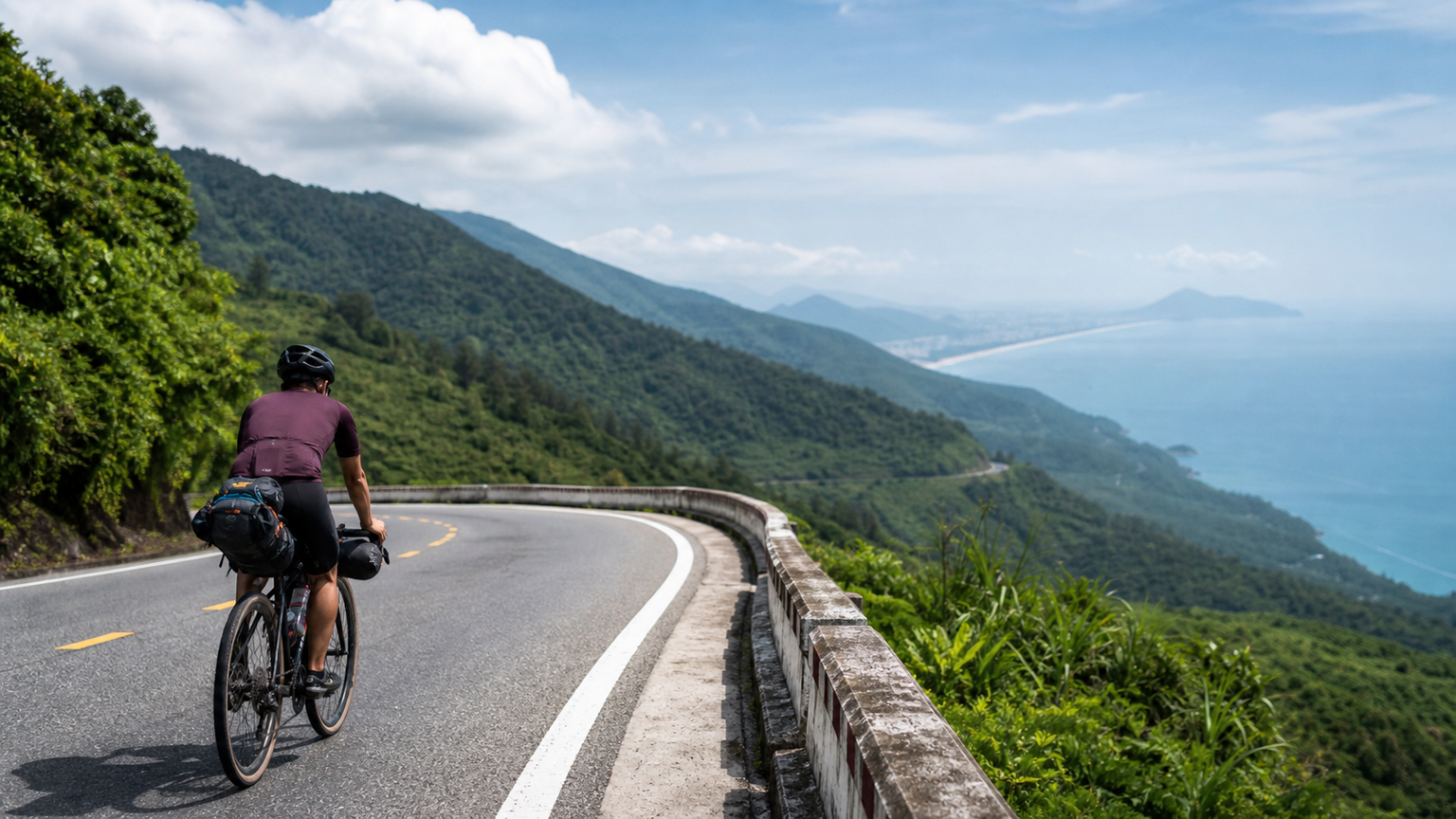
Vietnam Cycling Adventure: A Thousand-Mile Ride from Hanoi to Da Nang
Why Is Vietnam a Cycling Paradise?
Vietnam’s territory is shaped like a carrying pole, stretching about 1,650 kilometers from north to south, with its narrowest point less than 50 kilometers from east to west. This elongated geography makes a north-south cycling tour a natural route choice. Moreover, Vietnam’s affordable prices, friendly people, rich food culture, and increasingly well-developed road infrastructure have made it a top destination for more and more Asian cyclists.
The route from Hanoi to Da Nang spans about 800 kilometers, covering the most spectacular scenery of northern and central Vietnam. You’ll traverse the rice paddies of the Red River Delta, climb the majestic Truong Son Mountains, soak in the ancient history of the old capital Hue, and gaze out over the endless blue of the South China Sea from the Hai Van Pass. This is not just a ride—it’s a cultural journey into the very soul of Vietnam.
Pre-Trip Preparation
Visa
Taiwanese passport holders currently need a visa for Vietnam. You can opt for the e-Visa, which takes about 3 business days to obtain online at a cost of approximately US$25 and is valid for 90 days.
Bicycle
A touring bike or gravel bike is recommended, as road conditions in Vietnam vary considerably. The main national highways (such as Highway 1A) have acceptable pavement, but some rural roads may be gravel or dirt. Tires in the 32-40mm range are a safer choice.
If you’d rather not bring your own bike, several reputable rental shops in Hanoi and Ho Chi Minh City offer bikes suitable for long-distance touring.
Essential Gear
- Sunscreen (Vietnam’s UV rays are extremely intense)
- Rain jacket or waterproof shell (sudden showers can happen anytime)
- Face mask or buff (poor air quality in cities)
- Ample water capacity (at least 1.5 liters)
- Basic repair tools and spare tubes
- Insect repellent
Route Breakdown
Stage 1: Hanoi → Ninh Binh | Approx. 100 km
Recommended Days: 2 days
The first 30 kilometers leaving Hanoi are the most challenging stretch—not because of the terrain, but because of the traffic. Motorbikes surge around you like a tide, car horns sound from every direction, and traffic lights seem to be decorative ornaments rather than actual instructions. But don’t be intimidated—take a deep breath, go with the flow, and you’ll discover that Vietnamese traffic has a kind of order within the chaos.
Once you leave the city limits of Hanoi, the scenery transforms instantly. Vast rice paddies unfold before you, with hazy limestone peaks in the distance. Farmers in conical hats bend over the flooded fields transplanting rice seedlings, while water buffalo lazily chew grass by the roadside—scenes that resemble a living ink painting.
Ninh Binh is known as “Ha Long Bay on Land,” where karst limestone peaks rise abruptly from the flat rice fields, creating a landscape so surreal it feels like another planet. It’s recommended to spend a day here, taking a traditional bamboo boat through the Trang An Scenic Landscape Complex (a UNESCO World Heritage Site) to appreciate this wonder from a different perspective.
Stage 2: Ninh Binh → Vinh | Approx. 200 km
Recommended Days: 3 days
This section heads south along Vietnam’s coastline, passing through Thanh Hoa and Nghe An provinces. The terrain is mostly flat plains with occasional gentle slopes, making for relatively easy riding. You’ll pass through many small towns and fishing villages where foreign tourists rarely venture, and you’ll receive the most genuine welcomes from local residents—often a group of children chasing your bike, excitedly shouting “Hello! Hello!”
Vinh is the hometown of President Ho Chi Minh, where you can visit his former residence and a museum. The city itself isn’t particularly attractive, but the food is excellent, especially Nghe An’s specialty dish “Bánh Mướt” (a steamed rice roll) and the local rice noodles.
Stage 3: Vinh → Hue | Approx. 350 km
Recommended Days: 4-5 days
This is the most challenging section of the entire journey. After leaving Vinh, the road enters the hilly terrain of the Truong Son Mountains, with relentless ups and downs. In particular, as you cross Quang Binh Province, you’ll pass through Phong Nha-Ke Bang National Park—home to the world’s largest cave, Son Doong, and the magnificent Paradise Cave. A 1-2 day stop here to explore the caves and underground rivers is highly recommended.
Arriving in Hue is a milestone moment. This ancient capital was the seat of Vietnam’s last dynasty—the Nguyen Dynasty—with its Imperial City, royal tombs, and temples scattered along the banks of the Perfume River. Hue is also Vietnam’s culinary capital, and Bún Bò Huế (Hue-style beef noodle soup) is a must-try classic.
Stage 4: Hue → Da Nang | Approx. 100 km
Recommended Days: 1-2 days
Though the shortest section, it contains the most iconic scenery of the entire journey—the Hai Van Pass.
At 496 meters above sea level, the Hai Van Pass is a saddle where the Truong Son Mountains meet the coastline, serving as the natural dividing line between northern and southern Vietnam since ancient times. Departing from Hue, you climb steadily along Highway 1A. When you reach the French colonial-era bunker ruins at the summit and look back over the winding coastline and the Hue plain in the distance, that view will stay with you forever.
Shortly after descending, you enter the city of Da Nang. This rapidly developing coastal city boasts beautiful beaches, a modern urban landscape, and the ancient town of Hoi An just 30 kilometers away—another UNESCO World Heritage Site.
Accommodation and Food
Accommodation in Vietnam offers exceptional value for money. Along the way, Nhà Nghỉ (Vietnamese guesthouses/hostels) cost just US$10-20 per night, usually including a private bathroom, fan or air conditioning, and free Wi-Fi. In larger cities like Hue and Da Nang, you can also find excellent boutique hotels.
As for food, Vietnam is truly Southeast Asia’s culinary paradise. A bowl of street-side pho costs just 30,000-50,000 Vietnamese dong (about NT$40-65), and a cup of drip coffee is 20,000 dong (about NT$26). The street food stalls and roadside restaurants along the way are your best supply stations.
Safety Reminders
- Traffic safety: Vietnamese traffic is the biggest challenge for foreign cyclists. Try to choose quieter rural roads and avoid long stretches on Highway 1A. If you must use the national highway, pick early morning or early evening hours when traffic is lighter.
- Drinking water hygiene: Do not drink tap water directly—buy bottled water or use a water filter.
- Theft prevention: While Vietnam is generally safe, keep an eye on your belongings in cities, especially your phone and camera. Always lock your bike when parking.
Conclusion
Cycling through Vietnam is a feast for the senses. Your eyes will be filled with magnificent landscapes, your ears will be alternately washed by the clamor of the streets and the tranquility of the countryside, your taste buds will be amazed by endless culinary delights, and your heart will be deeply touched by the sincerity and warmth of the Vietnamese people.
This 800-kilometer journey is not just a test of your legs, but a transformation of the soul. When you watch the sunset on the beaches of Da Nang and reflect on every moment of the road behind you, you’ll realize—the most beautiful scenery is always on the road itself.
Related Reading
- Kinmen Cycling Tour: A Bicycle Journey Through Battlefield Landscapes and Minnan Culture
- The Climatic Divide Between Northern and Southern Vietnam: Hai Van Pass, the Cycling Section Praised by Top Gear as “The World’s Most Beautiful Coastal Road”
- Wheels Across Borders: The Complete Guide to Cycling Visas and Border Crossings
- Bicycle Travel: Planning a Five-Day, Four-Night Cycling Trip in Northern Taiwan
南竿 單車 | 老婆公路車首航 | 偽出國體驗 | 4K 高畫質 | 綠色騎跡低碳輕旅遊 | #公路車
5 年前
[海外單車] 日本 茨城 霞之浦單車 銀杏 慢遊體驗
7 年前
單車 一日北高 ( 雙城 ) 肥宅雙人瘋狂行 紀錄片 REACTO
10 年前
日本自助單車旅,茨城絕景路線/ 新手也可以體驗 / 4K空拍絕景 / 機票省錢大法 / 單車友善旅館 / 國家級霞之浦180K自行車道 / feat. 緯緯 / CT Yeh
1 年前
金門 ! 我騎過最棒的離島了 / 最後可以騎車上金門大橋的機會!?/ 公路車 / CT Yeh
1 年前
彰化經典百K 多視角衝刺實錄 | 范老師高鐵 NEKO's Fun Eva | 公路車
5 年前
大武山後門26%歡樂陡坡!JJSC南台灣單車行Day2 / 被颱風追著跑 / 公路車 / CT Yeh
2 年前
荷蘭 Rapha 租公路車 騎 阿姆斯特丹 Amsterdam Rapha Cycling Club Bike Hiring
6 年前