The Danube Cycle Path: Europe’s Most Classic Riverside Cycling Tour
A Route for Everyone
Among the thousands of long-distance cycling routes around the world, the Danube Cycle Path (German: Donauradweg; English: Danube Cycle Path) consistently ranks near the top. The reason for its popularity is simple: this is a route that almost anyone can complete.
The entire route follows a nearly flat riverside path, with no steep climbs and excellent surface quality (mostly well-paved asphalt or gravel). Towns are spaced closely enough along the way that you’ll find restaurants, accommodation, and supplies every 10-20 kilometers. You don’t need to be an experienced cyclist — you just need to be able to sit on a bike and pedal. That’s enough.
The Danube Cycle Path in its entirety runs from Donaueschingen, Germany (the source of the Danube) all the way to the river’s mouth at the Black Sea in Romania, a total distance of about 2,850 kilometers. But the most classic, best-equipped, and most scenic section is the 330 kilometers from Passau, Germany to Vienna, Austria.
Route Breakdown
Section 1: Passau → Linz | About 100 km
Suggested duration: 2 days
Passau is a beautiful small city on the German-Austrian border, known as the “City of Three Rivers” because the Danube, Inn, and Ilz rivers converge here. Setting off from Passau’s old town, you ride east along the left (north) bank of the Danube and soon cross the border into Austria.
The scenery on this stretch is largely pastoral. The Danube isn’t very wide here, and both banks are lined with rolling hills and dense forest. Along the way you’ll pass several charming small towns:
- Schlögen: The Danube forms a spectacular bend here, the Schlögener Schlinge. Viewed from the overlook above, the river curves almost a full 180 degrees — one of the most striking natural sights on the entire route
- Aschach an der Donau: A well-preserved medieval town where the colorful houses and Gothic church on the main square are worth a photo stop
Linz is Austria’s third-largest city, known for blending tradition with modernity. After arriving, be sure to visit the Ars Electronica Center — an interactive museum exploring the intersection of art, technology, and society. And don’t forget to try Linzer Torte, said to be the world’s oldest documented cake recipe.
Section 2: Linz → Melk | About 110 km
Suggested duration: 2 days
Leaving Linz, the Danube begins to widen, and you’ll occasionally spot large cargo barges gliding slowly along the water. The highlight of this stretch is the Strudengau gorge, where the Danube passes through a narrow rocky canyon, its cliffs crowned with the ruins of several medieval castles.
Worth stopping for along the way:
- Grein: Home to Austria’s oldest theater, and the town itself is thoroughly charming
- Mauthausen: A place of heavy history — the site of a former Nazi concentration camp lies just outside town, and if time allows, it’s an important place for historical reflection
- Enns: Austria’s oldest city, founded in 1212
Section 3: Melk → Vienna | About 120 km
Suggested duration: 2-3 days
This is the most spectacular section of the entire route, as you’ll ride through the famous Wachau Valley — a UNESCO World Heritage Site.
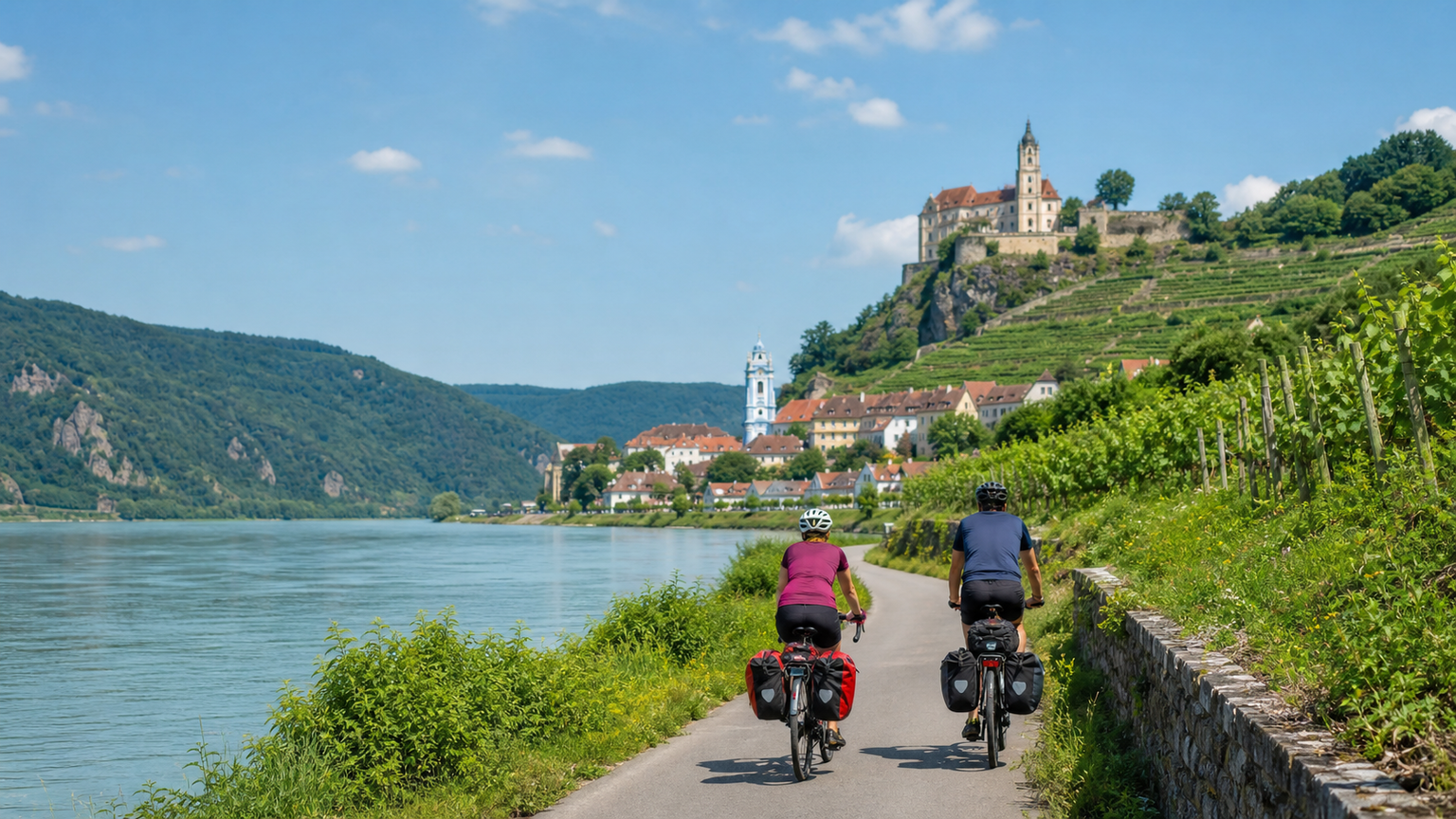
The Wachau Valley is a roughly 36-kilometer stretch of the Danube lined on both banks by steep, vineyard-covered slopes, with medieval castles and monasteries dotting the hilltops. The scenery here is the best the route has to offer:
- Melk Abbey (Stift Melk): A masterpiece of Baroque architecture, this gilded abbey perches on a rocky bluff above the Danube and marks the western gateway to the Wachau Valley
- Spitz an der Donau: A tranquil town encircled by vineyards, where local wineries offer tastings of Grüner Veltliner, the region’s signature white wine
- Dürnstein: Its blue church tower is the iconic image of the Wachau Valley. Legend has it that England’s King Richard the Lionheart was once held prisoner in the castle ruins above the town
- Krems: The eastern gateway to the Wachau Valley, with a beautifully preserved old town that comes alive during the autumn grape harvest festivals (Heuriger)
After leaving the Wachau Valley, it’s another 80 kilometers or so to Vienna. The final stretch into the city follows Donauinsel (Danube Island) — an artificial island and one of Vienna’s most beloved recreational spots.
Accommodation
There’s no shortage of places to stay along the Danube Cycle Path. Beyond regular hotels and guesthouses, the route features a distinctive style of lodging: Radlerquartier (cyclist-friendly guesthouses). These specially marked accommodations cater to touring cyclists and typically offer:
- Secure bicycle storage
- Basic repair tools and a pump
- Early breakfast service (for early departures)
- Facilities for washing and drying cycling gear
- Route information and maps
A night’s stay usually costs between 40 and 80 euros, breakfast included. During peak season (July and August), popular spots can fill up quickly, so booking ahead is recommended.
Luggage Transfer Service
One of the most convenient features of the Danube Cycle Path is its luggage transfer service. Several tour operators and logistics companies offer this: simply leave your bags at your hotel’s front desk before setting off each morning, and by afternoon they’ll be waiting in your room at that night’s destination. This means you can ride light, without lugging heavy panniers. The typical cost is 8-12 euros per bag per day.
Best Season
- Best: Late May to June (late spring — warm but not hot, with flowers in bloom) and September to October (autumn, grape harvest season, when the Wachau Valley’s vineyards turn gold)
- Good: July to August (summer — hot, but with long daylight hours)
- Avoid: November to March (winter — cold with short daylight hours, and many guesthouses and restaurants closed)
Extending the Route
If Vienna leaves you wanting more, the Danube Cycle Path can be extended further:
- Vienna → Bratislava (capital of Slovakia): About 65 km, doable in a single day
- Bratislava → Budapest (capital of Hungary): About 200 km, 3-4 days
- Budapest → Belgrade → Black Sea: About 1,500 km, suited to long-distance travelers with plenty of time
The “Passau–Budapest” route (about 600 km) is also a very popular option, letting you experience the culture and scenery of Austria, Slovakia, and Hungary in a single trip.
Gear Recommendations
The Danube Cycle Path doesn’t require any special equipment, but a few points are worth noting:
- Bike type: A touring bike or city bike is best suited to this route; the narrow tires of a road bike may feel uncomfortable on gravel sections
- Panniers or handlebar bag: If you’re not using a luggage transfer service, you’ll need enough storage capacity
- Rain gear: Central European weather is changeable, and rain can arrive at any time
- Bike lock: The route is generally very safe, but it’s still wise to lock your bike whenever you park it
- Offline maps: Komoot or Bikeline’s Danube Cycle Path maps are the most popular navigation tools
Conclusion
The charm of the Danube Cycle Path lies in its accessibility. It won’t test your fitness with steep mountain climbs, won’t challenge your preparation with long stretches devoid of supplies, and won’t threaten your safety with poor road conditions. It simply flows quietly alongside one of Europe’s greatest rivers, carrying you through a thousand years of history, past vineyards and castles, through peaceful villages and magnificent monasteries.
Whether you’re a complete newcomer to long-distance cycling or a seasoned rider who has conquered countless mountain passes, the Danube Cycle Path will give you memories worth keeping. Some routes exist to challenge you. The Danube Cycle Path exists to be enjoyed.
Grab your bike, follow the Danube, and ride on — slowly, and happily.
Related Reading
- Dolomites, Italy: The World’s Most Beautiful Mountain Cycling Roads
- The World’s Top 10 Cycling Tour Routes: The European Alps, Colorado, and New Zealand’s South Island
- An Overseas Cycling Pilgrimage: Notes from Conquering Italy’s Dolomites
- Northern Taiwan’s Best Cycling Route: A Weekend from the Tamsui River Path to Shimen Reservoir
日本自助單車旅,茨城絕景路線/ 新手也可以體驗 / 4K空拍絕景 / 機票省錢大法 / 單車友善旅館 / 國家級霞之浦180K自行車道 / feat. 緯緯 / CT Yeh
1 年前
[海外單車] 日本 茨城 霞之浦單車 銀杏 慢遊體驗
7 年前
日本島波海道 EP2 / 自行車神社拜什麼?/ 整天都大景 太離譜啦!/大三島 to 尾道/公路車 / CT Yeh
2 年前
日本島波海道 EP1 / 五大絕景路線之一! / 私房溫泉 x 豪華單車客棧 / 今治 to 大三島 / 公路車 / CT Yeh
2 年前
南竿 單車 | 老婆公路車首航 | 偽出國體驗 | 4K 高畫質 | 綠色騎跡低碳輕旅遊 | #公路車
5 年前
半日 小台灣 極限單車路線挑戰實錄
7 年前
馬祖北竿單車體驗遊 | 被歐兜賣集體80差點摧不動 | 兩台公路車上飛機超重費...? 4K高畫質
5 年前
密境!雙灣自行車道 / 環法日月潭 x YAKIMA 百人大約騎 / 公路車 / CT Yeh
11 個月前