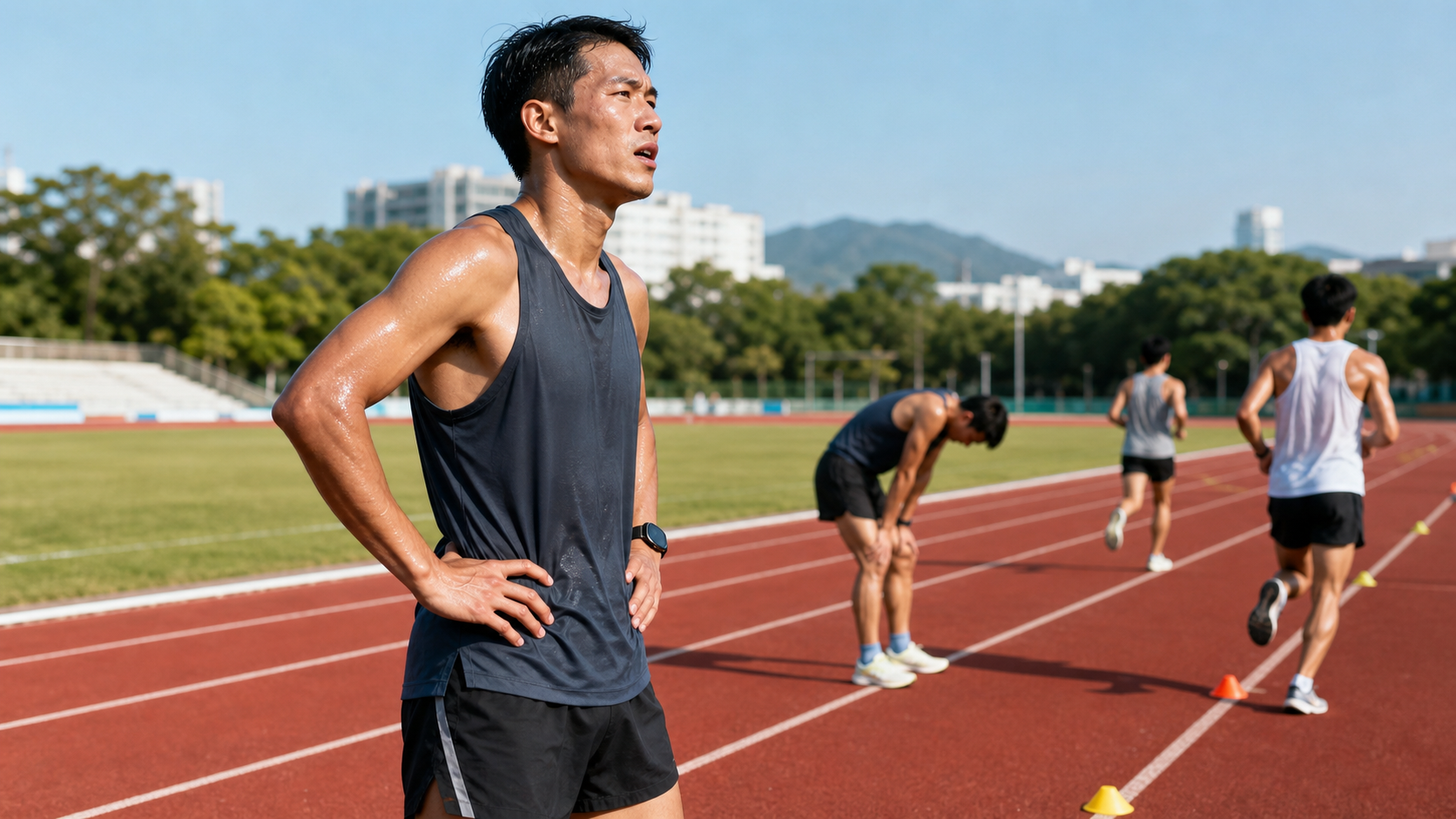
Opening: Why Systematic Training
Many Taiwanese runners’ goal is not “faster,” but “to improve consistently without injury every time.” This article breaks training down into monitorable units, first replacing imagination with measurable indicators.
1. Goals and Measurement
Interpreting lactate response in interval training is not just about chasing mileage, but also about repeatability.
- Indicator 1: Weekly total mileage and time.
- Indicator 2: Resting/morning heart rate.
- Indicator 3: Subjective fatigue (0–10).
2. Core Techniques: Rhythm, Cadence
Excessively high cadence is not a cure-all; it is recommended to first stabilize breathing and foot feel, then make minor adjustments to cadence. Taiwan’s humid roads have a greater impact on landing response, so ground contact deserves more attention than on dry sections.
3. 8-Week Training Prescription
| Week | Focus | Operation | Check Indicator |
|---|---|---|---|
| Weeks 1–2 | Build base mileage | 3 sessions per week, including 1 easy-paced run | Steady breathing, RPE ≤3 |
| Weeks 3–4 | Increase frequency and stride control | 4 sessions per week, add 1 pace variation | Fine-tune cadence, stable gait |
| Weeks 5–6 | Add tempo and short intervals | 5 sessions per week, 1 tempo + 1 recovery | Maintain stable gait after intervals |
| Weeks 7–8 | Race simulation and fueling | Long run + fueling rehearsal | Monitor heart rate drift and foot feel |
4. Injury Prevention and Correction
- Keep weekly total volume increases within 5–10% to avoid sudden spikes.
- If any pain indicator does not subside for 48 consecutive hours, stop high-impact training and revert to recovery.
- At least once a week, test breathing rhythm at a conversational pace to rediscover a comfortable cadence sustainable over long periods.
- Monitor morning heart rate and sleep quality; lower intensity when both are elevated.
5. Nutrition and Hydration
In hot conditions, hydrate before consuming sugar; it is recommended to take small amounts every 30–40 minutes to avoid gastrointestinal discomfort from concentrated intake.
6. Recovery and Sleep
Sleep is free “advanced training.” Include at least 1 unloading day per week to avoid cumulative fatigue across cycles.
7. Common Myths
- Myth: Running fast = good.
- Truth: Completing every session steadily is progress.
- Myth: Not being able to stop shows strong willpower.
- Truth: Knowing when to stop is for long-term output.
8. Routes and Scenario Application
When transitioning environments, schedule tempo on flat days, add short sprints on hill days, and switch to safe walking and light training on rainy days—prioritizing training consistency above all.
9. Academic Research References
- “The risks and benefits of running barefoot or in minimalist shoes: A systematic review” shows that barefoot/minimalist shoes alter gait, but there is no consistent evidence of reduced long-term injury rates.
- Research results typically describe trends; individualization still requires 6–12 weeks of observation.
Key Takeaways
- Control the “intensity, recovery, risk” triangle simultaneously.
- Review data regularly each week and adjust the following week’s plan.
- Running’s value lies not only in speed; durability and recovery ability are equally important.
Related Reading
- Running Special Feature | Interpreting Lactate Response in Interval Training (R096)
- Running Special Feature | Interpreting Lactate Response in Interval Training (R075)
- Running Special Feature | Interpreting Lactate Response in Interval Training (R012)
- Running Special Feature | Interpreting Lactate Response in Interval Training (R054)
西進武嶺 免費訓練分析服務 Intervals | 練不夠還是練過頭?你哪一種類型選手?AI模型告訴你! | 備戰神器 | 公路車 訓練 | CT Yeh
4 年前
一個測試有沒有認真練車的方法😂 #公路車
10 個月前
2019 柯P 超越北高 第一集團實錄 (11小時實錄請參考另一部影片) 一日雙城 一日北高 NeverStop Taiwan Long Distance Cycling Challenge
7 年前
Live) 備戰2019彰化經典百K 賽前攻略 (已完賽請看新影片
7 年前
一日北高/長距離團騎 常見問題補充篇 / 組團或跟團的眉角 / 壯車友容易被瘦車友慢性拉爆 / 原來屁股痛可能是這個原因...? / 風場配速法 / 公路車 / CT Yeh
2 年前
[教學] Premiere 影片 手震 修正 教學 防抖 單眼 影像 GoPro 穩定 Video Stabilization
8 年前
實景訓練台) 彰化經典百K 高強度喵團 90分鐘 跟著一起練功 2019 Indoor workout Changhua Classic 100 Taiwan
7 年前
FTL 與 SYB 車隊專訪 西進武嶺 實用攻略分享! 2小時 如何練?!你不知道的眉角!新手準備武嶺必看 EP1 | 實力派女車友 | 精華版 | 公路車 | CTYeh
4 年前