[Race Practice] Twin Cities Challenge (Beiyi Highway + Northern Coast) Complete Guide: Aerobic Pacing and Nutrition Strategy for the Rolling Section from Fengguizui to Jiufen, and Pre-Race Tapering Guide: 2026 Latest Sports Medicine Perspectives
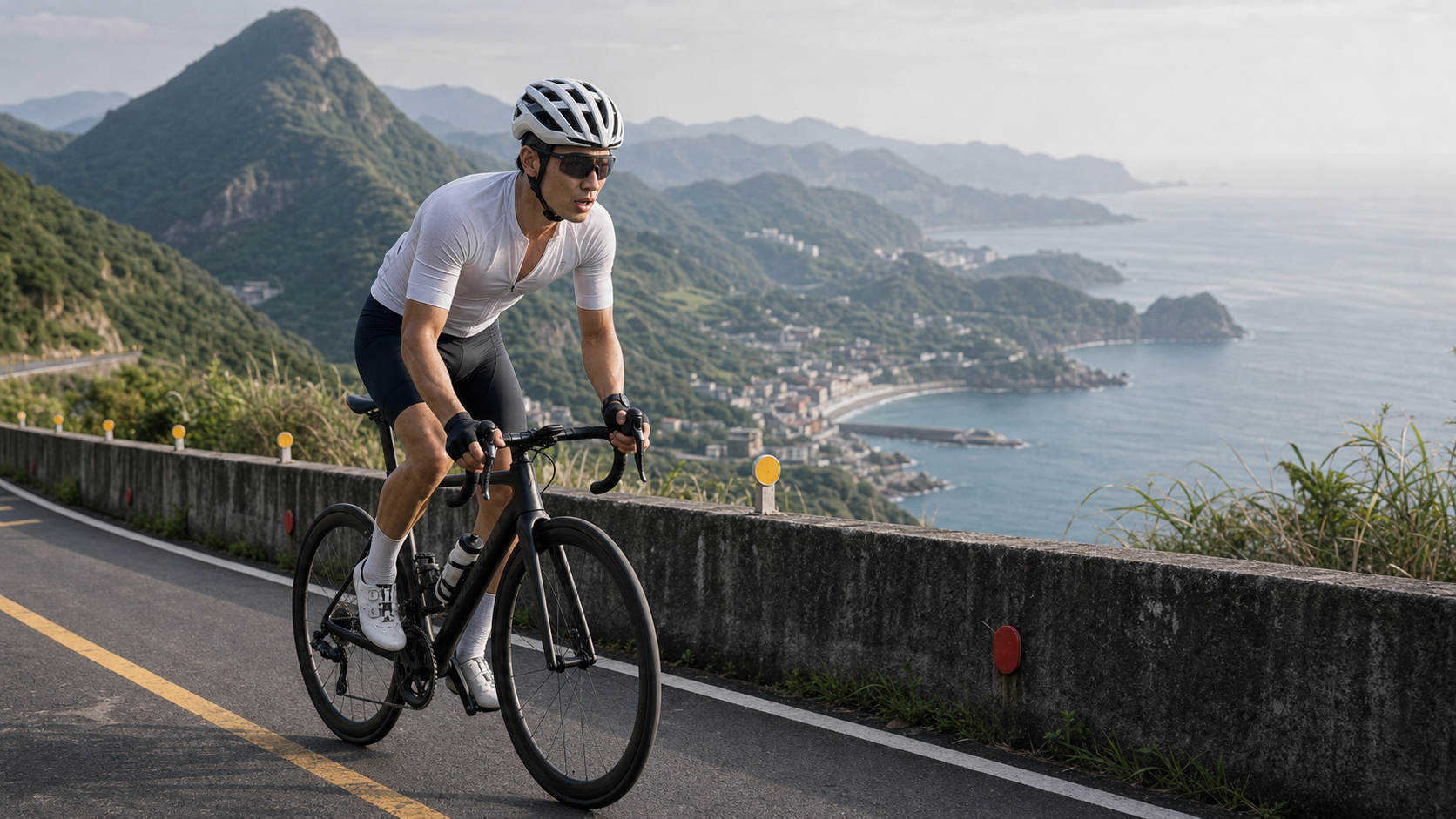
This kind of “Twin Cities Challenge” topic is often used interchangeably in the northern Taiwan cycling community, referring to two versions: one centered on the long climb of Beiyi Highway + long-distance recovery along the Northern Coast; the other is a mountain-and-sea alternating challenge like Fengguizui climb + Wanli North Coast + Ruifang Jiufen/Buyanting. The routes aren’t exactly the same, but the limiting factors they impose on the body are very similar: you first endure a long period of aerobic output, then enter rolling terrain disturbed by wind and topography, and finally, when glycogen is running low and your neck, shoulders, and lower back are starting to stiffen, you still have to complete several 5-to-20-minute climbs with repeated accelerations and decelerations.
Therefore, this article takes a more practical approach: instead of fixating on a single official GPX file, we build a pacing, nutrition, and tapering model that can be applied simultaneously to the Beiyi long climb, the North Coast headwind rollers, and the final climb into Jiufen. If you regularly ride Beiyi, Fengguizui, Wanli, Keelung Waimushan, or Ruifang to Jiufen, this method can be applied directly to your challenge day.
1. First, Define the Real Difficulty of This Challenge: It’s Not a Single Climb Race, but “Variable Power Tolerance After Prolonged Aerobic Effort”
Official tourism data shows that the Beiyi Highway main line connects Taipei and Yilan, with a total length of approximately 58 km; the common Fengguizui climb, measured from near the National Palace Museum, is about 7.5-8.5 km with an elevation gain of roughly 430-470 meters and an average gradient of about 5.5-5.7%. Extending further along the North Coast, the Wanjin Bike Path itself is about 15 km, while the stretch from Ruifang to Jiufen and Buyanting is a classic winding climb with expansive views. In other words, this type of Twin Cities long-distance challenge is not like a hill climb race that blows you up in one go, nor is it like a flat time trial that locks you into a fixed wattage for a long time—it’s a composite event somewhere in between.
Breaking it down into physiological limiting factors, there are roughly four:
- Prolonged sub-threshold output in the early section: Beiyi or Fengguizui will put you into a long seated pedaling effort, primarily depleting glycogen and testing muscular endurance.
- Coastal wind and false flats in the middle section: The North Coast may not look like big mountain roads, but headwinds, crosswinds, and continuous short climbs amplify power fluctuations.
- Repeated short-climb ability in the final section: Once you enter the Ruifang, Jiufen, and Buyanting area, you’re not facing a single mountain, but repeated gear changes under fatigue.
- Low margin for error in nutrition: If you eat too little in the first 2 hours, the final 60 to 90 minutes can easily bring on high-cadence grinding, pre-cramp signs, decreased focus, or delayed descending judgment.
So the core ability for this challenge isn’t pure FTP, but rather:
Finish-line output quality = prolonged aerobic stability × variable power tolerance × nutrition execution rate
2. The Pacing Principle Isn’t “Average Wattage,” but “Save the High Watts for Sections Where They Actually Pay Off”
The key finding in road bike time trial and pacing research is clear: when terrain or wind conditions change, moderately increasing output on climbs and into headwinds, while actively backing off on descents and tailwinds, is generally more efficient than stubbornly holding a completely fixed power. The reason is simple: speed is more affected by power in the low-speed range. The extra watts you put out on a climb or into a headwind buy you more time than hammering hard on a fast, tailwind section.
But this principle has a prerequisite: you need a “daily cap” first. For most riders aiming to complete a 4-to-7-hour Twin Cities-style challenge, I suggest using the following ranges as a starting point:
IF = NP / FTP
| Level | Daily Target IF | Acceptable IF on Long Climbs | Short-Climb Sprint Cap |
|---|---|---|---|
| Finish-oriented | 0.68-0.72 | 0.78-0.82 | No more than 110% FTP |
| Advanced endurance | 0.72-0.76 | 0.82-0.87 | No more than 115% FTP |
| Competitive | 0.76-0.80 | 0.87-0.92 | Brief spikes depending on race situation |
The most important thing about this table isn’t the numbers themselves, but the order behind them:
- Don’t use “it feels easy” as a reason to add watts in the early section. Because in the first 60 minutes, glycogen, the nervous system, and body temperature are still in a favorable state, and mis-paced overexertion usually happens here.
- On long climbs, chase steadiness, not heroics. If you push an extra 15-20W in the first half of Beiyi or Fengguizui, you’ll often pay it back over 40-60 minutes on the North Coast and the Jiufen final section.
- On coastal false flats, suppress your ego. Low speed into a headwind is normal; don’t drag yourself into the lactate zone just to maintain your speedometer reading.
- The places where you should genuinely raise output are the 2-to-8-minute key climbs, positioning points, or headwind bridge sections—not every spot that merely looks “not too steep.”
3. Break the Route into Segments, and Pacing Becomes Executable: The 5-Segment Model for Twin Cities Challenges
Whether you’re doing the Beiyi main-line version or the Fengguizui-Wanli-Jiufen version, I recommend splitting the day into five segments.
| Segment | Physiological Task | Recommended Approach | Most Common Mistake |
|---|---|---|---|
| Start to first main climb | Warm up, find rhythm | Stay conservative for 15-20 minutes, let heart rate and breathing sync up | Charging off with the group right out the door |
| First main climb | Establish steady all-day output | Lock into an intensity where you can speak short sentences but not chat | Over-pacing for Strava or pride |
| Descent and transition | Eat, drink, relax the upper body | Get in the food you couldn’t eat on the climb | Chasing riders on the descent without eating or drinking |
| North Coast rollers and wind | Control power fluctuations | Add a bit into headwinds, back off a bit with tailwinds, never surge recklessly | Emotional wattage spikes because speed drops |
| Ruifang/Jiufen final section | Finish with remaining glycogen | Take one last gel before entering, reduce standing sprint frequency | Hitting the final section on an empty stomach and blowing up |
If you have a power meter, here’s a very practical execution rule:
Long climbs: cap at 105-112% of target NP
Short climbs (<3 min): cap at 115-120% of target NP
Descents/tailwinds: actively recover to 70-85% of target NP
For example, a rider with an FTP of 250W and a daily target IF of 0.74 would have a target NP of approximately:
250 × 0.74 = 185W
So their long climbs should generally be controlled within 195-207W, and short climbs shouldn’t repeatedly exceed 213-222W. This kind of “bounded variable power” is usually more sensible than stubbornly locking in 185W the whole way, and far smarter than hitting 260W every time you see a hill.
4. Fueling Strategy Must Match the Terrain, Not Just “Eat When You Remember”
Recent reviews of pro road racing fueling show that on-bike carbohydrate intake in professional cycling has risen from the early common 30-60 g/h to 90 g/h, and even 120 g/h under specific conditions. There is also a stronger emphasis on gut training and contextual fueling. This direction matters just as much for amateur Taipei-Shuangxi challenges, but the numbers can’t be copied straight from pro teams.
For most 4-to-7-hour northern Taiwan long-distance challenges, here’s how I’d tier it:
| Ride Duration | Carb Recommendation | Who It Applies To |
|---|---|---|
| Under 3 hours | 40-60 g/h | Moderate intensity, finish-oriented riders |
| 3-5 hours | 60-75 g/h | Most Taipei-Shuangxi challenge riders |
| Over 5 hours or race intensity | 75-90 g/h | Those who have done gut training |
| Above 90 g/h | Requires gut training | Not recommended to experiment on your first challenge day |
Fueling isn’t just about the hourly total—it’s about when you can actually get it down. On climbs like Fengguizui, Beiyi, Xiaogetou, and Ruifang to Jiufen, you’re often in corners, traffic, or breathing hard and don’t want to chew. So you need to proactively eat on descents and transition sections. My advice:
- Eat on a fixed 20-minute schedule—don’t wait until you’re hungry.
- Put solid food in the first half; switch to gels, chews, and sports drinks in the second half.
- Front-load the final 60-90 minutes of fueling—don’t wait until you reach Jiufen to refuel.
Use this simple formula to estimate your intake rate:
Carb target per 20 min = hourly carb target ÷ 3
If your target is 75 g/h, that means roughly 25 g of carbs every 20 minutes. That usually equals:
- 1 small gel, or
- Half an energy bar + a few sips of sports drink, or
- 1/2 rice ball + 1/3 bottle of high-carb drink
5. In Northern Taiwan’s Summer Heat and Humidity, Hydration Slips Out of Control Faster Than You Think
Endurance sports nutrition literature has long pointed out that one of the most common sources of fatigue during prolonged exercise is dehydration combined with carbohydrate depletion. The literature also warns that body weight loss beyond roughly 2-3% tends to start hurting performance. But the other extreme is also risky—overdrinking can lead to hyponatremia.
In practice, I break hydration for a Taipei-Shuangxi-style challenge into three layers:
1. 1-2 Hours Before the Start
- About
500 mLof fluid - With a small amount of sodium and carbs
- If it’s hot and humid, you can take small sips of 150-250 mL 15 minutes before the start
2. During the Ride
The broad range in the research literature goes up to 600-1200 mL/h, but that’s a wide experimental/race range. For a typical challenge day in northern Taiwan, I’d suggest testing within these ranges first:
| Climate | Fluid Intake | Sodium Concentration Recommendation |
|---|---|---|
| Cool and dry | 450-600 mL/h | 400-600 mg/L |
| Generally hot and humid | 550-750 mL/h | 500-700 mg/L |
| High summer, very humid | 650-900 mL/h | 600-900 mg/L |
If you’re taking in 600 mg sodium per liter and drinking 700 mL per hour, you’re getting:
0.7 L × 600 mg/L = 420 mg sodium per hour
For most heavy-sweating riders, that’s far more reasonable than plain water.
3. Post-Ride Rehydration
Weigh yourself. Use this formula to estimate your sweat rate:
Sweat rate = (pre-ride weight - post-ride weight + fluid consumed during ride - urine output) ÷ ride duration in hours
Without this data, your next hydration plan is just a guess.
6. Pre-Race Tapering Isn’t “Just Ride Less”—It’s About Removing Fatigue While Keeping the Rhythm
A 2023 systematic review and meta-analysis of tapering in endurance sports showed that reducing training volume by roughly 41-60%, while maintaining intensity and frequency, with a taper length within 21 days, generally improves time-trial or endurance performance. This finding matters because most amateur riders don’t get tapering wrong by skipping it entirely—they get it wrong by:
- Cutting volume but dropping intensity too, leaving their legs feeling flat.
- Claiming to taper, but still cramming in a big training block the week before the race.
- Overeating and sleeping erratically during the taper week, so fatigue never actually drops.
For a Taipei-Shuangxi challenge, I recommend a 10-14 day taper. Example:
| Timing | Volume | Key Content | Purpose |
|---|---|---|---|
| 14-10 days before race | 80-85% of normal peak volume | Keep one long aerobic ride, one tempo/sweetspot session | Last full stimulus |
| 9-5 days before race | Drop to 60-70% | One short tempo, some leg-opening high cadence | Start unloading fatigue |
| 4-2 days before race | Drop to 40-50% | 45-75 min easy ride + 3-5 short leg openers | Maintain neural activation |
| Day before | 30-45 min very easy | 3-4 sets of 30-60 sec cadence wake-ups | Just feel fresh, not stimulated |
Carb loading in the two days before the race doesn’t need to be elevated into the old-school extreme supercompensation ritual, but you should raise the carb proportion and avoid high-fiber, high-fat, or first-time foods. If you’re prone to gut sensitivity, keep the pre-race dinner as simple as possible.
7. Actually Applying the 2026 Perspective to Northern Taiwan Routes: Contextual Fueling and Contextual Pacing
The so-called “latest 2026 sports medicine perspective” isn’t about a magic formula—it’s about these points becoming increasingly consistent:
- Fueling must be individualized: Two riders at the same 70 kg—Rider A feels great at 90 g/h of carbs, Rider B gets bloated at 60 g/h.
- Early-race energy demand is higher than previously thought: More research and practical observation now indicate that road races often enter a high-expenditure rhythm much earlier than expected.
- Caffeine works, but not if you just throw it down randomly: A 2024 meta-analysis on cyclists in time trials showed that a moderate dose of
4-6 mg/kgis most likely to improve performance, while1-3 mg/kgmay not be significant.
Translated into practical terms for a Taipei-Shuangxi challenge:
- If you haven’t trained high-carb intake, don’t force
90 g/hon challenge day. - If you’re sensitive to caffeine, don’t use a race dose for the first time just because a study says it works.
- If you know you tolerate caffeine well, consider splitting the total dose into part before the start and part before the final climbs, rather than slamming it all at once.
The key concept here is: You’re not applying a paper—you’re translating a paper into a process you can execute on the day.
8. The Most Common Failure Pattern Is Almost Always “Too Confident Early, Too Reactive Late”
For a mixed mountain-and-coast challenge in northern Taiwan, the classic blow-up script usually looks like this:
- Feeling great on Fengguizui or the early Beiyi section, pushing 20W more than planned.
- Too busy chasing wheels on the descent, missing the first round of fueling.
- Getting emotional about watts on the north coast headwind because the speed looks bad.
- Blood sugar starting to drop before Ruifang or Jiufen, but still telling yourself “just hold on a bit longer.”
- In the final 30-45 minutes, pre-cramp signs, stiff lower back, can’t hold the saddle, and the whole rhythm falls apart.
So your checkpoints shouldn’t be “am I feeling strong right now?” but rather:
- Am I eating on schedule?
- Is my current output matching the return on time for this section?
- Do I still have clear legs and fueling margin heading into the final stretch?
9. Conclusion: The Real Test of the Taipei–New Taipei Challenge Isn’t Burst Power, but All-Day Decision Quality
Whether you call this route the Beiyi plus Northern Coast, or the mountain-to-sea link from Fengguizui to Jiufen, what truly determines success or failure isn’t any single KOM—it’s whether you can maintain steady decision-making, consistent fueling, and stable power distribution after prolonged aerobic output.
If this article could be distilled into its core execution principles, they’d be these three:
- Being conservative early isn’t weakness—it’s preserving glycogen for the later stages.
- Fuel ahead of time; don’t wait until you’re hungry, thirsty, or cramping to act.
- You can push a little more on climbs and into headwinds, but if you’re pushing all day, that’s not strategy—that’s losing control.
Those who get these three things right are usually not the flashiest riders in the first 30 minutes, but they’re often the ones who can still steadily close out the final 60 minutes through the Jiufen section. For a long-distance challenge like the Taipei–New Taipei route, that’s the most valuable ability of all.
Related Reading
- Complete Fengguizui Climbing Technique Analysis: Training Tips from the North’s Sacred Ground
- Yilan Beiyi Highway Riding Guide: The Challenging Route from Taipei to Yilan Over the Snow Mountain Range
- Classic North Coast and Northeast Corner Routes: The Complete Guide to Fengguizui, Balaka, and Buyanting
- South Cross-Island Eastbound Practical Guide: Full Breakdown of the Category 5 Battle from Chulai to Xiangyang—48 km, 2,074 m of Climbing
風櫃嘴時間 預測西進武嶺時間?13000名車友統計數據分析告訴你 !
5 年前
台北闊瀨陡坡 騎旅 / 日本單車雜誌編輯車友臨時加入!/ 髮香才是最強的 / feat. 北迴歸線小隊 / 公路車 CT Yeh
6 個月前
風櫃嘴 | 全台最多大砲的單車路線 | 尋寶網攝影師告訴你怎麼擺拍起來才好看 | 熱門攝影地點巡禮
6 年前
#公路車 台北 #風櫃嘴 23:47 全台單車實境請訂閱鎖定
7 年前
一日北高前的高裝檢 | 北高 360 | 挑戰11小時的裝備 | 一日雙塔 | 補給
6 年前
備戰 戀戀197 賽前關門點分析 西濱團練 #公路車 4K高畫質
6 年前
大禹嶺 到 武嶺牌樓 全程前後實況錄影 | 北進武嶺 | 東進武嶺 | KOM | 訓練台 | 坡度分析 | Taiwan KOM Last 10 km HARD | 公路車
6 年前
#公路車 #西進武嶺 配速配瓦實驗 坡度分析 四小時內攻略 建大盃 NeverStop #西進武嶺攻略
6 年前