Kona World Championship Full Analysis: From 1978 to Today's Ironman Holy Land, Course Conditions, and the KQ Qualification System
Coach’s Opening: Why Every Triathlete Has a Kona in Their Heart
After fifteen years of coaching, I’ve seen all kinds of athletes staring blankly at registration pages. Some want to finish their first 226 (full-distance Ironman), some want to beat their personal best (PB), but the one word that truly makes their eyes light up and their speech start to stammer is always the same—Kona.
I remember coaching an engineer in his early forties; let’s call him A-Jhe. He wasn’t a naturally gifted athlete. He’d taken up swimming late, and he’d even had knee surgery from running. But he told me, “Coach, I don’t care about my time. I just want to stand at the start on Ali’i Drive once.” At that moment, I knew that this small town on the Big Island of Hawaii had become more than just a race for triathletes—it was a belief.
In this article, I want to use a coach’s perspective to walk you through the whole Kona story from start to finish: how it went from a drunken argument to the World Championship, why that Queen’s Highway in Kailua-Kona can blow even elite athletes into doubting their existence, and the thing most people get confused about—how KQ (Kona Qualification) is actually calculated. After reading this, even if you’re not planning to go this year, you’ll understand the ins and outs of this sport better and be able to plan your season with a clearer head.
1. History: How a Drunken Argument Became the Holy Land of Triathlon
1.1 The “Who’s Toughest” Bet in 1978
Many people think triathlon was the carefully designed product of some sports science team. It wasn’t. Its origins are quite “street-level.”
According to records, in 1977, at the awards ceremony of a running relay race on Oahu, Hawaii, members of the Mid-Pacific Road Runners Club and the Waikiki Swim Club got into an argument over “which type of athlete is the toughest.” A US Navy commander present, John Collins, chimed in: reportedly, cyclist Eddy Merckx had the highest VO2 max ever recorded among athletes at the time, so maybe cyclists were the toughest.
The argument reached no conclusion, so Collins proposed: why not just string together three existing endurance races on the island—the Waikiki Roughwater Swim, the Around-Oahu Bike Race, and the Honolulu Marathon—and do them back-to-back, to see who could survive to the end. Whoever finished would be the “Ironman.”
On February 18, 1978, the first race took place on Oahu, with only 15 people on the starting line. In the end, 12 finished. The champion was a taxi driver and fitness enthusiast named Gordon Haller, with a time of 11 hours, 46 minutes, and 58 seconds. Interestingly, he exited the water only eighth, but thanks to the fastest bike split of the day (about 6 hours 56 minutes), he passed the leader around mile 21 of the marathon to take the win. This script of “coming from behind late in the race” would play out countless times in Kona later.
Coach’s Note: The distance of that first race was exactly what we know today: a 3.8 km swim, 180 km bike, and 42.195 km run. This wasn’t a scientifically calculated “optimal training distance”; it was simply the length of three existing races strung together. So next time someone tells you “the 226 distance has some sacred physiological meaning,” you can smile—it’s actually a historical accident.
1.2 Moving to the Big Island in 1981: The Birth of the Holy Land
After a few editions on Oahu, the race moved to Kailua-Kona on the Big Island of Hawaii in 1981. From then on, the name Kona became synonymous with the “Ironman World Championship.”
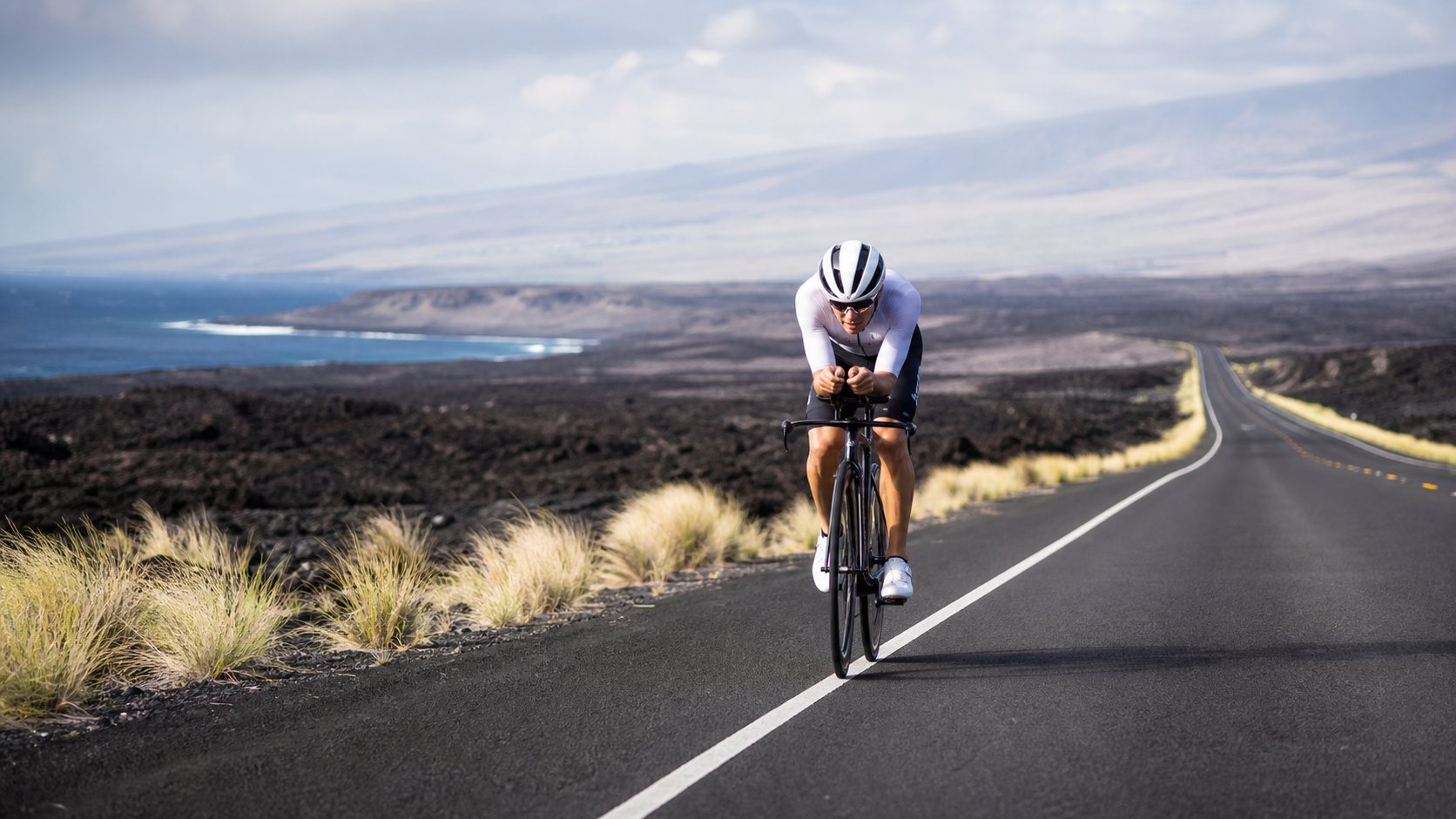
Why was the Big Island so crucial? Because it took the difficulty to another level entirely. Oahu had cities and shelter, but the Big Island course runs mostly through barren lava fields, with no shade, no buildings, and nothing to block the wind or sun. This almost cruel environment is exactly what cemented Kona’s legendary status—it doesn’t just test your physical fitness; it tests your willpower and strategy under extreme conditions.
1.3 From Broadcast to Global Phenomenon
What truly brought Kona to the world was television. In 1982, that famous image—Julie Moss collapsing before the finish line and crawling to complete the race—was broadcast worldwide, making countless viewers understand for the first time “what it means to burn yourself to the absolute limit.” That image, in a way, defined the Ironman spirit: it’s not about how fast you run, but whether you’re willing to keep moving forward on the edge of collapse.
Over the years, Kona has grown from a bet among fifteen people into a world stage that hundreds of thousands of amateur athletes worldwide are desperate to get into. Its threshold—the qualification system we’re about to discuss—is the most realistic and anxiety-inducing part of this story.
1.4 From Grassroots to Global Industry
It’s worth noting that Kona’s growth isn’t just about more athletes; the entire ecosystem has grown with it. From a few friends seeing who could survive, to now having a professional division, an age-group division, and a qualification network of dozens of qualifying races worldwide, triathlon has become a mature endurance sports industry. Equipment technology (aero frames, carbon fiber, nutrition science) has evolved continuously, and training methods have progressed from “just train hard” to emphasizing intensity distribution, recovery science, and periodization.
But interestingly, no matter how much technology advances, the core difficulty of Kona has never changed—it tests whether a person can maintain rationality, execute strategy, and refuse to break down under extreme heat and wind. This is a challenge no equipment can solve for you, and it’s why Kona remains as brutal as ever even as gear gets better.
For Taiwanese athletes, this path is actually getting clearer: build up from domestic standard-distance and half-distance races, accumulate experience, then challenge overseas qualifying races, and step by step approach that KQ slot. It’s no longer an unreachable myth, but a path that requires years of patient effort—yet is genuinely attainable.
2. The Course: Why the Queen’s Highway Is a “Meat Grinder”
To understand why Kona is hard, you first need to know its main character—Queen Ka’ahumanu Highway (the Queen K). Most of the bike leg’s out-and-back runs along this road through the lava wasteland, and its two biggest killers are: heat and wind.
2.1 Heat: The Double Oven of Lava and Asphalt
According to race data and weather analysis, temperatures on race day in Kona typically range from about 28 to 35°C (82 to 95°F), sometimes exceeding 38°C. But that’s just “air temperature.” The real problem is the reflected heat from the lava terrain and asphalt—the actual perceived temperature athletes experience on the Queen K can approach or exceed 38°C on some sections.
Humidity doesn’t let up either. In the coolest early morning hours, humidity can be as high as 85%, dropping to about 40% during the hottest afternoon period. This combination of “hot and muggy, then transitioning to dry heat” is a nightmare for heat dissipation.
Coach’s Interpretation: Taiwanese athletes actually have an underestimated advantage—our hot, humid summer training environment is somewhat similar to Kona’s. Going out for a ride at noon in July or August in the Taipei Basin, with that asphalt-reflected heat plus high humidity, is essentially a natural heat-acclimatization training ground. I often tell my athletes, don’t always hide in the gym with air conditioning; moderate afternoon heat training (done safely) is actually a hidden benefit for Taiwanese athletes preparing for Kona. Of course, heat acclimatization must be gradual, and hydration, electrolytes, and watching for heatstroke symptoms are all non-negotiable.
2.2 Wind: The Crosswinds That Make Even Elites Doubt Themselves
If heat is chronic torture, wind is random violence.
The Queen’s Highway is famous for its strong and unpredictable crosswinds. According to weather and race analysis data, on a typical day, sustained crosswinds range from about 8 to 24 km/h (about 5–15 mph), but on bad days, crosswinds on certain sections can approach nearly 90 km/h or more, with gusts that are impossible to anticipate.
The most notorious section is the climb and descent toward the Hawi turnaround (roughly in the middle-to-late part of the bike leg), where wind can come from all directions, completely unpredictable. One moment you’re on your aero bars trying to hold your position, the next a gust shoves your entire bike toward the oncoming lane.
2.3 Course Section Overview
Breaking the entire course down, each section presents very different challenges:
| Segment | Approximate Location | Main Challenge | Coach’s Reminder |
|---|---|---|---|
| Swim 3.8 km | Kailua Bay | Saltwater buoyancy, currents, crowded pushing | Don’t sprint at the start; finding your rhythm matters more than saving seconds |
| Bike – early | Ali’i Drive → Airport → Queen K | Wind picking up, temperature rising | This is where it’s easiest to “feel great” and over-ride; hold your power back |
| Bike – middle | Climb to Hawi turnaround | Chaotic crosswinds, climbing, gusts | Keep your hands low, grip the drops, abandon trying to hold an aero position |
| Bike – late | Hawi turnaround back on Queen K | Headwinds, accumulated lava-reflected heat | Don’t disrupt your fueling rhythm; this is where heat tolerance starts to matter |
| Run 42.195 km | Ali’i Drive → Queen K → Energy Lab | Heat, no shade, mental low point | Energy Lab is the legendary “hell”; pace yourself with margin |
Coach’s Insight: The biggest mistake many first-time long-distance triathletes make happens when they “feel great on the early bike.” The first half of Kona’s Queen K often gives you a false sense of tailwind and coolness, so a bunch of people get excited and push their power up. Then when the wind shifts and the heat accumulates in the middle-to-late stages, all that overdraft from earlier comes due. In Kona, “feeling easy” in the early stages is a trap, not a gift.
2.4 The Swim and Transitions: Two Underrated Keys
Everyone focuses on the bike and run when talking about Kona, but the swim and transitions actually hold a lot of nuance.
The Kona swim takes place in the saltwater of Kailua Bay. Saltwater provides better buoyancy than freshwater, which is good news for poor floaters, but the ocean currents, swells, and the jostling of thousands of people starting simultaneously can spike the heart rate and disrupt rhythm for those unaccustomed to open water. I often remind my athletes: the goal of the swim isn’t to swim fast, but to “exit the water as efficiently as possible while keeping your heart rate and emotions under control.” What you save in the swim isn’t a few seconds—it’s the energy and focus you’ll need for the next ten-plus hours.
The transition areas (T1 bike mount, T2 run start) are where most people “waste time for nothing.” I’m not telling you to sprint through transitions, but to rehearse the process in advance: how your gear is laid out, how you reapply sunscreen, how to get your shoes on quickly, how to carry your nutrition onto the bike. An unrehearsed transition can cost you several extra minutes in chaos, plus forgotten items. These details need to be drilled like a standard operating procedure during training.
Coach’s Reminder: The sun in Kona is extremely intense. Sunscreen is absolutely worth those extra tens of seconds in transition. I’ve seen too many athletes who skimped on sunscreen end up with sunburned skin on the run, feeling even hotter, and their condition completely falling apart. This isn’t about vanity; it’s about heat dissipation and endurance.
3. The Qualification System: How KQ Is Actually Calculated
This is the part most people don’t understand and get the most anxious about. I’ll explain the logic of how amateur athletes (Age Group) earn a Kona slot in the simplest terms possible.
3.1 Basic Principle: Race a Qualifying Event, Beat Others in Your Age Group
The core concept is just one sentence: You must race in a qualifying IRONMAN event, then finish fast enough within your age group to earn a slot to Kona.
Slots are allocated by age group. According to official race explanations, in principle, each age group with at least one finisher is guaranteed at least one slot; how many slots a particular group gets depends on the proportion of registered/finished athletes and relative performance in that group. Simply put: groups with more people and stronger competition usually get more slots.
3.2 Roll Down: How Slots Are Passed Down
There’s also an on-site procedure for claiming a slot, called Roll Down. This is where newcomers get most confused.
The process generally works like this:
- Age-group slots are first offered to the best-performing athletes in that group.
- If those athletes aren’t present on-site, or choose not to accept the Kona slot on the spot (e.g., can’t go this year, financial reasons, schedule conflicts), the slot “rolls down” to the next athlete.
- Key limitation: This within-group roll down typically only extends to the top finishers in that group (e.g., within the top three).
- If no one in the top finishers accepts, the slot goes into what’s called the Performance Pool, where it’s allocated based on “the strongest relative performance among athletes in the same race,” and continues to be passed down on a “first-come, first-accepted” basis until all slots are filled.
Coach’s Plain Version: Roll Down is like being on a standby list. You finish fifth and don’t get a ticket directly, but if the people ahead of you “don’t take this train,” the ticket might roll down to you. So you absolutely must be there in person—many people miss out because they didn’t attend the Roll Down ceremony, watching a slot that would have reached them fly away.
3.3 The System Is Changing: Moving Toward an Age-Graded Performance Model
I want to specifically flag that Kona’s qualification system has been evolving in recent years. According to the race organizer’s announced direction, the system is moving toward a more “performance-oriented” model, introducing an age-graded calculation method: placing athletes of different ages and genders on the same scale for comparison, making slot allocation more reflective of “performance relative to peers of the same age and gender.”
This age-grading concept roughly works by referencing the average times of top finishers in each category from world-championship-level races over the past several years to establish a conversion baseline. The details can be tweaked annually, so my advice is always: before registering, go directly to look at that specific race’s official slot allocation announcement for the current year—don’t rely on hearsay or last year’s outdated information.
3.4 A Table for Understanding the “Qualification” Mindset
| Athlete Type | Realistic Position | Coach’s Recommended Mindset |
|---|---|---|
| First-time finisher | KQ is far away | First make “consistent finishing” a habit; don’t rush to calculate slots |
| Mid-level age grouper | Possible but needs calculation | Pick qualifying races with less competition and relatively friendlier slot availability |
| Experienced age-group competitor | Performance close to the threshold | Beyond training, race selection and Roll Down attendance are equally strategic |
| Top amateur | Regular KQ qualifier | Focus shifts to heat/wind adaptation and pacing execution on Kona day |
4. Practical: A Framework and Sample Schedule for Aspiring Athletes
Knowing history and the course won’t make you faster, so here are some actionable items. The schedule below is an illustrative example to explain training logic; actual load must be adjusted based on your personal condition, coach’s assessment, and medical check-up results.
4.1 The Basic Logic of Heat Acclimatization
Heat acclimatization is an ability that “if you don’t use it, you lose it.” The principle is simple: repeatedly exercising in a controlled hot environment prompts earlier sweating onset, reduces electrolyte loss in sweat, and helps the cardiovascular system multitask (supplying blood to both muscles and skin for cooling). This adaptation typically requires several consecutive days to about two weeks of regular stimulus to become noticeable, and it gradually fades once you stop.
Local approaches for Taiwanese athletes:
- Take advantage of summer afternoon hours to schedule 60–90 minutes of low-to-moderate intensity riding or easy running (with proper ventilation, hydration access, and someone knowing your whereabouts for safety).
- Think of hydration strategy in “ranges”: during prolonged exercise in heat, roughly 500–800 ml of electrolyte-containing fluid per hour is a common starting point, but actual needs vary greatly by person and weather, so calibrate based on your own sweat rate.
- Pay attention to recovery and sleep after heat training; heat itself is a training stress.
4.2 Pacing Discipline on the Bike
The Kona bike leg isn’t for being a hero; it’s for protecting your run. I often use a simple principle with my athletes:
On the bike, it’s better to ride “boring” than “exciting.”
If you have a power meter, long-distance triathlon bike legs typically suggest keeping your average output at a relatively conservative percentage (clearly below your functional threshold power, FTP), saving energy for the run. If you don’t have a power meter, use the feel of “still able to breathe through your nose and speak short sentences” as your upper limit. Heart rate (bpm) can be a supplementary reference, but heart rate drifts in heat, so don’t let it dictate you.
4.3 Sample Weekly Schedule (General Preparation Phase, 8–10 Weeks Out)
Below is an illustrative weekly schedule framework for age-group athletes with some foundation who are preparing for a long-distance triathlon. Intensity is described by feel/zone, not rigid numbers:
| Day | Morning | Afternoon/Evening | Focus |
|---|---|---|---|
| Mon | Swim technique + short intervals | Rest or stretching | Recovery plus technique work |
| Tue | Bike threshold intervals | 30 min easy run | Improve lactate tolerance |
| Wed | Long swim | Strength training | Aerobic base + injury prevention |
| Thu | Run tempo | Rest | Running economy |
| Fri | Long aerobic bike (can include heat acclimatization) | Short brick run | Bike-to-run adaptation |
| Sat | Long endurance bike | Open-water swim | Race-pace rehearsal |
| Sun | Long endurance run | Complete rest | Accumulate running endurance |
Coach’s Reminder: The two most overlooked boxes in this table are “rest” and “strength training.” Age-group athletes are mostly working professionals; training time is already fragmented by work and family. Many people get excited and use rest days to make up missed workouts, leading to overtraining, injury, and decreased immunity—training more but regressing further. Recovery isn’t wasted time; recovery is part of training.
4.4 Fueling Rhythm: Don’t Let Your Gut Go on Strike Mid-Race
Fueling for a long-distance triathlon is a major discipline, with core principles:
- Carbohydrates are the primary fuel: during prolonged high-intensity exercise, common carbohydrate intake ranges from tens of grams up to around 90 grams per hour, but gut tolerance varies by person—you must train your gut during training, never try something new on race day.
- Electrolytes (especially sodium) are particularly important when sweating heavily in heat; sodium deficiency can cause cramping, hyponatremia, and other issues.
- Calories (kcal) aren’t the only metric: rather than obsessing over total calories, focus on “carbohydrate intake rate per hour” and “whether your gut feels comfortable.”
Taiwanese athletes have another local advantage: one of the highest convenience store densities in the world. During regular long rides, you can easily refuel at convenience stores and rehearse “eating real food” strategies—a luxury in many countries. Make good use of this environment to test your fueling combinations.
5. Common Mistakes and Corrections
After all these years, I’ve found that athletes aiming for Kona (or any long-distance triathlon) repeat the same mistakes with striking consistency. Here’s a list to help you avoid the traps:
Mistake 1: Only Training Your Strengths
Many people who are good at swimming just keep swimming, and those who enjoy cycling just keep riding, avoiding their weaknesses. But triathlon is the sum of three disciplines, and your overall time is often limited by your weakest one.
Correction: Spend more time on your weaknesses. Every bit of improvement in a weak area often yields greater marginal benefit to your total time than making a strength even stronger.
Mistake 2: Turning Every Workout into a Race
Age-group athletes are especially prone to “going all out every session,” trying to prove themselves daily. The result is imbalanced intensity distribution—easy days aren’t easy enough, and hard days are too exhausted to train properly.
Correction: Strictly adhere to intensity distribution. The majority of endurance training volume should fall in the easy, conversational aerobic zone, with truly high intensity making up only a small portion. This is what’s meant by “when it’s time to go slow, really go slow.”
Mistake 3: Ignoring Heat Acclimatization and Pacing Rehearsal, Just Stacking Mileage
Some people have beautifully stacked mileage on their schedules but have never rehearsed pacing and fueling under conditions resembling race-day temperature and wind. When they arrive in Kona’s environment, their body and gut are completely unprepared.
Correction: Before race day, be sure to schedule several “race simulation” long sessions—similar time of day, similar heat, and a complete fueling protocol run through.
Mistake 4: Using Gear for the First Time on Race Day
New energy gels, a new saddle, a new skinsuit, a new fueling rhythm… in the pre-race excitement, you want to change everything. This is the number one cause of gut issues, chafing, and cramping.
Correction: Nothing new on race day. All gear and fueling must be repeatedly validated in training.
Mistake 5: Treating KQ as the Only Definition of Success
This is a psychological mistake, and the one I most want to highlight. KQ slots are limited, competition is fierce, and there’s an element of luck in Roll Down. If you make “earning a Kona slot” your only measure of success, you risk losing your love for the sport itself in the pursuit.
Correction: Treat KQ as a long-term goal where “it’s great if it happens, and fine if it doesn’t.” The real core is becoming stronger each season and understanding your body better.
6. Actionable Advice for Athletes at Different Levels
For Beginners Aiming to Finish Their First Triathlon
- Don’t rush to look at Kona; first make “consistently finishing a full or half-distance triathlon” a repeatable capability.
- Build a solid swimming foundation; this is the biggest stumbling block for most beginners.
- Learn to pace by feel; don’t become obsessed with data devices from the start.
- Establishing a regular training and recovery rhythm matters a hundred times more than an occasional all-out session.
For Intermediate Athletes Seriously Starting to Chase KQ
- Seriously research “race selection”: competition strength in age groups varies greatly across different qualifying races; choosing your race wisely is itself part of the strategy.
- Begin systematically doing heat acclimatization and pacing rehearsals, incorporating Kona’s environmental conditions into your training design.
- Strengthen your weakest discipline; that’s usually the ceiling on your KQ chances.
- Remember to research your target race’s current-year official slot allocation rules; don’t make decisions based on outdated information.
For Experienced Athletes Close to the Threshold
- Beyond training, treat Roll Down attendance as a necessary strategic move—you can only accept a rolled-down slot if you’re physically present.
- Do specialized preparation for Kona’s heat and crosswinds: low-position bike handling, handlebar choices for chaotic crosswinds, and fueling rhythm in hot conditions.
- Start shifting your focus from “earning the slot” to “executing a good race on Kona day”—that’s a completely different level of challenge.
7. FAQ
Having coached for years, here are the questions about Kona I’ve been asked to death, all answered in one place:
Q1: Do I have to race a designated qualifying event to earn a KQ?
Yes. KQ slots are only awarded at officially recognized qualifying events; you must actually participate and achieve a good enough placing in your age group. You can’t just race any triathlon and count it. Before registering, be sure to confirm that the event is a qualifying race for the current year.
Q2: If I win my age group, am I guaranteed to go to Kona?
Winning your age group usually earns you a slot directly, with a very high probability. But the real variables are further down the standings—whether you get a slot via Roll Down depends on whether those ahead of you accept their slots and how many slots your group was allocated in total. So unless you’re a lock for the age-group win, you must attend the Roll Down ceremony in person.
Q3: Is Taiwan’s climate a plus or a minus for Kona preparation?
In summer, it’s a hidden plus. Taiwan’s high heat and humidity are somewhat similar to Kona’s, making it a natural heat-acclimatization training ground. But safety is paramount—heat training must be gradual, with hydration, electrolytes, avoiding the most dangerous midday hours, and always watching for heatstroke symptoms, all non-negotiable. In winter, you’ll need to find other ways to maintain heat adaptation, since this ability fades when you stop training.
Q4: Can I seriously train for Kona without a power meter?
Yes. A power meter is a great tool, but not a necessity. Using feel-based pacing (can you breathe through your nose, can you speak short sentences) combined with knowledge of your own body can execute disciplined pacing just as well. Many legendary athletes from past eras had no power meter. Tools are aids; judgment is the core.
Q5: Is going from zero to completing the Kona distance in one year realistic?
For the vast majority of people, going from zero to “safely completing” the 226 distance in one year is too aggressive a goal, risking injury or overtraining. A more pragmatic path is: first complete shorter distances (like standard-distance or half-distance), build a solid base, then gradually progress to longer distances. Haste makes waste—this saying is especially true in endurance sports.
8. Conclusion: Kona Is a Finish Line, and Also a Mirror
Back to the engineer A-Jhe from the beginning. He never got a KQ, and he may never stand at the official start on Ali’i Drive in his lifetime. But he told me that the years he spent training seriously for the dream of Kona made him rediscover his own body, taught him how to keep moving forward on the edge of collapse, and brought him a group of friends who sweat together. “Coach, even though I didn’t make it, the journey was worth it.”
That’s the perspective I want to leave you with. Kona is great not just because it’s the World Championship, but because it’s like a mirror—it forces you to confront your limits, your weaknesses, and your choices at your most painful moments. From that bet among fifteen people in 1978 to the hallowed hall athletes worldwide are desperate to enter today, what has changed is the scale and the system; what hasn’t changed is the most primal question: when the environment pushes you to your limit, are you willing to take one more step forward?
Whether your goal this year is finishing your first triathlon or seriously chasing a KQ slot, I hope you move forward step by step with a clear head, a healthy body, and a long-lasting love for this sport. See you on the course.
This article is educational content and cannot replace individual assessment by a physician, physical therapist, or nutritionist. Training load, fueling strategies, and heat acclimatization methods should be adjusted according to your personal health condition, and professional assistance should be sought when necessary.
References
- Information on the first Ironman (1978) and Gordon Haller: Gordon Haller - Wikipedia
- Analysis of crosswinds and heat conditions on the Kona bike course (Queen K): IRONMAN World Championship Kona - How to defeat the notorious Big Island cross winds on the bike (TRI247)
- Kona course weather and wind explanation: Ironman World Championship Kona: a wind primer (Tempest/WeatherFlow)
- Official Kona Slot Allocation explanation: Slot Allocation - IRONMAN World Championship Kailua-Kona
- Explanation of the new age-group qualification and age-graded system: IRONMAN’s new age-group system for Kona - all the big questions answered (TRI247)
Related Reading
- IRONMAN World Championship Kona Introduction: History and Qualification of the Hall of Glory
- IRONMAN World Championship Kona: In-Depth Analysis of Course Features, Wind Conditions, and Athlete Strategies
- The Triathlete’s World Bucket List: Ten Triathlon Events You Must Pilgrimage to in Your Lifetime
- IRONMAN 70.3 Taiwan Penghu Station Course Guide: The Wind Is Everything
2019 夏季KOM 5小 完賽心得 準備攻略 東進武嶺 夏季登山王之路 Taiwan KOM Challenge
7 年前
#KOM 夏季登山王之路 比賽實況 #東進武嶺
7 年前
小野田真的存在!日本赤城山爬坡公路賽 台灣首發團完全實錄 | 頭文字D真實賽道! | 看完東奧自行車賽後好想再去騎一次啊! | 公路車 | CT Yeh
4 年前
#東進武嶺 全程實況錄影 5小時半 #夏季KOM #太魯閣 Taiwan KOM Challenge Reality Video Taroko scenery
7 年前
一個測試有沒有認真練車的方法😂 #公路車
10 個月前
2023 台灣KOM自行車登山王挑戰 (AI修復版) / Taiwan KOM Challenge / Live 實況直播 / 班傑明刷破大會成績全記錄
2 年前
大禹嶺 到 武嶺牌樓 全程前後實況錄影 | 北進武嶺 | 東進武嶺 | KOM | 訓練台 | 坡度分析 | Taiwan KOM Last 10 km HARD | 公路車
6 年前
嘉義大埔、阿婆灣挑戰賽,美到以為在日本!ft. 環騎5 Cool 西拉雅188 / 公路車 / CT Yeh
7 個月前