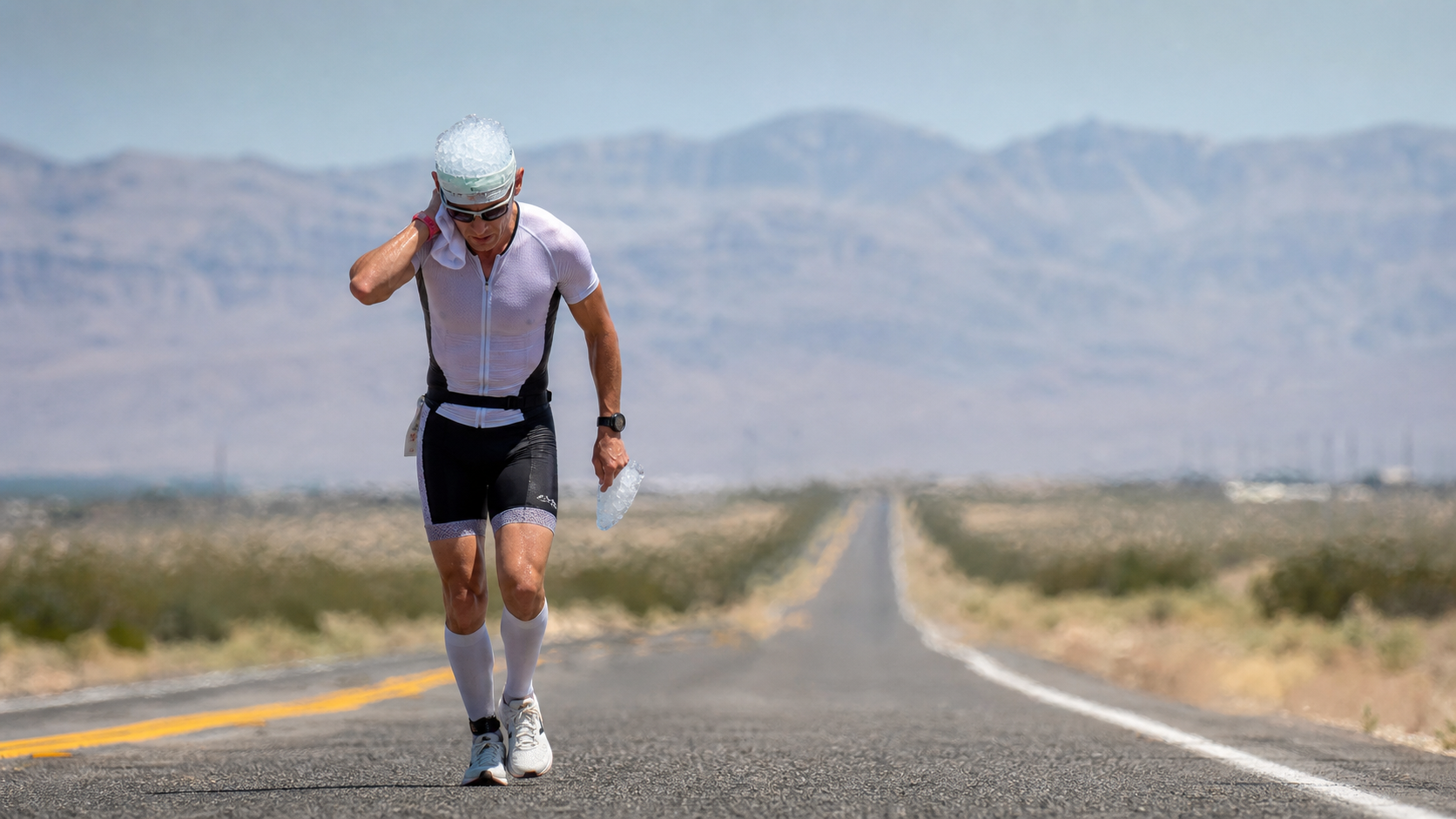
Coach’s Opening: The Athlete Who Squatted Down at the Kenting Aid Station
Let me start with a scene I’ll never forget. A few years ago, at a long-distance triathlon in southern Taiwan, the feels-like temperature was close to 38°C, and the asphalt was so hot it rippled. One athlete I was coaching swam a beautiful leg, and on the first half of the bike he stuck to the pacing plan obediently. But then, at the 90-kilometer aid station, he suddenly felt he was “in amazing shape,” started cranking up the watts, and ignored the power ceiling I’d drilled into him before the race.
The result? At the first turnaround point on the run, he squatted down in the shade and couldn’t get up—pale face, goosebumps, and his speech started becoming incoherent. These are the classic warning signs of heat exhaustion sliding toward heat stroke. That day he got a DNF (did not finish), but I was actually relieved, because heat stroke can kill you; a DNF is just disappointing.
In this article, I want to use my fifteen years of coaching experience to talk to you seriously about one thing: in a hot-weather race, your opponent isn’t anyone else—it’s your own core body temperature. A 226-kilometer Ironman (3.8 km swim + 180 km bike + 42.195 km run) is already the ultimate test of temperature management. Once the feels-like temperature hits 38°C, the race’s nature shifts from “pushing your physical limits” to “pushing your cooling capacity.” Whoever can keep their core temperature in check will finish; whoever can’t—no matter how powerful their engine—will overheat and stall.
This isn’t meant to scare you; it’s the daily reality of Taiwan’s triathletes. Our summer races routinely see humidity above 80%. In hot, humid conditions, sweat evaporation efficiency drops dramatically, making the cooling path inherently harder than in dry-heat countries. So instead of praying for cooler weather, treat the heat as a variable that “will definitely happen,” and prepare a complete survival strategy before race day.
Core Concepts: Why Heat Slows You Down and Makes You Collapse
Core Body Temperature: The Real Engine Gauge
When you exercise, your muscles are an engine that isn’t very efficient—of the energy produced by pedaling or running, only about 20%–25% becomes forward motion, and the remaining 75%+ turns into heat. That heat must be carried by blood to the skin’s surface and dissipated through sweat evaporation. Here’s the problem: when both ambient temperature and humidity are high, cooling efficiency collapses, and heat accumulates in the core.
The human core temperature normally sits around 37°C. Rising to 38–39°C during exercise is normal, and the body can handle it. But once it keeps climbing:
- Above 40°C: This falls within the warning range for exertional heat stroke, and the central nervous system starts to malfunction.
- Approaching 42°C: Cells suffer irreversible damage—this is the line between life and death.
According to sports medicine literature, the classic definition of exertional heat stroke is a core temperature above 40°C accompanied by central nervous system dysfunction (confusion, disorientation, loss of coordination). The core goal of emergency treatment is to bring the core temperature below the threshold for cellular damage (about 42°C) within the “golden half hour” after diagnosis. That half hour is critical for survival.
Let me also share a piece of first-aid knowledge that I hope you’ll never need: the most effective on-site treatment for exertional heat stroke is whole-body cold-water immersion, considered the gold standard in sports medicine. Clinically, the patient is placed in ice water (head kept above the surface) and cooled until the rectal temperature reaches about 38.3–38.9°C, then stopped to avoid overcooling. The literature even shows that if aggressive cooling begins within 10 minutes of collapse, exertional heat stroke survival rates approach nearly 100%—the key isn’t how fast you get to the hospital, but “cool first, then transport,” because what saves a life is that tub of ice water, not the ambulance. This is also why experienced race medical stations in Taiwan prepare ice-water immersion tubs for summer hot-weather events. Knowing this, if you ever see a fellow athlete collapse on the course, you’ll know what to do.
Heat Exhaustion vs. Heat Stroke: A Thin Line, a World of Difference
Many athletes can’t tell heat exhaustion from heat stroke, but this line is a matter of life and death. Let me break it down in the simplest terms:
| Item | Heat Exhaustion | Heat Stroke |
|---|---|---|
| Core temperature | Usually below 40°C | Usually above 40°C |
| Mental state | Conscious, but weak and dizzy | Confused, giving nonsensical answers, behaving abnormally |
| Skin | Cool and clammy, heavy sweating | May still be sweating, or may feel hot |
| Goosebumps | Possible | Goosebumps in high heat are a danger signal |
| Treatment | Stop, seek shade, hydrate and cool down, rest | Cool immediately and seek medical help—every second counts |
| Danger level | Requires vigilance | Potentially fatal |
The most important indicator for judging heat stroke isn’t a thermometer (and you won’t have one on the course)—it’s “consciousness.” As soon as an athlete starts speaking incoherently, doesn’t know where they are, staggers, or becomes unusually agitated, treat it as heat stroke without hesitation. My iron rule for all my athletes is: Better to overreact and get a DNF than to gamble and keep going.
Heat Slows You Down—and There’s Clear Data
Here’s both good news and bad news: heat slowing you down is scientifically predictable, so we can build a downward-adjusted pace into our strategy in advance, rather than pushing hard until we collapse.
According to a study analyzing a large volume of marathon results and weather data (see references at the end), researchers found that: for every 1 degree the environmental conditions (measured by the WBGT composite heat index) deviate from the optimal range, performance declines by approximately 0.3%–0.4%. The optimal performance range falls at a WBGT of about 7.5–15°C (corresponding to air temperatures of about 10–17.5°C)—a fairly cool range.
Even more critical: the study points out that once WBGT rises above about 13°C, medical incidents at the finish line and dropout rates along the course begin to climb. In other words, as soon as the temperature is even slightly above comfortable, the risk curve is already tilting upward. Taiwan’s summer races routinely see WBGT above 28–30°C, far exceeding that threshold—you can imagine where performance and risk get pushed.
A note here: the above is data from a marathon-only study. A 226 is swim first, then 180 km on the bike, and only then a full marathon on the run. The run segment happens at the hottest time of day, when you’re also most fatigued and dehydrated. Heat accumulation is “cumulative,” so the actual impact is more severe than running a standalone marathon. That’s why when I estimate heat-adjusted pacing for 226 athletes, I build in a more conservative margin than the marathon study’s numbers.
Practical Method One: Pre-Race Risk Assessment and Heat Acclimatization
Heat Acclimation Schedule 10–14 Days Before Race Day
Your body can be “trained” to handle heat. Through regular heat exposure, your plasma volume increases, the body temperature threshold for starting to sweat lowers, and you lose less sodium in your sweat—all of which make you more resilient in high temperatures. Heat acclimation typically requires 10–14 consecutive days of exercising in a hot environment for 60–90 minutes per day to build up.
Below is the heat acclimation framework I give athletes preparing for a summer 226, scheduled in the two weeks before race day (intensity is mostly easy to moderate; the focus is on “heat exposure,” not speed work):
| Day | Content | Environment/Time of Day | Key Points |
|---|---|---|---|
| Days 1–3 | 60 minutes of Zone 2 easy run or ride | Midday or afternoon peak heat | Let the body start adapting to sweating; stay well hydrated |
| Days 4–7 | 75–90 minutes Zone 2, with a few tempo efforts in the middle | Peak heat hours | Extend heat exposure time; monitor sweat rate and heart rate drift |
| Days 8–11 | Simulated race-day bike-to-run transition (brick) | Peak heat hours | Practice fueling rhythm and cooling actions in the heat |
| Days 12–13 | Taper; short heat exposure to maintain adaptation | 30–40 minutes during peak heat | Preserve adaptation without accumulating fatigue |
| 1 day before race | Complete rest or very light activity | Avoid peak heat | Hydrate fully and stock up on electrolytes |
Key reminder: The intensity of a heat acclimation schedule must be scaled down. You are not training fitness; you are training your “cooling system.” Many athletes turn heat acclimation into a hard workout block and end up exhausted or suffering heat illness before the race even starts—putting the cart before the horse. When training at midday in a Taiwanese summer, remember to bring plenty of water and choose routes with shade or turnaround points where you can refill (for example, riverside bike paths with water sources at the turnaround). Never push yourself into a remote stretch with no way out.
Pre-Race Risk Self-Assessment Checklist
The night before the race, I ask athletes to answer these questions honestly. If two or more are red flags, the goal for race day automatically downgrades from “chasing a PR” to “finishing safely”:
- Sleep: Did you get at least 6 hours of sleep last night? Poor sleep impairs your body’s ability to regulate temperature.
- Hydration status: Has your urine been light yellow over the past two days? Dark yellow means you are already dehydrated.
- Digestion: Have you had diarrhea or a poor appetite recently? Poor gut health severely affects mid-race fueling and absorption.
- Heat acclimation: Have you had regular heat exposure over the past two weeks? If not, you need to scale down your pace even more.
- Feels-like forecast: What is the forecast feels-like temperature and humidity on race day? The higher the humidity, the more dangerous it is.
- Medical history: Have you ever suffered heat stroke or heat exhaustion during exercise? If you have had it once, your risk of recurrence is higher.
Understanding WBGT: Don’t Just Look at Air Temperature
Many athletes only look at “air temperature” in the weather forecast, but in humid, hot Taiwan, that is far from enough. What you should really pay attention to is the WBGT (Wet Bulb Globe Temperature), which combines air temperature, humidity, radiant heat, and wind speed. It reflects the actual heat load your body experiences far better than air temperature alone.
Why is humidity so critical? Because the body’s primary cooling mechanism in high heat is “sweat evaporation.” When humidity is high, sweat cannot evaporate—you just lose water without shedding much heat. That is why at the same 33°C, a dry inland area and a humid coastal area feel completely different and carry vastly different levels of danger. Summer races in Taiwan are often held near the coast or river mouths, where humidity frequently exceeds 80%. This is also why I always emphasize being “more conservative than international recommendations.”
In practice, you don’t need to calculate WBGT yourself, but you should build the habit of checking “feels-like temperature + humidity,” and remember one principle: the higher the humidity, the lower your cooling ceiling, and the more you need to scale down your pace. Start tracking the forecast a week before the race so both your mind and your strategy are prepared in advance.
Gear Checklist for Hot-Weather Races
The right gear can save you precious body-temperature budget. Here is the checklist I require athletes to have for hot-weather races:
- Light-colored, breathable, sun-protective tri suit: Dark colors absorb heat; light colors reflect it. Don’t choose dark just for looks.
- Vented or brimless cap: Provides shade while allowing you to stuff ice or pour water.
- Sunglasses: Reduces eye fatigue and UV damage.
- Waterproof sunscreen: Sunburn reduces your skin’s ability to dissipate heat and makes you more uncomfortable.
- Cooling towel or ice sleeves: Can be re-wetted repeatedly and cool you through evaporation.
- Electrolyte tablets or salt candies: Bring your own; don’t rely entirely on aid stations.
- Simple identification info: Write emergency contacts, allergies, or medical history on your race bib or wristband so medical staff can help if something goes wrong.
Practical Method 2: Ice Socks, Ice Caps, and On-Course Cooling in Action
The core logic of cooling strategy for hot-weather races is simple: place ice where blood flow is abundant and close to the skin to give your core temperature an “external cooling assist.” These actions may look crude, but on a course with a feels-like temperature of 38°C, they are lifesaving gear.
Effectiveness and Usage of Various Cooling Tools
| Tool/Body Part | Principle | Practical Use | Notes |
|---|---|---|---|
| Ice cap / pouring water on head | Head and neck have abundant blood flow; cooling sensation is obvious | Pour ice water over head and neck and stuff ice into the cap at every aid station | Subjective comfort improves greatly; actual core cooling is limited but worth doing |
| Ice sock / neck ice pack | Carotid artery is close to the skin surface; cools blood flowing to the brain | Put ice from aid stations into a neck collar or stocking and hang around the neck | Don’t let it get painfully cold or numb; moderation is key |
| Forearm / palm cooling | Palms have rich arteriovenous anastomoses and are key heat-dissipation pathways | Soak palms in ice water, hold ice, pour water over arms | Effect is underestimated; actually very effective |
| Ice sleeves / wet cooling towel | Increases evaporative cooling surface area on the skin | Wet them and put them on; let evaporation carry heat away | When humidity is very high, evaporation is less effective, but still helpful |
| Drinking lots of ice / slushies | Absorbs heat from inside the body (heat sink) | Take small sips of ice-cold sports drink at aid stations | Don’t chug too much at once to avoid stomach discomfort |
The practical mantra I teach athletes is: “Head, neck, and hands—three-pronged attack.” At every aid station, do three things consistently: pour ice water over your head and neck, hang ice around your neck, and wet your arms and palms. These three actions take less than 15 seconds combined, but they genuinely slow down the rise of your core temperature.
Aid Station Cooling SOP
Turn cooling into a “reflex action” so you won’t forget to do it when the heat dulls your mind. I require athletes to follow this sequence at every aid station:
- Slow down: Drop your pace/power before entering the station; don’t charge in.
- Pour over head and neck: Grab water and pour it over the top of your head, back of your neck, and face.
- Hang ice: Around the neck, and tuck ice under your armpits if needed.
- Cool your arms: Wet your forearms and palms.
- Rehydrate and replace electrolytes: Take small sips; multiple small amounts are better than one big gulp.
- Check yourself: Ask yourself, “Am I still clear-headed? Do I know what kilometer I’m on?”
Step 6 is the most important self-monitoring—use “can I still answer the question?” as a way to gauge your own consciousness. Once you realize you can’t even remember what lap you’re on, that’s not fatigue—that’s your core temperature sending you a warning.
Practical Method 3: The Science Behind Scaling Down Your Pace
How Much Should You Slow Down? A Workable Framework
This is the question athletes ask me most often: “Coach, it’s so hot — how much slower should I actually go?” I won’t give you a falsely precise number, but I can give you a science-based, and deliberately conservative, tiered framework.
As mentioned earlier, marathon research shows that for every 1 degree WBGT deviates from the optimal range, performance drops by roughly 0.3%–0.4%. But the run leg of a 226 is happening while dehydrated, fatigued, and at the hottest part of the day, so in practice I add extra margin to the reduction. Here is my reference table for reducing bike power and run pace (based on your personal “cool-weather target pace/power”):
| Perceived Temperature Range | Bike Power Reduction | Run Pace Reduction | Key Strategy |
|---|---|---|---|
| Below 25°C (Cool) | 0% | 0% | Execute the plan as written |
| 26–30°C (Warm) | Reduce 3–5% | Slow 10–20 seconds per km | Increase hydration, start head-and-neck cooling |
| 31–35°C (Hot and Humid) | Reduce 5–10% | Slow 20–40 seconds per km | Cooling becomes mandatory at every aid station |
| Above 36°C (Extreme Heat, like the scenario in question) | Reduce 10–15% or more | Slow 40+ seconds per km, use run-walk if necessary | Goal shifts to “finish safely,” be ready to stop at any time |
This table isn’t meant for you to memorize numbers — it’s meant to build a mindset of “the hotter it gets, the more conservative you become.” I often tell athletes: in a hot race, the restraint you show in the first half determines whether you can still run in the second half. Too many people refuse to hold back early on, and then pay back the time they “saved” in the form of cramps, walking, and squatting at aid stations in the second half — all while risking heat illness.
Monitor with Both Heart Rate and Perceived Effort — Don’t Just Watch Pace
In the heat, there’s a phenomenon called “cardiac drift” — even if you hold the same pace, your heart rate drifts higher and higher over time due to dehydration and rising core temperature. So in hot races, I have athletes use a heart rate ceiling to govern their pace, rather than chasing a specific number of seconds.
In practice:
- Set a heart rate ceiling for the run leg (for example, 5–8 bpm lower than your average heart rate in a cool-weather marathon).
- Once your heart rate hits that ceiling, slow down no matter how slow you’re already going, because it means your cooling system is already struggling.
- Pair this with “Rating of Perceived Exertion (RPE)”: in the heat, the same RPE will naturally produce a slower pace than in cool weather. That’s normal — accept it.
Practical Method Four: Hydration and Fueling Rhythm in the Heat
Pace reduction is only one side of the coin — the other is fueling rhythm. In perceived 38°C conditions, your sweat rate can reach 1–1.5 liters per hour or more, and the sodium lost in that sweat is significant. If the fluid and electrolytes you take in can’t keep up with what you’re losing, you’ll not only dehydrate and see your heart rate spike, but you could also fall into the danger of hyponatremia if you only drink water without replacing sodium.
My principle for athletes is simple: fuel on a schedule, take small amounts frequently, balance water and sodium, and prioritize your gut. In the heat, gastric emptying slows down, so chugging a large volume at once will just slosh around in your stomach and make you nauseous. Better to take small sips every 10–15 minutes than to wait until an aid station and guzzle a whole bottle.
Here is the fueling rhythm framework I give 226 athletes for hot races (actual numbers should be fine-tuned to your individual sweat rate, body weight, and tolerance — these are ranges, not rigid rules):
| Segment | Fluid Rhythm | Electrolytes (Sodium) | Carbohydrates | Notes |
|---|---|---|---|---|
| Bike Leg (180 km) | ~500–800 ml per hour, in small frequent sips | ~500–1000 mg sodium per hour | ~60–90 g carbs per hour | Best to fuel on the bike; eat enough while you still can |
| Transition / Early Run | Confirm you’re not bloated or thirsty before starting the run | Take one electrolyte tablet as a base | Easily absorbed gels or drinks | Don’t binge eat or drink in transition |
| Run Leg (42 km) | Take small sips at every aid station, stay hydrated | Keep taking sodium; increase if you feel cramps coming on | Adjust based on gut status; eat when you can | If your gut shuts down, switch to sports drinks to survive |
A local reminder for races in Taiwan: Our aid stations commonly have cola, salt candies, bananas, and sports drinks — these are all good things: the sugar and caffeine in cola, sodium in salt candies, potassium in bananas. But don’t forget the “small amounts, frequent” principle — if you grab a huge handful of food at a well-stocked aid station, your gut will likely rebel in the heat. Also, sweat rates in Taiwan’s humid environment tend to be higher, so sodium replacement should be more aggressive than the recommendations for dry, cool climates — especially for athletes prone to cramping.
A Simple Way to Gauge Dehydration
There’s no scale on the race course, but you can self-monitor with two simple signals: urination and thirst. If you haven’t felt the urge to pee for a long time, or your urine is dark, that usually means you’re not drinking enough. Conversely, if you constantly need the bathroom, your urine is very clear, or you feel a bit nauseous, you might be drinking too much and not getting enough sodium. The ideal state is somewhere in between — this requires tracking your sweat rate and tolerance during regular training so you know your rhythm on race day.
Two Real-World Case Studies: Same Heat, Different Outcomes
Case One: An Age-Group Talent Who Made Restraint a Discipline
I coached a strong age-group athlete whose goal was to stand on the age-group podium. The forecast called for a perceived temperature near 37°C, and he was anxious, feeling his target time was going down the drain. I told him: “Everyone will be slower today. Your job isn’t to hit your usual time — it’s to fall apart less than everyone else.”
We changed the strategy: reduce bike power by about 8% from his original target, set a heart rate ceiling for the run, and require him to execute the “head, neck, and hands” cooling SOP at every aid station. In the first half, he kept thinking, “This is too conservative, I’m running so slow,” but I told him to hold back. By the final 12 km of the run, the course was littered with athletes walking, cramping, and squatting in the shade — while he maintained a steady pace and kept passing people. He not only finished, but he actually made the age-group podium — not because he ran faster than usual, but because he fell apart less than everyone else.
Case Two: The Strong Athlete Who Didn’t Believe It
The contrast was another athlete with even better fitness. In the same heat, I gave him the same instructions: reduce power, cool down properly. But he wasn’t convinced, thinking, “My watts are usually so high — it’d be a waste to slow down.” For the first 100 km of the bike, he held high power the whole way and skipped aid stations whenever he felt like it.
Not long into the run, he started feeling dizzy, his heart rate wouldn’t come down no matter what, and his gut was churning so badly he couldn’t eat. By 25 km, he was walking and stopping constantly, and only managed to finish by taking long breaks and cooling down extensively. His time was far worse than the less-fit athlete in Case One. After the race, he admitted: “Coach, I paid back all the time I saved in the first half with cramps and walking in the second.”
I use these two cases as a comparison for my athletes because they illustrate the core truth of hot-weather racing: fitness determines your ceiling, but temperature management determines whether you can reach that ceiling. In extreme heat, discipline is often worth more than talent.
Common Mistakes and Fixes
After coaching athletes for so many years, the ways races fall apart in the heat all look the same. Here are the five most common mistakes, along with my suggested fixes:
Mistake One: Pushing Harder Because You “Feel Great” Early On
This is the most fatal mistake — it’s the exact version of the athlete I mentioned at the start. In the heat, “feeling great” is often an illusion, because the penalty from heat accumulation and dehydration is delayed. Fix: write your power/pace ceiling on your bike computer, and never exceed it no matter how good you feel. Treat restraint as discipline.
Mistake Two: Drinking Water Without Replacing Electrolytes
Heavy sweating in the heat loses a lot of sodium. Drinking only plain water without sodium can lead to “exercise-associated hyponatremia” — the symptoms (dizziness, nausea, confusion) look similar to heat stroke, but the treatment is completely opposite. Fix: during prolonged exercise in the heat, you must take in sodium-containing sports drinks or electrolyte tablets, and “fuel on a schedule, in small amounts frequently” — don’t wait until you’re thirsty, and don’t chug large volumes at once.
Mistake 3: Treating Cooling Measures as “Wasted Time”
Many well-intentioned athletes think that pouring water on themselves and grabbing ice at aid stations is a waste of those 15 seconds. The fix: Let’s do the math—compare the 15 seconds saved per station against sitting by the roadside for 15 minutes with heat exhaustion, or even a DNF. Which is worth it? Cooling down isn’t wasted time; it’s an investment in finishing.
Mistake 4: Ignoring Your “Consciousness” as an Alarm
Athletes often mistake the early signs of heatstroke (dizziness, nausea, goosebumps, speaking strangely) for “just being tired” and push through. The fix: Treat your consciousness like a red light on your dashboard. Teach yourself and your fellow athletes that the moment someone starts giving nonsensical answers, stop immediately, cool them down, and seek medical help.
Mistake 5: Racing Without Prior Heat Acclimatization
You train in air-conditioned rooms or during the cool early morning hours, but on race day you face high noon heat, and your body is completely unprepared. The fix: Schedule at least 10–14 days of training during the hottest part of the day before the race so your body can “get to know” the heat. If you don’t have time for full heat acclimatization, increase the downward adjustment to your target pace.
Actionable Advice for Athletes of Different Levels
First-Time Ironman / First-Time Half Ironman Athletes
Your primary goal should always be finishing safely; your time is secondary.
- Be sure to do heat acclimatization before the race, even just one week is better than none.
- Use the most conservative pace column; better to be slow than to blow up.
- Stop at every aid station to cool down and hydrate; treat it as standard operating procedure.
- Keep the warning signs of heatstroke in mind, and remind your fellow athletes to watch out for each other.
Advanced Age-Group Athletes (Aiming for a Personal Best)
You have the capacity to push, but in high heat, the race is about “who loses the least.”
- Complete a full 10–14 day heat acclimatization block before the race to train your body’s heat tolerance.
- Use your heart rate ceiling to govern your pace; don’t be fooled by how good you feel early on.
- Deliberately hold back in the first half, saving your bullets for the run in the second half; those who can still hold their pace in the final 10 km are often the ones overtaking a wave of fading athletes.
- Fine-tune your aid station and cooling rhythm to the point where it becomes a reflex.
Elite / Kona Qualifier Hopefuls
Your engine is strong enough; the race often comes down to the details of temperature management.
- Heat acclimatization must be thorough; consider even incorporating core body temperature monitoring into your training.
- Plan the cooling and fueling content for each aid station in advance, based on the course layout.
- Your pacing strategy should prioritize “maintaining controllable core body temperature” above all else. Be unhesitatingly conservative when needed, because in hot races, the one who stays steady and doesn’t crack is the winner.
FAQ
Q1: What if race day turns out to be extremely hot and I didn’t have time to heat acclimatize?
You can’t make up for heat acclimatization on the spot, but you can “compensate with strategy”: increase your pace reduction, cool down more frequently, fuel more aggressively, and change your goal from a time to simply finishing safely. Acknowledging that your body isn’t prepared is actually the smartest decision.
Q2: Do ice caps and ice socks really work, or is it just a placebo?
Cooling the head and neck has a clear benefit for “subjective comfort” and “reducing perceived exertion,” which can keep you willing to move forward. Meanwhile, cooling areas like the palms and forearms has an underestimated effect on lowering actual core body temperature. Even if part of it is perceptual, if it helps you maintain your pace and avoid cracking, it’s a useful tool.
Q3: If I’m sweating a lot, does that mean I’m cooling well and don’t need to worry?
Sweating a lot means your body is working hard to cool itself, but it also means you’re rapidly losing water and sodium. Sweating profusely doesn’t equal safety; on the contrary, you need to be even more proactive about replacing fluids and electrolytes, and watch out for cumulative dehydration.
Q4: Should I chug water in high heat?
No. Drinking excessive plain water without replacing sodium carries a risk of hyponatremia. The correct approach is to “follow a schedule, in small amounts and frequently,” consuming electrolyte-containing drinks to roughly balance what you take in with what you lose.
Q5: If I feel dizzy and nauseous mid-run, should I stop or push through?
Dizziness, nausea, goosebumps, and confusion are all alarms from your body. The correct response is to stop immediately, get into the shade, cool down, hydrate, and assess your mental state. If your consciousness starts to become unclear, seek medical help right away. No race is worth risking your life.
Q6: Does run-walk-run mean I “lost the race”?
Absolutely not. In extreme heat, deliberately incorporating run-walk-run is a smart temperature management strategy. It allows your heart rate and core temperature to drop, which actually helps you stabilize in the later stages and avoid a complete meltdown. Many finishers get through the final 10 km thanks to run-walk-run. Put your pride aside; being able to steadily move forward to the finish line is the real skill.
Conclusion: Crossing the Finish Line Alive Is the True Finish
I often tell athletes that a distance like 226, especially in a Taiwan summer with a feels-like temperature of 38°C, is never about who’s the toughest, but about who best knows how to cooperate with their own body. You can have a powerful engine, but if you don’t manage your cooling system, no matter how strong the engine is, it will overheat and stall.
The wisdom of hot-weather racing is really a wisdom of “delayed gratification”: hold back in the first half, slow down, dutifully cool down and refuel, saving the good feelings for the version of yourself that can still run in the second half. That athlete who squatted down in Kenting—I later helped him readjust his strategy, and the following year on the same sweltering course, he ran steadily through the finish arch at a pace nearly an hour slower than his original goal. He told me: “Coach, that slower pace was actually my happiest finish ever.”
Remember this: In hot-weather races, anyone who can walk across the finish line standing is a winner. Put temperature management ahead of your time, put safety ahead of your records, and you’ll have the chance to enjoy this sport year after year. After all, being an Ironman is a lifelong pursuit, not a one-time gamble; the wisdom to slow down today gives you more tomorrows to stand on the starting line again. A feels-like temperature of 38°C isn’t telling you to give up; it’s reminding you to complete the race in a smarter, more body-respecting way. May we all run our most clear-headed selves on the hottest courses.
This article is for educational purposes and does not replace individual assessment by a physician, physical therapist, or nutritionist. If you have a history of cardiovascular disease, heat illness, or any physical discomfort, please consult a qualified medical professional before participating in hot-weather endurance events.
References
- Casa DJ, et al. Cold-Water Immersion and the Treatment of Hyperthermia: Using 38.6°C as a Safe Rectal Temperature Cooling Limit. https://pmc.ncbi.nlm.nih.gov/articles/PMC2938313/
- Korey Stringer Institute, University of Connecticut — Exertional Heat Stroke. https://koreystringer.institute.uconn.edu/heat-stroke/
- Diverse Effects of Thermal Conditions on Performance of Marathon Runners. https://pmc.ncbi.nlm.nih.gov/articles/PMC7350124/
- Impact of Environmental Parameters on Marathon Running Performance (PLOS One). https://journals.plos.org/plosone/article?id=10.1371%2Fjournal.pone.0037407
Related Reading
- The Science of Heat Acclimatization: Teaching Your Body to Dissipate Heat in Two Weeks
- Heat Acclimatization Training: Physiological Strategies to Improve Summer Cycling Performance in Taiwan
- Heat-Tolerant Runners: The Physiological Mechanisms of Heat Acclimatization for Summer Road Running in Taiwan
- Body Temperature and Athletic Performance: The Overlooked Code of Core Temperature
水金九不厭五分 10度寒流冷到不願停!feat. 卡卡 / 公路車 / CT Yeh
6 個月前
[防寒衣體驗] 鐵人魂 三鐵 防寒衣試穿會 於松運 深水游泳池 鯨魚池
8 年前
TBA 北高360 逆風爆熱再送空汙 苦行挑戰賽全記錄 4K沈浸式臨空畫質| 公路車 | CT Yeh
3 年前
台北闊瀨陡坡 騎旅 / 日本單車雜誌編輯車友臨時加入!/ 髮香才是最強的 / feat. 北迴歸線小隊 / 公路車 CT Yeh
6 個月前
西進武嶺 世界紀錄挑戰!破2:30 ?!一群人推著一個夢上山 直播精華版 / ft. 張翰允 & 台視主播魏于恬 & KPLUS / #cycling 公路車 CT Yeh
2 個月前
#東進武嶺 全程實況錄影 5小時半 #夏季KOM #太魯閣 Taiwan KOM Challenge Reality Video Taroko scenery
7 年前
2019 夏季KOM 5小 完賽心得 準備攻略 東進武嶺 夏季登山王之路 Taiwan KOM Challenge
7 年前
#KOM 夏季登山王之路 比賽實況 #東進武嶺
7 年前