Only 8 Hours a Week, Still Making It to the 70.3 Finish Line: A Coach's Practical Guide to Time-Efficient Training
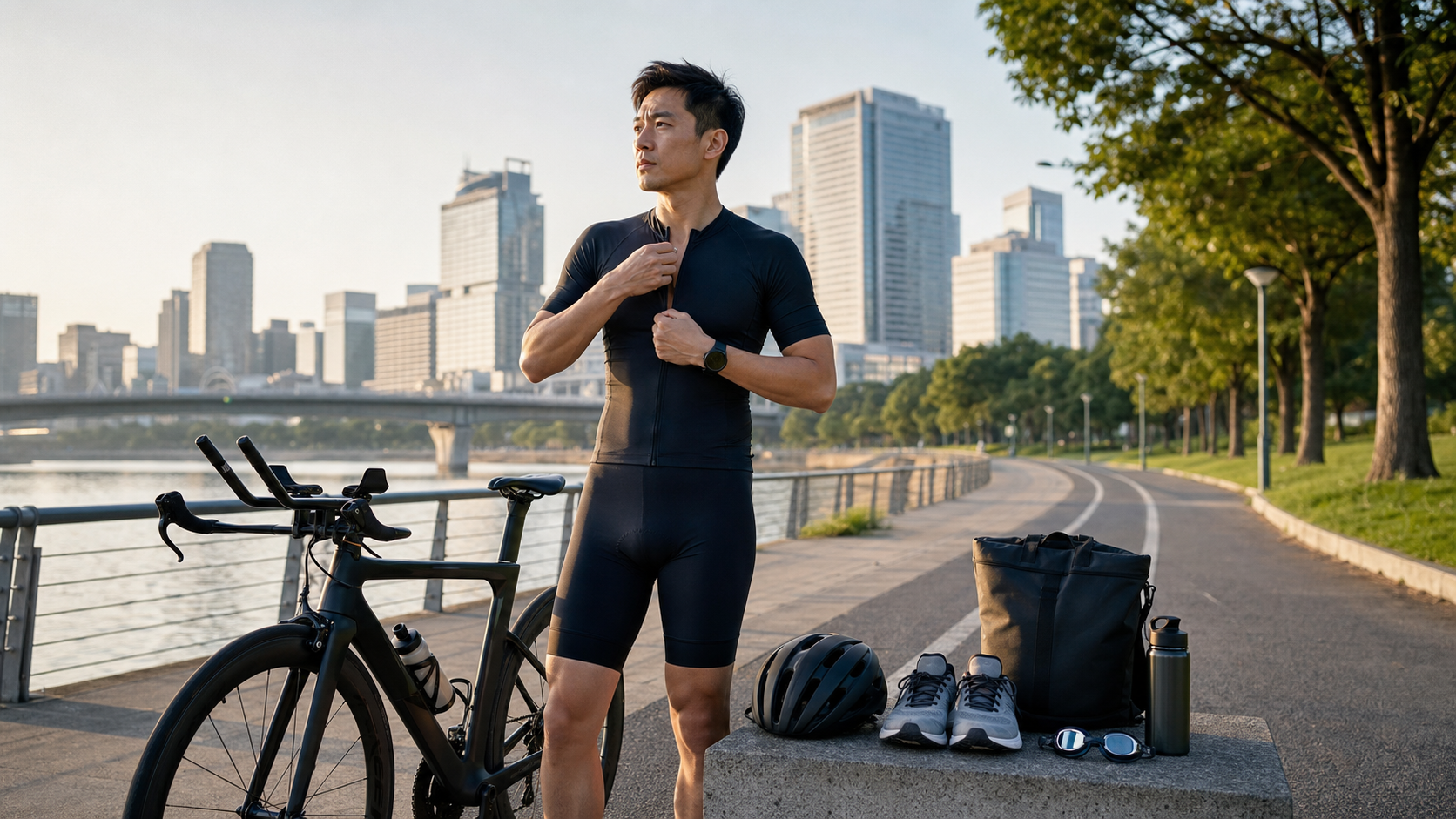
Coach’s Opening: The Problem Was Never “You’re Not Working Hard Enough”
I’ve been coaching triathletes for fifteen years now. Over the years, the people who sit across from me sighing the most aren’t those who “can’t push themselves,” but those who “really want to train but genuinely can’t find the time.”
Last autumn, an engineer working in the Neihu Technology Park—let’s call him A-Kai—came to me for the first time. His goal was simple: he wanted to finish a 70.3 (half-distance Ironman: 1.9 km swim, 90 km bike, 21.1 km run) the following May. He pulled out his phone to show me his calendar: in the office by 8:30 AM, off work at 7 or 8 PM, shuttling the kids around on weekdays, and wanting to spend weekends with family. He asked me: “Coach, all the training plans online call for 12 to 15 hours a week. I have at most 8 hours. Should I just forget about it?”
I told him something I want to tell you first: The biggest enemy of finishing a 70.3 is never your cardio—it’s your calendar. And calendar problems can be solved with strategy. Six months later, A-Kai crossed the finish line at the Kenting racecourse, completing his first 70.3 in 6 hours and 12 minutes. His average weekly training time? Just 7 to 8 hours.
This article is the complete methodology I used with A-Kai and many other time-crunched office-worker athletes. It rests on just three pillars: intensity density, commute training, and sacrifice-priority decision-making. You don’t need more time; you need to use the time you have correctly.
1. Conceptual Foundation: Time-Crunched Athletes Should Actually Train “Harder”
This is the most counterintuitive point, and the one most people get wrong.
High-Hour and Low-Hour Athletes Need Completely Different Formulas
You’ve certainly heard of the “80/20 training method” or “polarized training”—roughly 80% of training volume at a truly easy, conversation-pace low intensity, with only 20% at high intensity. That principle is correct for athletes training 15 to 20 hours a week.
But if you only have 8 hours, things change. The consensus among sports science and coaching circles is: time-crunched athletes who can only train 8 to 12 hours a week should actually increase the relative proportion of high-intensity training. The reason is simple—low-intensity training relies on “accumulated volume,” which you don’t have; high-intensity training relies on “quality of stimulus,” which you can deliver in short bursts.
In other words: someone with 3 hours a day to ride slowly can build an aerobic base through sheer hours; but if you only have 45 minutes, you need to make those 45 minutes “hurt” in a way that counts.
How Many Hours Do You Actually Need to Finish?
Here’s an honest benchmark so you know where you stand:
| Average Weekly Training Hours | Realistic Expectation |
|---|---|
| 6–8 hours | Possible to finish, but requires extremely high training efficiency and zero wasted effort |
| 9–10 hours | The sweet spot for a solid finish |
| 10–12 hours | Finish and actually “run” that final marathon segment, not walk it |
| 12+ hours | Starting to have the capital for age-group competition |
This table tells us: 8 hours is the “possible, but no room for error” zone. You can’t afford to spend 20% of your plan on ineffective moderate-intensity junk miles like high-hour athletes can. Every single minute needs a purpose.
Why “Moderate Intensity” Is the #1 Thief for Time-Crunched Athletes
What polarized training hates most is the so-called “grey zone”—that middle intensity that’s not easy enough to recover from, nor hard enough to trigger adaptation (roughly the pace where you feel “a bit breathless but can still hold on”).
A lot of office workers train like this: every ride at the same “fairly hard” pace, heart rate stuck between 75% and 82%. The problem with this kind of training—it makes you tired (so the next day’s quality suffers), yet doesn’t tire you where it counts (not enough high-intensity stimulus, and not low enough for recovery). For someone with 8 hours, the grey zone is the thief that steals your precious time.
Quantify Intensity with Heart Rate and Power
To avoid the grey zone, you first need to be able to “see” your intensity. I recommend every athlete at least master heart rate zones; a power meter is even better. Here’s the simplified five-zone comparison I use, expressed as “percentage of max heart rate” and “percentage of FTP” (FTP is the maximum average power you can sustain for about an hour):
| Zone | % Max HR | % FTP | Subjective Feel | Use for Time-Crunched Athletes |
|---|---|---|---|---|
| Z1 Recovery | <68% | <55% | Barely noticeable, can hum a tune | Commute recovery, active recovery swim |
| Z2 Aerobic | 68–78% | 56–75% | Can hold full conversation | Main body of long sessions, commute base volume |
| Z3 Tempo (Grey Zone) | 78–85% | 76–90% | Conversation starts breaking up | Spend as little time here as possible; only briefly at the tail end of race-pace efforts |
| Z4 Threshold | 85–92% | 91–105% | Can only say a few words | Main course of trainer intervals, run threshold sessions |
| Z5 VO2 Max | >92% | >105% | Unable to speak | Commute hill sprints, short high-intensity stimulus |
The goal for time-crunched athletes is clear: pack your training time with Z1–Z2 (via commuting and long sessions) and Z4–Z5 (via formal high-intensity sessions), and clear out the Z3 grey zone as much as possible. A heart rate strap costing a few hundred dollars can save you dozens of hours of ineffective training—in my opinion, it’s the highest-ROI equipment investment you can make.
2. Pillar One: Intensity Density—Squeezing 8 Hours Dry
“Intensity density,” in plain terms, means: within your limited training time, pack in enough high-quality stimulus that your body thinks you trained more than you actually did.
The Three Disciplines Have Different “Return on Investment”
The most important decision for a time-crunched athlete is allocating time to where the ROI is highest. Based on my experience, the “time ROI” ranking for the three 70.3 disciplines is roughly:
- Running—highest physiological stimulus per unit time, and also the highest injury risk. But because the 70.3 run happens under extreme fatigue, your run fitness directly determines how “dignified” you look at the finish.
- Cycling—takes up the longest portion of race time (usually over half), is the discipline where commuting can “steal time” most effectively, and is the least injury-prone endurance vehicle.
- Swimming—lowest ROI per unit time (high technical barrier, slow progress), but the 70.3 swim only accounts for about 10% of total time. The finish-line threshold is “swim safely without panicking,” not “swim fast.”
This ranking directly influences your sacrifice priorities, which I’ll cover in section three.
A Sample Weekly Plan for the 8-Hour Athlete
This is the framework I designed for A-Kai, which he actually followed for six months. You’ll notice it’s “hard” with discipline, but the total volume really is only around 7.5 hours.
| Day | Session & Details | Time | Intensity Focus |
|---|---|---|---|
| Mon | Rest / full recovery (sleep is more important than anything) | — | Recovery |
| Tue | Run: after warm-up, 5×3 minutes near lactate threshold pace, 90-second easy jog between reps | 45 min | High intensity |
| Wed | Commute ride (to work) + swim technique session (after work) | 30+45 min | Low + technique |
| Thu | Bike trainer: 4×5 minutes at 100–105% of FTP, 3-minute rest between reps | 60 min | High intensity |
| Fri | Commute ride (to and from work), add 3 sprints on the way home | 60 min | Low + neuromuscular |
| Sat | Long ride: 60–90 km, mostly low intensity, last 20 minutes at race pace | 150 min | Low (with race-pace tail end) |
| Sun | Brick session: 40 min bike followed by 25 min run at 70.3 goal pace | 65 min | Moderate-high (specific) |
The design logic behind this table:
- Two to three genuinely high-intensity sessions per week (Tue run, Thu bike, Sun brick tail end)—this is the engine for time-crunched athletes.
- Commuting handles the “volume”—using zero-cost commute time to build aerobic base without eating into family time.
- The Saturday long session is non-negotiable, because a 70.3 requires 5 to 7 hours of sustained capability; you need at least one session where your body adapts to “moving continuously for a long time.”
- The brick session is the soul of triathlon—running immediately after riding, simulating that “legs full of lead” transition feeling. Once a week is enough for time-crunched athletes, but it must be there.
Don’t Forget Strength: Two 20-Minute High-Efficiency Investments a Week
Time-crunched athletes often cut strength training first, which I think is a shame. For time-limited people, strength work is actually the most cost-effective “injury-prevention investment.” You don’t need to spend an hour in the gym—20 minutes at home with bodyweight exercises is effective: squats, lunges, single-leg deadlifts, planks, glute bridges. These movements cover the core and lower-body stability that triathlon needs most.
My strength prescription for time-crunched athletes is simple: twice a week, 20 minutes each, scheduled on the same days as high-intensity sessions (concentrating the hard days and keeping recovery days pure). It won’t eat much of your budget, but it dramatically reduces the risk of your legs collapsing in the late run and your bike position falling apart. The less you train, the less you can afford an injury layoff—because you have no margin to start over.
Trainers and Rollers: The Best Allies for Time-Crunched Athletes
In Taiwan, you know how it is—summer afternoon thunderstorms, commuter traffic, air quality. Outdoor riding often hits “bad timing, bad place, bad conditions.” That’s where a smart trainer becomes a godsend. Its greatest value isn’t replacing outdoor riding, but eliminating all the time lost to “warming up, finding routes, and waiting at red lights.” In a 60-minute trainer session, maybe 50 minutes is actual effective pedaling; in the same 60 minutes outdoors, effective time might be only 35 minutes. For an 8-hour athlete, that 15-minute difference adds up to an entire session over the course of a week.
3. Pillar Two: Commute Training—Turning Dead Time Alive
This is what I consider the most underestimated weapon for office workers. Taiwan’s urban commuting distances are actually very training-friendly.
The Core Mindset of Commute Training: Not “Ride to Work,” but “Train While Going to Work”
Many people think commute training just means riding slowly to the office. Wrong. Commuting has two distinct uses, and you decide based on that day’s plan:
- As recovery / aerobic base: Entirely easy, heart rate kept below 70%. This is the most common mode, responsible for topping up the low-intensity volume you “don’t have time” to do otherwise.
- As a high-intensity session: If your route to work has bridges, overpasses, or sustained climbs (like the various river crossings Taipei commuters know well, Dazhi Bridge, or the climbs toward Neihu), turn it into an interval session. Full effort on the climbs, completely relaxed coasting on the flats. This is exactly what sports science supports—you don’t need to obsess over precise interval seconds on your computer; attack every hill you see, and take everything else easy.
Practical Tips for Commute Training (Taiwan Edition)
- Gear separation: Keep a set of toiletries and a set of work clothes at the office. Bring them by car on Monday, take them home Friday. That way you can shower and get to work right after your commute ride without lugging a big bag.
- Outbound vs. return: Keep the outbound ride easy (so you’re not drenched in sweat before a meeting), and push the intensity on the return (since you can shower and rest at home anyway). This is the iron rule I give all commuting athletes.
- Safety always comes first: Taiwan’s roads are complex—scooters, buses, and right-turning cars are all threats. No matter how important training intensity is, it’s never worth squeezing through a gap for a sprint interval. During peak-hour traffic, treat it as a recovery ride and save the attacks for quieter roads or the weekend.
- Weather backup plan: If it’s raining or the air quality index hits purple, turn the commute session into 30 minutes on the home trainer instead. Don’t force it. Flexibility is the key to long-term consistency for time-crunched athletes.
A Real Number to Feel
A-Kai lives in Xizhi and works in Neihu, about 12 km each way. He commuted by bike three days a week (six trips), accumulating roughly 70 km of cycling from commuting alone. None of that mileage ate into his family or sleep time—that’s turning dead time you’d spend moving anyway into live training time. For someone with only 8 hours, that’s almost like gaining an extra day and a half of training out of thin air.
Let me break it down further. Suppose an office worker commutes by bike about 40 minutes round trip daily, four days a week. That’s 160 minutes per week—nearly 2.7 hours of training volume, almost a third of the 8-hour budget, and it requires zero “time off” from family. That’s why I keep telling my athletes: if your living and work situation allows commuting by bike, that’s the biggest gift the universe gives time-crunched athletes—you must take it. Conversely, if commuting truly isn’t feasible (too far, too dangerous), you need to honestly face the fact that your effective training budget is nearly 30% smaller than others’, and your planning needs to be even more meticulous.
The Long-Term Compound Interest of Commute Training
Commute training has another benefit rarely mentioned: it makes “exercise” the default of your life, not an extra task you need willpower to squeeze in. You don’t have to battle yourself every morning over “should I train today?” because you’re going to work anyway. This approach of “attaching training to existing habits” is called habit stacking in behavioral science, and it’s the key to time-crunched athletes sustaining training for six months or even years. Among the athletes I’ve coached, the group that consistently commuted had a noticeably lower dropout rate than the group that relied on willpower to force formal sessions.
4. Pillar Three: Sacrifice-Priority Decision-Making—When Time Runs Short, Which Cut Comes First?
This is the most realistic part, and the one few people teach. Time-crunched athletes face “one session I can’t do this week” almost every week—overtime, a sick kid, a business dinner, body fatigue. The key isn’t “never miss a session,” but “when you absolutely must miss one, know which miss hurts the least.”
My Sacrifice Order (From First to Cut to Last to Cut)
Keep this order in your head, and follow it when you need to make a call:
- Cut first: the “extra” swim session—if you’ve already been in the water once this week, the second swim is the most expendable. Swimming has the lowest ROI, and skipping it short-term won’t cause much regression.
- Cut second: the moderate-intensity “filler” ride—those in-between bike sessions are the least painful to drop (they were already on the edge of the grey zone anyway).
- Next: combine two sessions—for example, shorten Thursday’s bike intervals and fit them into your commute.
- Second to last: the high-intensity run session—run fitness is key to how dignified your finish looks; don’t cut it if you can help it.
- Absolutely last: Saturday’s long session and Sunday’s brick—these two are the foundation of a 70.3. If you go two consecutive weeks without a long session, your finish confidence will visibly drop.
“Combining” Is Smarter Than “Canceling”
The masters among time-crunched athletes aren’t the ones who never miss a session—they’re the ones who are great at combining. Here are a few combination moves I often give my athletes:
- Commute + intervals: Do the day’s bike intensity session on the return commute.
- Brick + long session: If the weekend doesn’t allow two separate days, tack a run onto the end of the long ride, solving endurance and transition in one go.
- Swim + recovery: Schedule the swim session the day after a high-intensity day, using low-intensity swimming as active recovery—two birds, one stone.
Sleep Is the Line That Cannot Be Sacrificed
I want to emphasize this: in the sacrifice order, sleep is never on the list. I’ve seen too many office workers destroy themselves by “making up training with late nights.” Training adaptation and supercompensation all happen during sleep. Staying up two hours to ride buys you a collapsed next day, a suppressed immune system, and even injury. For time-crunched people, better to miss one session than to miss one night of sleep. Please tape that to your wall.
4.5. How to Plan Six Months? Periodization for Time-Crunched Athletes
A weekly plan alone isn’t enough; you need to know how the six months unfold. Periodization for time-crunched athletes demands more discipline than for high-hour athletes, because you have no margin to train the wrong thing at the wrong time. Using A-Kai’s six months (about 24 weeks) as an example, I split it into four phases:
| Phase | Weeks | Focus | Commute Role | High-Intensity Proportion |
|---|---|---|---|---|
| Base | Weeks 1–8 | Build consistency, lay the groundwork for swim technique, establish commuting habits | All recovery rides, accumulate aerobic volume | Low (1x per week) |
| Build | Weeks 9–16 | Raise FTP and run threshold, gradually increase long-session distance | Start adding hill intervals on the return | Moderate (2x per week) |
| Specific | Weeks 17–22 | Brick sessions at race pace, heat adaptation, fueling rehearsal | Maintain base volume, no more intensity added | High (2–3x per week) |
| Taper | Weeks 23–24 | Dramatically reduce volume, keep a little intensity, conserve energy | Just commuting as transport, all intensity dialed back | Low (just maintain the feel) |
The key message of this table: intensity is “loaded later,” not hammered from day one. Many time-crunched athletes are in a hurry to improve, exhaust themselves in week one, and burn out or get injured within three weeks. The ones who actually finish spend the first eight weeks “taking it slow and building habits,” saving the heavy medicine until the body is ready.
Also, don’t get clever and add training during the taper. I’ve seen too many athletes secretly add sessions two weeks before race day out of nervousness, then show up fatigued. What you should do pre-race is sleep plenty, eat well, and cut intensity by 70% so supercompensation peaks on race day.
5. Common Mistakes and Fixes: Pits I’ve Seen Too Many Times
Mistake 1: Turning Every Session into Moderate Intensity
Symptoms: After every ride and run you feel “okay”—not particularly tired, not particularly fresh—yet your results haven’t improved in six months.
Fix: Force yourself to “polarize.” Easy sessions should be slow enough to be boring (heart rate below 70%), and high-intensity sessions should be brutal enough that you’re gasping between reps. Clear out that grey zone in the middle. Time-crunched athletes especially need to be ruthless.
Mistake 2: Too Much Swimming, Too Little Running
Symptoms: Because you’re afraid of the swim, you keep swimming and taking swim lessons, but your run training is insufficient, and you walk the entire final 21 km on race day.
Fix: Recognize that the 70.3 swim threshold is “complete safely,” not “swim fast.” Redirect the time saved from swimming into running, which has higher ROI. You won’t fail to finish because you swam two minutes slower, but you will suffer for two hours because you can’t run.
Mistake 3: Trying to Substitute the Long Session with Multiple Short Ones
Symptoms: Thinking “as long as the weekly total is there,” you replace one 90-minute session with three 30-minute ones.
Fix: Endurance has a “continuous time” threshold that short sessions can’t replicate. Your body needs to learn to keep functioning after 2 hours—this adaptation in fat metabolism and muscular endurance can only come from one sufficiently long session. The length of the long session is itself the stimulus; it cannot be replaced by fragments.
Mistake 4: Ignoring Taiwan’s Heat and Humidity
Symptoms: Copying a training plan from overseas, then stepping onto the Kenting course in May and immediately suffering heatstroke, cramps, and a spiking heart rate.
Fix: Taiwan’s humid spring/summer heat is a real race variable. You need at least 2 to 3 weeks of “heat adaptation” before race day—deliberately doing some sessions in the hotter midday hours so your body gets used to sweating and electrolyte loss. Your hydration strategy also needs practice; don’t try sports drink on the bike for the first time on race day.
6. Nutrition and Eating Out: The Reality for Taiwanese Office Workers
Nutrition principles for time-crunched athletes are actually simpler, because your training volume isn’t huge and you don’t need to eat like a pro. The key is “fuel correctly during training, eat clean in daily life.”
Fueling During Training (Ranges, Not Precise Prescriptions)
- Sessions over 75 minutes need carbohydrate intake during the session, roughly 30 to 60 grams of carbs per hour (the scale of one energy gel or half a banana plus sports drink).
- Sessions under an hour usually just need water with a bit of electrolytes; no extra food required.
- Brick and long sessions are your chance to “practice fueling”—whatever gel or drink you plan to use in the race must be tested on your gut during training. Don’t do human experiments on race day.
Daily Eating for Taiwan’s Eating-Out Crowd
Office workers don’t have time to meal prep, and that’s normal. You can eat well with convenience stores and buffet restaurants:
| Situation | Recommended Choices | Coach’s Reminder |
|---|---|---|
| 1 hour before training | Onigiri (rice ball), sweet potato, banana | Easy-to-digest carbs; avoid greasy food |
| Within 30 minutes after training | Unsweetened soy milk + tea egg, chicken breast bento | Catch the recovery window; carbs plus protein |
| Buffet main meal | Normal rice portion, two vegetable sides, one whole-protein item (fish/chicken/tofu) | Less thickening sauce, less fried food, sauce on the side |
| Late-night snack after overtime | Unsweetened yogurt, boiled eggs, small handful of nuts | Avoid high-fat/high-sugar; don’t disrupt sleep |
The key is not to go to extremes. The most common nutrition mistake time-crunched athletes make is “eating supplements aggressively despite low training volume,” resulting in no weight loss and stomach issues. Your training volume determines your fueling volume—don’t pair a pro athlete’s appetite with an amateur’s training.
7. Actionable Advice for Athletes at Different Levels
If You’re a “First-Time Triathlon Newbie” (Your First 70.3)
- First, confirm you can safely swim 1.9 km—this is your only “absolute threshold.” Handle the fear of swimming with maximum patience; don’t chase speed.
- Aim for “completing the distance” in cycling and running, not chasing pace.
- Drop the high-intensity parts of the 8-hour plan above by one notch; first build the ability to “keep moving for half a day,” then add specific intensity 8 weeks before race day.
- The goal is to finish with a smile, not to compare times with anyone.
If You’re a “Returning Triathlete Looking to Improve Your Time”
- You already have a base; now it’s time to clear out the grey zone and truly implement polarization.
- Commute sessions need to start “dividing labor”—easy outbound, attacking return; stop being zen the whole way.
- The run segment of brick sessions should start using “goal race pace” instead of just running whatever feels comfortable.
- Target your weakest discipline (for most, it’s running or swimming) with a 4-week focused block mid-season.
If You’re “Extremely Time-Limited, Only 6 Hours”
- Be honest: finishing with 6 hours is possible, but there can be zero wasted movement.
- Almost all low-intensity volume comes from commuting; your formal plan is entirely for high-quality high-intensity and long sessions.
- Cut swimming to once a week, and schedule it on a day that can double as recovery.
- Weekend long sessions and bricks become untouchable sacred ground; everything else can make way.
8. FAQ
Q: I have no commuting option at all (I drive or take the MRT to work). What do I do?
A: Then shift the “commute low-intensity volume” to 30-minute sessions on a smart trainer in the early morning or before bed. The core logic doesn’t change—use fragmented, low-disruption time to build aerobic base, and reserve your block training time for high-quality sessions.
Q: Within 8 hours, how should I split the three disciplines?
A: For a finish-focused goal, a rough ratio is cycling 45%, running 35%, swimming 20%. But a large portion of that 20% swim time should be technique work, not fitness work. If time gets compressed, cut swimming first and protect running and the long ride.
Q: Can I skip swim training entirely and just tough it out on race day?
A: No. This is a safety issue, not a performance issue. Open water (especially Taiwan’s coast with waves and currents) is a completely different world from a pool. You need at least a few open-water or simulated sessions so you don’t panic in a crowd, with no bottom in sight, and in waves.
Q: Won’t weekly high-intensity sessions be too damaging and injury-prone?
A: For time-crunched athletes, the “volume” of high-intensity work is actually small. The key is sufficient recovery between sessions. In my framework, high-intensity days are sandwiched between recovery or low-intensity days, plus adequate sleep, so injury risk is manageable. What actually injures people is usually fatigue accumulation from the grey zone, not well-structured high-intensity work.
Q: The plan is so hard—what if I can’t keep going and feel mentally drained?
A: This is the most real challenge for time-crunched athletes. My advice is to give yourself flexibility “by the block”—every four weeks, schedule a deload week (cut both hours and intensity by 30%) to let your body and mind catch their breath. The people who last long-term aren’t the most relentless; they’re the ones best at scheduling rest.
Q: I genuinely can’t fit in any weekday sessions, only weekends. Is that viable?
A: Barely viable, but risky. The body needs “frequency” of stimulus to adapt. Weekend-only training (the classic “weekend warrior”) tends to fully regress Monday through Friday, then overdo it on the weekend, with a higher injury rate. If you truly only have weekends, at least find a way to squeeze in two to three 20–30-minute short sessions during the week (home trainer, office stair runs, a brisk lunch walk all count) to maintain stimulus frequency, and save the “volume” for weekend long sessions.
Q: I’m older (40+). Is this hard plan suitable for me?
A: The principles are the same, but recovery needs to be longer. For older athletes, I add an extra recovery day between high-intensity sessions and protect sleep more strictly. High intensity isn’t just for the young; appropriate high-intensity work is actually very helpful for maintaining muscle and cardiovascular fitness after middle age—the key is always “give enough recovery after the stimulus,” not “be afraid to train hard.”
Conclusion: Time Isn’t an Excuse—It’s a Design Problem
Back to A-Kai. The message he sent me on race day wasn’t about his time. It was one sentence: “Coach, so 8 hours a week really is enough.”
That’s exactly what I want to tell you through this article. Being time-limited isn’t a reason you can’t finish a 70.3; it’s just a problem that needs smarter design. High intensity gives you the engine, commuting gives you the base, and sacrifice priorities give you the discipline to not fall apart amid life’s chaos. What these three pillars support isn’t just a finish line—it’s a way of living where “even if life is full, I can still pursue what I love.”
You don’t need to quit your job to train for a triathlon. What you need is to use the 8 hours in your hands more wisely than someone else uses their 15. Taiwan has great races, tough climbs, hot weather, and the world’s most convenient convenience-store fueling—these are all your resources. Now, open your calendar, treat every empty slot as a design problem, and get to work.
See you on the racecourse.
This article is educational content and does not replace individual assessment by a physician, physical therapist, or nutritionist.
References
- Purple Patch Fitness — IRONMAN and IRONMAN 70.3 Triathlon Success in a Time-Starved Life: https://www.purplepatchfitness.com/freetrainingtips/ironman-triathlon-success
- Purple Patch Fitness — Episode 225: Triathlon in a Time-Starved Life (IM & IM70.3 in 8–14 hrs/week): https://www.purplepatchfitness.com/podcast-transfer/episode-225-triathlon-in-a-time-starved-life-ironman-im703-in-8-14hrs/week
- TrainerRoad — Base Training: How to Decide Your Best Approach: https://www.trainerroad.com/blog/base-training-how-to-decide-your-best-approach/
- Sense Endurance Coaching — The Time-Crunched Triathlete: Maximising Limited Training Hours: https://www.sense-endurance.com/articles/the-time-crunched-triathlete-maximising-limited-training-hours
- Triathlon Magazine Canada — Commuter workouts: Get stronger on your commute: https://triathlonmagazine.ca/training/commuter-workouts-get-stronger-on-your-commute/
Related Reading
- Periodized Triathlon Training for Office Workers: Maximizing Performance with Limited Time
- Time Management in Triathlon Training: How Office Workers Can Train Three Disciplines in a Week
- 70.3 Half-Ironman Finish Guide: Full Breakdown of Pacing, Fueling, and Mental Milestones
- Half-Distance 70.3 Three-Month Race Prep Plan — Complete 12-Week Progressive Volume Module
西進武嶺 免費訓練分析服務 Intervals | 練不夠還是練過頭?你哪一種類型選手?AI模型告訴你! | 備戰神器 | 公路車 訓練 | CT Yeh
4 年前
Live) 備戰2019彰化經典百K 賽前攻略 (已完賽請看新影片
7 年前
CT趣訪 西進武嶺 2小時組 EP2 全村的希望 蔣緯緯! 訓練菜單&技巧公開 |公路車 |CT Yeh
4 年前
#公路車 #西進武嶺 配速配瓦實驗 坡度分析 四小時內攻略 建大盃 NeverStop #西進武嶺攻略
6 年前
2019 夏季KOM 5小 完賽心得 準備攻略 東進武嶺 夏季登山王之路 Taiwan KOM Challenge
7 年前
2016 桐花飛舞 單車挑戰 精華片段
10 年前
FTL 與 SYB 車隊專訪 西進武嶺 實用攻略分享! 2小時 如何練?!你不知道的眉角!新手準備武嶺必看 EP1 | 實力派女車友 | 精華版 | 公路車 | CTYeh
4 年前
JE22 百里任務體驗,心跳不能過150,三小時內有可能...? 沒有天時地利難度有多高? / 公路車 / CT Yeh
1 年前