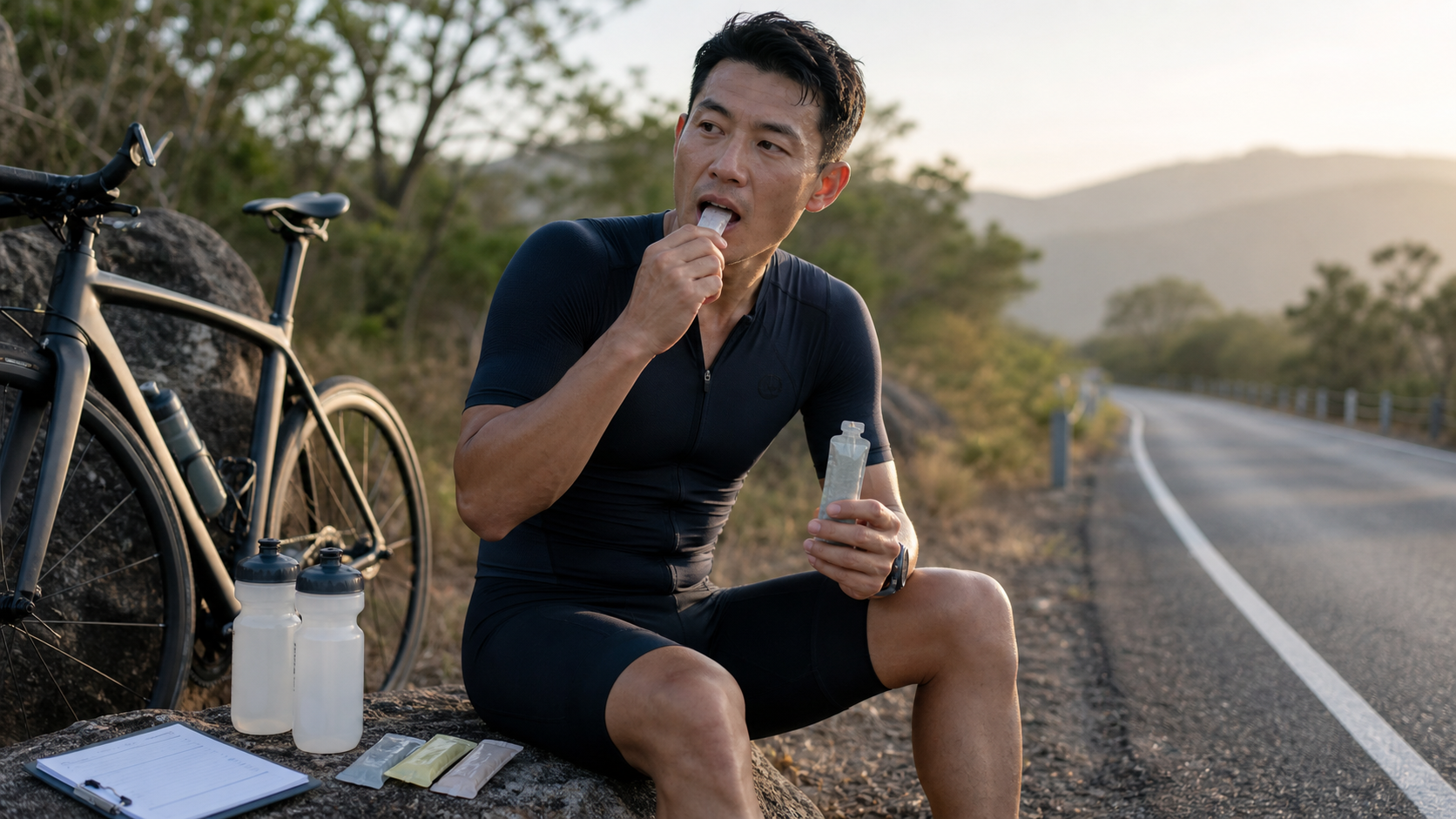
Coach’s Opening: Perfect Training Plan, Derailed by One Energy Gel
In all my years coaching athletes, the most heartbreaking sight isn’t someone blowing up in the final five kilometers. It’s someone who executed their training cycle flawlessly, with fitness data trending steadily upward, only to have race day ruined by an energy gel or a sip of sports drink—stomach cramps, nausea, bathroom sprints—flushing months of hard work down the toilet.
The athlete I remember most vividly, let’s call him A-Kai. A-Kai trained for a 226 Ironman (full distance) for eight full months. He did all the long rides he was supposed to, and his run volume was solid. But on race day, he started feeling nauseous in the latter half of the bike leg, vomited twice right after exiting T2 on the run, and ended up walking the marathon, finishing nearly an hour slower than his training projections. After the race, I asked him: “Those gels you used—how many times did you test them on long training days before the race?” He paused and said, “I saw everyone online recommending that brand, so I just bought the race-day quantity.”
That’s the core of the problem. Many people treat training as solely about conditioning the heart, lungs, muscles, and joints, forgetting that the gut is also an organ that needs training. You wouldn’t run a full marathon without ever having trained for it. So why would you expect a stomach that has never processed large amounts of carbohydrates under high intensity to behave perfectly on race day?
In this article, I want to thoroughly explain the concept of “practicing nutrition during training.” It’s not about telling you to buy more gels. It’s about treating nutrition as a skill—rehearsing it repeatedly on long training days, recording, adjusting, until your stomach is as reliable on race day as your legs.
Concepts and Scientific Basis: The Gut Can Be Trained
Why Race Nutrition Can’t Be Left to Improvisation
For endurance sports, energy supply during prolonged, moderate-to-high-intensity events relies heavily on exogenous carbohydrates (the carbs you consume while moving). When exercise extends beyond roughly 90 minutes, muscle glycogen stores gradually deplete. At that point, whether you can continuously ingest, digest, absorb, and deliver external carbs to your working muscles directly determines whether you’ll have any energy left in the second half.
The problem is that during exercise, the body prioritizes blood flow to working muscles and skin (for cooling), reducing blood flow to the gastrointestinal tract. With reduced blood flow, gastric emptying slows and intestinal absorption efficiency drops. This is why many people experience “I’m fine eating this normally, but it causes problems when I exercise.” This exercise-associated gastrointestinal distress is extremely common. Depending on the research methodology, prevalence rates among long-distance runners range from roughly 30% to 90% (Costa et al. systematic review). Common symptoms include bloating, abdominal pain, nausea, urgency to defecate, and even vomiting. This isn’t a problem for a few unlucky individuals—it’s a standard risk of endurance sports.
“Gut Training” Is Scientifically Supported
The good news is that the gastrointestinal system, like muscle, is adaptable. Repeatedly consuming carbohydrates during exercise can enhance the gut’s carbohydrate transport capacity, speed up gastric emptying, and reduce discomfort. In sports science, this is known as “gut training” or a “feeding challenge.”
A systematic literature review summarized this phenomenon (Martinez et al., PMC10185635), noting that repeatedly exposing the gut to nutrients before and during exercise can improve intestinal integrity and reduce lower gastrointestinal symptoms during and after exercise. Simply put: the more you practice consuming large amounts of food during training, the better your stomach can handle it on race day.
The mechanisms behind this generally involve three levels:
- Upregulation of carbohydrate transporters: The small intestine absorbs glucose and fructose via different transporters. Repeated stimulation increases the expression of these transporters, raising the absorption ceiling.
- Faster gastric emptying: Regularly practicing fixed amounts of food intake trains the stomach to process food during exercise, speeding up emptying and reducing that nauseating “food sloshing around in my stomach” feeling.
- Psychological and behavioral proficiency: Knowing exactly what you’ll eat at each aid point, how it tastes, and how much water to pair with it—this certainty itself reduces race-day anxiety and turns eating into an automatic response rather than a struggle.
How Many Carbs Per Hour? Here’s a Range, Not False Precision
Any discussion of fueling inevitably hits the question: “How many grams of carbs per hour?” Here’s a range supported by sports nutrition consensus, rather than a magic number pretending to be precise:
- Exercise under 1 hour: Usually no additional carbs needed; water or a bit of electrolytes suffices.
- Exercise 1 to 2 hours: Approximately 30 to 60 grams of carbs per hour.
- Exercise over 2 hours: Can increase to 60 to 90 grams per hour. At this level, a “glucose + fructose” multi-transporter combination is recommended (common ratio around 2:1), because relying solely on the glucose transporter pathway will saturate earlier.
- Well-trained athletes with a trained gut: Some can tolerate over 90 grams per hour, or even more, but this is absolutely built through training, not innate.
These figures are compiled from sports nutrition consensus literature (see Precision Fuel & Hydration’s summary of hourly carb intake). I want to emphasize: The upper limit is a ceiling, not a target. I’ve seen too many people hear “elite athletes consume 90 or even 120 grams” and try to jump straight there, only to have their gut completely rebel on the first attempt because it wasn’t trained to that level. Carb intake needs to be increased week by week on long training days—that’s the whole point of “practicing nutrition.”
Frequency of Fueling Rehearsals: When to Practice and How Often
Principle One: Tie Fueling Rehearsals to Long Training Days
The most logical vehicle for fueling rehearsals is your long training day (long ride / long run). The reason is straightforward: only long training days are long enough and intense enough to genuinely stress your gut. Eating a gel during a 40-minute easy run isn’t a test, because that scenario won’t cause problems anyway.
My frequency guidelines for athletes are:
- Every long training session exceeding 90 minutes should have a fueling plan. Not just bringing fuel along, but consuming it according to a predetermined schedule.
- During the specific preparation phase, 8 to 12 weeks out from race day, fueling rehearsals should start matching the actual products, actual dosages, and actual timing you’ll use in the race.
- In the final 4 to 6 weeks before race day, schedule at least 2 to 3 “full dress rehearsal” long sessions: using the exact same fueling brands, flavors, dosages, and hydration rhythm as race day—even wearing the same gear and heading out at a similar time of day.
Principle Two: Change Only One Variable at a Time
This is the iron rule I constantly emphasize to athletes. When testing nutrition, change only one variable at a time. If you switch gel brands, add salt tablets, and increase fluid intake all at once, and then your stomach acts up, you have no idea which one caused it.
So testing should be like running an experiment: this week, keep the gel type fixed and only adjust the hourly intake; next week, keep the dosage fixed and test different flavors or brands; the week after, add salt tablets or sports drinks. Build up gradually so you can pinpoint the culprit when problems arise.
Principle Three: Progressive Overload, Not All at Once
Gut training, like strength training, is progressive overload. Suppose your race goal is 80 grams of carbs per hour. Don’t start with 80 grams on your first attempt. Here’s a possible progression:
| Week (Race Distance) | Hourly Carb Target for Long Sessions | Rehearsal Focus |
|---|---|---|
| 12 weeks out | 40–50 g | Build the habit of eating on schedule; establish hydration rhythm |
| 10 weeks out | 50–60 g | Lock in primary fuel products; test flavor tolerance |
| 8 weeks out | 60–70 g | Introduce multi-carb (glucose + fructose) combinations |
| 6 weeks out | 70–80 g | Approach race dosage; test solid + liquid mixing |
| 4 weeks out | 80 g (target) | Full dress rehearsal; complete race fueling protocol |
| 2 weeks out | 60–70 g | Reduce intake alongside taper; maintain gut memory |
Note that in the final two weeks, as you enter the taper and training volume decreases, fueling volume can also decrease slightly, but don’t completely stop fueling rehearsals, or your gut adaptations will regress. Maintain some stimulus so your body remembers how to handle large amounts of carbs.
Product Testing Methods: How to Choose, Test, and Eliminate
The Real Situation for Taiwanese Athletes
Let’s address local reality first. Endurance events in Taiwan—whether Puyuma Ironman, Challenge Taiwan, Taitung 226, or various marathons—are mostly held in hot, humid conditions. Starting in the early summer morning, with perceived temperatures often exceeding 30°C and humidity at 70–80%, there are two particularly important points for fueling in this climate:
- Sweat rates are high and electrolytes are lost quickly. Carb-only fueling isn’t enough; sodium supplementation needs to be rehearsed alongside it.
- High heat further reduces gastrointestinal blood flow, making nausea more likely. So your fueling tolerance in hot, humid conditions absolutely must be tested on hot, humid long training days. You can’t extrapolate from experience on a treadmill in an air-conditioned room.
This is why I often tell Taiwanese athletes preparing for summer races to deliberately schedule several “hot-weather long sessions” to rehearse fueling under conditions closest to race day. A formula that works perfectly on a cool morning test can completely fall apart in the midday heat.
Four Dimensions of Product Testing
When evaluating whether a fueling product is usable, I look at four dimensions:
- Tolerance: Does it cause bloating, nausea, or diarrhea? This is the most basic threshold. If it fails here, eliminate it immediately.
- Palatability and sustainability: It might taste good at first, but can you still swallow it by hour three? Many overly sweet gels cause nausea in the later stages—this is called “flavor fatigue.”
- Practicality: Is the packaging easy to open? Can you operate it single-handedly while riding? Will you choke on it while running?
- Availability at aid stations: What brand of sports drink does the race provide at its aid stations? If you only practice with your own formula but plan to drink the aid station’s beverage during the race, that’s equivalent to not having practiced at all. Be sure to check in advance what products will be at your target race’s aid stations and incorporate them into your rehearsals.
How to Combine Solids, Gels, and Liquids
Fueling products generally fall into three forms, each with pros and cons. Long-distance races typically involve a mix:
| Form | Advantages | Disadvantages | Best Timing |
|---|---|---|---|
| Energy gels | Portable, fast absorption, precise dosage | Can be too sweet and cloying, requires water, monotonous flavor | High-intensity segments, when rapid carb replenishment is needed |
| Solids (energy bars, rice balls, bananas) | Provides satiety, flavor variety, psychological satisfaction | Requires chewing, slower digestion | First half of the bike leg, when intensity is lower |
| Liquids (sports drinks, carb powder mixes) | Simultaneously hydrates, fuels, and replenishes electrolytes | Concentration needs to be precise, bottles take up space | Continuous base fueling throughout the event |
In practice, the combination I often give triathletes is: use solids + liquids as a base in the first half of the bike leg (eating more while intensity is lower and the gut can handle solids), then transition to gels + water primarily in the latter half and the run leg (when intensity is high and the gut is more sensitive, switch to easily absorbed options). But this is just a general guideline. Your optimal combination can only be figured out through repeated testing on long training days.
Elimination Mechanism: If It Doesn’t Work, Swap It Out
The point of testing is to be willing to eliminate. If a product causes discomfort in two consecutive long training sessions, don’t second-guess yourself with “maybe I’m just not feeling well today.” Swap it out. The preparation period is for ruthlessly filtering—eliminating problematic products during training so that only formulas that have passed all tests make it to the starting line.
Record Sheet Design: Turning Fueling into Trackable Data
Now we come to the most critical tool: the fueling log. Trying to adjust your nutrition from memory is a recipe for chaos. By recording each rehearsal in a table, you can actually identify patterns.
What a Good Fueling Rehearsal Log Should Capture
The log I give athletes typically includes these fields:
| Field | What to Record | Why It Matters |
|---|---|---|
| Date/Weather | Temperature, humidity, time of day | Hot, humid conditions are a key variable for Taiwanese races |
| Training details | Distance, duration, intensity zones | Intensity affects gut tolerance |
| Fueling timeline | What was consumed at which minute, and how much | Identifies eating rhythm and problem time points |
| Carb tally | Actual grams consumed per hour | Compare against targets; track progressive increases |
| Fluids/Electrolytes | How much water and sodium per hour | Lifesaving data for hot days |
| GI response | Any bloating, nausea, abdominal pain, urgency (rate 1–5) | Identifies tolerance limits and problematic products |
| Subjective feelings | Perceived effort, late-stage bonking, flavor fatigue | Captures information that pure numbers miss |
| Conclusion/Adjustments | What to change next time (remember: one variable at a time) | Ensures each rehearsal has a direction for improvement |
A Sample Entry
Here’s an actual long-training fueling log from one of my athletes (numbers are illustrative):
- Date/Weather: June, departed 5:30 AM, 28°C, 82% humidity
- Training details: 120 km bike, average power 180 W, heart rate mostly 140–150 bpm
- Fueling timeline: Half an energy bar at minute 20, one Brand A gel at minute 40, then one gel every 30 minutes, sipping sports drink continuously
- Carb tally: ~65 g/hour for the first two hours, dropped to 50 g/hour in the third hour (couldn’t eat much)
- Fluids/Electrolytes: ~600 ml water per hour, ~500 mg sodium
- GI response: 1/5 for the first two hours (almost no issues), 3/5 starting in the third hour (mild bloating, gels became hard to swallow)
- Subjective feelings: Clear flavor fatigue in the third hour, sweetness became nauseating
- Conclusion/Adjustments: Try switching the third-hour gel to a savory solid (rice ball), and increase the interval between individual gels
See how this log makes the problem crystal clear: it’s not insufficient quantity—it’s flavor fatigue in the later stages. The adjustment direction for next time is obvious. That’s the value of the log—transforming “I feel weird” into actionable information like “hour three, Brand A gel, flavor fatigue, bloating 3/5.”
How to Roughly Estimate Calories and Sodium
Many athletes ask whether they need to precisely calculate calories. My stance is: Focus on the big picture; don’t get obsessive. Carbs provide approximately 4 kcal per gram, so consuming 60 grams of carbs per hour provides roughly 240 kcal of exogenous energy. For long-distance racing, your goal is to “delay glycogen depletion,” not to fully replace all calories burned (that’s impossible and unnecessary). For sodium, in hot, humid conditions with high sweat rates, 500 to 1000 mg per hour is a common reference range, but individual variation is large—again, you need the log to calibrate your own sweet spot. Here’s a simple self-assessment method: if after long training sessions your jersey or hat brim shows obvious white salt residue, or you crave salty foods afterward, you’re likely a “heavy sweater, high salt loss” type, and your sodium intake should trend toward the upper end of the range. Conversely, if there’s almost no salt residue, you can be more conservative. This kind of observation should itself be recorded in the log. Over time, you’ll know exactly which type you are.
How the Log Helps You Choose Pre-Race Meals in Taiwan’s Eating-Out Environment
Taiwan’s food culture is incredibly convenient—this is both an advantage and a trap. The advantage is that you can easily buy easily digestible carbs like white rice, white noodles, steamed buns, and onigiri at any time. The trap is that many seemingly light meals actually hide high fat, high fiber, or high dairy content that can cause problems during exercise. I recommend athletes record “pre-race meal tests” in their log as well: one long session you ate ding bian cuo (a local rice noodle soup), another time a tuna onigiri with sports drink, another time cereal with milk—record the GI response each time, and gradually filter out a “safe pre-race meal list” that you can find anywhere in Taiwan and that won’t cause issues. When you’re racing elsewhere, with limited hotel or convenience store options, this list becomes your lifeline.
Common Mistakes and Corrections
Having coached so many athletes, the fueling pitfalls people fall into are highly repetitive. Here are the most common ones—check how many you’ve hit.
Mistake One: Using a Product for the First Time on Race Day
This is the most fatal and most common mistake. You see someone recommend it, or it’s handed out at an aid station, and you put it in your mouth for the first time on race day. Correction: Any product you plan to use in the race must be fully tested at least 2 to 3 times on long training days. Anything untested is off-limits on race day. Better to be conservative.
Mistake Two: Only Practicing Carbs, Forgetting Water and Electrolytes
Many athletes focus their fueling rehearsals solely on energy gels, while water intake and sodium supplementation are completely haphazard. Then in a hot, humid race, they either cramp up or get dizzy from hyponatremia. Correction: Write your fluid intake and electrolytes into the log, and rehearse them as variables just as important as carb intake.
Mistake Three: Changing Too Many Variables at Once
I’ve covered this before, but it’s so common it deserves repeating. If you switch brands, increase dosage, and change your hydration strategy simultaneously, you won’t be able to identify the cause when something goes wrong. Correction: Change one variable at a time, building up gradually.
Mistake Four: Training in Cool Conditions, Racing in Scorching Noon Heat
Taiwanese athletes are especially prone to this. Mornings are cool, training feels great, fueling is fine—then race day hits with high temperatures and everything falls apart. Correction: In the later stages of preparation, deliberately schedule several hot-weather long sessions to rehearse fueling under conditions closest to race day.
Mistake Five: Flavor Fatigue in the Later Stages, Carrying Only One Flavor
By the third or fourth hour of sweet gels, many people feel so nauseated they can’t swallow another bite. Correction: Prepare alternating sweet and savory options, or rotate at least 2 to 3 flavors. Use long training days to figure out the combination you can tolerate best in the later stages.
Mistake Six: No Fixed Eating Rhythm, Waiting Until Hungry
During exercise, “waiting until you’re hungry to eat” is usually too late. The stomach also doesn’t send reliable hunger signals under high intensity. Correction: Set a fixed schedule (e.g., fuel every 20 to 30 minutes), use your watch to remind you, and eat proactively rather than reactively.
Actionable Recommendations for Athletes at Different Levels
There’s no one-size-fits-all formula for fueling rehearsals. Athletes at different stages need to do different things. Here are concrete starting points by level.
Beginner: First-Time Long Distance (First Triathlon, First Half/Full Marathon)
- Prioritize not having problems over optimization. Your primary goal is to finish. Your fueling strategy should be conservative and simple.
- Every training session over 90 minutes, practice “eating on schedule, drinking on schedule.” Building rhythm matters more than chasing high carb numbers.
- Start with 30 to 40 grams of carbs per hour, using the easiest-to-buy, least-likely-to-cause-problems products.
- Definitely prepare a simple log, even if it only records “what I ate today and whether my stomach felt okay.”
- Research what your registered race’s aid stations will provide, and practice with those items.
Intermediate: Aiming for a Personal Best (Competitive Age-Grouper)
- Start doing serious gut training. Use the “progressive overload” table above to push your carb intake toward your target week by week.
- Introduce multi-carb (glucose + fructose) combinations and test tolerance at 60 to 80 grams per hour.
- Keep a complete log and begin analyzing your “GI tolerance ceiling” and “flavor fatigue time point.”
- Schedule at least 2 to 3 full dress rehearsal long sessions, matching gear, start time, and weather as closely as possible to race day.
- Specifically for Taiwan’s hot, humid climate, get your electrolyte strategy dialed in.
Advanced: Chasing a Kona Slot or Ironman Finish
- Fueling is one of your competitive advantages. Treat it as an independent training discipline.
- Systematically push hourly carb intake toward 90 grams or more, but only with months of progressive build-up and rigorous logging. Never rush it.
- For ultra-long events (226 or ultramarathons), specifically rehearse “late-stage solid fueling” and “flavor fatigue management.” This is often the deciding factor.
- Consider testing fueling tolerance across different intensity zones: the gut is more sensitive at high intensity, so your formula needs to survive the hardest segment of your race.
- If fueling problems persist and resist resolution, seek individualized assessment from a sports nutritionist rather than guessing on your own.
A Complete Dress Rehearsal Checklist You Can Copy
Here’s everything above condensed into an actionable checklist for your “full dress rehearsal long sessions” in the final 4 to 6 weeks before race day:
- The night before: Eat the same pre-race meal you plan to have on race day, testing your GI response.
- Before departure: Wake up at race-day time, eat your pre-race fuel, and record the timing.
- Choose a similar climate and time window: For Taiwanese summer races, find a hot, humid early morning to late morning slot.
- Fuel throughout according to your race plan: Use race products, dosages, and intervals. Set alarms as reminders.
- Rehearse fluids and electrolytes simultaneously—don’t just focus on gels.
- Record in your log during the session or immediately after, while your memory is fresh.
- Post-session review: Identify the problem points and decide on “that one” variable to change next time.
- Repeat 2 to 3 times until the entire process becomes second nature.
When you can run through this process knowing exactly what to eat and drink at every minute with your eyes closed, your fueling transforms from “a race-day variable” into “a weapon you can rely on.”
In-Depth Case Studies: Fueling Rehearsal Stories of Three Different Athletes
Principles alone are too abstract. Let me walk you through three real scenarios (names changed, numbers illustrative) to show how fueling rehearsals actually work in practice.
Case One: Xiao-Ting—A First-Time Triathlete Derailed by a High-Fiber Breakfast
Xiao-Ting was attempting her first standard-distance triathlon (51.5 km). She was very health-conscious and typically ate whole wheat bread with lots of raw vegetables and oatmeal for breakfast. She transplanted this “healthy diet” unchanged to race morning. The result: right after the swim, before she’d even finished the bike leg, she was constantly running for the bathroom. The entire race became a battle between “holding it in” and “sprinting to the toilet.”
What was the problem? High-fiber foods are healthy at rest, but during exercise they increase GI burden and stimulate the defecation reflex. Research indicates that many endurance runners deliberately avoid high-fiber foods and dairy before races to reduce GI symptoms (Wilson et al. dietary strategy study). We adjusted her approach: one to two days before the race, she switched to low-fiber, easily digestible carbs (white rice, white toast, white noodles), and we validated this repeatedly on long training days. In her second standard-distance triathlon, she never once had to run for the bathroom. Lesson: The pre-race meal needs just as much rehearsal as in-race fueling. Healthy doesn’t necessarily mean race-appropriate.
Case Two: Lao-Zhang—An Age-Group Veteran Who Trained Carbs but Forgot Sodium
Lao-Zhang was a seasoned age-group competitor. He was diligent with fueling rehearsals, building his hourly carb intake to 75 grams with rock-solid GI stability. But he had a blind spot: he only focused on carbs, while fluid and electrolyte intake were entirely by feel. At a summer 113 half-Ironman in Taiwan, he flew through the bike leg, but at the 15 km mark of the run, his calves seized up with severe cramps, forcing him into a walk-run-walk pattern.
When we reviewed his log, we found he was only consuming about 300 mg of sodium per hour—clearly insufficient for someone with his heavy sweat rate (the type whose clothes crust with white salt). After the adjustment, we raised his sodium to approximately 800 mg per hour and verified through several subsequent hot-weather long sessions that the cramping stopped. Lesson: Fueling is a trinity of carbs, water, and electrolytes. Neglect one corner, and you’ll pay the price in the later stages.
Case Three: A-Zhe—An Ironman Athlete Chasing Kona but Stuck on Flavor Fatigue
A-Zhe was preparing for a 226 full Ironman. His fitness and carb tolerance were both excellent—he could handle 90 grams per hour. But every ultra-long session exceeding six hours, he would become completely revolted by sweet gels in the later stages, unable to swallow another bite. This caused his carb intake to collapse in the final two hours, and his pace dropped significantly.
This is classic flavor fatigue. Our solution wasn’t to force him to choke down the gels. Instead, we designed a “flavor rotation” strategy: sweet gels and sports drink in the first half, then switching to savory solids (onigiri, savory energy blocks) and plain water in the second half. We even prepared sugar-free rinse water to “wash away” the cloying sweetness in his mouth. After several ultra-long rehearsal sessions, he was able to maintain his late-stage carb intake above 70 grams per hour. Lesson: In ultra-long events, the difference between winning and losing often isn’t fitness—it’s whether you can keep eating.
Frequently Asked Questions (FAQ)
Q1: I don’t eat much during regular training and I’m fine. Do I really need to rehearse for race day?
You don’t eat during training usually because your long-session intensity or duration hasn’t reached the point where problems occur. On race day, intensity is higher, duration is longer, and you add nerves and heat—a completely different situation. As long as your target event exceeds 90 minutes, you absolutely must rehearse your fueling.
Q2: Can I eat energy gels dry without water?
Most energy gels are highly concentrated carbs. Eating them dry creates high osmotic pressure in the stomach, slowing gastric emptying and causing bloating and nausea. It’s generally recommended to swallow them with water to dilute the concentration to a level the gut can handle. However, some products are marketed as isotonic and can be consumed directly—regardless of which type, test it on a long training day first.
Q3: I have a particularly sensitive stomach and feel uncomfortable on every long session. What should I do?
First, rigorously apply “change one variable at a time” and use your log to identify exactly which product, which time point, and which dosage is causing the problem. Start with a very low carb intake (30 grams per hour) and increase slowly, giving your gut adequate adaptation time. If severe discomfort persists after months of troubleshooting, seek individualized assessment from a sports nutritionist or gastroenterologist to rule out underlying digestive issues.
Q4: Should I do “carb-loading” before the race? Is it related to fueling rehearsals?
Yes, it’s related. Carb-loading in the days before the race is about “filling the tank.” In-race fueling is about “refueling while driving.” Both need to be practiced. The carb-loading menu should also be trial-run before a long session to confirm your gut can handle that volume of food. Don’t wait until race week to suddenly stuff yourself with carbs for the first time.
Q5: Are fueling strategies the same for running and cycling?
The principles are the same, but because the upper body is relatively stable and both hands are available on the bike, cycling generally makes it easier to handle solid foods. Running’s up-and-down impact makes the gut more sensitive, so most people prefer liquids or gels during the run leg. Triathletes especially need to practice the transition rhythm of “eating well on the bike, eating smart on the run.”
Conclusion: Train Your Stomach to Be as Reliable as Your Legs
Let’s return to A-Kai from the beginning. The following year, he started over. This time, we treated fueling as part of the official training plan. Every long session had a fueling plan, every session was logged, he deliberately went out for rehearsals in hot, humid weather, and products were tested and eliminated one by one. On race day, he could eat on the bike, didn’t vomit on the run, and not only finished—he beat his projected time by over twenty minutes. He told me the biggest difference was, “This time I knew exactly how my stomach would react. I wasn’t panicked at all.”
That’s the meaning of practicing fueling. You wouldn’t train your cardio at the last minute, so you shouldn’t train your gut at the last minute either. Fueling is a skill that can be trained, recorded, and refined. Long training days are the only place you should make mistakes—test out and eliminate all the problematic combinations during training, so that on race day you stand at the starting line carrying only validated formulas.
Next long session, don’t just bring along whatever fuel you happen to have. Bring your plan, bring your log, and do a proper dress rehearsal. Your finish time will be determined, bit by bit, on those long training days no one sees.
This article is educational content and does not replace individualized assessment by a physician, physical therapist, or nutritionist. Individual tolerance to carbohydrates and electrolytes varies greatly. If you have chronic conditions, a history of digestive issues, or special nutritional needs, please consult a professional.
References
- Gastrointestinal Complaints During Exercise: Prevalence, Etiology, and Nutritional Recommendations — https://www.ncbi.nlm.nih.gov/pmc/articles/PMC4008808/
- The Effect of Gut-Training and Feeding-Challenge on Markers of Gastrointestinal Status in Response to Endurance Exercise: A Systematic Literature Review — https://www.ncbi.nlm.nih.gov/pmc/articles/PMC10185635/
- How much carbohydrate do athletes need per hour? — https://www.precisionhydration.com/performance-advice/nutrition/how-much-carbohydrate-carbs-athletes-per-hour/
- Dietary restrictions in endurance runners to mitigate exercise-induced gastrointestinal symptoms — https://www.ncbi.nlm.nih.gov/pmc/articles/PMC7288429/
Related Reading
- Gut Training: Why Your Gut Needs Training Too, and How to Handle Race-Day GI Distress
- Gut Training: Treating the Gut as a Trainable Organ So You Can Still Eat in the Second Half
- Feeling Nauseous During Exercise? A Coach Explains the Causes and Nutritional Countermeasures
- How to Design a Race-Day Fueling Plan: A Practical Framework from the Week Before to Every Hour After the Start
FTL 與 SYB 車隊專訪 西進武嶺 實用攻略分享! 2小時 如何練?!你不知道的眉角!新手準備武嶺必看 EP1 | 實力派女車友 | 精華版 | 公路車 | CTYeh
4 年前
約騎爆笑地獄梗 大腸怎麼了🤣 #公路車 #cycling
3 年前
一個測試有沒有認真練車的方法😂 #公路車
10 個月前
一日北高/長距離團騎 常見問題補充篇 / 組團或跟團的眉角 / 壯車友容易被瘦車友慢性拉爆 / 原來屁股痛可能是這個原因...? / 風場配速法 / 公路車 / CT Yeh
2 年前
一日北高前的高裝檢 | 北高 360 | 挑戰11小時的裝備 | 一日雙塔 | 補給
6 年前
西進武嶺 免費訓練分析服務 Intervals | 練不夠還是練過頭?你哪一種類型選手?AI模型告訴你! | 備戰神器 | 公路車 訓練 | CT Yeh
4 年前
2021 96聯賽 桃園市長盃 4K多視角實況 當天選手瓦數/推力比/均速/時間 即時數據分析 | 公路車 | CT Yeh
5 年前
CT暗黑廚房) 車友必備 宇宙無敵鮮蚵湯 幫助訓練恢復 天然食補 好市多 超肥鮮蚵 破PR
7 年前