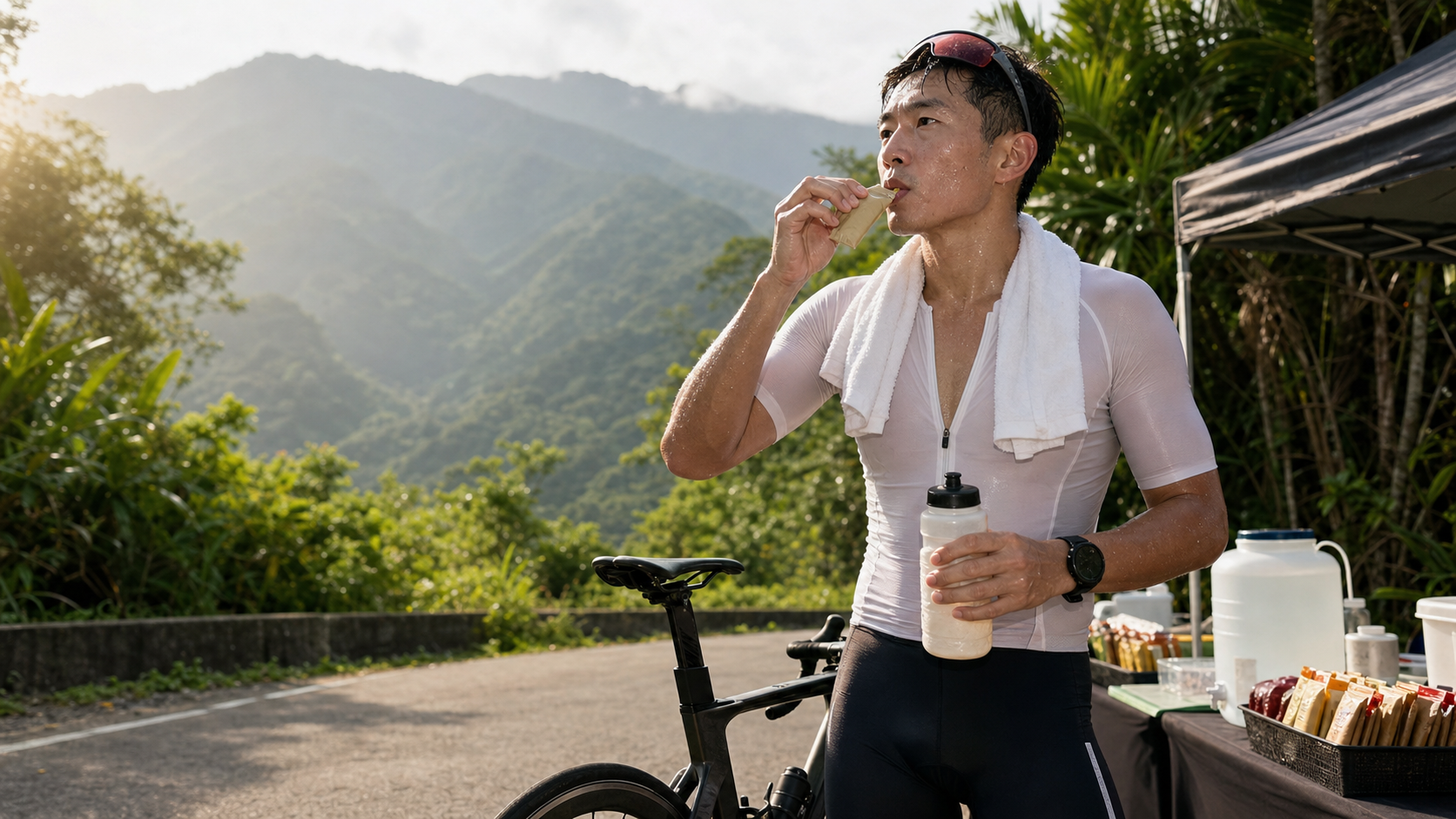
Coach’s Opening: The Athlete Who “Threw Up in Front of Me” in the Second Half of a 226
I once coached an athlete—let’s call him A-Kai. He wasn’t weak—FTP around 240 watts, 68 kg, smooth flat-road pacing, and he could climb Guanyin Mountain or Fengguizui without getting winded. But every time he raced a 113 or 226 iron-distance event, once he passed the two-thirds mark of the bike leg, he started to “fall apart.” Not his legs—his stomach. He told me, “Coach, I clearly still have power, but the moment I swallow a gel I feel like throwing up, and when I drink water, my stomach feels like it’s sloshing around with a bucket of undigested food.”
That year at Challenge Taiwan, on the course around Liyu Lake in Hualien, he barely took in any fuel for the final 30 km of the bike leg. Within the first 5 km of the run, he was cramping and nauseous, and ended up walking to the finish. He was frustrated and thought it was a mental toughness issue.
I told him: This isn’t about willpower—it’s about insufficient organ training. You’ve trained your legs for a year, but you’ve never trained your gut for a single day. If you asked someone who’s never lifted weights to deadlift 100 kg, of course they couldn’t do it. Likewise, if you ask a gut that’s never trained for absorption to process 90 grams of carbs per hour in hot, humid, high-intensity conditions where blood flow is shunted to the limbs, of course it’s going to go on strike.
The good news: the gut, like muscle, can be trained. In this article, I’ll walk you through “Gut Training” from the scientific foundation to actual training plans, so you know how to push your fueling ceiling higher.
1. Concepts and Scientific Foundation: Your Gut’s Absorption Ceiling Can Be Upgraded
Why “Being Able to Eat” Is Harder Than “Eating the Right Things”
Let’s start with a harsh truth: in long-distance endurance sports, what limits you is often not “what you eat,” but “how much your gut can absorb.” You can carry an entire pack of energy gels, but if you can’t absorb them, those sugars just pile up in your stomach, ferment, cause bloating and nausea, and can even trigger the gastrointestinal distress (GI distress) common among runners.
Research estimates that gastrointestinal discomfort is quite common in long-distance events, especially in high-impact activities like running, where the up-and-down motion makes problems more likely. Many finish times fall apart in the second half not because energy is gone, but because “energy can’t get in.”
Why Is the Gut Especially Vulnerable During Exercise?
First, let’s build an important physiological picture. When you exercise at high intensity, your body redirects a large amount of blood to the working muscles and skin (for cooling), significantly reducing blood flow to the internal organs and intestines. Intestinal ischemia, elevated core temperature, the mechanical impact of running, and the osmotic pressure from concentrated sugar solutions—these four factors combined are what cause Exercise-Induced Gastrointestinal Syndrome.
This is why “the same fueling works fine when sitting, is okay when cycling, but makes you nauseous when running.” The higher the intensity, the hotter the weather, and the greater the impact, the harsher the environment for your gut to process food. The value of gut training is precisely to help your digestive system maintain a certain absorption efficiency even in these harsh conditions—this isn’t innate; it’s trained.
Key Players: The SGLT1 and GLUT5 Transport Channels
To understand why the gut can be trained, you first need to know the “transport proteins” on the small intestine wall. Carbohydrates are absorbed in the small intestine mainly through two channels:
- SGLT1: Responsible for transporting glucose and its polymers (such as maltodextrin). This channel has a processing limit.
- GLUT5: Responsible for transporting fructose. This is an independent channel.
Here’s the key point: relying solely on the SGLT1 glucose channel, the human body can oxidize and utilize only about 60 grams of exogenous carbohydrates per hour. Eat more than that, and the excess can’t be absorbed, becoming a burden in the gut. This is why for a long time, “60 grams per hour” was considered the ceiling.
But if you simultaneously feed glucose and fructose, because they use different channels and don’t compete, the total absorption can stack. Research shows that a glucose-to-fructose ratio of about 2:1 can increase carbohydrate oxidation by roughly 50% compared to glucose alone, pushing the total to 90 grams per hour—with glucose above 60 g/hr plus fructose—and some studies have observed that exogenous oxidation rates with combined carbohydrates are about 60% higher than with a single carbohydrate (GSSI Multiple Transportable Carbohydrates Review). This is the core logic behind “Multiple Transportable Carbohydrates.”
Let’s Crunch the Numbers: Why 60 Grams Is the Ceiling for a Single Sugar
Many people find SGLT1 and GLUT5 abstract, so let me walk you through it with actual numbers. Suppose you’re an age-group athlete weighing 70 kg, riding the bike leg of a 226 at aerobic intensity. You burn roughly 700 to 900 kcal per hour, a significant portion of which comes from carbohydrates. Since carbs provide about 4 kcal per gram, just to “break even,” you’d need to take in 70 to 90 grams of carbs per hour.
But if all your fueling is pure glucose or maltodextrin, once the SGLT1 channel is saturated, the excess sugar just lingers in the gut—you think you’ve consumed 90 grams, but your body might only actually use 60, and the remaining 30 become the culprit behind bloating and nausea. That’s the cruel gap between “eating it” and “absorbing it.”
Switch to a 2:1 glucose-to-fructose ratio, and the situation is completely different: 60 grams of glucose go through SGLT1, 30 grams of fructose go through GLUT5—two lanes open simultaneously—and most of the 90 grams can actually be utilized. You’re not just able to eat it; you’re eating it “effectively.” This is why virtually all mainstream high-end energy gels and powders tout a 2:1 glucose-to-fructose ratio.
It’s Not Just Transport Proteins: Gastric Emptying and Gut Microbiota Are Also Trained
The effects of gut training go beyond the “transport protein” level. Literature reviews indicate that regular high-carbohydrate fueling during exercise also accelerates gastric emptying (food moves from the stomach to the small intestine faster, so it doesn’t pool in the stomach), reduces the gut’s sensitivity to mechanical and osmotic stimuli, and may even affect how the gut microbiota processes certain sugars.
This also explains a phenomenon: why some people feel nauseous the first time they eat 80 grams of gel, but after two months of training, the same amount causes no issues. It’s not that their willpower got stronger—it’s that their entire digestive system—from the stomach, to the intestinal wall, to the absorption channels—has been genuinely “remodeled.” That’s the beauty of treating the gut as an organ to train.
The Gut Is “Plastic”: This Is the Soul of Gut Training
What I’ve covered above is “how to eat,” but the real key to training your gut lies in this—the quantity and activity of these transport proteins change in response to your long-term diet and training stimuli.
Sports science literature indicates that regularly consuming high carbohydrates during exercise over the long term upregulates the density and activity of SGLT1 transport proteins in the small intestine, enhancing the gut’s ability to absorb and oxidize carbohydrates; it also accelerates gastric emptying and reduces the occurrence of GI discomfort (Springer, “Training the Gut for Athletes”). Animal studies have also observed that continuous exposure of the intestinal lumen to sugar increases SGLT1 mRNA expression and protein synthesis.
In other words: your gut’s absorption ceiling isn’t a fixed limit—it’s a muscle that can be trained upward. A rider who could only handle 60 grams per hour has a very good chance of reaching 90 or even 120 grams per hour through 6 to 12 weeks of progressive gut training (Roadman Cycling Gut Training Guide).
One-sentence summary: Gut training = using the principle of progressive overload to stimulate your digestive and absorptive system, just as you use progressive overload to stimulate muscle.
2. Practical Methods: A Progressive Plan to Increase Carbohydrate Intake
Start with a “Baseline Test”: Where Is Your Current Ceiling?
Before starting any plan, you must know where you currently stand. I usually have athletes do a “fueling stress test”:
Pick a 2.5- to 3-hour long ride at Zone 2 to Zone 3 intensity (aerobic to sweet spot), deliberately consume 70 to 80 grams of carbs per hour, and honestly record your body’s response.
| Response Level | Symptom Description | Interpretation |
|---|---|---|
| Green Light | No bloating, no nausea, steady energy | Your baseline is higher than you think; start at 70g |
| Yellow Light | Mild bloating, burping, slight nausea in the latter part | Typical untrained gut; start at 50–60g |
| Red Light | Obvious nausea, cramping, urge to vomit, or diarrhea | Start at 40–45g, and prioritize fixing the formula and concentration |
Remember: This is a test, not a race—don’t push through it. A red light is a good thing; it means you’ve found your starting point for training.
12-Week Progressive Plan (Using Cycling as the Primary Vehicle)
This is the framework I use most often. The principle: every 2 weeks, increase the “target carbs per hour” by 10 to 15 grams, and schedule one “long gut-specific ride” to test the new intake level. Cycling is the best training vehicle because the upper body is stable and stomach movement is minimal, making absorption easier than when running.
| Week | Target Carbs/Hour | Specific Long Ride Duration | Fueling Format Recommendations |
|---|---|---|---|
| Weeks 1–2 | 50–60 g | 2.0–2.5 hours | Sports drink + 1 gel; practice eating on a schedule |
| Weeks 3–4 | 60–70 g | 2.5–3.0 hours | Add solids (energy bar/rice ball) to diversify sources |
| Weeks 5–6 | 70–80 g | 3.0–3.5 hours | Introduce a 2:1 glucose-to-fructose formula |
| Weeks 7–8 | 80–90 g | 3.5–4.0 hours | Increase concentration; practice with the actual products you’ll race with |
| Weeks 9–10 | 90–100 g | 4.0 hours | Simulate race conditions (heat, humidity, intensity changes) |
| Weeks 11–12 | Maintain 90+ g and fine-tune | Brick training | Bike-to-run transition; test whether you can still eat during the run |
A few execution details:
- Eat on a schedule; don’t wait until you’re hungry. I have athletes set a 15-minute watch reminder and take about a quarter to a third of a serving each time, breaking large loads into small bites. The gut hates getting a big load all at once.
- Hydration must keep pace. Concentrated sugar needs water to dilute it; otherwise, the high sugar concentration pulls water back into the gut, causing bloating and diarrhea. Taiwan’s summers are hot and humid, so hydration needs to be higher anyway—this is even more important.
- The higher the intensity, the more blood flows to the limbs, and the weaker the gut becomes. So early training should be at Zone 2 to Zone 3; once absorption improves, gradually test at higher intensities.
Taiwan-Specific Scenarios: Build Training into Your Familiar Routes
For athletes in the Taipei–New Taipei area, I often schedule “riverside long-ride gut training”—riding from Dadaocheng along the Tamsui River and Keelung River for 3 to 4 hours. The roads are flat, there are few traffic lights, and convenience stores (with the highest density in the world) are easy to find—perfect for practicing timed, measured fueling.
For those in central or southern Taiwan, use lake loops or long flat routes. To simulate hilly races (like Wuling, Taipei–Kaohsiung, or K.O.M.), test “whether you can still eat at high intensity” on continuous climbs like Yangmingshan or Fengguizui—that’s the real exam.
Taiwan’s heat and humidity are an extra boss-level challenge. High temperatures worsen GI discomfort and accelerate dehydration, so your gut training should ideally be scheduled at a time and climate similar to race conditions (e.g., the muggy hours after 9 a.m. in summer), letting your body adapt in advance to the counterintuitive act of “digesting while pouring sweat.”
A Practical Fueling Example You Can Understand: How to Structure 90 g/Hour
Saying “90 grams per hour” is vague, so let me break down what one advanced athlete actually consumed during the bike leg in a single hour. This is just an example—numbers will vary based on product labels—but the point is to give you a feel for “how to break 90 grams into small, easy-to-take portions”:
| Time Point | Fueling Content | Approx. Carbs | Notes |
|---|---|---|---|
| 0 min | One big sip of sports drink | ~15 g | Start with a base layer; also replenish electrolytes |
| 15 min | Half an energy gel | ~12 g | Chase with 2–3 sips of plain water to dilute |
| 30 min | One bite of energy bar/small rice ball | ~20 g | Solid source to break up flavor fatigue |
| 45 min | Half an energy gel | ~12 g | Also with water |
| 45–60 min | Continuous small sips of sports drink | ~30 g | Increase hydration; add more in hot weather |
| Total | — | ~90 g | Spread over 5–6 feedings; avoid large single doses |
See the pattern? Nobody “swallows 90 grams in one gulp.” Splitting an hour into 4 to 6 small bites of ten-odd grams each is the rhythm your gut can handle. This is also why watch reminders are so important—your brain gets dull during a race; rely on discipline, not memory.
A quick note on the solids-versus-liquids trade-off: Liquids (sports drinks, gels) absorb quickly and are easy to take, but a liquid-only diet gets monotonous and can cause nausea later on; solids (energy bars, rice balls, savory snacks) are more satiating and provide chewing satisfaction, but digest more slowly and need more water to go down. My advice is to use both solids and liquids on the bike leg (high speed and a stable upper body make it easier to handle solids), while the run leg should focus on easy-to-take liquids or gels. During gut training, you should practice both textures so you know on race day which works at which point.
Gut Training Should Also Be Periodized
Like physical training, gut training doesn’t need to be done every day, nor should you do high volumes every day. My scheduling principle: pick 1 to 2 long sessions per week (LSD long rides or long brick workouts) as gut-specific days, pushing fueling to the target amount; on other days with shorter or interval sessions, return to a comfortable, everyday fueling level, giving the gut room to recover and adapt.
In the 2 to 3 weeks before race day during the taper, reduce the “volume” of gut training along with the rest of the plan, but keep at least one full race-day fueling rehearsal—using the products you’ll race with, at race time, and at race intensity, run through the entire routine. This session isn’t to train absorption; it’s to confirm “this formula won’t fail me on race day.”
How Do You Know “It’s Working”? Three Observation Indicators
Athletes often ask me, “Coach, how do I know if my gut has actually improved?” I give them three practical, instrument-free self-assessment indicators:
- Subjective comfort at the same intake level. A few weeks ago, 70 grams caused bloating; now 70 grams goes down smoothly—this is the most direct sign of progress. I recommend keeping a training diary, recording intake and gut response for each session; trends become obvious at a glance.
- Energy stability in the second half. In the past, you’d “hit a wall” after three hours of riding—dizziness, scattered focus. After training, these energy cliffs noticeably diminish, meaning the sugar is truly being absorbed and utilized.
- Gut status after cooling down. No post-race diarrhea, no heavy “stomach full of undigested food” feeling—this means your intake is within the range your gut can genuinely handle.
When all three indicators move in the right direction together, that’s hard evidence that your gut—this “organ”—is getting stronger.
One easily overlooked detail to close this section: the quality of gut training is tied to your sleep, stress levels, and what you ate the previous meal. On days when you slept poorly, are under work stress, or ate a heavy previous meal, your gut is naturally more sensitive. Forcing high-volume fueling practice on such days can easily produce a red light that isn’t representative, which undermines confidence. I recommend scheduling gut-specific days when your life is relatively stable and you have more physical and mental leeway, so you’re measuring “your gut’s true absorption capacity” rather than the noise of “today just happens to be a bad day.” Train this way consistently, and the data will be reliable, and progress will be solid.
3. Common Mistakes and Fixes
After coaching athletes for years, I’ve found that the pitfalls people fall into are highly repetitive. Here’s a checklist for you:
Mistake 1: Only “Eating Seriously” on Race Day
This is the most fatal one. Training on an empty stomach or eating whatever, then trying to stuff 90 grams in on race day—that’s like asking an untrained gut to deadlift on the spot. Fix: Treat fueling as part of your training plan; every long ride is a gut training session.
Mistake 2: Using Only a Single Glucose Source and Force-Feeding
Many people keep increasing their gel intake, but it’s all pure glucose/maltodextrin. They hit the SGLT1 ceiling and keep forcing more, and it all gets stuck in the stomach. Fix: Introduce a 2:1 glucose-to-fructose multiple-transportable-carbohydrate formula so the GLUT5 channel works too.
Mistake 3: Concentration Too High Without Enough Water
Mixing powder extra thick and sweet, thinking you’re being clever by carrying fewer bottles, but the high osmotic pressure pulls water into the gut, causing direct diarrhea. Fix: Pay attention to the sugar concentration per sip; solid gels must be chased with enough plain water or low-concentration electrolyte water.
Mistake 4: Progressing Too Fast, Jumping from 60 to 100 in One Go
The gut needs time to adapt. Jumping too fast just makes every session a red light and trains you to fear fueling. Fix: Strictly follow the rhythm of adding 10–15 g every 2 weeks; if your body gives a yellow light, hold that week’s amount before moving up.
Mistake 5: Only Training on the Bike, Not the “Bike-to-Run Transition”
Triathletes especially overlook this—just because you absorb well on the bike doesn’t mean you can still eat when the up-and-down impact of running starts. Fix: Your plan must include brick (bike-to-run) sessions in the later phase, testing fueling during the run segment.
Mistake 6: Training with Product A but Racing with Product B
I’ve seen too many people train well with one brand, then switch to another brand’s gel on race day because it came in the athlete swag bag or someone recommended it—and all that gut adaptation goes to waste. Different products vary greatly in sugar ratios, osmolality, and additives (caffeine, amino acids, thickeners). Fix: Lock in your race products at least 3–4 weeks before race day and use only them throughout training. You’re not training “the ability to absorb sugar”; you’re training “the ability to absorb this specific product.”
Mistake 7: Ignoring the Effects of Caffeine and Protein on the Gut
Many energy gels contain caffeine. In moderation, it can boost alertness and even promote sugar absorption in the gut; but excess caffeine stimulates intestinal motility, and for sensitive people, that’s a one-way ticket to diarrhea. If you plan to include protein/amino acid-containing fueling in long races, test your tolerance in advance. Fix: Include caffeine and protein fueling in your gut training test list; don’t try them for the first time on race day.
4. Actionable Advice for Athletes at Different Levels
First-Timers/Beginners (Goal: Finish Without Falling Apart)
You don’t need to chase 90 grams from the start. First aim to consistently consume 50 to 60 grams per hour without issues—that’s enough for most 51.5 or 113 distances. Focus on “building the habit of eating on a schedule” and “finding products your gut doesn’t resist.” Taiwan’s convenience stores make fueling easy; train with the same things you can buy for race day.
One extra reminder for beginners: Taiwan’s eating-out environment is heavy on oil, salt, fiber, and spices. What you eat one to two days before the race is also part of gut preparation. I often remind newcomers: don’t go out for hot pot or fried chicken on the night before the race just because you’re nervous—choose foods your gut is already familiar with and that are easy to digest. Gut training isn’t just “what you eat during exercise”; it also includes “how you eat before the race to keep your gut clean and comfortable at the starting line.” Many people have learned this lesson the hard way.
Advanced/Age-Group Competitors (Goal: No Collapse in the Second Half)
You should seriously run an 8- to 12-week progressive plan, targeting 80 to 90 grams per hour, and introduce multiple transportable carbohydrates. In particular, train the combination of “high intensity + heat and humidity + bike-to-run transition,” because that’s the real battlefield in the second half of your 226 or full marathon.
At this stage, I give athletes a concrete milestone check: in a 4-hour brick session that includes 30 minutes of bike-to-run transition, maintain a steady intake of 85+ grams per hour throughout, with no significant GI discomfort after cooling down and no “post-race diarrhea” aftermath. If you can do this consistently, you’ve truly “banked” the 90-gram fueling strategy and can bring it to race day with confidence. If you can’t, don’t rush the volume—drop back to the previous week’s amount and consolidate for two more sessions.
Also, a reminder for Taiwan athletes: our target races vary greatly in climate—Challenge Taiwan (April, Hualien, relatively mild), IRONMAN 70.3 Taiwan (Kenting, usually very hot and humid), and various standard-distance triathlons. You should design your gut training’s heat-and-humidity scenario around “the hottest race,” because absorption under heat stress is the most severe test of any fueling strategy. The Kenting sun will instantly shatter the confidence you built in an air-conditioned room.
Elite/Kona Contenders or PB Chasers (Goal: Turn Fueling into a Weapon)
Top athletes are already exploring 100 to 120 grams per hour of intake (EndureIQ 90 vs 120 g Comparison). At this level, you need very precise “formula testing + concentration control + intensity stratification,” even using different intake strategies for different race segments. But the prerequisite is: your gut has been systematically trained to handle this amount; otherwise, 120 grams will just become 120 grams of disaster.
5. Coach’s Mailbag: The Most Frequently Asked Questions About Gut Training
These are the questions I’ve been asked to death over years of coaching, yet everyone genuinely wonders about them. Let me answer them all at once.
Q1: How Long Until Gut Training Shows Results?
Generally, 6 to 12 weeks is a reasonable timeframe. Some people notice “eating goes more smoothly” within 4 weeks; others with more sensitive guts need more patience. The key is consistency—training once or twice a week for several consecutive weeks is far more effective than one intense session followed by a three-week break. Organ adaptation, like muscle, relies on sustained stimulation.
Q2: Will I Regress After I’ve Trained It?
Yes, but not as fast as you might think. Just as stopping training causes muscle loss, if you completely stop consuming carbs during exercise for a long period, your gut’s absorption capacity will gradually decline. So my advice: during the season, maintain at least one high-volume fueling long ride per week to keep your gut “online.” Off-season, you can relax, but be sure to run a new block before race season.
Q3: Does This Apply to Runners Who Only Run and Don’t Cycle?
Absolutely—the principles are identical. It’s just that running’s up-and-down impact makes absorption harder, so runners’ progress curves are usually flatter than cyclists’, and starting volumes should be more conservative. Many runners first build up absorption on the bike or spin bike, then gradually transition to testing in running scenarios—that’s a smart approach.
Q4: Do People on a Low-Carb (LCHF) Diet Need Gut Training?
If you’re on a low-carb diet and don’t plan to use high-carb fueling in races, then gut training is indeed a lower priority. But a word of caution: how you eat day to day determines what your gut is “prepared” to handle. People on long-term low-carb diets typically have a weaker ability to process large amounts of sugar. If you ever want to use a high-carb strategy for a key race, you must retrain several weeks in advance—you can’t just switch on race day.
Q5: Doesn’t Fructose Cause Diarrhea Easily? Won’t Eating a Lot of It Cause Problems?
Consuming large amounts of fructose alone can indeed cause osmotic diarrhea due to the limited GLUT5 channel—that’s where fructose’s bad reputation comes from. But in a “2:1 glucose-to-fructose” combination, the presence of glucose actually synergistically promotes fructose absorption, making overall tolerance much better than fructose alone. This is why we emphasize “ratio” rather than mindlessly adding fructose.
6. A Quick-Reference Table: Key Takeaways
| Aspect | Remember This |
|---|---|
| Core Concept | The gut is an organ that can be trained like muscle |
| Physiological Mechanism | SGLT1 handles glucose, GLUT5 handles fructose; the two channels stack |
| Golden Ratio | Glucose:fructose ≈ 2:1, pushing the ceiling toward 90 g/hr |
| Progression Rhythm | +10–15 g every 2 weeks; listen to your body’s red/yellow/green lights |
| Execution Discipline | Eat on a schedule, hydrate adequately, watch concentration, practice bricks |
| Taiwan Context | Riverside for measured fueling, climbs for high intensity, summer for heat and humidity |
| Time Investment | Generally effective in 6–12 weeks; complete before race day |
Conclusion: Back to A-Kai’s Story
A-Kai dutifully completed the 12-week gut training plan I gave him. From a yellow light at 55 grams per hour at the start, he eventually reached a steady 90 grams on riverside long rides, and could even handle it during bike-to-run transitions. The following year, he returned to Challenge Taiwan. He got in everything he needed during the final 30 km of the bike leg, ran the entire marathon without cramping or nausea, and broke his PB by nearly 20 minutes.
He texted me after the race: “Coach, I realize I wasn’t weak before—I just never prepared my stomach.”
I particularly remember a turning point during his training that year. Around week 6, I asked him to introduce the 2:1 glucose-to-fructose formula. He was resistant at first, thinking, “I’m not a pro athlete; why make things so complicated?” But on that riverside long ride, for the first time, after finishing 3.5 hours, he could smile and tell me, “Coach, I actually still want to eat right now”—in the past, at that point, he’d already be grimacing at the sight of a gel. He was shocked himself in that moment and finally believed the gut could be trained. From then on, he went from someone who dreaded fueling to a detail-obsessed athlete whose training diary recorded “how many grams I ate today and how my body reacted” with precision.
This is what I want to tell every reader: when your legs have been trained for a long time, yet you inexplicably fall apart in the second half, don’t rush to blame willpower—first ask yourself whether you’ve trained your gut. Treat the gut as a trainable organ, approach it with progression, patience, and discipline, and you’ll find that the version of you in the second half of a race who “can still eat and still run” is closer than you think.
On your next long ride, start by setting a 15-minute fueling alarm. From today, treat every long session as a gut weightlifting workout, stacking it up gram by gram, week by week. When that critical second half arrives on race day, you’ll be glad you trained not just your legs, but also the stomach that’s willing to keep working for you in the toughest moments. That is the reward of treating the gut as an organ to train.
This article is educational content and does not replace individual assessment by a physician, physical therapist, or nutritionist. Individual gut tolerance, chronic conditions, and medication use vary widely; before implementing any fueling strategy, we recommend consulting a professional sports nutritionist.
References
- Gatorade Sports Science Institute — Multiple Transportable Carbohydrates And Their Benefits:https://www.gssiweb.org/sports-science-exchange/article/sse-108-multiple-transportable-carbohydrates-and-their-benefits
- Springer / Sports Medicine — Training the Gut for Athletes:https://link.springer.com/article/10.1007/s40279-017-0690-6
- Roadman Cycling — Gut Training for Cycling: Absorb 90–120g Carbs/Hour:https://roadmancycling.com/blog/gut-training-cycling-absorb-more-carbs
- EndureIQ — 90 vs 120 g of Carbohydrates for Endurance Performance:https://www.endureiq.com/blog/carbohydrate-ingestion-rates-during-exercise-90-vs-120-grams-per-hour-which-is-best
Related Reading
- Gut Training for Triathlon Fueling: Treat Your Intestines Like Muscle
- Gut Training: Why Fueling Must Be Rehearsed in Training
- Gut Training: Treat Absorption Capacity Like Muscle to Take in 30 More Grams of Carbs Per Hour
- Gut Training: An Evidence-Based Method to Expand Carbohydrate Absorption Capacity in Two Weeks
FTL 與 SYB 車隊專訪 西進武嶺 實用攻略分享! 2小時 如何練?!你不知道的眉角!新手準備武嶺必看 EP1 | 實力派女車友 | 精華版 | 公路車 | CTYeh
4 年前
約騎爆笑地獄梗 大腸怎麼了🤣 #公路車 #cycling
3 年前
CT暗黑廚房) 車友必備 宇宙無敵鮮蚵湯 幫助訓練恢復 天然食補 好市多 超肥鮮蚵 破PR
7 年前
單車AI教練!全新 ChatGPT4o 幫你分析訓練成果!排武嶺課表,分析騎車姿勢! 太神了! / 公路車 / CT Yeh / feat. 緯緯
2 年前
靠單車減肥35公斤 心得分享與整理
7 年前
CT趣訪 西進武嶺 2小時組 EP2 全村的希望 蔣緯緯! 訓練菜單&技巧公開 |公路車 |CT Yeh
4 年前
實景訓練台) 彰化經典百K 高強度喵團 90分鐘 跟著一起練功 2019 Indoor workout Changhua Classic 100 Taiwan
7 年前
一日北高常見問題大集合 | 攻略 | 路線 | 訓練 | 補給 | 自行車 單車 | 一日雙城 | 雙塔 | TWB北高360 | 屁股痛
6 年前