Low-Carb High-Fat and Keto: The Biggest Controversy in Endurance Sports, a Triathlon Coach's 15-Year Observation
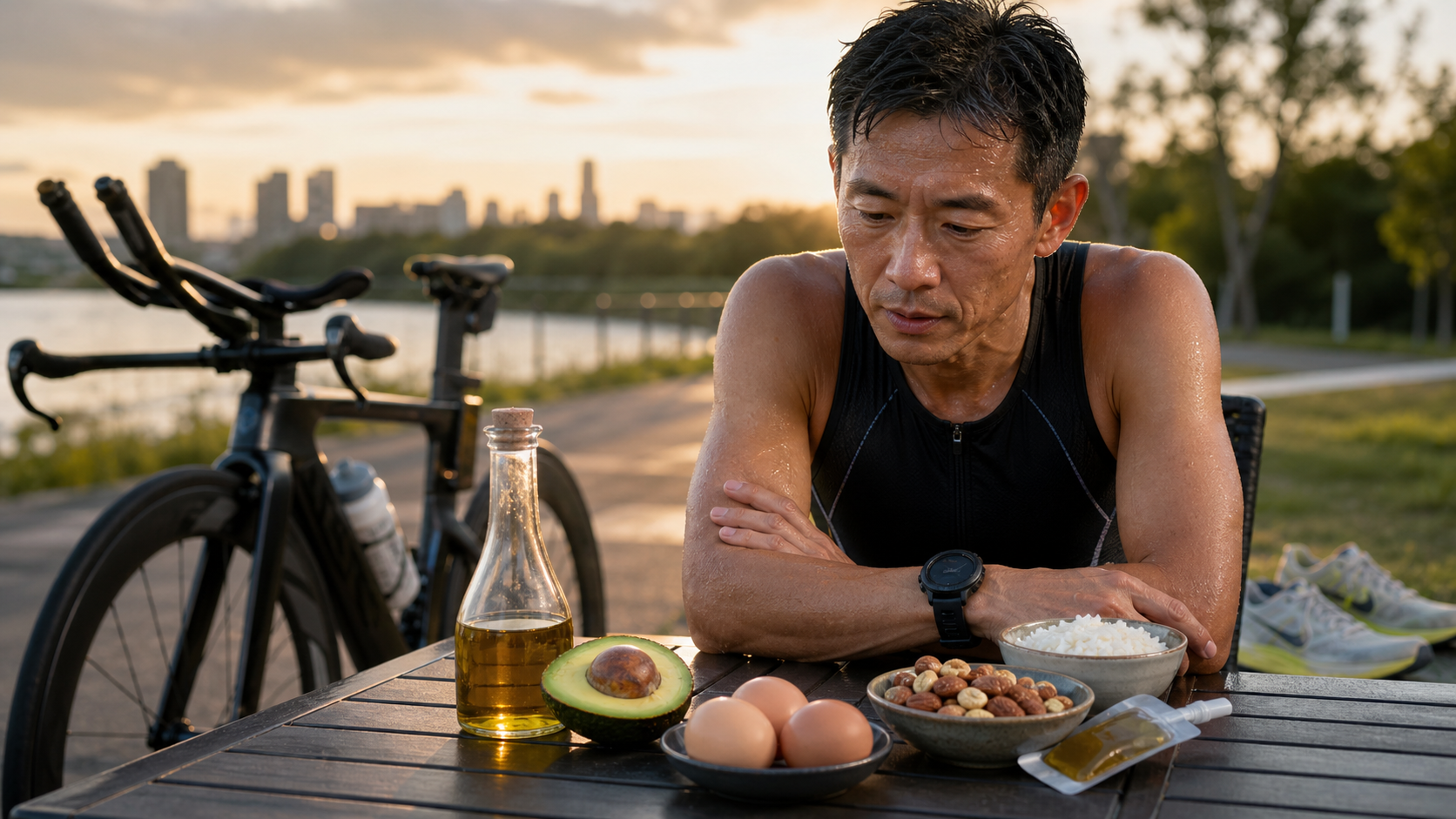
Coach’s Opening: The Athlete Who Almost Gave Up Carbohydrates
Let me start with a real scenario (I won’t fabricate the data, but the situation is a composite of athletes I’ve coached).
A few years ago, I had an athlete in his early forties, A-Kai, who had completed several 226 Ironman-distance races, with a best time around 12 hours. When he came to me, he had the excitement of someone who’d “finally found the holy grail.” He said he’d been on a low-carb, high-fat (LCHF) diet for nearly six months. He’d lost 4 kg, his blood sugar was stable, he no longer felt that “running on empty” feeling during morning rides, and he could even sustain three hours on long LSD rides without any fueling at all. He asked me: “Coach, should I go full keto so I won’t hit the wall in races?”
I didn’t answer right away. I asked him to do a race-pace simulation test—using the intensity he planned for the bike leg of a half Ironman, plus his race pace for the run leg. The results were interesting: at low intensity, for long durations, he performed more steadily than before; but as soon as the intensity climbed above his race “sweet spot,” his breathing got heavier, his heart rate was 5 to 8 bpm higher at the same pace, and lactate seemed to build up earlier than before. He admitted himself: “On climbs and in the latter half of the run, I feel like my legs don’t have that ‘explosive gear.’”
That scene is essentially a microcosm of the entire LCHF/keto controversy. It’s not a simple either/or of “effective” or “ineffective.” It’s a trade-off: “At what intensity, in what kind of race, and at what cost, are you willing to exchange for what benefit?” In this article, I want to use a coach’s perspective to clearly explain the research I’ve read, the athletes I’ve coached, and the pitfalls I’ve encountered over the past fifteen years.
Conclusion first for those short on time: For the vast majority of competitive endurance athletes who want to run and ride fast, a high-carb strategy remains mainstream with stronger evidence; LCHF may be a consideration for specific groups doing ultra-long, ultra-low-intensity events where placing isn’t the goal. But the devil is in the details, so please read on.
1. Let’s Clarify the Terms: Low-Carb, Keto, and Fat Adaptation Are Not the Same Thing
Many people lump “low-carb,” “keto,” and “fat adaptation” together, and that’s where the disaster begins. Let’s distinguish them first:
Three Concepts Often Confused
- Low-carb diet: Reduces the proportion of carbohydrates, but not necessarily low enough to enter ketosis. The range is broad—anything from 150 grams of carbs per day down to 50 grams gets called low-carb.
- Ketogenic diet (Ketogenic / LCHF): Extremely low carb (common settings are below 50 grams per day, sometimes even below 20 grams, with carbs making up about 5–10% of total calories), high fat (fat often makes up 65–80% of total calories), forcing the body to produce large amounts of ketones as fuel.
- Fat adaptation: This is a “metabolic capacity,” referring to the body’s ability to increase the rate of fat oxidation during exercise. You can strengthen it through long-term low-carb eating, but it’s a “result,” not the “diet method” itself.
The relationship among these three is: keto is an extreme version of low-carb, and fat adaptation is a physiological outcome of keto/long-term low-carb. A person can be well fat-adapted while still retaining the flexibility to eat carbs during races—this is actually the middle path many practical coaches have been taking in recent years.
Why Is the Endurance World So Fascinated with Fat?
The reason is simple: fuel tank capacity. An adult athlete with normal body fat has fat stores measured in “tens of thousands of kcal”; glycogen (carbohydrate storage), even when fully loaded, is only on the order of about 2000 kcal. For events like ultramarathons, Ironman races, or Wuling (a long mountain climb in Taiwan) that last for hours, the intuition that “glycogen runs out, fat doesn’t” leads many to believe: if I can get better at burning fat, I won’t hit the wall.
That intuition is half right and half trap. Read on.
A Key Concept: The Crossover Point
I want to plant an important concept here that we’ll keep coming back to—the crossover point.
During exercise, the proportion of energy supplied by fat versus carbohydrate changes with intensity. At very low intensity, fat supplies a higher proportion. As intensity increases, carbohydrate (glycogen) supplies a larger and larger share. At a certain intensity, carbohydrate “overtakes” fat as the primary fuel—that turning point is the crossover point.
What does fat adaptation do? It pushes this crossover point to the right—meaning you have to ride/run at a higher intensity before carbs become the dominant fuel. Sounds great, right? At the same absolute intensity, you burn more fat and spare more glycogen.
But note, this is only a change in “fuel ratio,” not a guarantee that “you can output more at high intensity.” These two things are often conflated, and that’s the root of much of the debate. Burning fat ≠ being fast. Please engrave that sentence in your mind; we’ll return to it repeatedly.
2. Evidence for: LCHF Can Indeed Dramatically Increase Fat Oxidation
On this point, there’s actually not much scientific controversy: long-term LCHF really does turn you into a fat-burning machine.
The most frequently cited study is the FASTER study by Volek et al., which looked at elite ultramarathon runners. The study compared ultra-endurance runners who had been on long-term LCHF (carbs below 20% of total calories, fat above 60%, maintained for at least 6 months) against a control group on a traditional high-carb, low-fat (HCLF) diet, matched for competitive level and VO2max. The results were striking:
- The LCHF group, at an intensity of about 70% VO2max, reached peak fat oxidation rates of approximately 1.5 grams/minute.
- The high-carb control group peaked at about 0.7 grams/minute.
- In other words, the fat-adapted group’s fat-burning capacity was roughly double that of the traditional diet group.
What does this mean? It means that at low to moderate intensity, fat-adapted athletes can maintain the same output using less glycogen, “saving” precious carbohydrates. For race formats where intensity stays very low but duration stretches extremely long (e.g., certain ultra-distance trail races, ultramarathons, multi-day events), this “glycogen-sparing” ability is theoretically valuable.
Positive Phenomena I’ve Seen in My Athletes
Back to A-Kai. He wasn’t fooling himself. His stability on long, low-intensity rides, his lack of hunger, and his gut being less troublesome over ultra-long durations—these were all real and consistent with the physiological mechanisms above. I’ve coached some “finish-oriented, not time-oriented” ultra-distance enthusiasts who genuinely found a more comfortable rhythm on LCHF, especially those who previously suffered from gastrointestinal distress with high-carb fueling.
Let me summarize LCHF’s potential benefits in a table:
| Potential Benefit | Applicable Scenario | My Practical Observation |
|---|---|---|
| Large increase in fat oxidation rate | Low-moderate intensity, ultra-long duration | Clear evidence, little individual variation |
| Slower glycogen depletion (fuel efficiency) | Events requiring long endurance | Noticeable for “finish-oriented” athletes |
| Reduced fueling frequency during races | Those with sensitive guts, prone to bloating | Some experience improved GI comfort |
| Weight/body fat loss | Those needing to lose weight | Common, but watch total calorie intake |
| More stable blood sugar and energy levels | Daily training periods | Generally positive subjective feedback |
Seeing this, you might think: well, isn’t that great? Don’t rush to switch yet. The evidence against is what really determines whether you should use it.
Making “Fuel Efficiency” More Concrete
I often use a car analogy to help athletes understand. Imagine your body is a hybrid car with two fuel tanks: one huge “fat tank” (nearly inexhaustible) and one small “carb tank” (only enough for about 90 to 120 minutes of high-intensity output).
A traditional high-carb athlete at moderate-to-high intensity will burn through the small carb tank quickly, requiring a constant stream of gels and fuel to refill. Once refueling can’t keep up with consumption, that’s what we commonly call “hitting the wall.”
What about a fat-adapted athlete? During low-intensity cruising, they rely more on the big fat tank, saving the small carb tank. So theoretically, they can go longer without hitting the wall. In ultra-long, low-intensity events, this is a genuine advantage.
But—remember the crossover point section—once you need to climb a long steep grade like Wuling, hold off a competitor in the latter half of an Olympic-distance run, or sprint to the finish, intensity spikes and you need that “high-power carb gear.” At that moment, the fat-adapted athlete may actually be stuck, because their body is too accustomed to slowly burning fat and can’t immediately summon the carbohydrate explosive power needed at high intensity. Moreover, burning fat itself requires more oxygen. That’s the harsh truth in the next section.
3. Evidence Against: The “Hidden Tax” of Fat Adaptation
This is the most important section of the entire article. Please read it carefully.
Fat adaptation is not a free lunch. Its biggest cost hides in a place few notice at first—exercise economy, which in plain terms means “how much oxygen you burn at the same speed.”
Key Study: A Three-Week Diet Experiment with Elite Race Walkers
Burke et al. conducted a rigorously designed study on elite race walkers that has since been replicated. They divided the elite athletes into three diet groups for three weeks while maintaining high-intensity training:
- High-carb group
- Periodized carb group (alternating high and low carb across training sessions)
- Low-carb, high-fat (LCHF) group
After three weeks, the results were very clear:
- The LCHF group’s whole-body fat oxidation rate did increase significantly (consistent with the evidence for—fat-burning capacity improved).
- However, at intensities close to actual race pace, the LCHF group showed worsened exercise economy—in plain terms, at the same race pace, they needed to consume more oxygen.
- The high-carb and periodized carb groups actually improved their exercise economy (more oxygen-efficient at the same speed), and their 10 km race walk times also improved.
- The LCHF group? No improvement in economy, and no improvement in race performance. Even though their aerobic capacity improved somewhat, that improvement was cancelled out by the worsened economy.
This result has since been replicated, with consistent conclusions: for elite endurance athletes chasing results and needing to hold pace at higher intensities, the fat-adaptation benefits of LCHF are eaten up by the decline in economy.
Why Does This Happen? A Coach’s Plain-Language Explanation
Burning fat to produce the same unit of energy (ATP) requires more oxygen than burning carbohydrate. This doesn’t matter at low intensity, since oxygen is plentiful. But when you push intensity to race-level high gears, oxygen supply itself becomes the bottleneck, and “fat burning is more oxygen-hungry” becomes a fatal flaw. You’ll find that at the same pace, your heart rate is higher, your breathing is heavier, and you can’t sustain it as long.
This is exactly the “missing explosive gear” A-Kai felt in the test. It wasn’t psychological; it was a real physiological limitation.
A Point Often Misread: VO2max Increase ≠ Getting Faster
Some LCHF proponents point to “aerobic capacity (VO2max) improved” as evidence that keto strengthens aerobic fitness. But the race-walking study directly refutes this inference: even though the LCHF group’s aerobic capacity improved, race performance didn’t, because the decline in economy cancelled out the benefit.
This teaches us an important lesson: endurance performance is never determined by a single metric. It’s the product of “VO2max × lactate threshold × exercise economy.” If you nudge one (aerobic capacity) up a bit but let another (economy) drop, your final performance may stay flat or even regress. This is why I strongly dislike any claim that “look at this one number, therefore it works”—endurance physiology isn’t that cheap.
A Counterexample from Another Athlete
Let me give you a contrasting case. Xiao-Yun is a female athlete competing in Olympic-distance triathlon, with a clear goal: to podium in her age group. She’d been swayed by the online keto trend and secretly tried it for two months before telling me. During those two months, her run pace at race intensity slowed by about 15 to 20 seconds per kilometer, and the quality of her interval sessions noticeably declined. She described it herself: “My legs felt dull the whole time, couldn’t push up.”
I asked her to stop strict keto and return to a regular approach of “whole foods + carbs around training sessions.” About three to four weeks later, her high-intensity quality gradually returned. Her case and A-Kai’s are two sides of the same coin: the same physiological mechanism, applied to athletes with different race goals, one benefits (low-intensity ultra-long), one suffers (high-intensity racing). This is why I always emphasize—ask about your race first, then talk about diet.
Let’s Also Summarize the Costs in a Table
| Potential Cost | Affected Population | Severity |
|---|---|---|
| Decreased exercise economy at high intensity | Competitive athletes chasing results | High, often decisive |
| Limited high-intensity output/sprint capacity | Those needing to change pace, climb, or sprint | High |
| Adaptation-period performance and mood slump (keto flu) | Everyone just transitioning | Moderate, usually passes |
| Reduced quality of high-intensity intervals | Anyone needing to train speed | Moderate to high |
| Difficulty with eating out and social dining | Taiwan’s eating-out population | Moderate, poor long-term adherence |
| Potential nutrient/fiber imbalances | Those executing poorly | Moderate |
Once you understand this table, you’ll see why the professional endurance world keeps arguing about LCHF: its benefits are real, its costs are real, and the key is which capability your race demands.
4. The Middle Ground Without a Standard Answer: Carbohydrate Periodization
If you’ve read this far and think “both sides seem to have a point,” congratulations, your intuition is correct. In recent years, more and more practical coaches aren’t asking “should I go keto?” but rather: “Can I have both better fat adaptation and retain the carbohydrate capacity needed for high intensity?”
The direction of the answer is carbohydrate periodization, or more precisely, “train low, race high”—strategically doing some sessions in a low-carb state during training to stimulate fat adaptation and mitochondrial-related adaptations, but fully loading carbs for key high-intensity sessions and races to preserve the high gear.
In the race-walking study mentioned earlier, the “periodized carb group” was a co-winner alongside the high-carb group—it got both the training stimulus and the race performance. That gave the practical world an important insight.
A Practical Example of Train-Low (Conceptual Illustration Only, Not Medical Advice)
Here’s a weekly framework I’d give advanced athletes as a reference, emphasizing “which sessions go low-carb, which go high-carb,” not telling you to starve all week:
| Day | Session Type | Carb Strategy | Coach’s Notes |
|---|---|---|---|
| Mon | Easy aerobic 60–90 min | Low-carb (fasted in the morning or low-carb the night before) | Stimulate fat oxidation; keep intensity very low |
| Tue | High-intensity intervals (VO2/threshold) | High-carb (fully fueled before) | Protect training quality; don’t go low-carb here |
| Wed | Recovery day / rest | Moderate | Let the body repair |
| Thu | Long LSD | Low-carb early, high-carb later | Practice “fueling timing” and gut tolerance |
| Fri | Tempo run / tempo ride | Moderate to high carb | Depends on session intensity |
| Sat | Long ride or race simulation | High-carb (race-like fueling rehearsal) | Practice race-day gut and fueling protocol |
| Sun | Easy or rest | Moderate | Weekly review |
This is only a conceptual illustration; the actual arrangement depends on your race goals, training volume, physical condition, and health history. But the spirit is clear: low-carb is a tool, not a religion. You go low when you should go low, and you fuel up when you should fuel up.
5. Putting It Back into Taiwan’s Races: Different Courses, Different Answers
Now that the theory is done, let’s place it into the race scenarios Taiwanese athletes most commonly enter, and you’ll get a better feel. Taiwan’s courses and climate actually amplify LCHF’s pros and cons.
Taiwan’s Common Race Scenarios Compared
| Race Type | Intensity Profile | LCHF Suitability | Coach’s Recommendation |
|---|---|---|---|
| Olympic-distance triathlon | Moderate-high intensity, sustained pace-holding | Low | Carb-centric; avoid full-time keto |
| Half Ironman (113) | Moderate, somewhat long | Low-moderate | Gentle periodization possible; fuel up on race day |
| Full Ironman (226) | Long duration, low-moderate intensity | Moderate | Fat adaptation + race-day carbs can coexist |
| City marathon (e.g., Taipei Marathon) | Moderate-high intensity, chasing PB | Low | High-carb/periodized; normal glycogen loading pre-race |
| Ultramarathon/ultra-trail | Ultra-long, low intensity | Moderate-high | Fat adaptation advantages can shine |
| Wuling long climb challenge | Long duration, sustained high output | Low to moderate | Needs carbohydrate power; don’t go low-carb here |
Note a few key points:
- Wuling, the classic long climb, many assume “long duration means fat adaptation is suitable,” but it’s actually a combination of “long duration + sustained moderate-high intensity output (you have to keep pushing watts uphill).” This kind of course needs the high gear that carbs provide; full-time keto can easily cause you to fade in the latter half. Long duration doesn’t equal low intensity—this is a common misjudgment.
- City marathons chasing a PB are essentially moderate-high intensity races where economy is extremely important. Keto’s economy penalty is amplified here.
- Ultramarathons and ultra-trail races, where intensity is genuinely low enough and duration long enough, are where fat adaptation has a relatively better chance to shine.
The Taiwan Climate Variable That Many Underestimate
Taiwan’s summers are hot and humid, with apparent temperatures often approaching or exceeding 35°C, plus high humidity, making heat dissipation difficult. This has two practical implications for dietary strategy:
- The early phase of low-carb naturally causes water and sodium loss, and combined with Taiwan’s hot, humid conditions and heavy sweating, the risk of dehydration and cramping rises. I’ve seen athletes rashly switch to low-carb during summer training and end up cramping on long sessions.
- In high heat, blood flow to the gut is diverted to the skin for cooling, reducing gastrointestinal tolerance for fueling. If you’re normally strict low-carb and your gut isn’t used to processing carbs, trying to suddenly fuel with carbs on race day has a higher chance of backfiring.
So in Taiwan, regardless of which camp you choose, the weight on hydration, sodium, and gut training all needs to be increased. That’s the detail local coaches keep nagging about.
6. Common Mistakes and Corrections: Pitfalls I’ve Seen Athletes Repeatedly Fall Into
Over these fifteen years, I’ve seen the same mistakes too many times. Let me list them so you don’t repeat them.
Mistake 1: Drawing Conclusions Before the Adaptation Period Is Over
Many people feel weak, moody, and see their training fall apart in the first two weeks of LCHF (the so-called keto flu) and rush to say “keto ruined me”; others, before truly fat-adapted, rush to say “keto made me super strong.” True fat adaptation usually takes weeks or more, and short-term assessments are unreliable.
- Correction: Give any dietary strategy at least one full training cycle to evaluate, and use objective data (pace, heart rate, power, subjective RPE) rather than feelings.
Mistake 2: Mistaking “Feeling Better at Low Intensity” for “Racing Faster”
This is the classic trap, and A-Kai fell into it at first. Feeling better at low intensity is real, but your race isn’t fought at low intensity.
- Correction: Always test at near-race intensity, not just how easy rides or easy runs feel.
Mistake 3: Forcing High-Intensity Intervals While Low-Carb
High-intensity intervals are fundamentally highly dependent on the carbohydrate system. Doing them in a low-carb state only produces poor-quality sessions and increases the risk of injury and overtraining.
- Correction: Schedule high-intensity sessions on carb-loading days; reserve low-carb for low-intensity aerobic work. That’s the core of periodization.
Mistake 4: Never Training “Race-Day Fueling”
Some long-term low-carb athletes try to suddenly eat carbs on race day as a rescue, only to find their gut can’t handle it anymore—one bite and it’s a mess. The gut needs training.
- Correction: Regardless of whether you’re usually low-carb, your race-day fueling strategy must be rehearsed in long training sessions, letting your gut get used to what and how much you’ll use on race day.
Mistake 5: Ignoring Taiwan’s Climate and Eating-Out Reality
Taiwan’s summers are hot and humid; during long rides or runs, electrolyte and fluid loss is staggering. And low-carb diets themselves cause water and sodium loss in the early phase. Stack those together and the risk of dehydration and cramping rises. Add to that the reality that strictly executing keto in Taiwan’s eating-out environment is extremely difficult (bento boxes, noodles, rice, and bubble tea are everywhere).
- Correction: If you’re truly going low-carb, you must pay even more attention to hydration and sodium; and honestly assess your long-term adherence in an eating-out environment—no matter how good the strategy, if you can’t stick to it, it’s worth zero.
7. Actionable Advice for Athletes at Different Levels
After all this talk, the most practical question is: “So what exactly should I do?” Here’s tiered advice based on your level.
Beginner / New Finish-Oriented Athletes
- Don’t touch extreme keto. What you need most now is building consistent training, learning to fuel, and laying an aerobic foundation. On diet, just doing “whole foods as the base, adequate protein, and carbs around training” puts you ahead of 80% of people.
- If you need to manage weight, start with low-risk adjustments like “cutting refined sugar and sugary drinks,” rather than jumping straight into keto.
- If your goal is to finish, practice eating carb fuel on race day—that’s the safest path.
Intermediate / Have Some Race Experience, Want to Break Through
- You can start trying gentle carbohydrate periodization: schedule one or two easy aerobic sessions per week as low-carb (e.g., an easy morning ride fasted), keeping everything else normal.
- For high-intensity sessions and races, carbs must be fully fueled to protect the high gear.
- Track with data: check whether heart rate, power, pace, and RPE on the same sessions are deteriorating. If high-intensity quality starts dropping, it means you’ve gone too low-carb.
Advanced / Chasing Results, Higher Race Intensity
- Honestly, if your target race requires holding pace at higher intensity, climbing, and changing pace (which is almost all competitive road cycling, Olympic-distance triathlon, and most marathons), high-carb or refined periodization strategies have stronger evidence.
- For you, full-time keto’s exercise economy cost is likely greater than its benefit.
- If you still want to leverage fat adaptation, go “train low, race high,” and do it under professional supervision, closely monitoring training quality and health markers.
Ultra-Endurance Enthusiasts Who Just Want to Finish, Not Placing
- This is the group where LCHF has the best chance of being useful. Low intensity, ultra-long duration, seeking stability and gut comfort—fat adaptation’s benefits are relatively easier to realize, and the economy penalty is less fatal.
- But still be realistic about Taiwan’s eating-out and hot, humid climate challenges, and nail down hydration and sodium.
- One small reminder: even if you’re finish-oriented, in a few long sessions before the race, test once “if I want to eat some carbs mid-way, can my gut still handle it?” Keeping a little carb flexibility can often save you during an unexpected low patch.
A Summary: Three Questions You Should Ask Yourself
Instead of agonizing over whether to go keto, honestly answer these three questions before adjusting your diet. The answers will directly point you in the right direction:
| Question to Ask Yourself | If the Answer Leans “Yes” | Recommended Direction |
|---|---|---|
| Does my target race require holding pace at high intensity? | Yes | Carb-centric; don’t touch full-time keto |
| Am I chasing results, needing sprints and climbs? | Yes | High-carb or refined periodization |
| Do I just want to steadily finish ultra-long distances, not caring about placing? | Yes | LCHF/fat adaptation can be considered |
If your answer to the first two questions is “yes,” then the answer is actually clear—you need the high gear that carbs provide, not to cut them out.
8. FAQ
Q1: Is keto harmful to the body?
A: For generally healthy people, short- to medium-term studies mostly haven’t shown serious harm, but long-term data is still incomplete, and for those with chronic illness, metabolic disease, kidney issues, or pregnancy, the risk profile is completely different. This is why the compliance reminder below is so important—please only proceed under professional evaluation.
Q2: Can I be keto normally and then carb-load a few days before the race?
A: Theoretically, some people try this to get “the best of both worlds.” But in practice, a long-term fat-adapted body may not switch quickly when suddenly flooded with carbs; the gut and metabolism may not handle the transition well. Results vary by individual, and GI issues are common. If you want to try it, you must rehearse it during training—absolutely never try it for the first time on race day.
Q3: For weight loss, is keto the fastest?
A: Short-term weight loss is common (part of it is water), but “can you maintain it long-term” and “does it affect training quality” are the real keys. For athletes, sacrificing training quality for weight is often a losing trade. Weight loss should prioritize overall calories and long-term feasibility.
Q4: I’m in Taiwan and eat out all the time. Can I really do keto?
A: Honestly, it’s very hard to maintain long-term. Bento boxes, rice, noodles, dumplings, and bubble tea are part of daily Taiwanese eating. Strict keto carries high social and time costs. This is one of the practical reasons I don’t recommend “full-time keto” for most Taiwanese athletes—a strategy you can’t adhere to is empty talk no matter how good it sounds.
Q5: How long does fat adaptation take to appear?
A: The increase in whole-body fat oxidation rate actually appears faster than many think—a few weeks of low-carb eating can show a clear improvement in fat-burning capacity. But note—rapid fat adaptation does not equal improved performance. In the race-walking study, athletes developed stronger fat-burning in three weeks, but race performance didn’t improve; it was dragged down by the economy decline. So “how long until fat adaptation” and “how long until I get faster” are two completely different questions. Don’t confuse them.
Q6: Can I just eat low-carb normally and have a banana before training?
A: That’s actually no longer “keto”—it’s closer to gentle low-carb or carbohydrate periodization, and the direction is right. The key is “fuel enough for the sessions that need it.” If today is high-intensity intervals or a race simulation, one banana is nowhere near enough. You need to load carbs before the session to support the entire high-quality workout. Low-carb for low intensity, carbs for high intensity—this big principle matters more than any detail.
Q7: Do MCT oil and ketone esters (exogenous ketones) work?
A: This is a hot area, but the evidence is still developing, individual variation is large, and gut tolerance varies greatly between people. My stance: they’re not magic, and they can’t replace solid training and a sound fueling strategy. If you want to try them, treat them as “experiment during training first”—confirm your gut can handle them and whether they actually help your performance, rather than using them for the first time on race day. The same sentence applies to any supplement—verify it in training, don’t gamble on race day.
Q8: So who’s right? The high-carb camp or the low-carb camp?
A: If you force me to answer in one sentence: for competitive endurance athletes pursuing speed and results, current evidence supports a carb-centric strategy (or refined periodization); LCHF is a viable option for the low-intensity, ultra-long-distance, finish-oriented group. This isn’t fence-sitting; it’s because the answer inherently depends on “what capabilities your race demands.” Instead of picking a side, treat each camp as a tool in your toolbox, and choose based on what you’re fixing today.
9. Coach’s Closing: Don’t Look for a Holy Grail, Look for the Right Tool for You
Back to A-Kai’s story. What did we do? I didn’t tell him to completely abandon the low-carb lifestyle he enjoyed, nor did I turn him back into someone eating sweets all day. We took the middle path: generally lower-carb in daily life, scheduling morning easy sessions low-carb to build fat adaptation; but for key high-intensity sessions and races, carbs fully loaded to bring back the high gear. Three months later, his long-distance stability remained, the “gear” on climbs and in the latter half of the run returned, and he set a personal record at that Ironman.
The core idea I want to leave you with is just this:
LCHF/keto is not a belief system; it’s a tool with clear benefits and clear costs. Good coaches and smart athletes don’t ask “is this diet the best?” but rather “given my race, my body, and my life reality, when should I use it, and what should I trade for it?”
The most fascinating thing about endurance sports is that there’s never a one-size-fits-all answer. Fat adaptation can make you feel at home in long, low-intensity efforts, yet it can steal the most precious breath of oxygen when you need to sprint. Understanding this trade-off matters more than blindly following any camp.
Next time someone confidently tells you “keto is the future of endurance sports” or “people who eat fat are delusional,” you can smile and ask back: “Which race, which intensity, which athlete are you talking about?” Being able to ask that question already puts you ahead of most people in this debate.
This article is educational content and cannot replace individual assessment by a physician, physical therapist, or nutritionist. For any major dietary changes, especially extreme strategies like keto, please consult a professional first and have it tailored to your own health status and training goals.
References
- Volek et al. (FASTER study) and LCHF fat oxidation summaries: Low-Carbohydrate-High-Fat Diet: Can it Help Exercise Performance? (PMC) https://pmc.ncbi.nlm.nih.gov/articles/PMC5384055/
- Burke et al.'s study on LCHF’s impact on exercise economy in elite race walkers (replicated version, PLOS ONE): https://journals.plos.org/plosone/article?id=10.1371%2Fjournal.pone.0234027
- Review of the ketogenic diet’s effects on endurance athletes (performance gain or placebo?): A review of the ketogenic diet for endurance athletes (PMC) https://pmc.ncbi.nlm.nih.gov/articles/PMC7310409/
Related Reading
- Low-Carb and Keto for Athletes: The Real Evidence on LCHF, the Cost of Fat Adaptation, and Who It’s Actually For
- Nutrition & Recovery: A Guide to Ketogenic Diet and Low-Carb Adaptation (Fat-Adaptation) for Endurance Athletes: The Pros and Cons of High Fat Oxidation Rates for Ultra-Distance Races and the Core Secrets of Recovery Scheduling
- Physiology & Medicine: Decoding Very Slow Jogging, Aerobic Health, Ketogenic Diet, and Low-Carb Adaptation (Fat-Adaptation): The Latest Research and Practical Strategies on the Pros and Cons of High Fat Oxidation Rates for Ultra-Distance Races: Keys to Breaking Three Hours and Pushing Limits
- The Truth About Fat Adaptation: A New Strategy for Endurance Sports or Overhyped?
CT暗黑廚房) 車友必備 宇宙無敵鮮蚵湯 幫助訓練恢復 天然食補 好市多 超肥鮮蚵 破PR
7 年前
靠單車減肥35公斤 心得分享與整理
7 年前
2021 96聯賽 桃園市長盃 4K多視角實況 當天選手瓦數/推力比/均速/時間 即時數據分析 | 公路車 | CT Yeh
5 年前
大家都在開箱的...單車用藍芽對講耳機真的有幫助嗎? SENA BiKom 20 長距離旅遊 & 海鷗繞圈賽 實際體驗心得 / 公路車 / CT Yeh
9 個月前
碟煞公路車 優缺點?換車一年半實際經驗分享 / 公路車 / CT Yeh
2 年前
一個測試有沒有認真練車的方法😂 #公路車
10 個月前
一日北高/長距離團騎 常見問題補充篇 / 組團或跟團的眉角 / 壯車友容易被瘦車友慢性拉爆 / 原來屁股痛可能是這個原因...? / 風場配速法 / 公路車 / CT Yeh
2 年前
2016/4/20 - 中社路 夜騎 半年甩肉14KG 後測
10 年前