Exercise Science for Older Adults: Sarcopenia, Frailty, and Exercise Prescription—A Practical Guide to Resistance Training, Balance, and Fall Prevention
First, a Case I’ll Never Forget
I’ve been in the fitness industry for fifteen years, training athletes and office workers looking to lose fat. But the person who truly changed how I view “training” was a 73-year-old woman, Auntie Chen.
Her daughter practically dragged her in for the first visit. Six months prior, she had slipped in her bathroom, fracturing her right wrist and ending up in a cast. After leaving the hospital, she was afraid to move and spent her days on the sofa watching TV. Her daughter noticed her mother walking slower, needing several attempts to get up from a chair, and struggling even to wring out a towel. Alarmed, she brought her in for an assessment.
I ran a few simple tests: I asked her to stand up and sit down from a standard chair five times without using her hands. She had to stop and catch her breath after the third repetition. I asked her to stand on one leg; she wobbled and had to grab the wall before five seconds were up. Her grip strength, measured with a dynamometer, was far below the expected level for a woman her age. These weren’t signs of “just getting old”—they were a classic cluster of signals: sarcopenia combined with pre-frailty.
The first thing I said to Auntie Chen was: “Auntie, you’re not too old to move; you got this way because you stopped moving. And this can be trained back.”
Eight months later, she could carry her shopping basket through the entire market, stand steadily on one leg for over fifteen seconds, and rise from a low chair in a single motion. She hadn’t gotten younger, but she had gotten stronger and steadier. This article aims to explain fully what happened with Auntie Chen and the exercise science behind it—whether you want to help an elderly family member or are planning ahead for your own life after fifty.
Disclaimer: This article is for educational purposes and cannot replace individual diagnosis and treatment advice from a physician, physical therapist, or nutritionist. Where medical attention or individualized care is needed, the article will repeatedly remind you—please take it seriously.
What Actually Happens to the Aging Body
To address a problem, you first need to understand it. After middle age, several bodily functions decline simultaneously.
Muscle: The Silent Loss That Begins at Forty
Muscle loss begins earlier than most people think. The consensus in research is that skeletal muscle mass starts a gradual decline around age forty, with the rate of loss accelerating significantly after sixty. This is why experts consistently emphasize—the earlier you intervene, the better the results.
Even more critical is that the loss isn’t “uniform muscle.” Aging preferentially depletes Type II (fast-twitch) muscle fibers—the ones responsible for explosive power, for reaching out to catch yourself the instant you start to fall, and for taking a quick step to regain your center of gravity. This explains a common observation: many older adults “look like they still have decent leg mass,” but when they lose their balance, they simply can’t react in time to save themselves. The decline in strength and muscle power often occurs earlier and is more dangerous than a simple loss of muscle mass.
The formal definition of sarcopenia is low muscle mass, combined with decreased muscle strength or impaired physical performance. The World Health Organization (WHO) considers it a major contributor to frailty and disability in older age. It’s not a matter of being “fat or thin”—many older adults who look slender or even underweight actually have severe sarcopenia.
There’s also a particularly overlooked condition called “sarcopenic obesity”—where someone is overweight or even obese, looking “soft,” but has low muscle and high fat. Because these individuals “don’t look thin,” families often have no warning signs until functional decline becomes obvious. So I want to emphasize: you cannot judge sarcopenia by weight or body size alone; you must look at strength and functional performance. An older adult who can get up easily, walk steadily, and has a firm grip is far healthier than one whose weight is “on target” but who can’t get off the floor. This is why, in my assessments, I always look at “what can you do” before I look at the number on the scale.
Nerves, Bones, and Balance: Declining Together
- Decreased neural recruitment efficiency: The brain’s “activation speed” for commanding muscles slows down. This is why older adults not only have less strength, but also find it harder to “generate force quickly.”
- Loss of bone mineral density: Especially in postmenopausal women, declining estrogen accelerates bone loss, increasing fracture risk after a fall—this was the underlying concern with Auntie Chen’s bathroom fall.
- Declining proprioception and vestibular function: Joint position sense and the inner ear’s balance system become less acute, leading to swaying when standing and particular instability when walking in the dark.
- Slower reaction time: The gap between “sensing a fall” and “muscles responding” widens.
- Reduced flexibility and joint range of motion: Decreased range in the hips, ankles, and shoulders makes gait cautious and strides shorter, increasing the chance of tripping on thresholds or uneven surfaces.
These declines don’t happen in isolation; they drag each other down in a vicious cycle. Less muscle means less support for joints; poorer balance makes people afraid to move; not moving leads to more muscle loss. Understanding this “web of decline” makes it clear why a good exercise prescription for older adults is never about training just one thing, but about addressing strength, balance, power, and mobility together.
Frailty: The Sum of All These Declines
“Frailty” is the clinical state that results from adding up all these declines. Clinically, five indicators are commonly used for a rough assessment: unintentional weight loss, self-reported exhaustion, weak grip strength, slow walking speed, and low physical activity. Meeting three or more criteria typically defines frailty; one to two indicates pre-frailty.
Here’s a harsh but important concept—frailty is self-accelerating. Inactivity → muscle loss → more weakness and fear of falling → even less activity. It’s a downward spiral. The good news is that this spiral is bidirectional: with the right intervention, it can turn upward. And the most powerful lever to turn it upward is resistance training.
Self-Assessments You Can Do at Home
Many people ask me: “How do I know if I or an elderly family member is at risk for sarcopenia or frailty?” A formal diagnosis requires medical assessment (muscle mass measurement, grip strength, gait speed, etc.), but there are several rough screening tests you can do at home to catch warning signs early. These are self-awareness tools, not diagnostic tests; if something seems off, seek medical evaluation.
| Test | How to Do It | Warning Signs |
|---|---|---|
| Five Times Sit-to-Stand | Arms crossed over chest, stand up and sit down from a standard chair 5 times consecutively, timed | Visible difficulty, needing to push with hands, taking over ten-plus seconds |
| Single-Leg Stance | Hold onto something nearby, slowly let go and stand on one leg | Swaying significantly or needing to grab support within a few seconds |
| Wringing a Towel / Opening a Jar | Daily tasks like wringing a wet towel, opening a bottle cap | Noticeably harder than before (a sign of declining grip strength) |
| Walking Speed | Normal walking at home or in the market | Can’t finish crossing the street before the light changes; family says you’ve slowed down |
| Weight Change | Any unintentional weight loss in the past six months | Noticeably lighter without trying to diet |
Auntie Chen’s initial red flags were “had to stop after the third sit-to-stand” and “couldn’t hold a single-leg stance for five seconds.” Once those two lit up, I had a pretty good idea of what we were dealing with. If you test yourself at home and several things seem off, don’t panic, but don’t ignore it either. The most practical step is to see a doctor or physical therapist. In Taiwan, rehabilitation medicine and geriatric medicine departments can provide assessments.
Why Resistance Training Is the First-Line Prescription
In recent years, the consensus in exercise science for older adults has become quite clear: resistance training is the first-line strategy for preventing and managing sarcopenia. It has the most solid evidence for improving muscle strength, muscle power, increasing muscle mass, and enhancing daily function.
Aerobic exercise (brisk walking, cycling, swimming) is excellent for cardiovascular health, metabolism, and mood, and I absolutely encourage it. But aerobic exercise alone cannot effectively reverse muscle loss. To combat sarcopenia, you need to give your muscles a stress signal that says “you must get stronger,” and that signal is load.
What Resistance Training Gives Older Adults Isn’t Just “Getting Bigger”
I often explain to my clients’ families that the value hierarchy of resistance training for older adults is completely different from what younger gym-goers want:
- Being able to stand up and sit down independently (lower body and core strength)
- Being able to save yourself from a fall (muscle power and reaction time)
- Being able to lift and carry things steadily (upper body and grip strength)
- Stimulating bones and maintaining bone density (weight-bearing is good stress for bones)
- Improved blood sugar metabolism (muscle is the body’s largest glucose reservoir)
- And only lastly, appearance
For older adults, functional independence—“can I use the toilet by myself, can I walk to the market by myself”—is the true goal of training.
How We Progressed Auntie Chen Over Those Eight Months
To give you a concrete picture, I’ve organized Auntie Chen’s progression into a table. She could barely get out of a chair at the start. We didn’t try to do everything at once; we added a little each month. Everyone progresses at their own pace; this is just one real case’s rhythm, not a standard answer.
| Phase | Where She Was | What We Did | The Family’s Role |
|---|---|---|---|
| Month 1 | Needed hands to get up from chair, very afraid of falling | Assisted half-squats holding the chair back, sit-to-stand breakdown drills, breathing exercises | Daughter assisted and recorded reps throughout |
| Months 2–3 | Could do a few sit-to-stands without hands | Added resistance band rows, calf raises, started supported single-leg stance | Reminded her to drink water daily, added soy milk to breakfast |
| Months 4–5 | Walking steadier, confident using the bathroom alone | Slight progressive overload, balance progressed to tandem stance | Accompanied her on market walks as “practical training” |
| Months 6–8 | Single-leg stance over ten seconds, standing up in one motion | Added low-load explosive sit-to-stands (power), dual-task walking | Stepped back to “companionship” rather than “support” |
You’ll notice there’s no “magic exercise” in this table—everything is quite basic. The key is consistency, progression, and having someone there. These three things matter more than any fancy equipment.
Practical Prescription for Resistance Training in Older Adults
This section is the core. I’ve distilled mainstream exercise science guidelines (such as those from the American College of Sports Medicine, ACSM, and international expert consensus) into actionable principles, along with practical adjustments from training older adults. Please note: these are general educational principles. If you have chronic conditions or recent surgery/fractures, consult your physician or physical therapist before starting.
General Dosage Guidelines
Mainstream guidelines for resistance training in older adults generally fall within this range:
| Training Variable | General Recommended Range | Practical Notes for Older Adults |
|---|---|---|
| Frequency | 2–3 days per week, non-consecutive | Beginners should start steadily with 2 days; building the habit matters more than volume |
| Intensity | Approximately 50–80% 1RM | Early on, use a weight where you “could do 2–3 more reps”; don’t chase failure |
| Number of Exercises | Cover major muscle groups, about 6–10 exercises | Better to do fewer exercises with proper form |
| Sets per Exercise | Start with 1–3 sets | Even 1 set in the first month is effective; don’t rush to add more |
| Reps per Set | 8–15 reps (lower reps for strength focus) | Maintain control throughout the movement; breathe, don’t hold your breath |
| Rest Between Sets | 1–2 minutes | Older adults recover slower; longer rest is safer than too short |
“1RM” refers to the maximum weight you can lift exactly once with proper form. Older adults don’t need to actually test their 1RM (it carries injury risk). Instead, use the feeling of “having 2–3 reps left in the tank” after completing the prescribed reps. This is the RIR (reps in reserve) concept, which is safer for older adults.
Don’t Forget the “Power” Component
As mentioned earlier, aging preferentially depletes fast-twitch fibers and power. So beyond slow, controlled strength training, once a client’s foundation is solid, I add low-load, high-velocity movements—not lifting heavy, but “pushing/standing up quickly with a lighter weight,” then lowering slowly. Examples include seated explosive sit-to-stands or fast resistance band presses. This is especially helpful for “saving yourself in the instant of a fall.” But this component must only be added after sufficient baseline strength and joint stability, and both the range of motion and speed must remain under control.
An 8-Week Beginner Program Example for Older Adults
Below is a beginner framework I commonly use, suitable for older adults who “can walk independently and have no acute injuries or illnesses.” Those with heart disease, poorly controlled hypertension, severe arthritis, or recent fractures must get medical clearance first.
| Week | Days per Week | Sets × Reps per Exercise | Focus for This Phase | What the Trainer Is Thinking |
|---|---|---|---|---|
| Weeks 1–2 | 2 days | 1 set × 10 reps | Learn the movements, learn to breathe without holding breath | Get the body familiar with this; keep the bar low |
| Weeks 3–4 | 2–3 days | 2 sets × 10–12 reps | Add a set, adjust weight slightly | Watch for excessive soreness the next day |
| Weeks 5–6 | 3 days | 2–3 sets × 10–12 reps | Small progressive overload | Start adding balance exercises |
| Weeks 7–8 | 3 days | 2–3 sets × 8–12 reps | Add a small amount of power work | Assess whether to progress to equipment or heavier weights |
Core Exercise Menu (doable at home or community centers):
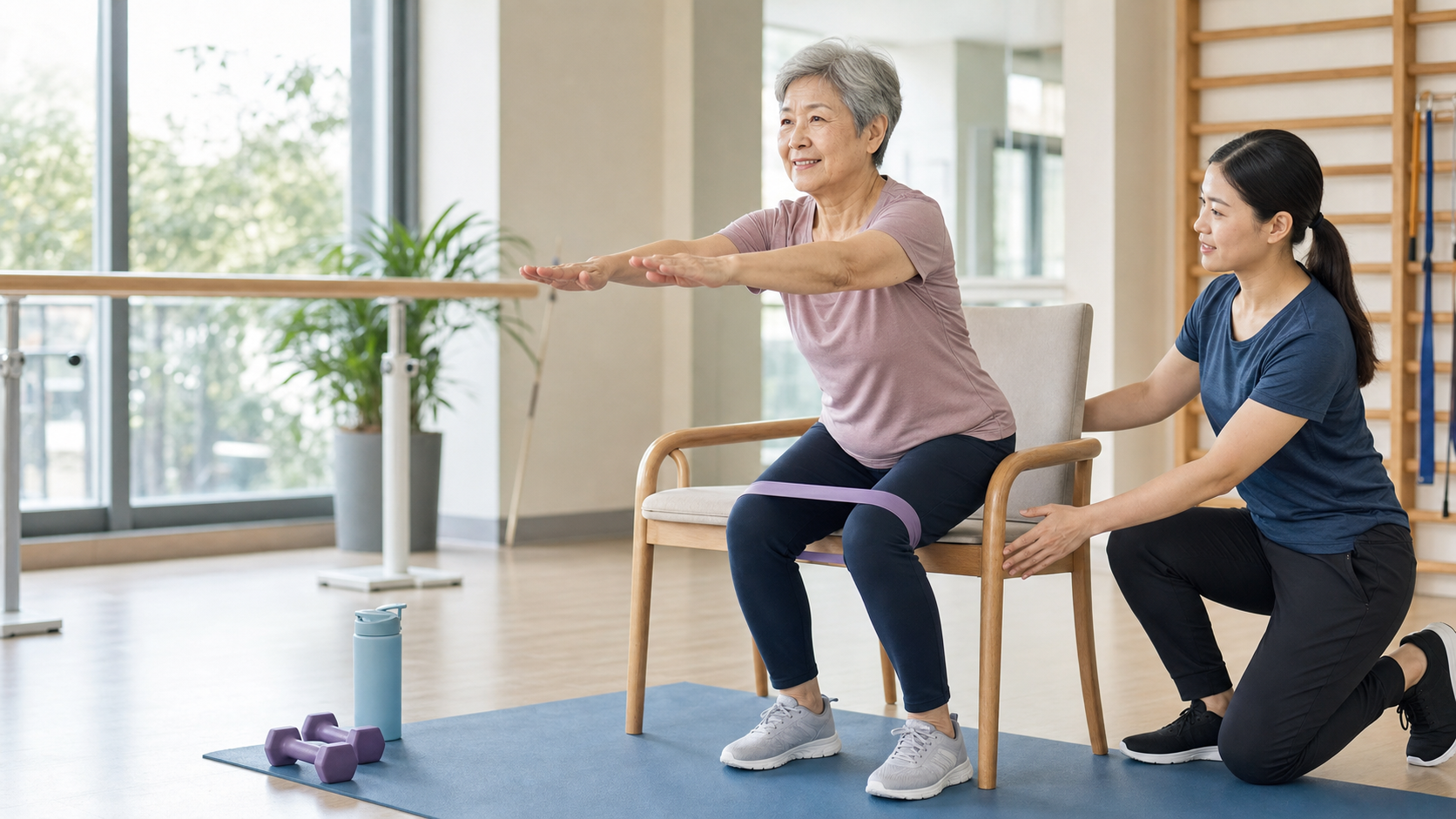
- Sit-to-Stand: Stand up from a chair without using hands, then sit back down—this is the most direct way to rebuild the ability to “get up on your own.” I start almost every older adult here.
- Wall Squat or Half Squat: Trains the thighs and glutes.
- Resistance Band Row: Trains the upper back, improves posture and lifting strength.
- Resistance Band Chest Press / Overhead Press: Trains pushing strength and shoulder mobility.
- Calf Raises: Trains the calves, beneficial for walking propulsion and balance.
- Grip Strength Training: Grip ball or towel wringing. Grip strength is actually a proxy indicator of overall health.
- Core: Seated or lying abdominal bracing, glute bridges.
For equipment, the easiest options for Taiwanese older adults are resistance bands, light dumbbells, water bottles, and bodyweight. Seated machine equipment at community centers or gyms (stable seat, fixed movement path) is also very friendly for those afraid of falling.
Balance Training and Fall Prevention: Strength Alone Isn’t Enough
If you only train strength but not balance, it’s like having a more powerful engine but a loose steering wheel. Fall prevention must be multicomponent.
This is clear in international guidelines: the WHO recommends that older adults engage in 3 or more days per week of multicomponent physical activity emphasizing functional balance and strength training to improve function and prevent falls. In community-dwelling older adults, the combination of “balance and functional training + resistance training” is considered effective in reducing fall risk.
My Commonly Used Balance Training Progression
Balance training should be progressive, with the key being “creating a little instability under safe conditions.” All balance exercises should be performed with a sturdy handrail nearby or with someone assisting.
| Level | Example Exercises | Progression |
|---|---|---|
| Beginner | Standing with feet together, holding the chair back | Slowly release one hand |
| Level 1 | Semi-tandem stance (heel of one foot beside the toe of the other) | Reduce reliance on support |
| Level 2 | Full tandem stance (heel-to-toe, tightrope stance) | Close one eye to increase difficulty |
| Level 3 | Single-leg stance | Increase duration, perform on a soft surface |
| Functional | Walking in a straight line, stepping over small obstacles, turning while walking | Add “walking while talking” dual-task |
That “walking while talking” dual-task training is especially important. Many older adults are “fine when walking, but fall when distracted (e.g., greeting someone on the street, or carrying something while thinking).” Deliberately having them walk while counting or answering questions during training replicates real-life challenges.
A Note for Older Adults Who Love Cycling and Hiking
Many middle-aged and older adults in Taiwan love cycling and hiking—these are excellent habits benefiting cardiovascular health, metabolism, and mood. But I need to honestly point out one thing: aerobic activities like cycling and brisk walking build endurance and cardiovascular fitness; they cannot replace the muscle and bone stimulus of resistance training. Cycling in particular is a seated, non-weight-bearing activity, offering limited benefit for maintaining bone density.
I’ve met many “strong cyclists” in their later years who can easily do a century ride in a day, but perform poorly on the five-times sit-to-stand test, struggle with single-leg stance, and have weak grip strength—because cycling doesn’t train those “rapid force generation, weight-bearing support” abilities. The ideal combination is: keep the cycling and hiking you love as your aerobic base, and add 2–3 sessions of resistance training and balance work each week. This way, you’re not just able to ride; you can also stabilize yourself on descents, getting on and off the bike, or in that split second when your foot misses the pedal—reducing both injury and fall risk. Your long-term cycling performance will also benefit from stronger legs and a stronger core.
The Home Environment Is Part of the Prescription
Fall prevention isn’t just about the body; the environment plays a huge role. I usually ask families to do these things at home, which are particularly practical in Taiwanese households:
- Bathroom/Toilet: Install non-slip mats and grab bars (Auntie Chen’s fall was in the bathroom—a high-risk location for falls among Taiwanese older adults).
- Lighting: Add night lights in hallways, stairways, and along the path to the bathroom for nighttime trips.
- Flooring: Remove loose throw rugs, tidy up electrical cords, and mark thresholds with warning tape.
- Footwear: Avoid slip-on slippers indoors; switch to indoor shoes with a heel counter and non-slip soles.
- Vision and Medication: Get regular eye exams; certain sedatives or blood pressure medications can increase dizziness and fall risk. This must be discussed with the prescribing physician or pharmacist—never stop medication on your own.
Nutrition: The Other Half of Training
Resistance training is the stimulus, but without the raw materials, muscle can’t be built. Older adults face a particular challenge called “anabolic resistance”—for the same amount of protein consumed, the muscle-building response in older adults is blunted compared to younger people. So their protein needs are actually higher than commonly assumed.
Here’s a summary of general nutritional principles (values are general recommendations; those with kidney dysfunction or specific conditions must have individualized adjustments from a physician or nutritionist—do not apply these blindly):
| Nutritional Focus | General Direction | Practical Taiwanese Approach |
|---|---|---|
| Daily Protein | Older adults typically need slightly more than younger adults, distributed evenly across meals | A palm-sized portion of protein at each meal (soy milk, eggs, fish, chicken, tofu) |
| Post-Exercise Supplementation | Consuming quality protein after training aids recovery | A glass of unsweetened soy milk or milk plus a tea egg is very convenient |
| Vitamin D | Related to muscle function and bone health; older adults are often deficient | Moderate sun exposure; whether to supplement should be determined by a physician after a blood test |
| Calcium | For bone health | Dark leafy greens, dairy, dried small fish, soy products |
| Water | Thirst sensation diminishes with age, leading to dehydration | Set regular reminders to drink; don’t wait until you’re thirsty |
I want to add a note about “distributing protein evenly”: Taiwanese older adults often eat a light breakfast (a steamed bun, or rice porridge with pickled vegetables) and then have a large, protein-heavy dinner. This pattern is disadvantageous for building muscle. Simply shifting some protein from dinner to every meal makes a significant difference for muscle synthesis. For those eating out, adding a glass of soy milk or an egg at breakfast, or an extra piece of tofu or meat from the buffet at lunch, is easy to implement.
Supplements (whey protein, HMB, creatine, etc.) may help older adults in certain situations, but whether they’re needed and at what dosage should be determined by a physician or nutritionist based on individual circumstances. This article makes no individual recommendations.
The Most Common Mistakes I’ve Seen Over the Years, and How to Fix Them
After working with older adults for so long, I’ve noticed people tend to step on the same rakes. Here are the most common ones:
Mistake 1: “I’m Afraid of Getting Hurt, So I Don’t Use Any Effort”
This is the most widespread and the most unfortunate. Many families and older adults misinterpret “safety” as “move gently, don’t exert yourself,” resulting in weights so light they don’t constitute a training stimulus. Six months of that yields no progress.
Fix: The key to safety is movement quality and progression, not “never exerting force.” With proper form and protection, muscles need sufficient load to get stronger. Using the “2–3 reps left in the tank” method to gauge weight is both effective and safe.
Mistake 2: Only Doing Aerobics, Never Touching Resistance Training
Many older adults diligently walk briskly in the park or do folk dancing every day—that’s great—but ask if they do any strength training, and the answer is usually no. Walking cannot effectively reverse muscle loss.
Fix: Keep the aerobic activities you enjoy, and add 2–3 resistance training sessions per week. They don’t conflict; they complement each other.
Mistake 3: Holding Your Breath While Exerting
Older adults often unconsciously hold their breath when exerting force (the Valsalva maneuver). This causes a sudden spike in blood pressure, a hidden danger for those with cardiovascular risk.
Fix: The mantra is “exhale on exertion, inhale on recovery.” Exhale when standing up, inhale when sitting down. Having a trainer or family member verbally cue this is very helpful.
Mistake 4: Progressing Too Fast, Then Being Too Sore to Move the Next Day
In the first few weeks, beginners are most prone to “doing too much on a whim,” resulting in delayed onset muscle soreness (DOMS) severe enough to make walking difficult—and then they never want to train again.
Fix: Better to do too little than too much. In the first month, just 1 set per exercise. Let the body adapt gradually. Building the habit is a hundred times more important than any single session’s volume.
Mistake 5: Training Only Strength, Not Balance
As mentioned, strength and balance are two different things. You can be strong but have poor balance and still fall.
Fix: Treat balance training as a fixed part of every session, even if it’s just five minutes.
Mistake 6: Mistaking Pain for “A Good Workout”
Sharp pain in a joint, or pain at the site of an old injury, is not a good sign. It’s different from the muscle soreness and fullness felt after training.
Fix: Muscle soreness is acceptable; sharp joint pain, swelling, or restricted movement means stop and seek medical attention. In Taiwan, seeing an orthopedist or rehabilitation specialist is easy—don’t tough it out.
Actionable Advice for Readers at Different Stages
Everyone starts from a different point. Let me address the three most common situations separately.
If You’re “Around Fifty, Currently Healthy” and Want to Prevent
You’re the luckiest group—starting now offers the highest return on investment.
- Schedule 2–3 full-body resistance training sessions per week. This is your future thirty years of mobility, in a fixed deposit.
- Don’t just do feather-light weights; give your muscles a real challenge within safe limits.
- Taiwan’s cycling and hiking culture is great, but those are aerobic. Don’t use them to replace weight training.
- Make “protein at every meal” a habit.
If You’re an Older Adult “Already Showing Signs of Sarcopenia” or a Family Member
Signs include: slower walking, weak grip when wringing towels, needing support to get up from a chair, unexplained weight loss.
- First, get a functional assessment from a physician or physical therapist to rule out other diseases.
- Start with the most basic, safest movements (sit-to-stand, resistance bands, supported balance).
- Frequency matters more than intensity; first aim for “consistently doable.”
- Companionship is crucial. A big part of why Auntie Chen stuck with it was her daughter training with her every week.
If You’re “Already Frail, or Recovering from a Hospital Stay/Fracture”
This group absolutely must not train on their own; it must be done under professional supervision.
- A medical and rehabilitation team must be involved, typically starting with bedside or seated exercises.
- The initial goal is the most basic function: “safe transfers, being able to sit up and stand up on your own.”
- Progress will be slow—that’s normal. Don’t get discouraged. As long as the direction is right, slow progress is still upward.
- Taiwan’s National Health Insurance rehabilitation resources can be utilized. Before discharge, proactively ask about follow-up with a rehabilitation department.
Frequently Asked Questions (FAQ)
Q: I’m in my eighties. Is it too late to start training?
No, it’s not too late. Research consistently shows that even very old, even frail older adults can significantly improve strength and function with resistance training under appropriate guidance. Starting at any age is better than not starting at all.
Q: Do I have to go to a gym?
No. Resistance bands, light dumbbells, water bottles, and bodyweight are enough for excellent training at home or at a community center. Equipment is just a tool; the key is consistency, progression, and proper form.
Q: I have high blood pressure/diabetes/heart disease. Can I do resistance training?
In most cases, not only can you, but it’s beneficial (for example, muscle helps with blood sugar metabolism). However, intensity and exercises must be individualized, and you must consult your primary care physician before starting. Also, be careful not to hold your breath during exertion. This isn’t something you should decide on your own by reading an article.
Q: How long until I see results?
From my experience, many older adults feel “standing up is less effortful” within the first month—this is actually neural adaptation improving first. True muscle mass gains typically require two to three months or more of consistent training to become noticeable. Patience is necessary.
Q: Will training make my joints worse?
With proper form and progressive loading, appropriate resistance training actually helps maintain the support of muscles around the joints, protecting them. What truly damages joints is poor form and progressing too quickly.
Q: Taiwan’s summers are hot and humid. Could an older adult overheat training at home?
This is a very practical concern. Taiwan’s summers are muggy, and older adults have blunted temperature and thirst sensations, making them prone to dehydration or overheating without realizing it. My advice: avoid the hottest afternoon hours; choose the cooler early morning or evening for indoor training. Use a fan or air conditioning, keep the space ventilated, and take a few sips of water every few sets—don’t wait until you’re thirsty. If dizziness, nausea, cold sweats, or an abnormally fast heartbeat occur, stop immediately, rest, rehydrate, and seek medical attention if necessary. Older adults with cardiovascular disease should be especially conservative when exercising in heat and should discuss this with their physician.
Q: What should I do if I feel dizzy or have chest tightness mid-workout?
Stop immediately, sit down, and rest. Mild dizziness may be from changing posture too quickly (e.g., standing up right after squatting) or breath-holding; adjusting the pace and breathing properly usually resolves it. But if you experience chest tightness, chest pain, shortness of breath, cold sweats, palpitations, weakness on one side, or slurred speech, these are not “just overexertion”—treat them as warning signs and seek medical attention promptly or call emergency services. Having someone with you during exercise is one of the reasons I always emphasize companionship—so there’s someone to help if something happens.
Conclusion: Aging Is a Fact, Becoming Weak Is a Choice
Back to Auntie Chen. She now comes three times a week, and recently she’s started complaining that the weights I give her are “too light,” asking me to add more—my favorite kind of complaint. She told me the most meaningful change isn’t that she looks stronger, but that she “dares” again. She dares to go to the market alone, dares to shower by herself, dares to squat down and play with her grandson.
This is the most beautiful part of exercise science for older adults. What we’re fighting is never the number “age,” but disability. Sarcopenia and frailty are not inevitable endpoints of aging; to a large extent, they are preventable and reversible. And the most powerful tool in our hands is progressive, properly performed resistance training, combined with balance work and adequate nutrition.
If you’ve read this far, whether for an elderly family member or for your future self—start today with one set of sit-to-stands. You don’t need to wait for “someday when I have time,” and you don’t need to buy a bunch of equipment. A sturdy chair and five deliberate sit-to-stands are the best first step. It’s never too late to get strong; and the best time to start is always now—starting with this moment, this one set.
Important Reminder: This article is for educational purposes and cannot replace individual diagnosis and treatment advice from a physician, physical therapist, or nutritionist. If you have chronic conditions (such as hypertension, diabetes, heart disease, osteoporosis, etc.), please discuss with your primary care physician or rehabilitation team before starting any exercise program, and adopt an individualized, conservative approach. Medication adjustments, supplement use, and nutritional dosages should all be determined by professionals based on your personal situation. Never decide on your own.
References
- Resistance exercise as a treatment for sarcopenia: prescription and delivery, Age and Ageing (Oxford Academic): https://academic.oup.com/ageing/article/51/2/afac003/6527381
- Strength training in elderly: An useful tool against sarcopenia (PMC): https://www.ncbi.nlm.nih.gov/pmc/articles/PMC9339797/
- A Review on Aging, Sarcopenia, Falls, and Resistance Training in Community-Dwelling Older Adults (PMC): https://www.ncbi.nlm.nih.gov/pmc/articles/PMC8775372/
- WHO Guidelines on Physical Activity and Sedentary Behaviour — Recommendations (NCBI Bookshelf): https://www.ncbi.nlm.nih.gov/books/NBK566046/
- International Exercise Recommendations in Older Adults (ICFSR): Expert Consensus Guidelines (ScienceDirect): https://www.sciencedirect.com/science/article/pii/S1279770723007881
Related Reading
- Exercise and Sarcopenia: A Complete Coach’s Guide to Combating Muscle Loss
- The Loss That Cycling Can’t Stop: Why Masters Endurance Athletes Must Lift Weights—A Complete Guide to Sarcopenia Prevention
- Exercise for Older Adults: A Complete Prescription for Extending Healthspan—A 15-Year Coach’s Practical Notes
- Endurance and Strength in Parallel After 60: The Dual Goals of Sarcopenia Defense and Independent Living
一日北高/長距離團騎 常見問題補充篇 / 組團或跟團的眉角 / 壯車友容易被瘦車友慢性拉爆 / 原來屁股痛可能是這個原因...? / 風場配速法 / 公路車 / CT Yeh
2 年前
白沙屯媽祖進香在家走!UREVO 坡度自調走步機 / 可連接訓練遊戲APP MyWhoosh / 邊看直播邊走起來 / CT Yeh
11 個月前
摔車後補裝備: 好市多新款單車安全帽& Specialized Romin 北高整路屁股都不痛的坐墊 | 一千元居然有MIPS | CT Yeh | 公路車
4 年前
Never Stop 西進武嶺 前後雙機 完整全程錄影 訓練台 實境
8 年前
[教學] Premiere 影片 手震 修正 教學 防抖 單眼 影像 GoPro 穩定 Video Stabilization
8 年前
實景訓練台) 彰化經典百K 高強度喵團 90分鐘 跟著一起練功 2019 Indoor workout Changhua Classic 100 Taiwan
7 年前
滑雪新手們慘摔學習全紀錄(請開字幕),滑雪好好玩 | Snowboard + Ski | 岩原 スキー場 | 滑雪APP使用 | GoPro Max
6 年前
一日北高常見問題大集合 | 攻略 | 路線 | 訓練 | 補給 | 自行車 單車 | 一日雙城 | 雙塔 | TWB北高360 | 屁股痛
6 年前