The Limits of Athletic Performance: How Fast Can Humans Still Run? From Physiological Ceilings to Record-Breaking Technology and Biology
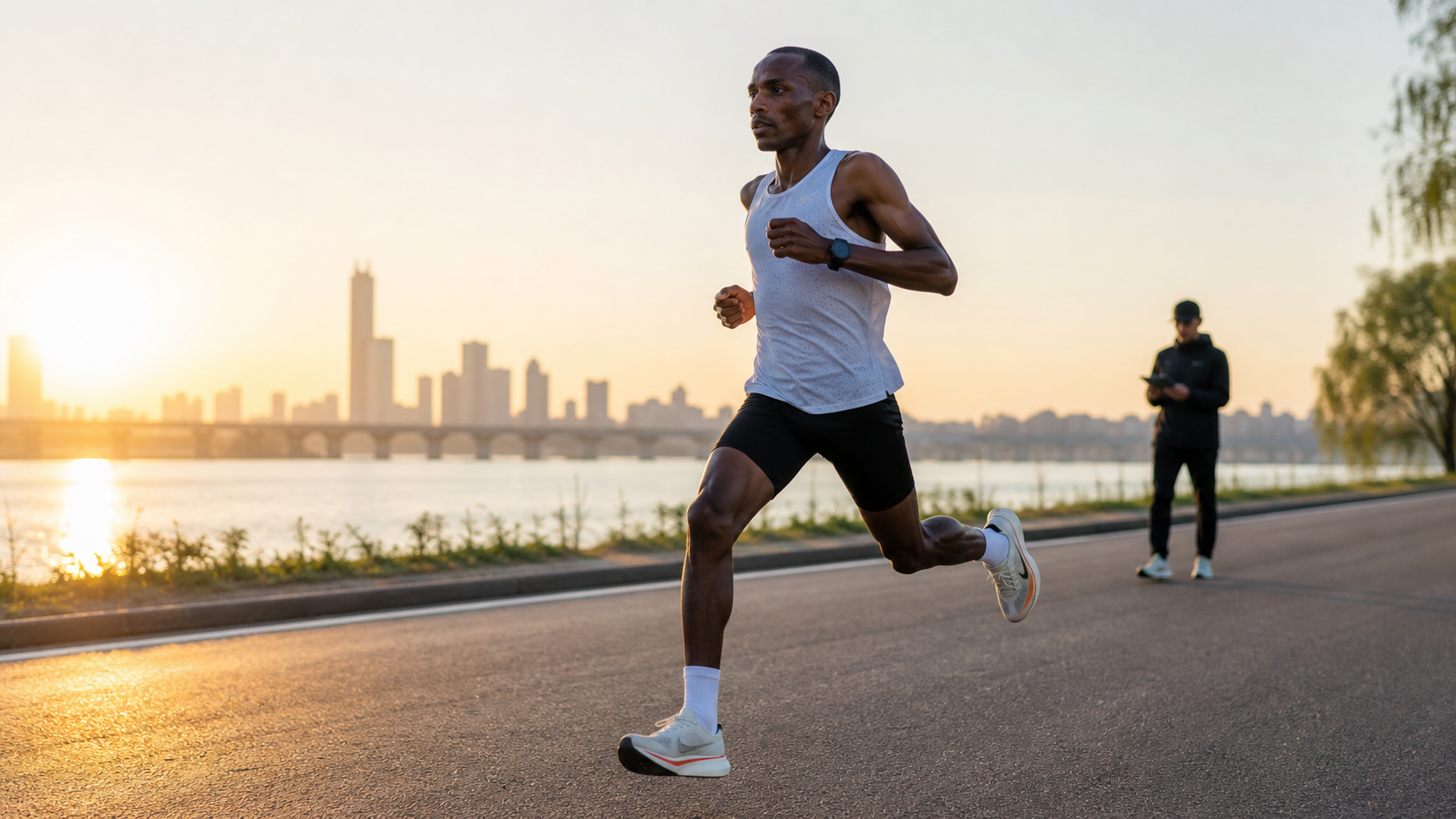
Opening: The Student Who Asked Me “How Fast Can I Actually Run?”
A few years ago, an engineer working in the Hsinchu Science Park sat across from me, pulled up three years of running data on his phone, and asked very seriously: “Coach, if I do everything right—training, nutrition, sleep, shoes all maxed out—what’s my lifetime limit, down to the minute and second?”
In my over a decade of coaching, this is the question I’ve been asked the most, and it’s also the most fascinating one. Hidden behind it is a much bigger proposition: How much faster can the human species actually run? Why have professional athletes pushed the marathon toward the 2-hour barrier for so long, only to hit what feels like an invisible wall in those final one or two minutes?
The answer I gave him then is the same one I’ll give you today: Running speed isn’t mysticism. It’s determined by several engines that can be measured, trained, and are also capped by physiological ceilings. In this article, I’ll break down the concept of “human limits” for you in the same tone I use with my athletes—covering the three physiological engines that determine running speed, how much the technology behind record-breaking (carbon-plated shoes) actually contributes, where the physiological ceiling lies, and most importantly: what all of this actually means for everyday city runners like us who have jobs, eat out, and do our training along the riverside on weekends.
Let me start with the conclusion: Your limit is farther than you think; but the human species’ limit is closer than most people imagine.
Conceptual Foundation: The Three Engines That Determine How Fast You Can Run
After decades of research, exercise physiology has distilled “how fast and how long a person can run” into three core variables. I like to compare them to three parts of a car. Understand these three engines, and you’ll know why some people are always faster than you no matter how they train, and how much room you still have.
Engine One: VO2max—Engine Displacement
VO2max is your body’s ability to consume oxygen per minute per kilogram of body weight at maximum intensity, measured in ml/kg/min. Think of it as the engine’s “displacement”—the bigger the displacement, the higher the ceiling for maximum horsepower.
- An average untrained adult male falls around 35–45 ml/kg/min, with females slightly lower.
- A serious city runner can reach 50–60.
- For world-class marathoners, according to lab measurements of 16 world-class male distance runners in Nike’s “Breaking 2” project, average VO2peak was about 71 ml/kg/min, with top individuals touching 80 or above.
Here’s a harsh truth: A large portion of your VO2max is genetic. Your heart size, blood’s oxygen-carrying capacity, and muscle capillary density are substantially written into your genes. Training can raise VO2max, but the improvement typically hits a personal ceiling within 15–25%. So when that engineer asked me about his limit, the first thing I did was estimate a reasonable VO2max range for him—that’s the foundation of the engine.
Engine Two: Lactate Threshold—How Much Throttle You Can Hold
Having a big displacement isn’t enough. What truly determines marathon performance is the percentage of your VO2max you can sustain for a long time without blowing up—that’s the lactate threshold.
Here’s an analogy: Two cars have the same displacement, but one can only hold the throttle at 70% for extended periods while the other can hold a steady 85% without overheating. The latter wins any long-distance race. Research shows world-class athletes can sustain between roughly 83–92% of their VO2max for extended periods, while average runners might hit 75–80% before lactate accumulates, legs go heavy, and they’re forced to slow down.
The good news: The lactate threshold is the most trainable of the three engines. That’s why tempo runs and threshold intervals make up a large portion of the training plans I give city runners—because it’s where you get the highest return on investment.
I often use a relatable analogy to help my athletes understand: Imagine climbing a long flight of stairs. VO2max determines your “maximum capacity to climb in one burst,” while lactate threshold determines “how long you can keep climbing steadily without having to stop and catch your breath.” A marathon is never about who has the most explosive power; it’s about who can hold high intensity the longest without falling apart. I once coached a female athlete whose VO2max was only slightly above average, but her threshold percentage was very high—she could hold a pace that made others fade, and her final marathon time beat plenty of male runners with higher VO2max. That’s the power of the threshold.
Engine Three: Running Economy—How Fuel-Efficient You Are at the Same Speed
The third engine is the most overlooked, yet it’s the key differentiator among elite athletes. Running economy refers to how much oxygen (or energy) you consume when running at the same speed. The more efficient, the better your economy.
Two people with identical VO2max—the one with better economy can run faster at the same oxygen cost, or run at the same speed with less effort. According to Nike Breaking 2 data, the oxygen cost at 2-hour marathon pace is approximately 191 ml of oxygen per kilogram of body weight per kilometer—an extremely fuel-efficient level.
What affects economy? Running form, tendon elasticity, body weight, footstrike pattern, and even your shoes (we’ll get to the carbon-plated shoe topic shortly). It can be trained, but improvements usually come in single-digit percentages.
How the Three Engines Combine to Determine Your Speed
Putting it all together, exercise physiologist Michael Joyner once made a classic theoretical estimate: assuming an ideal athlete with a VO2max of 84 ml/kg/min, a lactate threshold at 85% of VO2max, and极致 running economy, the theoretical marathon limit would be approximately 1 hour 57 minutes 58 seconds.
This number matters because it tells us two things: First, the 2-hour barrier is not physiologically impossible. Second, to push all three engines simultaneously near the human ceiling requires an almost “physiological unicorn” of an individual, combined with perfect conditions and technology.
It’s worth noting that even the 16 world-class athletes measured in the Nike Breaking 2 project had an average lab VO2peak of about 71 ml/kg/min—actually lower than the 84 assumed in Joyner’s theoretical model. This reveals something very interesting: Real-world elite athletes don’t approach the limit through one single extraordinary physiological number, but through a balanced integration of all three engines. Their lactate threshold appears at about 83% of VO2peak, with the lactate turnpoint as high as about 92%, plus extremely fuel-efficient economy. This kind of “balanced to the extreme” combination is rarer than a single off-the-charts number, and closer to what humans can actually achieve. This is actually encouraging news for city runners—you don’t need superhuman genetics; you need to train all the engines you have into balance.
| Physiological Engine | Average Person | Strong City Runner | World-Class Athlete | Trainability |
|---|---|---|---|---|
| VO2max (ml/kg/min) | 35–45 | 50–60 | 71–85 | Moderate (largely genetically limited) |
| Lactate Threshold (%VO2max) | 70–78% | 78–85% | 83–92% | High (best return on investment) |
| Running Economy | Average | Good | Extremely efficient | Moderate (includes footwear factors) |
Technology’s Contribution: How Much Do Carbon-Plated Shoes Actually Help?
When discussing human limits, we can’t avoid the biggest variable of the last decade: super shoes—what we commonly call carbon-plated shoes.
Records have been falling left and right in recent years, and many people ask: “Is it that humans got stronger, or are the shoes cheating?” My answer: It’s both, and technology’s contribution is real and measurable.
Which Engine Do Carbon-Plated Shoes Improve?
The answer is the third one—running economy. Carbon-plated shoes save energy through three mechanisms: a curved carbon fiber plate, lighter and more resilient midsole foam, and a higher stack height.
What does the research say? Take the early Nike Vaporfly 4% as an example. A 2017 study showed it improved running economy by an average of about 4% at certain paces, though individual variation was large, ranging from 1.59% to 6.26%. Subsequent studies have estimated the economy improvement of the Vaporfly series at speeds of 13–18 km/h at roughly 2.7%–4.2%.
Here’s a key concept many people get confused about: A 4% improvement in economy does not mean you’ll run 4% faster. Most studies estimate the actual “speed improvement” at 1%–2.5%. And the slower your pace, the smaller the benefit—one study found that runners at slower paces (around 6:00/km) might see economy improvements of less than 1%.
| Item | Data Range | Notes |
|---|---|---|
| Running Economy Improvement | ~2.7%–4.2% (individual: 1.6%–6.3%) | Faster speeds and lighter body weight usually yield greater benefits |
| Actual Speed Improvement | ~1%–2.5% | Economy ≠ speed; don’t confuse the two |
| Benefit for Slower Runners | Possibly <1% | Diminishes noticeably at paces slower than 6:00/km |
So Does It Count as “Humans Getting Stronger”?
My view: Technology lifts everyone’s third engine up a notch, but you need strong first two engines for the shoes to help at all. A runner with a VO2max of 45 and a threshold at only 75% won’t become elite by wearing top-tier carbon-plated shoes. Technology is a multiplier, not a foundation. So I never discourage my athletes from buying carbon-plated shoes for race day, but I remind them: Don’t expect the shoes to make up for the work you should be doing in training.
Beyond Shoes: What Other “Legal Technology” Is Pushing Records Forward?
Many people think record-breaking is all about the shoes, but behind it is a whole system of technology and methods working in concert. Let me lay it out in a table so you can see how broad “technology” really is:
| Technology/Method | Engine or Aspect Affected | Approximate Contribution |
|---|---|---|
| Carbon-plated super shoes | Running economy | Economy +2.7%–4.2% |
| Pacers/drafting | Air resistance, pace stability | Reduces energy waste, stabilizes rhythm |
| Precision in-race fueling strategy | Energy supply, delaying the wall | Extends high-intensity endurance |
| Cool, dry course and time of day | Heat dissipation, core temperature control | Directly loosens the thermal ceiling |
| Altitude training/hypoxic stimulus | Blood oxygen-carrying capacity, VO2-related adaptations | Highly individual, requires long-term commitment |
| Data-driven training (power, heart rate, GPS) | Training allocation precision | Reduces wasted workouts, prevents overtraining |
The core message of this table: Record-breaking is the stacking of multiple 1% gains. Shoes give you 1–2%, fueling reduces late-race fade, a cooler course saves heat dissipation, steadier pacing wastes less energy—each item alone isn’t impressive, but stacked together they add up to those crucial minutes. That’s why those unofficial “sub-2” exhibition races use a rotating wall of pacers, laser-projected pace lines, and closed flat courses—squeezing out every single 1%.
The lesson for city runners is the same: Don’t worship a single magic tool. Your PB also comes from stacking multiple small advantages—“training + fueling + choosing the right race + choosing the right weather.”
Where the Physiological Ceiling Actually Is: That “Invisible Wall”
Back to the core question: How much faster can humans run? Let me help you see this wall clearly from several angles.
Heat and Heat Dissipation: The Limit Taiwanese Runners Feel Most
When running, only about 20–25% of your energy is converted into forward motion; the remaining 70%+ becomes heat. As you approach limit pace, heat production skyrockets, core temperature rises, and your body must rely on sweating to cool down. In Taiwan’s hot, humid environment, heat dissipation itself is a physiological ceiling.
I often tell my athletes that the same person running in 12°C dry Berlin versus 28°C, 80% humidity Taipei riverside can see pace differences of 15–30 seconds per kilometer—it’s not that you got weaker; it’s that your cooling system is capped by the environment. That’s why world records are almost always set on cool, dry courses. For summer training in Taiwan, I always advise moving “PB attempts” to the cooler season, and focusing summer on aerobic base and heat adaptation.
Energy Supply: The Physiological Truth Behind Hitting the Wall
Over marathon distance, glycogen stores are a hard limit. The human body’s glycogen only supports about 90–120 minutes of high-intensity output; when it runs out, that’s the infamous “wall.” This is why fueling strategy (consuming 60–90 grams of carbohydrates per hour during the race) becomes so critical over long distances—it’s keeping your fuel tank topped up. Elite athletes even treat the gut’s ability to absorb carbohydrates as a skill that needs dedicated training.
Muscles and Bones: The Mechanical Stress Tissues Can Withstand
The faster you run, the greater the ground reaction force with each step, and the higher the mechanical stress on tendons, ligaments, and bones. Human connective tissue strength has a ceiling, which is why when elite athletes push training volume and intensity to a certain point, injury risk rises non-linearly. The limit isn’t just cardiorespiratory; it’s also the limit of tissue tolerance.
I especially want to emphasize this to city runners, because most people don’t fail to reach elite times—they fall to injuries. The cardiorespiratory system can adapt within weeks, but tendons and bones remodel much more slowly—they need months to gradually strengthen. Too many people have cardiorespiratory systems ready to fly while their tissues haven’t caught up, and the moment they spike their mileage, they develop Achilles, shin, or plantar issues. This is also a kind of limit: it’s not that you’re not trying hard enough; it’s that your connective tissue hasn’t been built up yet. My iron rule for athletes: weekly mileage increases should generally not exceed 10% over the previous week, giving tissues enough remodeling time.
Psychological and Central Fatigue: The Brain Also Applies the Brakes
There’s another often-overlooked ceiling, and it comes from your brain. As the body approaches its limit, the central nervous system actively limits output to protect you—you feel like “my legs still have strength, but I just can’t push.” This central fatigue is a real physiological protective mechanism, not purely a matter of willpower. Understanding this is important: it prevents you from excessively blaming yourself when you can’t run well on a given day, and it reminds you that “mental toughness training” (pace discipline, positive self-talk, race experience accumulation) can indeed loosen this brake slightly, but it too has its limits.
Putting It Together: Where’s the Wall?
Summing all this up, the consensus in mainstream sports science is: Under ideal conditions, with an ideal individual, and with modern technology, breaking 2 hours in the marathon (under official race conditions) is foreseeable. But pushing toward 1:55 or beyond requires an extreme combination of multiple physiological systems simultaneously approaching their ceilings. As a species, we are getting very close to that wall—but we haven’t hit it yet.
Practical Methods: Turning “Limit Science” into Training Plans You Can Use
After all that physiology, here’s the key part—how do you, someone with a day job, actually use this? I’ll map the three engines to three types of training and give you a weekly training framework you can reference directly.
Training Corresponding to the Three Engines
| Target Engine | Training Type | Perceived Effort | Recommended Frequency |
|---|---|---|---|
| VO2max | Short intervals (e.g., 400–1000m repeats) | Very breathless, near-maximal, can’t speak full sentences | Once per week |
| Lactate Threshold | Threshold/tempo runs | Comfortably hard, can speak short phrases | Once per week |
| Running Economy + Aerobic Base | Easy long runs, form work, strength training | Can hold a normal conversation | 2–3 times per week |
A Sample Weekly Schedule for City Runners (for someone with a running base, ~40 km/week)
| Day | Content | Purpose |
|---|---|---|
| Monday | Rest or cross-training (swimming/cycling) | Recovery |
| Tuesday | Threshold run: after warm-up, 3×10 min at threshold pace, 2 min easy jog between | Raise lactate threshold |
| Wednesday | Easy run 40–50 min + core strength | Aerobic base, economy |
| Thursday | VO2max intervals: 5×3 min hard, 2 min easy jog between | Raise VO2max |
| Friday | Rest | Recovery |
| Saturday | Long run 90–120 min (mostly easy pace) | Aerobic endurance, fat metabolism, mental tolerance |
| Sunday | Easy run 30 min + form drills | Active recovery, economy |
The spirit of this framework: Lots of easy aerobic work (about 80%) paired with a small amount of high-intensity work (about 20%). This 80/20 principle is what I emphasize most with city runners, because most people’s problem isn’t training too little—it’s “running moderately hard every day.” The result: threshold never gets trained properly, aerobic base never gets built thick, and you end up mediocre at both.
I want to explain specifically why “easy days must truly be easy” is so important. The purpose of easy runs is to build the aerobic base: increasing capillary density, mitochondrial count, and fat metabolism capacity—all adaptations that are effectively stimulated only at low intensity over extended time. If you run your easy days at moderate intensity, fatigue accumulates, and the quality of your interval and threshold days—the ones that really matter—drops. You end up neither fast nor well-conditioned. Slow is an investment, not laziness. I often tell my athletes: easy days should be run at a pace where “you can speak a full sentence without gasping.” This “talk test” is more practical than staring at your watch’s heart rate, especially in Taiwan’s summer when heat artificially elevates heart rate.
Practical Reminders for Taiwan
- Venues: Riverside bike paths (Dajia, Xindian River, Love River) are flat with few traffic lights, great for intervals and long runs; tracks are ideal for precisely controlled interval distances. For uphill economy work, look for gentle slopes on levee roads.
- Climate: In summer, definitely move long runs and intervals to early morning or evening, carry water, and watch your electrolytes. Don’t push through when core temperature is too high.
- Eating out: Getting carbohydrates from Taiwan’s food scene is very easy. A bowl of rice or noodles the night before a race, or toast with a banana 2–3 hours before, are all practical choices. No need to obsess over imported sports nutrition products.
Practical In-Race Fueling Reference
Many athletes know they should fuel but don’t know how much or when. Here’s a practical reference table for longer races (actual amounts should be adjusted individually based on gut tolerance and race distance):
| Race Duration | Recommended Carbs per Hour | Fluids/Electrolytes | Notes |
|---|---|---|---|
| < 60 minutes | Usually no extra carbs needed | Moderate water is fine | Eating well beforehand is sufficient |
| 60–150 minutes | ~30–60 grams | Water + electrolytes based on sweat loss | Energy gels/sports drinks |
| > 150 minutes (full marathon) | ~60–90 grams | Regular, small amounts frequently | Gut tolerance must be trained in advance |
Here’s the most critical and most overlooked point: Practice your fueling strategy during regular long runs—don’t try it for the first time on race day. The gut’s ability to absorb carbohydrates is trainable. If you suddenly flood your system on race day, you’re likely to end up with gastrointestinal distress and perform worse. In Taiwan’s hot, humid environment, you sweat a lot, so don’t neglect electrolyte (especially sodium) replacement.
Common Mistakes and Fixes
In over a decade of coaching, I’ve seen too many people stuck in the same traps. Avoid these and your improvement will be noticeably different.
Mistake One: Thinking the Limit = Maxing Out VO2max
Many people throw all their effort into VO2max intervals and end up overtrained. Fix: VO2max has a genetic ceiling with limited return on investment; putting more resources into lactate threshold and aerobic base will improve your times faster.
Mistake Two: Using Carbon-Plated Shoes to Cover Training Gaps
Fix: Technology is a multiplier, not a foundation. Build up the first two engines first; then the shoes’ 1–2% actually means something. Also, test your race shoes in a few sessions before race day—don’t debut them in the actual race.
Mistake Three: Running Moderately Hard Every Time, No Easy Days
This is the most common mistake among city runners. Fix: Strictly follow 80/20. Easy days must be slow enough to hold a conversation. Slow is what allows your fast days to actually be fast.
Mistake Four: Ignoring Heat and Fueling, Blaming “Lack of Willpower”
Many athletes fall apart in summer and blame their mental toughness. Fix: Hitting the wall and overheating are physiological phenomena, not willpower issues. Treat fueling (60–90 grams of carbs per hour) and heat management as part of your training.
Mistake Five: Ignoring Warning Signs and Pushing Through, Turning Minor Injuries into Major Ones
Fix: Tissue tolerance is a real ceiling. If pain in a specific area persists for more than two weeks, causes nighttime pain, or involves swelling, see a doctor. Taiwan’s National Health Insurance makes it easy to access sports medicine and rehabilitation clinics—don’t treat “toughing it out” as a virtue.
Actionable Advice for Readers at Different Levels
For Beginners Just Starting
Don’t rush to talk about limits. First, build a habit of running 3 times per week, each session comfortably completing 30 minutes. For the first six months, your improvement will come from “teaching your body aerobic metabolism,” and it’ll surprise you how fast you progress. At this stage, the most important engine is the aerobic base—stay away from high-intensity intervals.
For Intermediate Runners Wanting a PB
Your growth engine is the lactate threshold. Do one threshold run per week, and honestly follow 80/20. If your pace has been stagnant for three years, your easy days are probably too fast. Also, start taking long-run fueling and summer heat management seriously.
For Advanced Runners Near Their Personal Ceiling
It’s time to fine-tune running economy (form, strength, weight management, shoe selection) and periodization (season planning, tapering). At this stage, every 1% is hard-earned, and it’s the phase that demands the most patience and data logging. Also, prioritize recovery and injury prevention—you’re much closer to your tissue tolerance ceiling than beginners are.
The Final Answer for That Engineer
I eventually did a reasonable estimate for him: based on his VO2max, his trainable threshold range, and racing in carbon-plated shoes, his lifetime marathon limit fell within a specific, reachable range. The point wasn’t the number itself—it was that he finally understood: A limit isn’t a wall that makes you despair; it’s a map that shows you where to direct your effort.
Case Studies: Three Athletes, Three Different “Limits”
Theory aside, I want to use three realistic scenarios (characters are fictional, training logic is real) to show you that “approaching your limit” means something completely different for different people.
Case A | A 40-year-old executive at a foreign company, aiming to break 4 hours in the marathon. His problem wasn’t fitness—it was “running too fast every time.” I locked his easy-day heart rate ceiling, forced him to slow down, and inserted one threshold run per week. Three months later, his threshold pace had clearly improved, and he broke 4 hours. His “limit” was actually stuck in training allocation, not physiology.
Case B | A passionate 25-year-old, marathon time of 3:20 looking to go faster. His three engines were already good, and improvement had entered the diminishing returns zone. I introduced periodization, had him take in-race fueling seriously (70 grams of carbs per hour), and steered his target race to a flat course in the cool season. Every minute of his improvement came from systematically stacking “multiple 1% gains.”
Case C | A 55-year-old retired teacher with a history of hypertension, wanting to get back into running. For him, the word “limit” means something entirely different. I required him to first see his doctor and confirm an exercise prescription. Training was primarily easy aerobic work, strictly avoiding reckless high-intensity sprints. His goal wasn’t a record—it was health and sustainability. For him, the smartest limit is knowing not to push that physiological red line.
These three cases are meant to show you: Limit science doesn’t only serve elites. It also tells the middle-aged executive “you’re just running too fast,” tells the passionate young man “it’s time to stack small advantages,” and tells the older person with medical history “here’s the line you don’t cross.”
FAQ
Q1: Do I have to go to a lab to measure VO2max?
A: The most accurate method is a lab-based incremental exercise test, but for most runners, watch estimates are sufficient for tracking trends. What matters isn’t the absolute number’s precision, but whether it trends upward over time, and whether you’re getting more comfortable at the same pace.
Q2: I’m older now—is it hopeless?
A: VO2max does decline gradually with age, but regular training can significantly slow that decline—a fit 50-year-old can beat a sedentary 30-year-old. Threshold and economy remain trainable in middle age; you just need more patience with recovery and more attention to injury prevention. Age is a variable, not a death sentence.
Q3: Should I wear carbon-plated shoes for everyday training too?
A: Generally, save carbon-plated shoes for races and a few key workouts. Use regular shoes for daily training—one, to extend the shoes’ lifespan, and two, to avoid your calves and feet becoming overly dependent on the rebound and missing out on foundational strength stimulus.
Q4: How do I train in Taiwan’s summer without heatstroke while still improving?
A: Move quality sessions to early morning, stay on top of fluids and electrolytes, progressively adapt to the heat, and save PB attempts for the cool season. Summer’s value is “building the base,” not chasing results. If you experience dizziness, nausea, or stop sweating, stop immediately and cool down; seek medical attention if severe.
Q5: I have a chronic condition (hypertension, heart disease, diabetes). Can I still pursue running limits?
A: Whether you can, and how to train, must first be evaluated individually by a physician. For this group, the focus is safety and sustainability, not approaching physiological red lines. Taiwan’s healthcare system is accessible—make good use of sports medicine or cardiology clinics for an exercise prescription, and watch for warning signs during training such as chest tightness, unusual breathlessness, or dizziness. Stop immediately and seek medical care if they occur. Regular, moderate exercise is often beneficial for chronic disease management, but it must be done progressively under professional guidance—never rush into high intensity on your own.
Conclusion: We’re Standing at the Doorstep of Human Limits
Back to the original question: How much faster can humans run? Based on current science, we are very close to the species’ ceiling for the marathon—the theoretical limits of the physiological engines, plus the walls of heat dissipation, energy supply, and tissue tolerance, together frame that range near 1 hour 55 minutes to 2 hours. Technology (carbon-plated shoes) has lifted everyone’s third engine a notch, but ultimately it’s a multiplier, not a miracle.
And for everyday city runners like us, the most practical takeaway is this: Your personal limit is far more flexible than the human species’ limit. All three of your engines still have room—you just need the right map and the right training allocation.
Next time you’re running along the riverside questioning your life choices, remember: that wall is a physiological limit for professional athletes, but for you, it’s most likely just a threshold not yet trained, an aerobic base not yet built, or fueling skills not yet learned. All of those are trainable.
Finally, back to that engineer. He never became an elite runner—he didn’t need to. But he learned to view his training through the lens of the three engines, stopped blindly hammering every day, and stopped negating himself when he had an off day. He understood what could be advanced through effort (threshold, aerobic base, fueling, economy) and what needed to be accepted and respected (genetic ceilings, tissue tolerance, environmental limits). That clarity is more precious than any PB. How much faster humans can run is a fascinating scientific question; “how much faster you can run” is a question you answer with action every single day. That’s what limit science truly teaches us.
This article is educational content and cannot replace individual diagnosis and treatment advice from physicians, physical therapists, or nutritionists. If you have cardiac, metabolic, or other chronic conditions, consult a physician and undergo individual assessment before starting or adjusting high-intensity training.
References
- Physiological demands of running at 2-hour marathon race pace (Journal of Applied Physiology): https://journals.physiology.org/doi/full/10.1152/japplphysiol.00647.2020
- Modeling: optimal marathon performance on the basis of physiological factors (PubMed): https://pubmed.ncbi.nlm.nih.gov/2022559/
- Factors Influencing Running Performance During a Marathon: Breaking the 2-h Barrier (PMC): https://pmc.ncbi.nlm.nih.gov/articles/PMC8924290/
- New 10-Year Study Confirms Super Shoe Effect (Outside/Run): https://run.outsideonline.com/gear/road-shoes/new-10-year-study-confirms-super-shoe-effect/
- Effects of Highly Cushioned and Resilient Racing Shoes on Running Economy at Slower Running Speeds (PubMed): https://pubmed.ncbi.nlm.nih.gov/36626911/
Related Reading
- Lactate Threshold Training for Runners: The Physiological Foundation of Marathon Pace
- Calculating Long-Distance Pace: The Science Behind Marathon Goal Pace Minus 90 Seconds
- The Science of Shoes: From Barefoot to Carbon Plates, How a Shoe Rewrites Your Running
- Maximal Running Speed (Vmax) Training: Unlocking Your Speed Ceiling
#公路車 #Vo2Max #最大攝氧量 測驗 體驗 | 心肺測試
6 年前
西進武嶺 免費訓練分析服務 Intervals | 練不夠還是練過頭?你哪一種類型選手?AI模型告訴你! | 備戰神器 | 公路車 訓練 | CT Yeh
4 年前
JE22 百里任務體驗,心跳不能過150,三小時內有可能...? 沒有天時地利難度有多高? / 公路車 / CT Yeh
1 年前
一日北高前的高裝檢 | 北高 360 | 挑戰11小時的裝備 | 一日雙塔 | 補給
6 年前
#公路車 #Fitting 靠人工智慧APP 幫你調整單車
6 年前
如果Pogačar騎西進武嶺可以多快?會破2嗎?各種情況深度推估探討 / 公路車 / CT Yeh
2 年前
一日北高常見問題大集合 | 攻略 | 路線 | 訓練 | 補給 | 自行車 單車 | 一日雙城 | 雙塔 | TWB北高360 | 屁股痛
6 年前
2019 柯P 超越北高 第一集團實錄 (11小時實錄請參考另一部影片) 一日雙城 一日北高 NeverStop Taiwan Long Distance Cycling Challenge
7 年前