Pain Doesn't Mean Broken: The Mechanisms of Using Exercise to Manage Chronic Pain, Graded Exposure, and Breaking the Fear-Avoidance Cycle
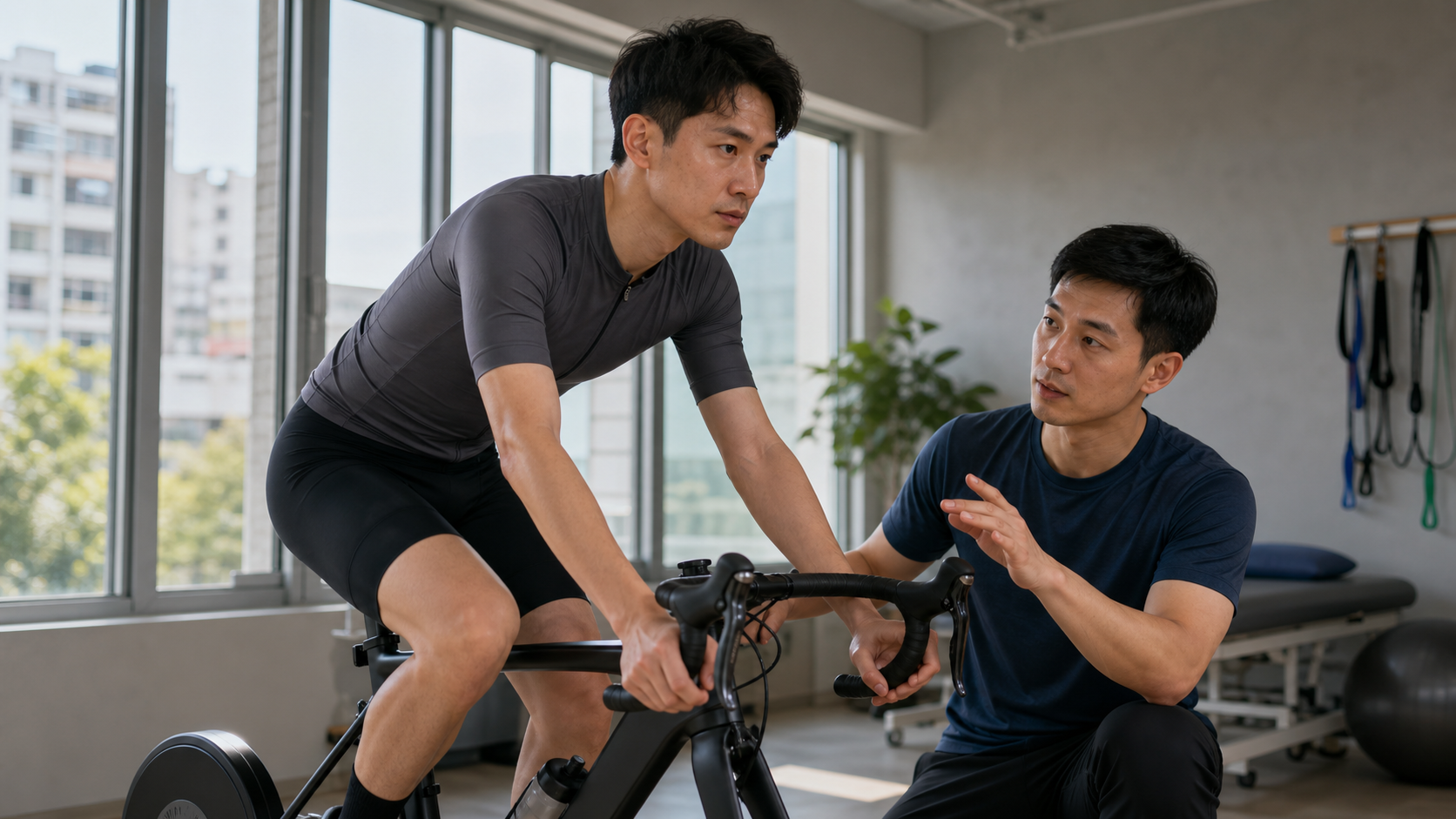
A Student Who Was Afraid to Ride Again
I remember it clearly—that afternoon in a space next to a physical therapy clinic in Taichung, A-Ming (a pseudonym) sat across from me, scrolling through his cycling records from three years ago on his phone. Wuling, Fengguizui, Beiyi—one climbing route after another, with pace, power, and heart rate all fully logged. Then he stopped and said, his voice catching a little: “Coach, I’ve had lower back pain for two years now. I’ve seen orthopedists, had X-rays, and MRIs. The doctor said there’s some disc degeneration, but nothing pressing on a nerve. But if I ride for more than twenty minutes, my lower back starts to tighten and hurt. Now I’m even afraid to wheel the bike out.”
He asked me a question I’ve heard countless times over the past fifteen years: “Is my back just broken? Will moving make it worse?”
This article is meant to answer A-Ming’s question—and to answer many of you reading this right now. I want to talk about something that is becoming increasingly clear in exercise science and pain medicine, yet runs almost completely opposite to common sense: for most people with chronic pain, appropriate exercise is not a danger—it is one of the most effective, guideline-recommended treatments available. And what blocks your recovery is often not that “broken back,” but a psychological and behavioral loop called “fear avoidance.”
Let me state my position clearly first. I am a coach, not a physician or a physical therapist. This article discusses the principles and practical applications of exercise science; it is not meant to replace your diagnosis. If you have red-flag symptoms—unexplained weight loss, fever combined with pain, nighttime pain that wakes you, bowel or bladder incontinence or perineal numbness, or severe pain after trauma—please seek medical care first. Those are outside the scope of this article. Everything below assumes you have already ruled out conditions requiring immediate medical attention.
Chronic Pain Is Not What You Think It Is
Acute Pain vs. Chronic Pain: Two Fundamentally Different Things
Many people treat “pain” as a single thing, but physiologically, acute pain and chronic pain are almost two different phenomena.
Acute pain is a useful alarm. You touch a hot pan, you sprain your ankle—tissue is damaged, nerves send signals upward, and your brain tells you to pull your hand back or stop putting weight on it. That’s a survival mechanism; it’s supposed to hurt. This kind of pain roughly corresponds to the degree of tissue damage, and once the tissue heals, the pain subsides. The typical healing period for soft tissue injuries ranges from a few weeks to about three months.
Chronic pain is generally defined as pain lasting more than three months. Here’s the key point: when pain outlasts the time tissue should have healed, the source of the pain is often no longer “the tissue is still breaking down,” but rather the nervous system itself has become overly sensitive. In pain science, this phenomenon is called “central sensitization.”
Here’s an analogy. Acute pain is like a smoke detector sensing an actual fire. Chronic pain is like that detector being tuned too sensitively—you’re just frying an egg in the kitchen, or even just walking through it, and the alarm blares. The problem isn’t the kitchen; the detector’s sensitivity has been turned up.
The clinical significance of this is enormous: when A-Ming feels pain after twenty minutes of riding, it doesn’t mean his discs are being damaged every time. It’s far more likely that his nervous system’s response threshold to the combination of “forward-leaning posture + sustained load” has been set too low. And the sensitivity of the nervous system can be recalibrated—that’s exactly where exercise can step in.
“Abnormalities” on Imaging: Plenty in Healthy People Too
I make a point of explaining this to everyone who comes to me with pain-related concerns, because it can lift a huge psychological burden.
Disc herniations, degeneration, bone spurs, small rotator cuff tears, meniscal degeneration seen on MRI are extremely common in completely asymptomatic healthy people, and the prevalence rises with age. In other words, finding something on imaging has a much looser correlation with whether you’ll feel pain—or how severe it will be—than most people assume. Many people show signs of disc degeneration on imaging in their forties yet never have a day of back pain in their lives.
I’m not saying imaging is useless—it’s crucial for ruling out serious problems (tumors, fractures, clear nerve compression). What I’m saying is: don’t treat an imaging report as a verdict on your body. The word “degeneration” sounds frightening, but it’s often just a natural process like wrinkles on your face. It does not mean you’re condemned to a life of pain or that you can’t exercise anymore.
Why Exercise Relieves Pain: Breaking Down the Mechanisms
This is the most important conceptual section of the entire article. Exercise improves chronic pain not through sheer willpower—there are real, concrete physiological mechanisms behind it. Let me break them down into several pathways.
1. Exercise-Induced Hypoalgesia (EIH)
This is the most direct pathway. In healthy, pain-free individuals, a single session of aerobic or resistance exercise produces a systemic decrease in pain sensitivity—both during and for a period after the exercise, sensitivity to painful stimuli is reduced. Research shows this “post-exercise analgesia window” lasts roughly thirty minutes after exercise ends in healthy people.
The mechanisms behind it are multiple and synergistic:
- Activation of descending inhibitory pathways: The brain has a “top-down” braking system for modulating pain, and exercise engages it.
- Release of endogenous opioids and monoamine neurotransmitters: The so-called endorphins and related substances, plus serotonin, norepinephrine, and others, work together to dampen pain transmission.
- Immune modulation via myokines: When muscles contract, they secrete myokines like IL-6 and irisin, which promote anti-inflammatory responses and reduce neural inflammation.
- Psychological factors: The sense of control, accomplishment, and attentional shift that come from completing exercise themselves lower pain perception.
Here’s a detail that is absolutely critical for people with chronic pain, and one I always use in practice: in chronic pain populations, exercise-induced hypoalgesia is less consistent than in healthy people—sometimes pain drops, sometimes nothing changes, and in a minority of cases it even hurts more. But research has observed a very practical phenomenon—exercising a “pain-free” body part makes it easier to elicit the analgesic effect. In other words, if someone has severe lower back pain, they don’t necessarily need to train the lower back first. Having them exercise with their arms or a pain-free leg can still activate the whole-body pain-relief mechanism, building a positive association of “exercise = feeling a bit better” before gradually bringing the painful area in. This is one of the physiological foundations that makes graded exposure workable.
2. Long-Term “Recalibration” Through Regular Exercise
A single session gives immediate effects, but what truly changes your life is the long-term adaptation from consistent training. Clinically, a meaningful reduction in pain typically appears after roughly eight to twelve weeks of regular exercise. You need to remember this timeline, because it manages your expectations: using exercise to address chronic pain isn’t like taking a painkiller—you won’t move today and be pain-free tomorrow. It’s a retraining process measured in weeks and months.
What does long-term exercise change?
- Reduces central sensitization: Repeated, safe, controllable loading input is like telling the nervous system, over and over, “this movement is safe,” gradually turning the heightened sensitivity back down.
- Increases tissue tolerance: Tendons, muscles, and bones get stronger and better able to withstand stress under progressive loading. A tissue that’s been avoided for years out of fear of pain is actually the weak one—more likely to hurt the moment you use it.
- Improves sleep, mood, and stress in tandem: Chronic pain is deeply entangled with insomnia, anxiety, and depression. Exercise helps with all three, creating a positive feedback loop.
3. How to Think About Pain-Relieving “Doses” for Different Exercise Types
Many people ask me: “So should I do cardio or strength training? How heavy, and how long before it works?” I have to be honest—there is no one-size-fits-all exercise prescription for chronic pain. Individual differences are huge, which is exactly why individualized assessment matters so much. But I can give you a “thinking framework” so you understand what each type of exercise is responsible for.
| Exercise Type | Main Contribution | Common Starting Point for Chronic Pain Populations | Notes |
|---|---|---|---|
| Low-intensity cardio (brisk walking, trainer, swimming) | Activates exercise-induced analgesia, improves circulation and mood, low joint impact | 10–20 minutes per session, RPE 3–4, 3–5 times per week | Water-based exercise is especially friendly for those afraid of weight-bearing |
| Resistance training (bodyweight, bands, machines) | Improves tissue tolerance and strength, key to long-term relapse prevention | Start with light loads, 10–15 reps per set, 2–3 times per week | Movement quality trumps weight; learn the movement first, then add load |
| Mobility and neuromuscular control (cat-cow, hip hinge, balance) | Rebuilds movement confidence, reduces compensation | Short daily sessions, in the green zone | Works great as “warm-up” and “daily maintenance” |
| High-intensity or impact types (intervals, jumping, climbing) | Advanced conditioning and functional recovery | Usually added after 8–12 weeks, once pain is stable | Introducing too early is a common cause of relapse |
Treat this table as a “map,” not a “prescription.” The actual dosage should be determined by how your body responded to the previous week (using the traffic light system covered later). The core principle is always: Start below what you think you’re capable of, and let your body’s response the next day dictate the next step.
Fear Avoidance: The Cycle That Truly Traps People
After covering the physiology, we need to address the factor that truly determines success or failure—the psychological and behavioral Fear-Avoidance Cycle. This is one of the most powerful models in pain science for explaining why some people recover from pain quickly while others get progressively worse.
How the Cycle Turns
It works roughly like this:
- Injury or pain occurs → This is normal.
- Catastrophic interpretation of the pain: “I’m done for, my back is ruined,” “If I keep moving, I’ll end up paralyzed.” This step is the fork in the road.
- Fear of pain and movement develops: You start fearing specific movements, fearing re-injury.
- Avoidance behavior: You avoid bending, avoid riding, avoid lifting heavy things—if you can stay still, you stay still.
- Disability and deconditioning: Strength drops, mobility worsens, fitness declines, tissue tolerance decreases.
- Pain becomes easier to trigger, and fear grows → Back to step two, and the cycle tightens.
Do you see the cruel part? Avoidance—this “reasonable” reaction meant to protect yourself—is precisely the core engine that turns acute pain into chronic disability. The less you move, the weaker you become; the weaker you are, the more it hurts to move; the more it hurts, the more you believe you’re broken and the less you move.
A-Ming is a classic case. His back wasn’t actually deteriorating. He spent two years turning himself from someone who could climb Wuling into someone who triggered a fear response just by wheeling his bike out. A large part of his problem wasn’t the disc—it was that cycle.
Catastrophizing and Hypervigilance
Two terms are worth remembering here. Pain catastrophizing is magnifying the meaning of pain without limit—“This must be a serious problem,” “I’ll never get better.” Hypervigilance is continuously scanning your attention toward the pain, tensing up at the slightest sign. Research consistently shows that a person’s level of pain catastrophizing often predicts future disability and pain persistence better than the “degree of damage” seen on imaging.
The practical implication for us is: When treating chronic pain, addressing “thoughts” is just as important as addressing “strength.” And exercise happens to be the best tool for tackling both at once—because every time you safely complete a movement you previously feared, you’re using firsthand experience to disprove the faulty prediction that “this movement will hurt me.”
Practical Approach: How to Do Graded Exposure
Alright, enough theory—let’s get practical. The core spirit of Graded Exposure in one sentence: Using controlled, stepwise challenges to let your body and brain repeatedly experience “I can actually do this feared movement, and it didn’t get worse,” thereby progressively dismantling fear and sensitization.
This is closely related to another concept, “Graded Exercise.” Studies comparing the two approaches have found they are roughly equally effective in reducing pain intensity and disability—both are helpful. So don’t get hung up on terminology. Just grasp the two keys: “graded” and “safe re-exposure.”
Principle 1: Find Your “Starting Point”—and Be Conservative
The most common failure in graded exposure is starting too high. The starting point isn’t determined by “how much I used to do,” but by “how much I can do now, and tolerate consistently both during and the day after.”
I use a simple tool to communicate with athletes—the Pain Traffic Light:
| Light | Pain Sensation (0–10 scale) | Meaning | What to Do |
|---|---|---|---|
| Green | 0–3, tolerable, not increasing | Safe zone, body is adapting | Can continue, can gradually increase |
| Yellow | 4–5, noticeable but manageable, returns to baseline within 24 hours post-exercise | Challenge zone, usually acceptable | Maintain this intensity, don’t increase yet, observe tomorrow |
| Red | 6 or above, or pain persists beyond 24 hours, or movement compensation/deformity appears | Overload | Step back to the previous safe intensity, reduce next time |
Remember this often-misunderstood point: In chronic pain rehabilitation, experiencing some pain during exercise (the yellow zone) is usually acceptable—even normal. It doesn’t mean you’re harming yourself. What you truly need to avoid is the red zone—pain that doesn’t subside by the next day, or pain that causes your movement pattern to break down. The standard of “no pain whatsoever” will actually keep you from ever stepping out of the avoidance cycle.
Principle 2: Build a Fear Hierarchy
Take the movements you fear, rank them from least feared to most feared, and build a ladder. Then start at the bottom and climb one rung at a time, staying on each rung until it “no longer triggers significant anxiety and your body tolerates it consistently” before moving up.
Using A-Ming (low back pain, afraid to ride) as an example, the ladder I built with him looked roughly like this:
| Rung | Task | Pass Criteria |
|---|---|---|
| Rung 1 | Daily gentle mobility movements indoors: cat-cow, pelvic tilts, etc. | 5 consecutive days completed in the green zone |
| Rung 2 | Wheel the bike out, mount it, pedal in place for 5 minutes | Anxiety noticeably reduced, green zone |
| Rung 3 | Stationary trainer ride for 15 minutes, low intensity | No residual pain the next day |
| Rung 4 | Trainer for 30 minutes, or 20 minutes of flat-road riding | Within yellow zone, recovered within 24 hours |
| Rung 5 | 40–60 minutes of flat-road riding | Consistently green to yellow zone |
| Rung 6 | Add gentle climbs, gradually extend duration | Tolerates consistently, confidence returns |
The point isn’t how many weeks it takes to climb the ladder—it’s giving each rung enough time to accumulate the experience of “I can do this, and it didn’t get worse.” That accumulation is what dismantles the fear he built up over two years.
Principle 3: Concrete Progression in Gradual Loading
When it comes to increasing load, let me give you a practical framework. For progressive overload in regular exercise, a widely used conservative principle is to increase weekly training volume (time, distance, or resistance) by no more than roughly 10 percent. This isn’t a hard rule, but for people with chronic pain, it’s better to go slow than to spike.
Below is a twelve-week framework using “getting back on the bike + foundational strength” as an example, with intensity expressed in RPE (Rating of Perceived Exertion 0–10), so you can follow it whether or not you have a power meter:
| Week | Aerobic (Trainer/Road Ride) | Strength (Sessions per Week) | RPE Target | Notes |
|---|---|---|---|---|
| Weeks 1–2 | 15 min × 3 sessions | 2 sessions, bodyweight-focused | 3–4 | The goal is “done it, no pain,” not breaking a sweat |
| Weeks 3–4 | 20 min × 3 sessions | 2 sessions, add light load | 4–5 | Observe how you feel the next day |
| Weeks 5–6 | 25–30 min × 3 sessions | 2–3 sessions | 4–6 | Start adding short, small undulations |
| Weeks 7–8 | 40 min × 3 sessions | 3 sessions | 5–6 | Pain usually begins to improve noticeably by now |
| Weeks 9–10 | 50–60 min × 2–3 sessions | 3 sessions | 5–7 | Add gentle climbs |
| Weeks 11–12 | 60+ min, including climbing | 3 sessions | 6–7 | Return close to daily life/sport goals |
Note that I’ve included strength training. Aerobic work alone is often insufficient for long-term improvement in chronic musculoskeletal pain, because you need to increase tissue tolerance and strength, which typically requires resistance training. For people with low back pain, core stability, hip hinge, and gluteal strength are especially important; for people with knee pain, quadriceps and gluteal strength are key.
Principle 4: Tell Your Brain the “Safety Signal”
Graded exposure is not just a physical practice—it’s also a cognitive one. I deliberately guide each trainee to do one thing when they complete each stage: explicitly tell yourself, “I just did the movement I was afraid of, and I did it—and it didn’t get worse.” This seemingly motivational phrase is actually doing “expectation violation”—using real experience to rewrite the faulty prediction that “this movement = danger.” This is precisely why graded exposure works at the psychological level: it creates a gap between “I expected it to be terrible” and “it actually wasn’t that bad,” allowing the brain to relearn.
The Taiwan Context: Connecting the Method to Your Life
For a method to take root, it has to connect to your real living environment. Let’s talk about a few Taiwan-specific points.
Climate and terrain. Taiwan’s summers are hot and humid. Outdoor riding carries a high risk of heatstroke and dehydration, and people with chronic pain who tense up from fear of pain are even more prone to full-body stiffness. In the early rebuilding phase, I highly recommend using an indoor trainer as your home base—temperature is controllable, you can stop anytime, psychological stress is low, and you don’t have to worry about sudden road conditions. It’s ideal for the early stages of graded exposure. Once your confidence and fitness return, move to flat riverside bike paths in the early morning or evening (such as the riverside paths in Greater Taipei, the Dongfeng Green Corridor in Taichung, or the Love River route in Kaohsiung—these gentle, dedicated paths) for flat road riding, and only then progress to gentle climbs in the foothills.
Eating out, body weight, and inflammation. Chronic pain is linked to body weight and overall inflammatory status; excess weight increases load on the lower limbs and spine. Eating out is convenient in Taiwan but tends to be high in oil, sugar, and sodium, and low in vegetables. I’m not going to tell you to diet (low energy intake is actually detrimental to tissue repair and athletic performance), but here are a few easy-to-follow directions: include protein at every meal (when eating out, add a braised egg or choose a combo with meat and beans), swap sugary drinks for unsweetened tea or water, and add an extra serving of blanched vegetables to your bento. Protein is important for maintaining and building muscle; a common recommendation for regular exercisers is roughly 1.2 to 2.0 grams of daily protein per kilogram of body weight, but if you have chronic conditions such as kidney disease, consult your physician or dietitian first—don’t increase it on your own.
Healthcare and the NHI system. Access to doctors and rehabilitation in Taiwan is relatively convenient—make good use of it, but use it correctly. My advice: first, have a physician rule out red flags and structural issues that need addressing; then find a physical therapist for a movement assessment and individualized plan; and then have a coach or therapist accompany you in carrying out the graded exposure. The three roles are different and complementary. A special reminder: don’t fall into “passive treatment dependence”—relying long-term on passive modalities like electrotherapy, heat packs, massage, or tape feels good short-term but does nothing to increase tissue tolerance or break the fear-avoidance cycle. What truly changes your physiology is the part where you move yourself. Passive treatment can be an adjunct, but it shouldn’t be the main act.
Second Case Study: A Runner with Knee Pain Who Was Afraid to Run
A-Ming is a cyclist, but let me share a road-running example, because knee pain is extremely common among runners in Taiwan. Xiao-Ling (pseudonym) is in her early forties, an engineer, with three years of running experience. After a half marathon, she developed pain on the lateral and anterior side of her knee. She went to a clinic for an X-ray and was told she had “slight degeneration and slightly poor patellar alignment.” From then on, just thinking about running made her tense, so she stopped running altogether and switched to daily walking. Six months later, her knee hadn’t improved—and now it started aching after long walks too. This is a classic case of deconditioning.
When she came to me, the first thing I did wasn’t giving her stretches—it was reframing her thinking. I told her: “Degeneration” and “poor alignment” on imaging are extremely common in middle-aged people without symptoms. It’s not a verdict that says “you can’t run.” What she needed wasn’t to protect that knee by not using it, but to make the muscles around the knee—especially the quadriceps and glutes—stronger, while helping her nervous system relearn that “running is safe.”
What I set up for her was a path combining strength work with run-walk graded exposure. For the first four weeks, she didn’t run at all—only foundational strength work like wall squats, split squats, bridges, and lateral band walks, plus riding the trainer to maintain cardiovascular fitness. Starting in week five, we introduced “run-walk intervals”: run 1 minute, walk 2 minutes, repeated for several sets, all while using the traffic-light system to monitor her knee. After her first run, she texted me: “Coach, I just ran, and my knee only had a tiny sensation—I actually did it.”—See, there it is again: “I did it.”
Here’s her run-walk graded exposure table, for anyone in a similar situation:
| Week | Session Plan | Strength | Decision Criteria |
|---|---|---|---|
| Weeks 1–4 | No running; brisk walking + trainer | 2–3 sessions/week of foundational strength | Build a strength base; knee pain-free in daily life |
| Weeks 5–6 | Run 1 min / walk 2 min × 6–8 sets | Maintain 2–3 sessions/week | Green light during the run and the next day |
| Weeks 7–8 | Run 2 min / walk 2 min × 6 sets | Add load | Stay within yellow light; recover within 24 hours |
| Weeks 9–10 | Run 3 min / walk 1 min × 6 sets | Maintain | Steady green to yellow light |
| Weeks 11–12 | Continuous easy run 20–30 min | Maintain | Confidence restored; can plan goals |
Xiao-Ling’s case is essentially the same thing as A-Ming’s, just with a different sport: the problem isn’t the “degenerated” joint—it’s that fear-avoidance dragged down her overall capacity; the solution is rebuilding strength and rewriting fear through graded exposure. This logic can be applied to the vast majority of non-red-flag chronic musculoskeletal pain.
Common Mistakes and Corrections
These are the pitfalls I’ve seen repeatedly over fifteen years—let me flag them for you in advance.
Mistake 1: Waiting for “Zero Pain” Before Daring to Move
As mentioned earlier, chronic pain rehabilitation allows for pain in the yellow-light zone. If you set the standard at “zero pain,” you’ll be stuck in the avoidance loop forever. Correction: Use the traffic-light system—green light and manageable yellow light are both signals that you can move forward.
Mistake 2: Going All Out After Several Pain-Free Days
This is the most common cause of relapse. Things improve, you get excited, and on the weekend you ride two hours in one go or climb a hill—then the next day the pain is back, and you conclude, “See, exercise hurts me,” and retreat into avoidance. Correction: Strictly adhere to gradual progression. The week you feel great is exactly the week you need the most restraint and to follow the plan.
Mistake 3: Doing Only Passive Treatment, Not Active Exercise
Three months of electrotherapy, heat packs, and taping, and your back still hurts the moment you ride—because none of it increases the tolerance of your lower back and glutes. Correction: Make passive treatment the supporting role and active progressive exercise the lead.
Mistake 4: Treating Pain as the Only Progress Indicator
Chronic pain fluctuates. If you only focus on “how much does it hurt today,” you can easily get emotionally drained and give up due to short-term swings. Fix: Track multiple indicators—total weekly exercise volume, the progression of movements you can complete, sleep quality, mood, medication use, and daily functional abilities (can you sit for long periods, can you lift things). Often, function and confidence improve first, and the pain score slowly follows.
Mistake 5: Toughing It Out Alone, Not Seeking Professional Help
Training on your own with red flag symptoms, or having significant movement compensations that no one corrects, can lead to problems. Fix: See a doctor when needed, and see a physical therapist when needed. Exercise is a powerful tool, but it must be used on top of a proper assessment.
Actionable Advice for Readers at Different Stages
If You Are in the Acute Phase or Just Started Hurting
Don’t rush to apply the training plan above. The focus during the acute phase (days to weeks) is: maintain daily activities and light movement as much as tolerable, and avoid complete bed rest—prolonged complete rest actually slows recovery and accelerates deconditioning. If pain is severe or you have red flag symptoms, seek medical attention first. Once the acute peak passes, then move into graded exposure.
If You Have Chronic Pain That Has Lasted Months (Like Ah-Ming)
This article is written for you. The action sequence:
- First, see a doctor to rule out red flags and get the green light to exercise.
- Accept this concept: degeneration on imaging is not a verdict; pain does not mean something is broken.
- Build your fear hierarchy, starting from the step you fear the least.
- Use the traffic light system and the ~10% weekly increase principle to progress slowly.
- Give it eight to twelve weeks, tracking multiple indicators, not just the pain score.
- Seek a physical therapist and a coach to support you when needed.
If You Have Already Returned to Exercise and Want to Prevent Relapse
Congratulations on climbing out of the cycle. The key to maintenance is: consistency, no long breaks, and continuous gradual progress. Make strength training a regular part of your weekly routine, and when the next minor pain flare-up happens, remember to use the traffic light system and graded exposure you’ve already learned, rather than falling back into fear avoidance. You’ve already had one successful experience, and that experience itself is your best asset against relapse.
FAQ
Q: Should I push through pain during exercise? Should I stop if it hurts?
A: The key is what kind of pain it is. Controllable yellow-light pain that doesn’t worsen with movement and subsides the next day is usually acceptable—it’s your body adapting. But if the pain is severe enough to alter your movement pattern, lasts more than 24 hours, or involves sharp stabbing pain, numbness/tingling, or joint locking or giving way, you should stop, step back a level, and see a doctor if necessary. Learning to distinguish between “discomfort you can work with” and “warning signs that require stopping” is the core skill of this entire approach.
Q: If I take painkillers, do I still need to exercise?
A: The two aren’t in conflict, but they play different roles. Painkillers (use as directed by your doctor) address the immediate pain sensation; they don’t increase your tissue tolerance or break the fear-avoidance cycle. Exercise is what changes your body’s capacity. Sometimes, in early rehabilitation, appropriate pain relief can help you “dare to move,” which is actually helpful—but long-term, the goal is for exercise and functional improvement to reduce your reliance on medication, not the other way around. Any medication adjustments should be discussed with your physician.
Q: I’m older and already have degeneration. Is it still suitable for me to start?
A: Yes, it’s suitable, and often even more necessary. The biggest risk for older adults is not moving due to fear of pain; muscle loss (sarcopenia) and declining fitness increase both pain and fall risk. Starting with low-intensity, controlled progressive exercise, older adults can equally improve strength, pain, and daily function. Just start more conservatively, progress more patiently, and be sure to have a doctor confirm that your cardiovascular and other conditions are suitable for exercise.
Q: Do I need to buy a lot of equipment?
A: No. In the early stages, the most important things are often bodyweight exercises, resistance bands, and a trainer you already own or a good pair of walking shoes. Ninety percent of success in chronic pain rehab comes down to “executing consistently and progressively”; only ten percent is equipment. Don’t let “I haven’t bought all my gear yet” become another excuse to keep avoiding.
Q: I followed the plan for a few weeks but haven’t improved. What should I do?
A: First check three things: one, whether your starting point was too high (often the case); two, whether you have a cycle of overdoing it and then backing off; three, whether you’ve included strength training. If none of these are issues but you’re stuck for several weeks, or your pain pattern changes, or new warning signs appear, then it’s time to go back to a physical therapist or doctor for a reassessment. Don’t just grit your teeth and push through on your own.
Epilogue: What Happened to Ah-Ming
Back to Ah-Ming. We didn’t do anything magical—just the whole system described above: first, we had him see an orthopedist to confirm there were no structural issues requiring intervention. Then we started with 15 minutes on the indoor trainer, cat-cow and pelvic tilts, using the traffic light system to judge, climbing his fear hierarchy step by step, paired with core and glute strength work two to three times a week.
For the first four weeks, he was quite skeptical, because his lower back still felt tight and he still had occasional yellow lights. But I kept reminding him of two things: one, progress is measured in weeks, so give it time; two, every time he completed a movement he previously feared, he was telling his brain “this is safe.” Around week eight, he texted me: “Coach, I rode the trainer for 40 minutes today. My back is only a little tight, and I’m not scared anymore.”
That “I’m not scared anymore” matters more than any pain score. Because what had trapped him for two years wasn’t just his back—it was fear. What exercise truly gave back to him was a sense of control and trust in his own body.
Pain doesn’t mean something is broken. Movement is often the real solution. May you also, step by step, climb out of that cycle.
This article is educational content and does not replace individual diagnosis and treatment advice from a physician, physical therapist, or nutritionist. If you have red flag symptoms (unexplained weight loss, fever, night pain waking you up, bowel or bladder dysfunction, perineal numbness, severe pain after trauma), or if you have chronic conditions such as heart disease, diabetes, or hypertension, please seek medical attention first and obtain individualized clearance for exercise. Do not apply the training plan in this article on your own.
References
- Exercise-Induced Hypoalgesia in Pain-Free and Chronic Pain Populations: State of the Art and Future Directions (The Journal of Pain): https://www.jpain.org/article/S1526-5900(18)30456-5/fulltext
- Exercise-induced hypoalgesia after acute and regular exercise: experimental and clinical manifestations and possible mechanisms in individuals with and without pain (PAIN Reports / PMC): https://pmc.ncbi.nlm.nih.gov/articles/PMC7523781/
- Comparison of Graded Exercise and Graded Exposure Clinical Outcomes for Patients With Chronic Low Back Pain (PMC): https://pmc.ncbi.nlm.nih.gov/articles/PMC5568573/
Related Reading
- Riding with Pain: Cycling Exercise Management Strategies for Chronic Pain Patients
- Low Back Pain Is Not a Reason to Lie Down and Rest: A Complete Coach’s Guide to Exercise Therapy, Core, and Activity
- Exercise and Arthritis: To Move or Not to Move? A Coach’s Guide to Understanding Why “The Less You Move, the Worse It Gets”
- Pain Sensation During Exercise: Can Pain Tolerance Be Trained? A Complete Breakdown from Science to Practice
Never Stop 西進武嶺 前後雙機 完整全程錄影 訓練台 實境
8 年前
一日北高/長距離團騎 常見問題補充篇 / 組團或跟團的眉角 / 壯車友容易被瘦車友慢性拉爆 / 原來屁股痛可能是這個原因...? / 風場配速法 / 公路車 / CT Yeh
2 年前
一日北高常見問題大集合 | 攻略 | 路線 | 訓練 | 補給 | 自行車 單車 | 一日雙城 | 雙塔 | TWB北高360 | 屁股痛
6 年前
摔車後補裝備: 好市多新款單車安全帽& Specialized Romin 北高整路屁股都不痛的坐墊 | 一千元居然有MIPS | CT Yeh | 公路車
4 年前
碟煞公路車 銑面器 !? 原來銑完差這麼多! 降低蹭碟機率! | TIME 公路車 保養小記錄 | CT Yeh
3 年前
高雄綠園道鐵路自行車道 / 外地人能輕鬆駕馭 還是整路崩潰? / 2025 全線開通 春節實地探索一次!(附GPS連結)/ 公路車 / CT Yeh
1 年前
約騎爆笑地獄梗 大腸怎麼了🤣 #公路車 #cycling
3 年前
靠單車減肥35公斤 心得分享與整理
7 年前