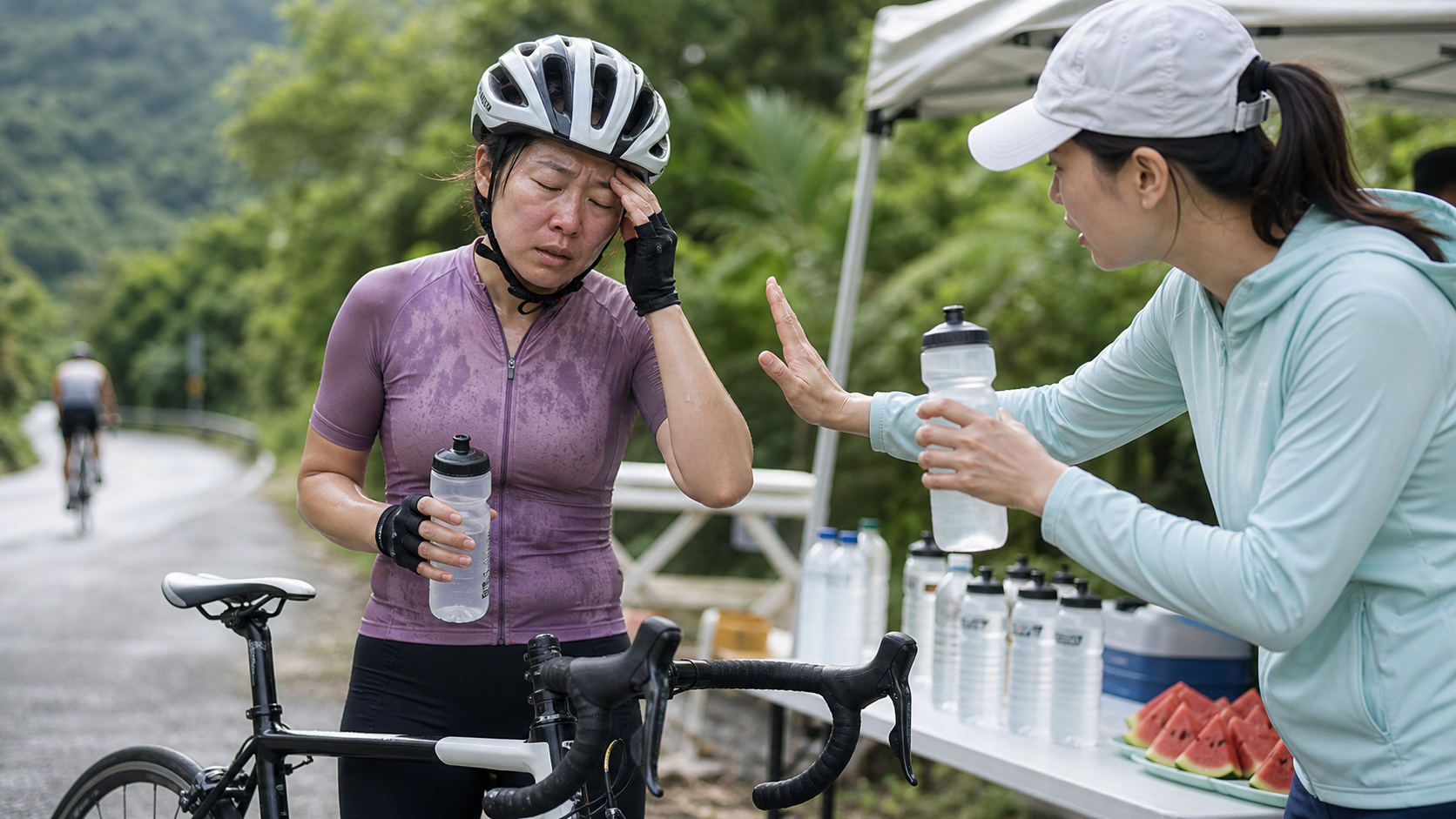
Starting with a Student Who Nearly Got into Trouble
In my fifteen years of coaching, I’ve seen every kind of hydration disaster. But the one that left the deepest impression wasn’t the athlete who cramped up from dehydration—it was a student who was “very serious about drinking water.”
She was a woman in her early forties, a regular cyclist with a desk job, who signed up for her first 100-kilometer long-distance event. That day featured typical Taiwanese muggy weather—high humidity, little wind. She took my usual advice to “remember to hydrate” very seriously—so seriously that she chugged water at every aid station, kept drinking nonstop from both bottle cages on her bike, and even bought a large-capacity hydration pack. Around the 80-kilometer mark, she started getting a severe headache, felt nauseous, and was a bit unsteady on her feet. Her teammates thought she had heatstroke and quickly “gave her more water to drink.”
Fortunately, an experienced volunteer at the rest stop sensed something was off—she didn’t look dehydrated at all; instead, she seemed slightly puffy all over and her reactions were slowing down—and immediately told her to stop drinking water and helped get her to medical care. A blood test later confirmed mild hyponatremia. She told me, “Coach, I always thought you had to drink as much as possible during exercise. How could drinking too much be what hurt me?”
That’s exactly the topic for today: Exercise-Associated Hyponatremia (EAH). It’s a severely underestimated—yet potentially fatal—problem in endurance sports. And the most counterintuitive part is that in the vast majority of cases, the culprit isn’t drinking too little—it’s drinking too much.
In this article, I’ll explain the mechanisms, at-risk groups, practical hydration strategies, common mistakes, and what to do at different severity levels, the same way I teach my students.
1. What Is Hyponatremia? Let’s Build the Foundation
What Sodium Actually Does in the Body
Sodium is the primary electrolyte in the extracellular fluid. It maintains the osmotic pressure of blood and tissue fluid, supports nerve transmission, and enables muscle contraction. The sodium concentration in blood has a fairly narrow normal range; clinically, the reference range for serum sodium is roughly 135 to 145 mmol/L.
Hyponatremia is defined as a serum sodium concentration below 135 mmol/L. “Exercise-associated hyponatremia” specifically refers to hyponatremia that occurs during prolonged exercise or within about 24 hours after exercise.
Let’s first bust a common misconception: hyponatremia doesn’t mean your body has “too little sodium”—it means “too much water relative to sodium.” In other words, it’s fundamentally a “dilution” problem. Imagine a pot of salty soup: the total amount of salt hasn’t changed, but if you keep adding water, the soup gets weaker and weaker—that’s exactly how the sodium concentration in your blood gets diluted.
Why Does Dilution Cause Problems?
The key lies in the fact that water moves toward areas of higher sodium concentration (osmosis). When sodium in the blood is diluted and becomes more dilute than inside the cells, water moves from the blood into the cells, causing cells to swell.
Most tissues can tolerate mild swelling, but one organ is encased in a hard skull with no room to expand—the brain. When brain cells start absorbing water and swelling, intracranial pressure rises, producing a cascade of neurological symptoms: headache, nausea, vomiting, confusion, seizures, and in the most severe cases, cerebral edema, respiratory failure, and even death.
This is why exercise-associated hyponatremia is a “rare but potentially fatal” problem. Unlike dehydration, which becomes more obvious the longer it goes on, it can develop quietly while you’re feeling “I’m hydrating diligently, I’m healthy.”
How Low Does Sodium Need to Drop Before It’s a Problem? A Severity Reference Table
Hyponatremia isn’t an on/off switch—it’s a continuous spectrum. The lower the sodium and the faster it drops, the more severe the symptoms. The table below helps you build a “rough picture”—again, this is a general reference for understanding, not a guide for self-diagnosis from your own blood test. Interpretation must be left to medical professionals.
| Approximate Serum Sodium Range (mmol/L) | General Status | Common Symptoms |
|---|---|---|
| 135–145 | Normal | No abnormalities |
| 130–135 | Mildly low | May be asymptomatic, or mild head pressure, fatigue, bloating |
| 125–130 | Moderately low | Noticeable headache, nausea, urge to vomit, slowed reactions, swelling |
| Below 125 | Severely low | Confusion, unsteady gait, seizures, persistent vomiting, potentially life-threatening |
Many people with mild hyponatremia actually have no obvious symptoms—that’s one of the things that makes it dangerous. You don’t feel pain, so you don’t become alert, until it accumulates to moderate or severe levels and the symptoms “wake you up.” So instead of waiting for symptoms, the focus should be on prevention at the source: don’t overdrink.
Why Is “Dropping Fast” More Dangerous Than “Dropping Low”?
This is a detail that’s often overlooked. The brain actually has some adaptive capacity. If sodium drops gradually, brain cells have time to expel certain internal substances and reduce water absorption, making acute swelling less likely. But if sodium is rapidly diluted by large amounts of plain water in a short period, the brain doesn’t have time to adapt, leading to acute swelling with symptoms that hit fast and hard.
This also explains why hyponatremia during exercise demands particular vigilance—downing large volumes of water within a few hours is the classic scenario for “rapid dilution.”
2. The Mechanisms of Exercise-Associated Hyponatremia: Two Pathways Working Together
Based on recent international consensus, the core causes of exercise-associated hyponatremia follow two main pathways, and they often act simultaneously, amplifying each other.
Pathway One: Overdrinking (Fluid Intake Exceeds Loss)
This is the primary and most common mechanism. When the amount of water you consume during exercise exceeds what you lose through sweat and respiration, and also exceeds what your kidneys can excrete, the excess water accumulates in the body and dilutes blood sodium.
Here’s the key point: under normal conditions, the kidneys are actually quite good at excreting water. But during prolonged exercise, this excretory capacity gets “shut off” by the second pathway below.
Pathway Two: Inappropriate Elevation of Antidiuretic Hormone (AVP/ADH)
The body has a hormone called antidiuretic hormone (arginine vasopressin, AVP, also commonly written as ADH). As the name suggests, its job is to “tell the kidneys to excrete less urine and hold onto water.”
Under normal conditions, if your blood sodium is diluted and your body has too much water, this hormone should decrease, allowing you to urinate more and flush out the excess. But during prolonged, stressful endurance exercise, various factors (exercise stress, nausea, pain, and other non-osmotic stimuli) can keep this hormone abnormally elevated, causing the kidneys to hold onto water precisely when they should be excreting it.
This creates a deadly combination:
- Drinking heavily on one end (too much in)
- Kidneys being instructed to retain water on the other (can’t get it out)
With nowhere to go, the water keeps diluting the blood, and sodium keeps dropping.
Why Does Exercise Make Antidiuretic Hormone “Misfire”?
Many people wonder: isn’t the body smart? How can it tell the kidneys to retain water when there’s already too much? Let me explain a bit more.
Normally, ADH secretion is primarily driven by blood osmolality (i.e., blood sodium concentration): high sodium means more secretion, low sodium means less. But it can also be driven up by certain “non-osmotic” stimuli, such as:
- The physiological stress of exercise itself: prolonged high-intensity exercise is a stress state.
- Nausea and vomiting: this is a very strong stimulus for ADH. Unfortunately, hyponatremia itself causes nausea, creating a vicious cycle—the more you vomit, the higher the hormone, the more water is retained, the lower the sodium drops.
- Pain and emotional stress: race anxiety and physical discomfort can also contribute.
So in a long, exhausting race where you might also feel nauseous, these non-osmotic stimuli “hold” ADH at elevated levels, making it ignore the correct signal that “sodium is already too low, time to excrete water.” This is why you can’t rely solely on your body’s automatic regulation—you also need to actively control not overdrinking.
A Table to Understand Dehydration vs. Hyponatremia
Many people can’t tell the two apart. Here’s a comparison table to help clarify—it’s also the diagram I draw most often in class.
| Comparison Item | Dehydration (Insufficient Water) | Exercise-Associated Hyponatremia (Relative Excess of Water) |
|---|---|---|
| Essence | Total body water is insufficient | Water is excessive relative to sodium; blood sodium is diluted |
| Body Weight Change | Weight decreases after exercise (water loss) | Weight stays the same or even increases after exercise |
| Common Scenarios | High heat, insufficient fluid intake, heavy sweating | Overhydration, ultra-long exercise, slower finishers |
| Typical Symptoms | Thirst, rapid heart rate, low urine output with dark color, dizziness | Headache, nausea/vomiting, swelling, confusion |
| Consequence of Wrong Treatment | Hydration improves the condition | “Drinking more water” makes it worse |
| Management Principle | Moderate fluid and electrolyte replacement | Stop drinking water; seek medical care for severe cases |
Please pay special attention to the last two rows of the table: when someone has a headache and feels nauseous, if you misjudge it as dehydration or heatstroke and “pour more water into them,” you’re adding fuel to the fire for someone with hyponatremia. This is why correct on-site assessment is so important.
3. Who Is at High Risk? Check Yourself
Exercise-associated hyponatremia doesn’t affect everyone with equal probability. The following characteristics carry significantly higher risk. Read through and compare yourself or your training partners.
High-Risk Characteristics Checklist
- People with long finish times: In events lasting more than four hours, the “accumulated time” for drinking stretches out, greatly increasing the chance of excessive intake. Slower finishers (e.g., back-of-the-pack marathoners, ultra-distance cyclists, ultramarathoners) are actually the higher-risk group because their sweat rate isn’t high, but they have plenty of time to slowly keep drinking.
- Smaller, lighter individuals: Drinking the same 500 ml of water has a much greater dilution effect on a 50 kg person than on an 80 kg person. Women and petite individuals are at relatively higher risk.
- “Obedient, diligent” beginners: This one is harsh but true. The more someone treats “you must drink plenty of water” as gospel and force-drinks on a schedule, the more likely they are to overdo it.
- Cool weather or high humidity with poor sweat evaporation: Not being hot doesn’t mean safe. In cool weather you sweat less and lose less sodium, but if you follow your usual habit of drinking large amounts, you’re actually more likely to dilute your blood.
- Those taking certain medications: For example, some nonsteroidal anti-inflammatory drugs (NSAIDs) may affect kidney water excretion. Those with chronic conditions or long-term medication use have specific risk profiles—this must be individualized and discussed with a physician.
- People with chronic diseases: Heart, kidney, and endocrine conditions affect fluid and electrolyte regulation and require more caution and individual assessment.
Special Notes for the Taiwanese Context
Taiwan’s climate amplifies this problem. High heat combined with high humidity is our daily reality—high humidity makes sweat evaporate poorly. You may be sweating profusely yet still have poor cooling efficiency, feel hotter, and want to drink more. In this cycle of “constantly feeling hot, constantly drinking,” it’s easy to overhydrate.
Additionally, many people in Taiwan are used to eating out and consuming salty, heavily seasoned food, so daily sodium intake isn’t usually low. But during exercise, with heavy sweating and lots of plain water, the short-term dilution effect still exists. Don’t let “I usually eat salty food” make you complacent.
An Easily Overlooked High-Risk Combination: Slow, Long, Cool, Diligent Hydration
I often remind my students of a “dangerous four-star combination.” The more of these factors you match, the more careful you need to be:
- Slow finish pace: Low sweat rate, low sodium loss.
- Very long duration: More opportunities to accumulate fluid intake.
- Weather isn’t particularly hot (or is even cool): You won’t be naturally limited by “too hot to drink.”
- Very diligent, very consistent hydration: Actively drinking large amounts.
Notice something? Put these four together, and you get exactly the profile of a “serious beginner slowly finishing a long ride in comfortable weather while diligently drinking the whole way.” This type of person often feels great about themselves, thinking “I did everything right,” yet they’re standing right in the path of hyponatremia. This is why I especially wanted to write this article—because the ones who get into trouble often aren’t the most reckless people, but the most obedient ones.
Case Two: The “Model Student” on a Cool, Long Ride
Let me share another memorable example. A female student weighing around 50-some kilograms participated in a long-distance event in late winter. The temperature was only around 10-something degrees Celsius, cool and comfortable. When she reported back, she was proud: “Coach, I was so good this time—I drank at every aid station, didn’t miss a single one!”
But in the latter half of the ride, she started getting a headache, felt nauseous, and noticed her fingers were a bit swollen and her ring felt tighter. She initially thought she was catching a cold. Looking back afterward, the problem was clear—the weather was cool, she wasn’t sweating much, sodium loss was low, but she followed her “drink lots in hot weather” habit the whole way, essentially stuffing unnecessary water into her body. Fortunately, hers was a mild case that resolved with rest, but this “drinking the same in cool weather” trap catches many people.
The common thread in both cases is clear: they weren’t drinking too little—they were drinking too much; they weren’t being careless—they were being too diligent about doing the wrong thing.
4. Practical Hydration Strategy: Drink to Thirst, Don’t Treat It Like Homework
Now that we’ve covered the mechanisms and risks, let’s get to the most practical part. The prevention principle for exercise-associated hyponatremia can be condensed into one sentence—“drink to thirst,” don’t force-drink on a schedule.
The international sports medicine community’s consensus in recent years has shifted from the old idea of “aggressively pre-hydrate and avoid any dehydration at all costs” to the safer principle of “hydrate according to thirst.” Research has found that what ultimately determines blood sodium concentration is primarily “the amount of water you drink,” not how much sodium you supplement. In other words, overhydration itself is the thing you most need to avoid.
Core Principle: Thirst Is Your Best Dashboard
The body’s thirst mechanism is actually quite sophisticated. When blood sodium rises slightly and the body needs water, you naturally feel thirsty; when fluid levels are adequate, thirst decreases. Instead of using a stopwatch to force yourself to “drink 200 ml every 15 minutes,” put your attention back on your body’s signals: drink when thirsty, don’t force it when you’re not.
This doesn’t mean you can ignore hydration entirely and only think about it when you’re desperately thirsty. Rather: thirst is your primary guide for hydration, not a mechanical fixed quota.
A “Drink to Thirst” Hydration Reference Table
Here’s the practical reference I give my students. Please note: these are ranges and principles, not precise prescriptions—adjust based on your body size, sweat rate, and weather.
| Scenario | Hydration Principle | Common Mistake |
|---|---|---|
| 1–2 hours before exercise | Drink small amounts until you no longer feel thirsty; light yellow urine is sufficient | “Tanking up” before the event |
| During exercise (within 1 hour) | Generally no need to deliberately drink large amounts; take small sips when thirsty | Mechanically force-drinking a set amount every 15 minutes |
| During exercise (1–3 hours) | Hydrate to thirst; in high heat with heavy sweating, consider electrolyte drinks | Only plain water, no sodium at all |
| During exercise (3+ hours) | Strictly drink to thirst, avoid cumulative excess; pay attention to sodium-containing fuel | Drinking your fill at every station, competing over who drinks more |
| After exercise | Rehydrate slowly to thirst, monitor urine output returning to normal | Chugging a large amount of plain water at once |
Can Sports Drinks “Prevent” Hyponatremia?
This is a commonly misunderstood point. Many people think, “If I drink sports drinks with sodium, I’ll be fine.” But to be honest: the sodium concentration in typical commercial sports drinks is usually still lower than your blood sodium concentration. In other words, if you drink an excessive volume, even with sodium, you’re still diluting your blood overall.
So the role of electrolyte drinks is “to provide some sodium and palatability within a reasonable volume, encouraging moderate hydration”—not “a free pass to drink as much as you want.” Controlling total volume is always more critical than which drink you choose.
Use Body Weight as Your Personal Monitor
If you’re an advanced athlete who wants to be more rigorous, here’s a very practical method you can do at home: weigh yourself.
- Weigh yourself before and after exercise (in similar clothing).
- Weight loss of about 2% or less after exercise: generally indicates reasonable hydration.
- Significant weight loss after exercise (more than 2–3%): leans toward underhydration; consider increasing intake next time.
- Weight stays the same or increases after exercise: this is a warning sign—it may mean you overhydrated, and you should reduce your fluid intake next time.
This “weight not decreasing or even increasing” red flag is something I think every long-distance athlete should remember. It doesn’t require a blood test, yet it provides a very direct clue.
Know Your Own Sweat Rate: A Weekend Project
Many hyponatremia (or conversely, dehydration) problems stem from “not knowing how much you sweat.” Sweat rates vary greatly between individuals—some people sweat less than 0.5 liters per hour, while others can sweat 1.5 liters or more. Applying the same hydration formula to everyone was never reasonable.
Estimating your sweat rate is very simple—you can do it this weekend:
- Before exercise, empty your bladder and weigh yourself (record as A).
- Exercise at your usual intensity for one hour, and record how much water you drink during that time (record as C, in liters).
- After exercise, dry off sweat and weigh yourself (record as B).
- Your sweat rate (per hour) is approximately: (A − B) + C.
Example: 60.0 kg before exercise, 59.4 kg after, and you drank 0.4 liters during the session. Your sweat rate for that hour is approximately (60.0 − 59.4) + 0.4 = 1.0 liter.
Once you know this number, your hydration is no longer guesswork. But remember—this is a “reference ceiling,” used to remind you not to exceed your losses, not a mandate to force yourself to drink that full amount. Thirst remains your primary guide. Sweat rate changes with weather and intensity, so it’s best to test in different seasons.
So Should You Supplement Sodium at All? A Practical Guideline
Many people ask at this point: “So do I need to supplement sodium during exercise or not?” My practical advice is:
- Exercise within 1 hour: Plain water (to thirst) is usually sufficient; no special sodium supplementation needed.
- 1–3 hours with heavy sweating: You can reasonably replace some plain water with electrolyte sports drinks for both taste and sodium, but the key is still controlling total volume.
- Long sessions over 3 hours: Pay attention to sodium-containing fuel (sports drinks, salt tablets, or salty foods like salted crackers, sodium-containing energy gels). But the purpose of sodium supplementation is “support”—it can’t save you from “drinking too much.” If total fluid volume blows up, no amount of sodium will stop the dilution.
Remember this priority order: Control total fluid volume > Moderate sodium supplementation > Which brand to choose. Too many people put their energy into the last item while ignoring the most important first one.
5. Common Mistakes and Corrections: What I Most Often Fix On-Site
Mistake One: The Belief That “Drinking More Water Is Always Right”
This is the most deeply ingrained myth. Drinking more water in daily life may be harmless (your kidneys will slowly excrete it), but in the specific context of prolonged endurance exercise, where ADH is elevated and kidney water excretion is suppressed, “drinking more” can become dangerous behavior.
Correction: Change “drink more water” to “drink moderately, according to thirst.” In the exercise context, both too little and too much carry risk—and overhydration is the more underestimated end in long-distance events.
Mistake Two: Mistaking Hyponatremia for Heatstroke or Dehydration, Then Pouring in More Water
Headache, nausea, altered consciousness—these symptoms can appear with dehydration, heatstroke, or hyponatremia, and it’s very hard to distinguish by appearance alone on-site. The danger is: if it’s hyponatremia, giving more water is actively harmful.
Correction: If someone on-site shows these symptoms, calmly observe two clues: (1) Does this person show clear signs of dehydration (low urine output with dark color, obvious thirst)? (2) Have they been drinking large amounts of water the whole way, or even look slightly puffy? If it leans toward the latter, don’t rush to give them large amounts of plain water. Have them stop drinking, and seek professional help as soon as possible. Severe symptoms (persistent vomiting, confusion, seizures) require immediate emergency care.
Mistake Three: Letting Your Guard Down in Cool Weather and Drinking Carelessly
Many people think hyponatremia only happens in hot weather. Wrong. In cool weather, you sweat less and lose less sodium. If you still chug water according to your hot-weather habits, you’re actually more likely to dilute your blood.
Correction: Fluid intake should be dynamically adjusted to weather and sweat rate. In cool weather, reduce your intake appropriately. Don’t transplant your hot-weather hydration habits unchanged.
Mistake Four: “Tanking Up” Before the Event
Some people drink heavily in the hour before a race, thinking “I’ll store it up in advance.” But the body can’t store water like a bottle. Excess water before the event either becomes urine or sets the stage for hyponatremia during exercise.
Correction: Pre-event hydration should be just enough to “not feel thirsty, with light yellow urine.” No need to drink until you feel bloated.
Mistake Five: Using Urine Color as the Only Criterion
“Check urine color to assess hydration” is a widely circulated method, and the direction is correct. But there’s a trap: if you deliberately chug water to chase “colorless, transparent urine,” you may actually overhydrate. Light yellow urine is actually ideal—it doesn’t need to be as clear as water. Treating “transparent and colorless” as the goal is essentially encouraging overhydration.
Correction: The goal is light yellow, not colorless. Urine color is just one auxiliary reference—combine it with thirst sensation and body weight changes.
Mistake Six: Chugging a Big Bottle of Water Immediately After Finishing
Once you cross the finish line, many people habitually “reward themselves” by downing a large bottle of water in one go. But don’t forget: ADH may still be elevated right after exercise ends. Chugging large amounts of plain water at this point carries the same risk of rapid short-term dilution.
Correction: After finishing, rehydrate slowly, in divided portions, according to thirst, paired with sodium-containing food or drinks. Monitor urine output returning to normal. No need to rush through it all at once.
6. Actionable Advice for Different Levels of Readers
Preventing exercise-associated hyponatremia doesn’t require complex tools—the key is getting the concepts right. Here are concrete steps by level.
For Beginners / General Exercisers
- Remember the core sentence: Hydrate “to thirst” during exercise. Don’t treat “drink more water” as a mandatory assignment.
- For exercise within one hour, you usually don’t need to deliberately drink large amounts—small sips when thirsty are enough.
- Don’t compete with others over who drinks more; hydration isn’t a race event.
- If you experience headache, nausea, or slowed reactions after exercise without feeling dehydrated, stay alert and stop drinking more water.
For Advanced / Regular Long-Distance Athletes
- Develop the habit of weighing yourself before and after exercise, using “weight not decreasing or even increasing” as an alarm for overhydration.
- For long distances (3+ hours), hydrate to thirst and moderately include electrolyte-containing fuel, but the focus is always on controlling total volume.
- Know your sweat rate and how it relates to weather; actively reduce intake in cool weather.
- If you take painkillers or medication for chronic conditions, consult your physician or pharmacist before exercise to understand the effects on fluid and electrolyte balance.
For Coaches / Team Leaders / Event Volunteers
- In pre-event education, emphasize the risks at both ends—“not drinking enough” and “drinking too much”— don’t just shout “remember to drink more.”
- When someone on-site shows suspected symptoms, first assess whether it leans toward dehydration or overhydration. Don’t reflexively give everyone water.
- For severe neurological symptoms (confusion, seizures, persistent vomiting), prioritize getting medical help. Don’t try to manage it on-site by pouring in large amounts of water.
A Simple Self-Checklist
| Check Question | Recommended Action |
|---|---|
| Am I drinking “because it’s time” rather than “because I’m thirsty”? | Switch back to thirst as the primary guide |
| Have I weighed myself after exercise? | Develop the habit of measuring before and after, observe changes |
| Do I drink the same in cool weather as in hot weather? | Adjust dynamically based on weather and sweat rate |
| Do I habitually tank up before events? | Drink just enough to not feel thirsty, not until bloated |
| What would I do if a teammate has a headache and nausea? | Assess first, don’t reflexively keep giving water |
7. About Seeking Medical Care: Taiwan’s Environment Is Actually Quite Favorable
Severe cases of hyponatremia require medical treatment, not self-treatment on the roadside. Taiwan has a relatively accessible national health insurance and emergency care system—that’s our advantage, so make good use of it.
If during exercise or within 24 hours afterward you experience persistent and worsening headache, repeated vomiting, confusion, unsteady gait, or seizures—especially if you’re certain you’re not significantly dehydrated, or you’ve actually drunk a lot of water—don’t hesitate. Seek medical care promptly and proactively tell the medical staff: “I drank a lot of water during exercise, and I’m worried it might be hyponatremia.” This information can help the medical team make a faster assessment.
For friends with chronic conditions (such as heart disease, kidney disease, or endocrine disorders) or long-term medication use, your fluid and electrolyte regulation is inherently different. Any adjustment to your hydration strategy should be discussed with your primary care physician first for an individualized plan—don’t just copy general rules from the internet.
8. Frequently Asked Questions (FAQ)
These are the questions I get asked constantly by my students. Here they are, all in one place.
Q1: So how much water should I drink on a normal workday? Is this article telling me to drink less?
Not at all. This article is about the risk of overhydration in the specific context of prolonged endurance exercise. In daily life, your kidneys excrete water normally, and ADH isn’t abnormally elevated, so drinking a moderate amount more is usually fine. Please don’t misinterpret “don’t chug during exercise” as “deliberately drink less in daily life”—those are two different things.
Q2: I’m just commuting or riding along the riverside for an hour. Should I worry about hyponatremia?
Basically, no. Exercise-associated hyponatremia mainly occurs in situations involving long duration (often 3–4 hours or more) combined with overhydration. For exercise within an hour, drinking a little water to thirst is plenty. The chance of hyponatremia is very low.
Q3: Is cramping just a sodium deficiency? Can I prevent cramps by loading up on sodium?
This is another extremely common myth. The causes of exercise-related cramping are actually complex (fatigue, neuromuscular control, local factors, etc. all play a role)—it can’t simply be equated with “sodium deficiency.” Moreover, aggressively supplementing sodium to prevent cramps, especially combined with heavy water intake, could create other problems. Cramping is a topic that can’t be fully covered in a few sentences, but at least let’s break the intuitive equation of “cramp = sodium deficiency.”
Q4: If I drink sodium-containing sports drinks, am I completely safe from hyponatremia?
No. As mentioned earlier, the sodium concentration in typical commercial sports drinks is usually still lower than your blood sodium. So if you chug too much volume, you’re still diluting your blood overall. Sports drinks do provide some sodium, but they are not a free pass to drink as much as you want. Controlling total volume is the key.
Q5: How can I tell whether I’m dehydrated or hyponatremic in the moment?
Precise on-site differentiation isn’t easy, but there are rough clues: dehydrated people typically have low urine output with dark color, obvious thirst, and weight loss; overhydrated/hyponatremic people may have weight that hasn’t dropped or has even increased, slight puffiness, and a history of drinking large amounts. If severe neurological symptoms appear (confusion, seizures, persistent vomiting), don’t get stuck trying to classify it on-site—go straight to medical care.
Q6: Are women really more prone to hyponatremia?
The risk is more related to smaller body size and lower body weight. Since women on average weigh less, and sometimes have longer finish times, they are overall a relatively higher-risk group. But this isn’t about gender per se—the key point is that “the same volume of water has a greater dilution effect on a lighter person.” Petite men should also pay attention.
9. Conclusion: Respect Water, But Also Know Its Limits
Let’s return to the student from the beginning. She later told me that what struck her most wasn’t the discomfort itself, but “the realization that the ‘drink more water to be healthy’ belief I’d always held so firmly could actually hurt me in certain situations.”
I think that’s the most important lesson of exercise-associated hyponatremia: water isn’t better in unlimited amounts—hydration is about getting it “just right.” Both too little and too much carry a price. And on the unique stage of long-distance endurance sports, the hyponatremia caused by “drinking too much” is often more insidious—and potentially more deadly—than dehydration.
The good news is that prevention isn’t difficult at all, and it doesn’t require expensive equipment. You just need to hand back the control of hydration from your stopwatch and the “must drink more” belief to your body’s most honest signal—thirst. Drink when thirsty, don’t force it when you’re not, reduce intake in cool weather, don’t tank up before events, and weigh yourself after exercise to observe changes. These few small habits can help you avoid the vast majority of trouble.
May you all ride long, run far, and hydrate just right.
This article is educational content and does not replace individual diagnosis or treatment advice from a physician, physical therapist, or nutritionist.
References
- Exercise-Associated Hyponatremia: 2017 Update (Frontiers in Medicine): https://www.frontiersin.org/journals/medicine/articles/10.3389/fmed.2017.00021/full
- Exercise-Associated Hyponatremia: 2017 Update (PMC): https://pmc.ncbi.nlm.nih.gov/articles/PMC5334560/
- Exercise-Associated Hyponatremia - StatPearls (NCBI Bookshelf): https://www.ncbi.nlm.nih.gov/books/NBK572128/
- ‘Drink when thirsty’ to avoid fatal drops in blood sodium levels during exercise (ScienceDaily): https://www.sciencedaily.com/releases/2015/06/150629100926.htm
Related Reading
- Water Intoxication and Overhydration in Athletes: The Invisible Killer of Hyponatremia—How to Hydrate Correctly
- Exercise-Associated Hyponatremia: The Fatal Mistake of Drinking Yourself into Trouble
- Hyponatremia in Ultramarathon: The Danger of Overhydration and the Importance of Electrolyte Balance
- Exercise-Associated Hyponatremia (EAH): Hydration Mistakes and Prevention in Races Over 4 Hours
CT暗黑廚房) 車友必備 宇宙無敵鮮蚵湯 幫助訓練恢復 天然食補 好市多 超肥鮮蚵 破PR
7 年前
洗單車神器 吹水機! 實際洗車用用看 暴力洗鍊條大法 | 公路車 | CT Yeh
4 年前
#公路車 #Vo2Max #最大攝氧量 測驗 體驗 | 心肺測試
6 年前
自助洗車場 洗單車 50元有找 清鍊條大法 居然還有小小兵
7 年前
CT 喇低賽) 武嶺牽車 才是王道 西進牽車四小時內秘訣 攝手位置 如何判斷 防抽筋小秘訣
7 年前
西進武嶺 免費訓練分析服務 Intervals | 練不夠還是練過頭?你哪一種類型選手?AI模型告訴你! | 備戰神器 | 公路車 訓練 | CT Yeh
4 年前
4K 東眼山 x 水蜜桃冰沙 百人單車約騎! 操完再吃冰 多爽快
7 年前
水金九不厭五分 10度寒流冷到不願停!feat. 卡卡 / 公路車 / CT Yeh
6 個月前