An Athlete's Daily Nutrition Framework: Eating Right Without Weighing Food (A Complete Practical Guide to the Plate Method)
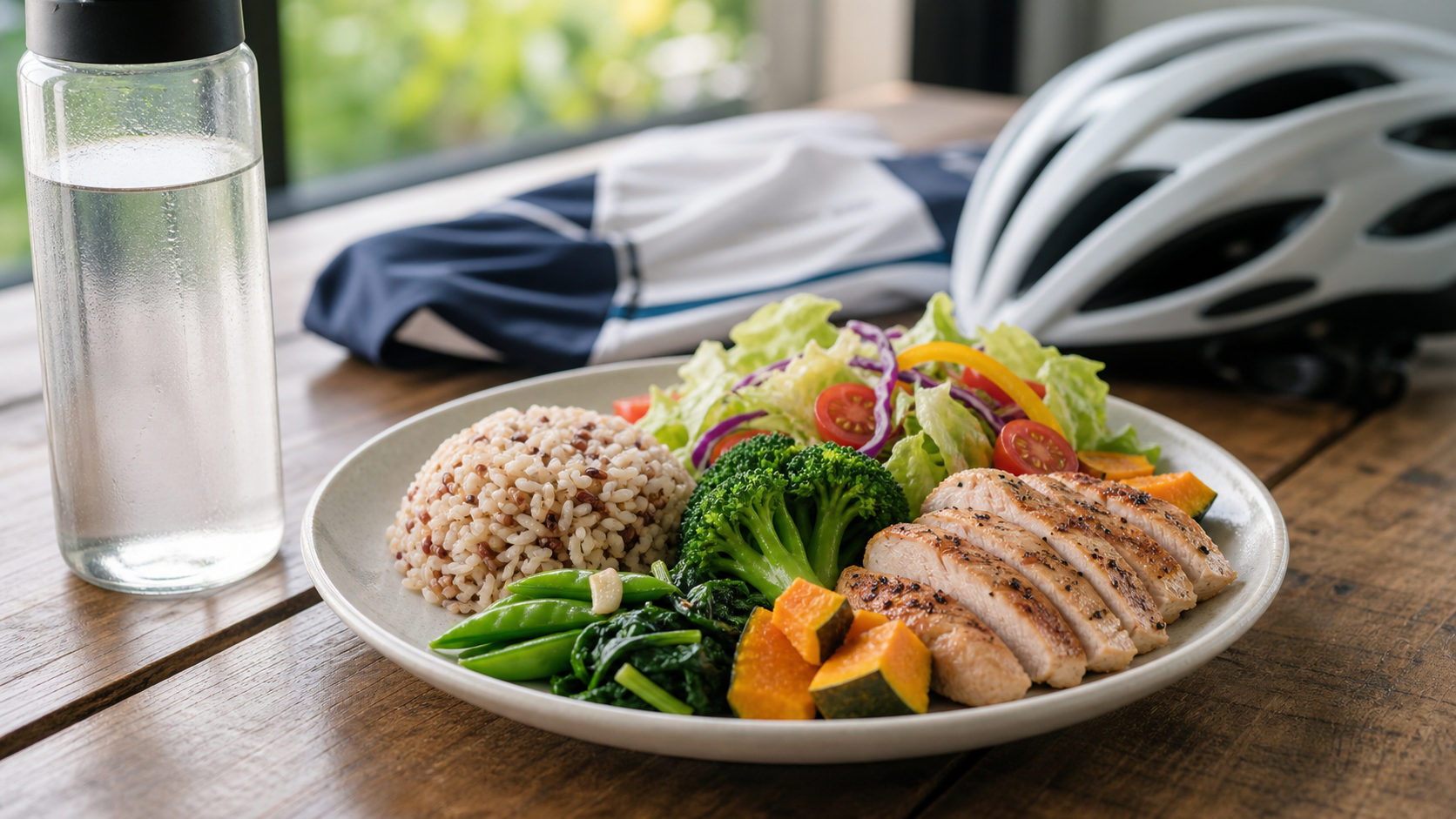
Starting with a Student’s Lunch Photo
I’ve been coaching athletes and the general fitness population for fifteen years now. Over that time, the question I’ve been asked most often isn’t “How do I train to get stronger?” but something far more straightforward: “Coach, what exactly am I supposed to eat?”
I remember one student vividly—A-Kai, a tech-industry guy in his early forties who rode three to four times a week. When he first came to me, his phone was full of screenshots from nutrition apps. He weighed every single bite, logged it, and tracked calories. The result? He gave up after three weeks, because the Taiwanese lifestyle simply can’t accommodate that approach—lunch at the bento shop downstairs from the office, dinner with colleagues at a stir-fry joint, and post-ride refueling at a 7-11 after a long weekend ride. Asking him to pull out a food scale at every meal was basically asking him to quit his job.
He asked me, frustrated: “Is it because I’m not disciplined enough?”
What I told him then is what I want to tell you in this article: You don’t need to weigh your food to eat right. The method that’s actually been proven effective with elite athletes isn’t about obsessing over every gram—it’s a visual framework called the “Athlete’s Plate.” Its core idea is simple—look at your plate, and let its composition match your training intensity for the day. Light training, light plate; hard training, heavy plate. That’s it.
In this article, I’ll break the whole method down for you: the science behind it, how to build your plate for three types of training days, how to apply it to Taiwan’s eating-out culture, the most common mistakes people make, and where to start whether you’re new to exercise or already chasing performance goals. By the end, I hope you’ll be like A-Kai—he’s long since put the food scale in a drawer, his weight is stable, his riding performance has improved, and he enjoys his food more than ever.
Why the “Plate Method” Fits Real Life Better Than Weighing
Three Real-World Problems with the Weighing Approach
Let me be clear: precisely calculating grams and calories isn’t a bad thing, and professional athletes do it during specific competition prep phases. But for the vast majority of people (including many amateur racers), the weighing approach has three real-world problems that are hard to overcome.
First, you can’t weigh food when eating out. How many of your three daily meals in Taiwan are eaten outside the home? Bento shops, noodle stands, buffet restaurants, convenience stores, stir-fry places—how are you supposed to weigh how much oil or meat is in that plate of three-cup chicken? You can’t.
Second, numbers hijack your mood. I’ve seen too many people go from “eating food” to “defending numbers” once they start counting calories. Anxiety over one extra bite—that kind of relationship with food eventually collapses. Exercise is supposed to make life better; it shouldn’t turn eating into an exam.
Third, calorie labels aren’t even accurate. Food composition fluctuates based on origin, cooking method, and portion size, and app databases are often off. You slave over calculations to the decimal point, but the underlying numbers can be off by 10–20 percent either way. The return on investment is actually very low.
The Scientific Foundation of the Plate Method
The plate method isn’t some lazy shortcut someone made up. It comes from a collaboration between the US Olympic Committee (USOC, now USOPC) sports nutrition team and the sports nutrition research team at the University of Colorado, with the goal of giving athletes a visual eating tool that adjusts to training intensity. The core idea in one sentence: as intensity goes up, carbohydrates go up. Because the more and harder you train, the more energy you expend, and the more carbohydrates you need to replenish what you’ve lost. (References: EIU Athlete Plate Easy Day Handout, USOC Nutrition Guide)
It breaks every meal into three visible sections:
- Carbohydrates: provide energy and are the fuel for athletic performance.
- Protein: repairs and builds muscle.
- Color (fruits and vegetables): the source of vitamins, minerals, and fiber.
What you need to do isn’t count grams—it’s adjust the proportions of these three sections on your plate. On easy days, shrink the carbohydrate section and enlarge the vegetables; on hard days, enlarge the carbohydrate section. It’s that intuitive.
Three Training Days, Three Plates
This is the heart of the whole method, so please make sure you understand it. The plate method divides days into three intensity levels, each with a corresponding plate configuration. I’ll describe the proportions using a standard round plate (imagine a Chinese bowl or a Western dinner plate).
Easy Day / Rest Day Plate
When it applies: complete rest days, recovery rides (easy pedaling under an hour), or days with only stretching and core work.
On these days your energy expenditure is low, so the focus is on maintaining, repairing, and replenishing micronutrients—not loading up on fuel. The star of the plate is vegetables.
Moderate Day Plate
When it applies: training at general intensity, such as a one to one-and-a-half hour ride with heart rate in the moderate zone (for most people roughly 130–150 bpm, depending on individual max heart rate), or moderate-intensity strength training. This is the most common state for working professionals who exercise on “weekdays.”
Hard Day / Race Day Plate
When it applies: long distances, interval sessions, climbing workouts, or race day itself. Think of rides familiar to Taiwanese cyclists like the one-day Taipei–Kaohsiung, the long Wuling climb, or the Huadong Rendezvous, or days with two training sessions. On these days, carbohydrates must take center stage, because you need to “store beforehand, maintain during, and replenish afterward.”
The table below is the pocket reference card I give my students. Please commit it to memory:
| Training Intensity | Carbohydrates (plate proportion) | Protein (plate proportion) | Vegetables / Color (plate proportion) | Extra Fat | Typical Scenario |
|---|---|---|---|---|---|
| Easy Day / Rest | About 1/4 | About 1/4 | About 1/2 | Small amount (one teaspoon of oil or a few nuts) | Rest, recovery ride, stretching only |
| Moderate Day | About 1/3 | About 1/4–1/3 | About 1/3 | Moderate | General intensity 1–1.5 hour ride |
| Hard Day / Race | About 1/2 | About 1/4 | About 1/4 | Moderate (avoid excess before competition) | Long distance, intervals, climbing, race |
Key reminder: These percentages are “visual proportions of the plate,” not calorie proportions—they’re different, so don’t confuse them. Carbohydrate foods are energy-dense; the same half-plate of carbs contains far more calories than half a plate of vegetables. You only need to look at the distribution on your plate with your eyes.
Why Should Carbohydrates Follow Intensity?
A lot of people fear carbs and starch—a lingering side effect of Taiwan’s weight-loss culture. But for athletes, carbohydrates (glycogen) are the primary fuel for high-intensity exercise. When you’re riding for two or three hours or doing interval sprints, your body burns glycogen first. Glycogen stores are limited: the harder you train, the faster you deplete them, so you need to top them up before and after hard days.
Conversely, on rest days you haven’t depleted much glycogen, so if you eat as many carbs as you would on race day, the excess energy naturally gets stored. That’s why “always eat lots of starch” or “never eat starch” are both wrong—the right approach is letting carbs fluctuate with intensity.
I often use an analogy with my students: carbs are like the gas in a scooter. If you only ride to the corner store today but insist on filling the tank to the brim, the extra gas has nowhere to go. But if you’re about to ride around the island and leave with only one bar of fuel, you’re guaranteed to break down halfway. Exercise is the same—how much fuel you add depends on how far you’re going today. Once you build that intuition, you’ll stop agonizing over binary questions like “can I eat starch or not,” because the answer is always “it depends on what you’re training today.”
Another point that’s often overlooked: insufficient carbs doesn’t just leave you feeling weak in the moment—over the long term it also drags down recovery and sleep, and can even push your body to break down muscle for energy, which works against anyone trying to maintain muscle mass. So instead of fearing carbs, learn to put them on the right days and at the right times, and let them boost your training results.
Protein: No Need to Weigh It, But Get the “Palm Portion” Right
Carbohydrates fluctuate with intensity, but protein is relatively stable—it’s the foundation you need to maintain every day. Research puts endurance athletes’ protein needs roughly at 1.2 to 2.0 grams per kilogram of body weight: recreational exercisers need about 1.0–1.2 g/kg, while those with higher training volume and intensity, or those in a calorie-restricted phase, should lean toward the upper end. Some studies on elite endurance athletes even point to 1.6 g/kg or more, and newer reviews suggest raising the upper limit. (References: Science for Sport: How Much Protein Do Athletes Need, Springer: Protein Nutrition for Endurance Athletes)
The numbers are there for reference, but you don’t need to multiply anything. I teach my athletes a much more practical method: use your own hand as the measuring tool.
| Hand Measurement | Corresponding Portion | Best For |
|---|---|---|
| One palm-sized portion, palm thickness (excluding fingers) | About one serving of protein (roughly 20–30 g protein, depending on the food) | At least one serving per meal |
| One fist | About one serving of carbs (the scale of one bowl of rice/noodles) | 1–3 servings depending on intensity |
| One thumb | About one serving of extra fat (oil, nuts, sauce) | Moderate control |
| Two palms cupped together | About one serving of vegetables | The more, the better |
The beauty of this “palm method” is that—the measuring tool scales with your body. Larger people have larger palms, so portions naturally increase; smaller people have smaller palms, so portions naturally decrease. You don’t need to know exactly how many grams to eat; your body’s proportions will calibrate it for you. That’s why I always say: your hand is your portable nutrition tool that never runs out of battery.
In practice, I ask my athletes to follow two principles: every meal should include at least one palm-sized portion of protein, and spread your daily protein across three to four meals rather than cramming it all into dinner. Spreading intake out is more efficient for muscle repair and avoids the imbalance of one overly heavy meal while others fall short.
Real-World Scenarios for Eating Out in Taiwan
Theory aside, let’s look at the situations you’ll actually encounter. I’ve translated the most common types of eating out in Taiwan directly into how to order using the plate method.
Bento Shops (Same for Buffet-Style Cafeterias)
This is actually heaven for the plate method, because you get to serve yourself. Here’s how:
- Protein: Choose a main dish the size of your palm. Prioritize braised chicken leg, steamed fish, braised pork chop, tofu, or chicken breast; fried items (fried pork chop, fried chicken) aren’t off-limits, but save them for hard days and eat them sparingly on regular days.
- Vegetables: Load up—make at least two of your side dishes vegetables, prioritizing dark leafy greens (sweet potato leaves, bok choy, broccoli).
- Carbs (rice): This is your dial for adjusting intensity. Half a bowl on rest days, one bowl on moderate days, one to one-and-a-half bowls on hard days. Telling the shop owner “less rice / more rice” is completely normal.
Noodle Shops
The trap at noodle shops is “carbs overloaded, protein and vegetables at zero.” A bowl of dry noodles with a bowl of soup is almost all starch. The fix is simple: add a serving of blanched vegetables, add a braised egg or a serving of dried tofu / pork cheek / squid, to fill in the two missing pieces.
Convenience Stores (Most Common After Long Rides)
After a long ride, many people stop at 7-11 or FamilyMart. Don’t just grab a bunch of bread and sports drinks. My recommended combo:
- Carbs: Onigiri, sweet potato, or one serving of bread (can be more lenient after a hard day).
- Protein: One to two tea eggs, unsweetened soy milk or milk, or ready-to-eat chicken breast / sous-vide chicken.
- Color: A box of salad or a banana (bananas also replenish potassium).
Stir-Fry Restaurants (Dining Out with Colleagues)
Stir-fry places are oily and high in sodium, but that doesn’t mean you can’t eat there. The strategy is: prioritize vegetable dishes (stir-fried greens, cold dishes), choose steamed or boiled proteins (steamed fish, white-cut chicken), control rice according to intensity, and keep alcohol to a minimum. Dining out is part of life, and the beauty of the plate method is that it accommodates real life—you don’t need to feel guilty about a stir-fry meal.
The table below integrates “different training days × three meals a day in Taiwan” so you can follow it directly:
| Meal | Easy Day / Rest | Moderate Day | Hard Day / Race Day |
|---|---|---|---|
| Breakfast | Vegetable egg crepe (less sauce) + unsweetened soy milk | Tuna egg toast + unsweetened soy milk + one piece of fruit | Sweet potato + two eggs + milk + banana (2–3 hours before the race) |
| Lunch | Bento: one main dish + double vegetables + half bowl of rice | Bento: one main dish + vegetables + one bowl of rice | Bento: one main dish + vegetables + one and a half bowls of rice |
| During Training | Usually no extra fueling needed | A banana / energy bar for longer sessions | Carb replenishment every hour (sports drink / energy gel / banana) |
| Dinner | Steamed fish + plenty of blanched vegetables + half bowl of brown rice | Braised chicken leg + vegetables + one bowl of rice | Post-race: one serving of protein + one and a half bowls of carbs to replenish + vegetables |
Hydration and Electrolytes: Taiwan’s Humidity and Heat Can’t Be Ignored
When talking about dietary structure, water can’t be left out. Taiwan’s summers are hot and humid, and high humidity makes it harder for sweat to evaporate and cool you down—you’ll sweat a lot more and lose electrolytes faster. I’ve seen many athletes feel dizzy, cramp up, or experience fatigue the next day after summer rides, and the root cause is often insufficient fluid and sodium intake.
Here are some practical principles:
- Before training: Drink about 400–600 ml of water 1–2 hours before heading out, so your body starts “fully topped up.”
- During training: In high heat, replenish every 15–20 minutes, roughly 500–800 ml per hour; for sessions over an hour, or with heavy sweating, switch to an electrolyte drink containing sodium—don’t just chug plain water (plain water alone can dilute blood sodium).
- After training: Use “weighing yourself” as a rough estimate—for every 1 kg lost after exercise, replenish roughly 1.2–1.5 liters of fluid.
- Check urine color: Pale yellow is ideal; dark yellow to amber means you’re already dehydrated. This is the easiest at-home self-monitoring method.
These numbers are ranges because everyone’s sweat rate varies greatly—treat them as a starting point and fine-tune based on your own sensations and experience.
Timing Around Training: Putting Good Food at the Right Moment
The plate method solves “how to structure the whole day,” but many people are still missing one piece of the puzzle—timing. The same food, eaten at the right time, makes a huge difference. Let me use one of my clients, Xiao Ling, as an example. She’s a nurse who has participated in several cycling events and complained that she “runs out of energy especially easily riding in the morning, and then binges after the ride.” When I asked, it turned out she rode on an empty stomach and didn’t eat until two hours after finishing. This wasn’t a fitness issue—it was a timing problem.
I’ll break timing into three phases for you to follow:
Before training (2–3 hours before you start): This meal should be carb-heavy, with moderate protein and less fat and fiber (to avoid GI discomfort). The goal is to top off glycogen. If you only have 30–60 minutes before heading out, switch to a small amount of easily digestible carbs—like a banana, a slice of toast, or half a sweet potato. Don’t eat a big meal.
During training (only needed if over 60–90 minutes): For rides shorter than an hour, water is usually enough. For longer rides, top up with some carbs every hour to maintain blood sugar. The form depends on what your stomach can handle—bananas, energy gels, or sugary sports drinks all work. This step is especially critical for long distances; hitting the wall is often just a matter of not fueling along the way.
After training (the sooner the better, especially on hard days): This is the golden window for recovery. The principle is to take in carbs + protein together—carbs replenish glycogen, protein repairs muscle. You can easily put this together at a Taiwanese convenience store: milk or unsweetened soy milk with an onigiri, or a sous-vide chicken breast with a banana. No need to obsess over the “30-minute anabolic window,” but not delaying too long after a hard day is a good habit.
Here’s a table summarizing the three phases:
| Phase | Main Goal | What to Eat | Ready-Made Examples in Taiwan |
|---|---|---|---|
| 2–3 hours before training | Top off glycogen | Carb-heavy, moderate protein, low fat and fiber | Sweet potato + egg + milk, onigiri + soy milk |
| 30–60 minutes before training | Quick energy boost | Small amount of easily digestible carbs | Banana, toast, energy bar |
| During training (>60–90 min) | Maintain blood sugar | Some carbs every hour | Banana, energy gel, sports drink |
| After training (sooner is better) | Replenish glycogen + repair muscle | Carbs + protein together | Milk + onigiri, sous-vide chicken + banana |
After Xiao Ling made these adjustments—eating a banana with a slice of toast before heading out and having an unsweetened soy milk with an onigiri right after her ride—she told me two weeks later that her morning rides no longer left her feeling weak, and she stopped losing control and binge-snacking when she got home. Once that timing piece clicked into place, her whole cycle smoothed out.
Don’t Overlook Micronutrients: Iron, Calcium, and Common Gaps for Taiwanese Riders
The “color” section of the plate method represents vitamins and minerals. It’s often treated as a supporting character, but it’s actually critical for people training long-term. I want to highlight two nutrients that Taiwanese athletes commonly struggle with.
Iron: Iron is directly linked to oxygen-carrying capacity. An iron deficiency can cause unexplained fatigue, declining endurance, and a pale complexion. People with high training volume—especially women, vegetarians, and women with heavy menstrual flow—are at higher risk for deficiency. In terms of diet, red meat, pork liver, dark leafy greens, and legumes are all sources. Pairing them with vitamin C-rich fruits and vegetables (like guava or citrus) helps with absorption. But please note: whether you need iron supplements must be determined by a doctor after a blood test—excess iron is harmful to the body, so you can’t just self-prescribe. Blood tests are very accessible in Taiwan. If you’ve been chronically fatigued without an identifiable cause, discussing a blood test with your doctor is a reasonable step.
Calcium and Vitamin D: Cycling is a non-weight-bearing sport, so it stimulates bone density less than running or strength training. For people who only ride and don’t get much sun exposure, bone health is worth paying attention to. Dairy, dried baby anchovies, tofu, and dark leafy greens are calcium sources; vitamin D comes from moderate sun exposure and diet. Although Taiwan has plenty of sunshine, many cyclists ride fully covered in sun protection or only go out at dawn or dusk, so actual vitamin D synthesis may not be sufficient.
The point of this section isn’t to send you out to buy a bunch of supplements—it’s to remind you that the “color” section isn’t decoration; it’s insurance for your long-term health. Putting fruits, vegetables, legumes, and dairy into your daily plate is far smarter than trying to patch things up with supplements later. If you do have a clear deficiency, follow the path of “blood test—see a doctor or dietitian—individualized supplementation.” Don’t play doctor with yourself.
Common Mistakes and Corrections
In all my years coaching clients, some mistakes are nearly universal. I’ve organized the most common ones into a “symptom—cause—correction” chart so you can find yourself in it.
| Common Mistake | Underlying Cause | My Correction Suggestion |
|---|---|---|
| Eating the same amount of carbs every day | Not adjusting carbs with training intensity | Shrink the carb section on rest days, enlarge it on hard days; make portion size your dial |
| Cutting out all carbs for fear of gaining weight | Mistaking carbs for the enemy | High-intensity exercise needs glycogen; cutting carbs leads to weakness and poor performance; adjust the ratio, don’t zero it out |
| Eating all protein in one big dinner | Not spreading intake across the day | Put one palm-sized portion of protein in each of three to four meals for better repair efficiency |
| Only refueling with sugar after training, no protein | Thinking only about energy, forgetting repair | Take in both carbs and protein after a ride to cover glycogen replenishment and muscle repair |
| Chronically eating too few vegetables | Busy schedule, inconvenient to eat out | Add two extra vegetable portions to your bento, grab a salad at the convenience store—this is your source of fiber and micronutrients |
| Only drinking plain water in summer | Overlooking electrolyte loss | Switch to a sodium-containing electrolyte drink during long rides or heavy sweating |
| Relying on a pile of supplements instead of real meals | Over-trusting health products | Supplements fill in what’s missing; the foundation is always real food |
I especially want to expand on “fear of carbs,” because it’s particularly severe in Taiwan. A-Kai started out the same way—he always thought eating rice would make him fat, so even before hard workouts he only dared to eat a little, and then he’d “hit the wall” mid-ride, legs giving out, feeling miserable. I asked him to load up on carbs the night before and the morning of his climbing workout. He came back the next week with bright eyes and said, “Turns out it wasn’t that I was unfit—I just wasn’t eating enough.” Put carbs on the right days, and they’re a help, not a burden.
Actionable Advice for Readers at Different Levels
Everyone starts from a different place, so I’ve divided the action list into three tiers. Pick the one that best matches where you are.
If You’re a Beginner Just Starting to Exercise
Don’t overthink it. Just do one thing well first: make sure every meal has all three components—carbs, protein, and vegetables. Many beginners’ problem isn’t ratios; it’s that a whole component is missing entirely (like a meal that’s only noodles with no vegetables at all). Your goal for this month is simply “all three components present at every meal.” Even just this will make your body feel better. Once that becomes a habit, then you can talk about intensity adjustments.
If You’re an Intermediate Training on a Regular Schedule
You already have a training rhythm, so now it’s time to practice “letting the plate float with intensity.” Lay out your weekly schedule, mark which days are easy and which are hard, and let the carb section expand and shrink accordingly. At the same time, spread your protein across every meal using the palm method, and start paying attention to fueling timing around workouts. At this stage, you’ll notice faster recovery and better endurance on hard workout days.
If You’re a Competitive Athlete Chasing Results
The plate method is still your daily framework, but you can add more refined strategies around key races: carb loading in the days before, an hourly carb intake rhythm during the race, and the golden recovery window afterward. These details are best designed individually with a professional sports dietitian, because your body weight, race distance, sweat rate, and GI tolerance all affect the optimal plan. General advice should give way to individualization at this point.
Here’s a quick-reference table for the three tiers:
| Level | Core Task for This Month | Optional Add-Ons |
|---|---|---|
| Beginner | Get all three components—carbs/protein/vegetables—at every meal | Establish regular meal times, cut back on sugary drinks |
| Intermediate | Let carbs float with training intensity, spread protein intake | Pay attention to pre- and post-workout fueling timing, hydration and electrolytes |
| Competitive | Plate method as daily framework + pre/during/post-race fueling strategy | Work with a sports dietitian for individualization, practice race-day fueling |
An Important Note on Health
This article discusses a general dietary framework for healthy, active individuals. If you have diabetes, high blood pressure, heart disease, or kidney disease, or are taking medications that can be affected by diet, the general guidelines on carbohydrate portions, sodium/electrolytes, and fluid intake may not be suitable for you. Please consult your physician or dietitian for individualized adjustments—for example, protein and electrolyte needs for those with impaired kidney function require professional oversight, and carbohydrate distribution for diabetics needs to be coordinated with your medical team. In Taiwan, access to healthcare through the NHI system is very convenient; metabolic, cardiology, nephrology, or nutrition consultation clinics can all help. Don’t just force general advice onto your own situation.
If you experience persistent chest tightness, chest pain, unusual shortness of breath, dizziness or faintness, or altered consciousness during exercise, stop immediately and seek medical attention. Don’t try to “push through it.” These are signals that cannot be resolved through dietary adjustments; seeking prompt medical care is the responsible way to take care of yourself.
A One-Week Example: Applying the Plate Method to a Real Training Schedule
Principles alone aren’t specific enough, so let me show you a sample week from A-Kai after his adjustments. His weekly schedule roughly looks like this: Tuesday evening moderate-intensity group ride, Thursday interval session, Saturday long climbing ride, Sunday recovery ride, with the remaining days for rest or core work. You’ll see how the “carbohydrate section” breathes in sync with the training schedule.
| Day | Training | Plate Focus | Key Nutrition Points |
|---|---|---|---|
| Monday | Rest | Easy Day | More vegetables, fewer carbs, protein stays at one palm-sized portion |
| Tuesday | Evening moderate group ride | Moderate Day | One bowl of rice at lunch as a base, one banana before the ride, milk + rice ball after |
| Wednesday | Core/Stretching | Easy Day | Carbs back to a small portion, focus on vegetables and protein |
| Thursday | Interval session | Hard Day | Load up on carbs 2–3 hours before the session, replenish carbs + protein promptly after |
| Friday | Rest | Easy Day | Let the body repair; focus on fruits, vegetables, and quality protein |
| Saturday | Long climbing ride | Hard Day | Load up on carbs the night before and at breakfast, fuel every hour during the ride, big replenishment after |
| Sunday | Recovery ride | Between Easy/Moderate | Small to moderate carbs depending on fatigue; focus on hydration and recovery |
Did you notice? A-Kai’s total weekly carbohydrate intake is actually quite substantial, but it’s smartly distributed—more on hard days, less on easy days. That’s the essence of the Plate Method: it’s not about eating less, it’s about eating in sync with what your body needs. With this approach, over the course of a year, his weight stayed stable, his climbing power improved, and he didn’t experience the typical fatigue and performance drop that often comes with fat loss.
I often tell my athletes: “Your diet should look like your training schedule.” Training has a rhythm, and so should your eating. When you align these two, you’ll find that both your training results and how you feel will go up a level.
Frequently Asked Questions (FAQ)
Q: I want to lose weight. Should I eat fewer carbs even on hard days?
A: This is the most common misconception. Weight loss comes from long-term overall energy balance, not from starving yourself on hard days. If you under-eat carbs on hard days, you’ll feel weak, can’t train properly, and recover poorly—which means you’ll end up training less. The right approach is to reduce carbs on easy/rest days while still fueling properly on hard days, placing the “cutting” on low-intensity days.
Q: Do I have to drink protein shakes or take whey protein?
A: Not necessarily. Whey is a convenient tool, but if you’re getting “a palm-sized portion of protein at every meal” across your three main meals, real food can absolutely get you there. Whey is best suited for situations like: you’re out after a ride, no real food available, and you need a quick protein hit. It’s a substitute player, not a starter.
Q: I exercise in the evening. Should I eat after my workout? Will eating before bed make me fat?
A: Yes, you should replenish after training, especially on hard days. Whether eating before bed leads to weight gain depends on your total daily intake, not the timing of that one meal. Rather than going to bed hungry and compromising recovery, it’s better to have an easily digestible portion of carbs plus protein (like milk with some carbs), which is good for both repair and sleep.
Q: As a vegetarian, will I get enough protein with the Plate Method?
A: Absolutely feasible, it just requires more attention. Make tofu, dried tofu, edamame, chickpeas, tempeh, and eggs/dairy (for lacto-ovo vegetarians) the mainstays of your protein section, and pay attention to varied combinations. Vegetarians are also a relatively higher-risk group for iron and vitamin B12 deficiency. If you’re a long-term vegetarian with high training volume, it’s recommended to regularly check your nutritional status with a physician or dietitian.
Q: On weekends I sometimes ride for a very long time (e.g., over 100 km). How should I prepare my nutrition specifically?
A: Treat it as a “Hard Day” scenario. Load up on carbs the night before and the morning of, fuel with carbs and fluid/electrolytes every hour during the ride, and replenish with carbs plus protein as soon as possible after. The biggest risk on long rides is running out of fuel mid-ride. Calculate and pack your supplies before you head out—don’t gamble on “making it to the next convenience store.”
Conclusion: Bringing Eating Back to Intuition
Back to A-Kai’s story from the beginning. I still occasionally receive photos of his lunch now—a bento box with one main dish, plenty of vegetables, and rice adjusted up or down based on that day’s training schedule. No scale, no app, no anxiety. He told me that his biggest takeaway over the past year wasn’t the number on the scale, but “finally feeling like eating is an easy thing.”
This is the core value I most want to convey about the Plate Method: it transforms eating from a precise calculation exam back into an intuition you can sustain for a lifetime. You don’t need to be perfect; you need a framework simple enough that you’re willing to follow it every day. Light training, light plate; heavy training, heavy plate. Get all three sections on your plate at every meal, use your palm for protein, and let intensity dictate carbs.
If you want to take just one sentence away from this article, let it be this: Stop asking “Can I eat this?” and start asking “What did I train today, and how much should go in this section?” When you start letting training intensity determine your plate, food stops being a restriction and becomes part of your performance. This is a path you can follow for a lifetime, and it can start with your very next meal.
Put the food scale away. Look at your plate—you already have the ability to eat right.
This article is educational content for general reference only and does not replace individual diagnosis and treatment advice from a physician, physical therapist, or dietitian.
References
- USOC/EIU Athlete Plate (Easy Day Handout): https://www.eiu.edu/herc/Athlete Plates Easy Day Handout.pdf
- USOC Sport Nutrition Guide (Athlete’s Plate): https://www.gomotionapp.com/kslst/UserFiles/Image/QuickUpload/usoc-nutrition-guide-081416_077258.pdf
- Science for Sport – How Much Protein Do Athletes Need: https://www.scienceforsport.com/how-much-protein-do-athletes-really-need/
- Springer – Protein Nutrition for Endurance Athletes: https://link.springer.com/article/10.1007/s40279-025-02203-8
Related Reading
- Daily Nutrition Framework for Triathletes: Eating Right Without Weighing Food
- A Sample Weekly Meal Plan for Athletes: A Complete Practical Guide from Weekly Structure to Training Day Adjustments
- Nutrition Time Management for the Working Athlete: Too Busy to Eat, Still Fueling Your Training
- Athlete Food Tracking: Apps and Methods—What to Log, How Accurate, How to Stick With It
靠單車減肥35公斤 心得分享與整理
7 年前
#公路車 #Fitting 靠人工智慧APP 幫你調整單車
6 年前
一個測試有沒有認真練車的方法😂 #公路車
10 個月前
CT暗黑廚房) 車友必備 宇宙無敵鮮蚵湯 幫助訓練恢復 天然食補 好市多 超肥鮮蚵 破PR
7 年前
再一組! 全碳幅條 碟煞/無內胎輪組 開箱! 到底好騎嗎? UNAAS X40 | 公路車 | CT Yeh
4 年前
西進武嶺 免費訓練分析服務 Intervals | 練不夠還是練過頭?你哪一種類型選手?AI模型告訴你! | 備戰神器 | 公路車 訓練 | CT Yeh
4 年前
一日北高常見問題大集合 | 攻略 | 路線 | 訓練 | 補給 | 自行車 單車 | 一日雙城 | 雙塔 | TWB北高360 | 屁股痛
6 年前
CT 喇低賽) 單車 比賽總是沒照片? 攝影師的觀點大公開 姿勢就是力量! 請加速1.25倍收看
7 年前