Vitamin B Complex and Energy Metabolism: A Complete Practical Guide to Supplementation for Cyclists and Athletes
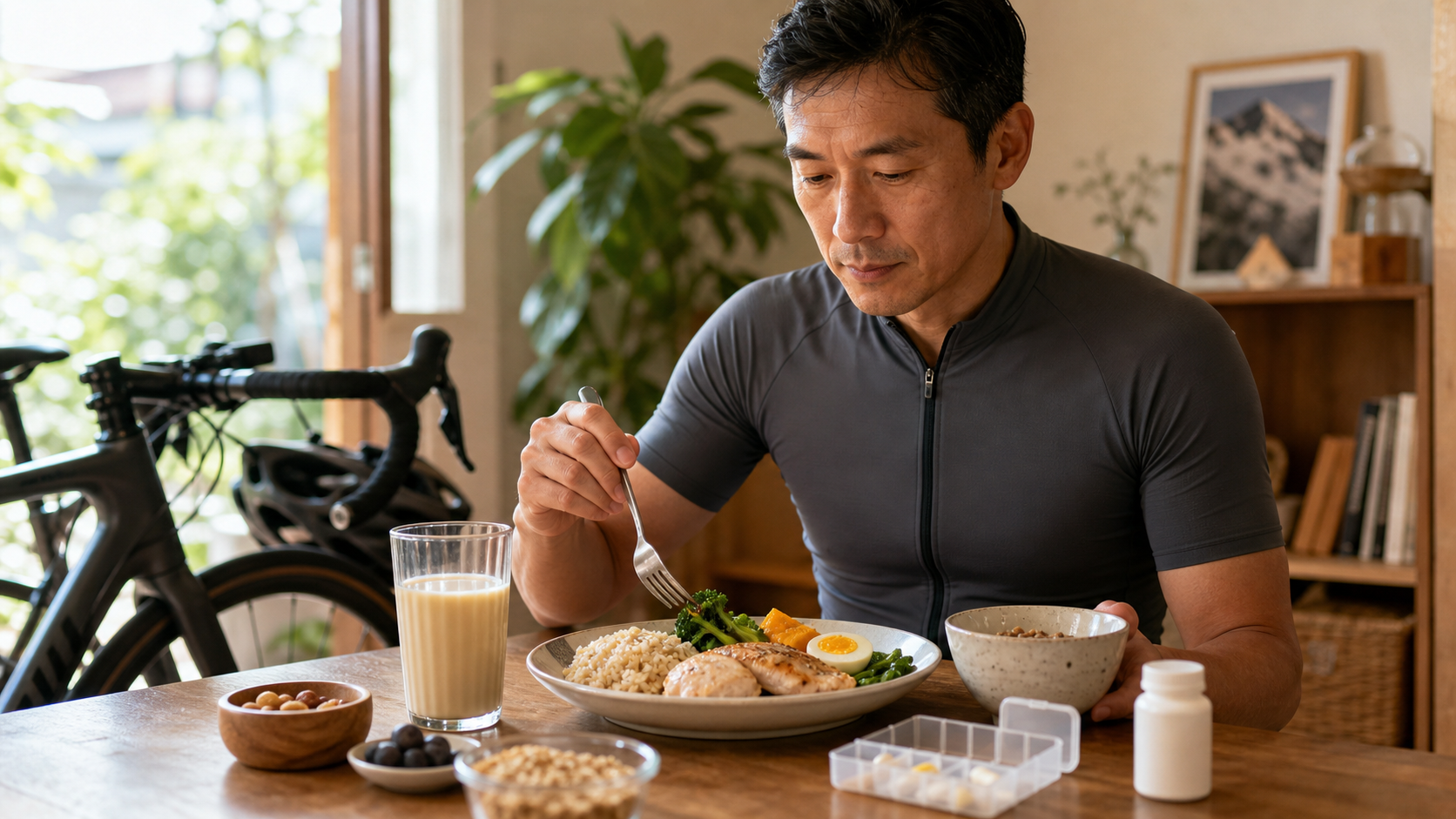
Starting with a Rider Who “Couldn’t Get Stronger No Matter What He Supplemented”
I once coached an amateur rider in his early forties—let’s call him A-Hong. He rode three to four times a week, and on weekends he regularly tackled the Yangjin P-Sign Mountain Road or Fengguizui. His fitness base was actually solid. But for six months, he kept complaining that his “legs felt like lead” and that he “couldn’t push watts on climbs,” adding that no matter how much he slept, he still felt exhausted. He went online and bought a big bottle of B-complex marketed as a “sports energy booster,” popping two a day. After more than a month, his urine turned very yellow, but he didn’t feel any stronger. When he came to me, his first question was: “Coach, is it because I’m not taking enough B-complex?”
I first asked him to write down three days of his diet in detail. The picture was clear: to cut fat, he often had only a black coffee for breakfast, a convenience-store rice ball with unsweetened soy milk for lunch, and only ate a proper dinner. His training volume hadn’t dropped, but his total calorie intake had been chronically low for a long time—and it was heavy on refined carbs, light on whole grains and protein. What he was missing was never that bottle of B-complex; it was steady, sufficient, and varied real food. Once we fixed his diet, he didn’t need to take any extra supplements at all—within two or three weeks, his climbing feel came back.
Looking back at A-Hong’s situation, you’ll see he had cause and effect backwards: he thought his fatigue was due to insufficient B-complex, so he frantically supplemented it; but the truth was that his fatigue came from a long-term calorie deficit, and the B-complex was just an innocent bystander dragged into the story. The extra B-complex he took did him no good at all—it only made him think he was addressing the problem, which delayed his visit to me by six months. This pattern of “supplementing looks like you’re doing something, but you’re not actually targeting the root cause” is something I see all the time with the athletes I coach.
This case highlights a very common misconception among Taiwan’s athletic community: treating B-complex like “energy pills” without understanding what it actually does in the body. In this article, I want to use my perspective as a coach and sports science consultant to clearly explain vitamin B complex and energy metabolism—what role it plays, how much you actually need, where to get it from food, when supplementation is truly necessary, and how to correct the most common mistakes.
Building the Concept First: B-Complex Isn’t Energy—It’s the Worker That Turns Food into Energy
This is the most important sentence in this entire article, so remember it first: B-complex itself contains no calories and doesn’t directly give you energy. Its role is as a “coenzyme”—in other words, an assistant to enzymes. The carbohydrates, fats, and proteins you eat must be broken down and oxidized step by step inside your cells to ultimately produce ATP (the cell’s energy currency). Many checkpoints along this production line require B-complex as components to keep running.
Here’s an analogy: food is the raw material, mitochondria are the factory, ATP is the product, and B-complex is the factory’s workforce. If raw materials are insufficient, no matter how many workers you have, there’s nothing to process (that was A-Hong’s situation—a calorie deficit). But if raw materials are abundant while workers are severely short, the production line also stalls. Most healthy people who eat a balanced diet already have enough workers in their bodies; cramming in more workers won’t magically increase output—the excess just gets excreted (hence the yellow urine, which is the color of riboflavin, i.e., B2).
According to literature reviews on B-complex and athletic performance, thiamine (B1), riboflavin (B2), niacin (B3), pantothenic acid (B5), and vitamin B6 primarily participate in energy-producing pathways, while folate (B9) and B12 mainly handle new cell synthesis, such as red blood cell production and repair of damaged cells (see references at the end). In other words, B-complex is a team with division of labor, not a single role.
The Division of Labor Among B-Complex Members in Energy Metabolism
The table below summarizes the main B-complex members, the steps they handle in energy metabolism, and the possible symptoms when deficient. Please note that the “symptoms of deficiency” column describes cases of obvious deficiency—it does not mean “if you’re a little tired, you’re deficient in this.” That distinction is important, and I’ll emphasize it again later.
| B-Complex Member | Common/Alternative Name | Main Role in Energy Metabolism | Manifestations of Obvious Deficiency |
|---|---|---|---|
| B1 Thiamine | Thiamine | Key to carbohydrate metabolism; essential coenzyme for pyruvate entering mitochondria | Fatigue, beriberi, neurological and cardiovascular issues |
| B2 Riboflavin | Riboflavin | Coenzyme in the electron transport chain and fatty acid oxidation (FAD/FMN) | Angular cheilitis, fatigue, reduced exercise endurance |
| B3 Niacin | Niacin | Raw material for core energy metabolism coenzymes NAD/NADP | Tiredness, skin and digestive issues |
| B5 Pantothenic acid | Pantothenic acid | Component of coenzyme A; hub for fat and carbohydrate metabolism | Very rarely deficient alone; fatigue, paresthesia |
| B6 | Pyridoxine | Protein/amino acid metabolism, glycogen breakdown, hemoglobin synthesis | Fatigue, lowered immunity, anemia-related issues |
| B7 Biotin | Biotin | Carboxylation reactions in fatty acid synthesis and gluconeogenesis | Rare; hair loss, skin issues |
| B9 Folate | Folate | Red blood cell and DNA synthesis, cell repair | Megaloblastic anemia, fatigue, pregnancy risks |
| B12 | Cobalamin | Red blood cell synthesis, neurological function, works with folate | Anemia, numbness in hands and feet, fatigue, neurological symptoms |
You’ll notice that “fatigue” appears in almost every row. That’s exactly why B-complex has been marketed as a “holy grail for energy”—but precisely because fatigue is so non-specific, blaming every bout of tiredness on B-complex deficiency is the easiest mistake to make. There are far too many causes of fatigue: insufficient sleep, overtraining, iron deficiency, thyroid issues, a simple calorie deficit, or even just stress.
Why Athletes Are Especially Reminded to Watch Their B-Complex Intake
There’s a physiological reason for this. Exercise—especially long-duration aerobic activities like cycling and running—dramatically increases the rate of energy metabolism. When you’re climbing Wuling or doing intervals, your body burns far more carbohydrates and fat per minute than when you’re sitting in an office, and these metabolic reactions are driven by B-complex as coenzymes.
Literature examining whether exercise changes B-complex requirements indicates that exercise may increase the need for riboflavin (B2) and vitamin B6; as for folate and B12, the available data is relatively limited. Overall, exercise places stress on metabolic pathways that depend on B vitamins such as thiamine and riboflavin, so active individuals and athletes may have higher requirements for these vitamins than sedentary people (see references at the end).
But here’s a crucial caveat—and it’s especially practical for riders in Taiwan: people who train a lot usually also eat more. When your total calorie intake rises with training volume and your food sources are varied enough, the extra B-complex you consume often naturally covers the increased demand. The real at-risk group isn’t “people who exercise”—it’s “people who exercise while deliberately restricting calories or cutting out certain food groups.”
In my practical experience, the people I most often see needing to watch their B-complex status fall into these categories:
- Riders actively cutting fat with a long-term calorie deficit: When you eat less, micronutrient density tends to drop along with it.
- Vegans or strict vegetarians: B12 exists almost exclusively in animal foods. On a long-term vegan diet without supplementation or fortified foods, B12 deficiency is a genuine risk.
- People who eat out for all three meals, mainly refined carbs: White rice, white noodles, and sugary drinks provide enough calories, but when whole grains, dark green vegetables, legumes, and protein are lacking, B-complex density runs low.
- Those with gastrointestinal absorption issues or who have had GI surgery: For example, certain stomach surgeries can impair B12 absorption.
- Older adults: With age, the efficiency of absorbing B12 from food declines, which is why many dietary guidelines recommend that older adults consider fortified foods or supplements.
If you’re a typical rider who eats three regular meals, has a balanced mix of meat and vegetables, and matches training volume with food intake, frankly, you probably don’t need to worry much about B-complex.
How Much Do You Actually Need? Look at the Numbers First, Then Reality
Many people feel anxious about “how much they need,” but the daily recommended amounts for the average adult are actually not high. Using the Dietary Reference Intakes compiled by U.S. national health agencies as an example, the daily recommended intakes for adults are roughly as follows (see references at the end):
| Vitamin | Adult Male (Daily) | Adult Female (Daily) | Common Good Sources |
|---|---|---|---|
| B1 Thiamine | ~1.2 mg | ~1.1 mg | Whole grains, pork, legumes, nuts |
| B2 Riboflavin | ~1.3 mg | ~1.1 mg | Milk, eggs, dark leafy greens, liver |
| B12 | ~2.4 mcg | ~2.4 mcg | Meat, fish, eggs, dairy, shellfish |
Please pay special attention to the units: B1 and B2 are measured in milligrams, while B12 is measured in micrograms (1 mg = 1000 mcg). The B12 requirement looks tiny on paper, but it is the one that vegans need to manage most proactively.
These are the amounts needed to “maintain health.” For athletes, the requirement may be slightly higher, but usually there’s no need to calculate down to the decimal point—because as long as you eat enough and eat a varied diet, it’s easy to meet or even exceed the target in practice. I never recommend that everyday cyclists pull out a calculator to tally up the B-vitamin milligrams of every meal; that’s neither practical nor necessary. Instead of crunching numbers, focus on “dietary diversity.”
Practical Principles for Athletes
Rather than memorizing numbers, I’d rather you remember these three practical principles:
- Water-soluble, fast metabolism: Most B vitamins are water-soluble, and the body doesn’t store much of them (B12 is a relative exception); excess is excreted in urine. So consistent daily intake matters more than one massive dose on a single day.
- Needs follow calorie intake and metabolism: The more you eat and the harder you train, the higher your theoretical requirement—but your appetite usually increases in tandem, naturally covering the gap.
- Deficiencies come from food choices, not exercise itself: What truly creates a deficiency is almost always “insufficient calorie intake” or “too monotonous a diet,” not “I exercise, so I must be deficient.”
A B-Vitamin Plate for Taiwanese People: How to Get It as a Regular Diner
Taiwan’s food environment is actually not bad for B vitamins; the problem lies in “choices,” not “availability.” At convenience stores, buffet restaurants, and street food stalls, as long as you choose consciously, B vitamins aren’t hard to get. Here are concrete approaches using common Taiwanese scenarios.
A One-Day B-Vitamin-Friendly Eating-Out Example
| Meal | Common “Landmine” Choice | B-Vitamin-Friendly Alternative |
|---|---|---|
| Breakfast | Just black coffee, or white toast with milk tea | Egg pancake or onigiri + unsweetened soy milk or milk, plus a tea egg |
| Lunch | White rice + one fried item | Buffet: choose brown rice or add multigrain, two dark leafy greens, a serving of lean meat or fish, a serving of soy product |
| Post-training | Sugary drink + bread | Chocolate milk or unsweetened yogurt + banana, or a steamed sweet potato with an egg |
| Dinner | Instant noodles | Noodle shop: plain noodles with blanched greens, braised egg, dried tofu, and a serving of meat |
A few especially practical tips for Taiwanese cyclists:
- Swap staples for whole grains: Switch white rice to brown rice, multigrain, or add some quinoa. Many buffet places offer these now, and B1 and B3 will noticeably improve.
- One palm of protein per meal: Rotate eggs, lean meat, fish, and soy products, and B6 and B12 are covered. Taiwan’s braised food stalls and buffets make this easy to assemble.
- Don’t skimp on dark leafy greens: Sweet potato leaves, spinach, and bok choy are great sources of folate and B2. Grab two servings at the buffet, or add a portion of blanched greens at a noodle stand.
- Make milk or soy milk a daily drink: Riboflavin (B2) is abundant in dairy; one glass a day is an easy habit for B2. Vegans can choose plant milks fortified with B12.
- Carry bananas on rides: Bananas contain B6 and are easy to carry; they offer better nutritional density than a handful of gummies for long-distance fueling.
Taiwan’s climate is hot and humid, and long summer rides mean heavy sweating. Many cyclists only focus on replacing water and sugar, overlooking the nutritional density of their meals. Rather than trusting a supplement bottle, eat your regular meals well every day—this is the foundation I emphasize to every athlete I coach.
Common Mistakes and Corrections
Over the years of coaching, I’ve compiled the most common B-vitamin pitfalls people fall into, and I’ve witnessed nearly every single one firsthand.
Mistake 1: Treating B Vitamins Like a Pick-Me-Up Pill, Popping Them When Tired
This is the most common one. B vitamins are not caffeine; they don’t “wake you up.” If you feel energized after taking them, it’s often a placebo effect, or you just happened to sleep well that day. Correction: Honestly examine your sleep, training load, and diet first. The root of fatigue usually lies in those three, not a B-vitamin deficiency.
Mistake 2: Higher Doses Are Better
Commercial “high-potency B-complex” products often pack each component at dozens of times the daily requirement. For water-soluble B vitamins, most of what exceeds the body’s needs is excreted—it’s “expensive urine.” And it’s not entirely without risk at high doses—for example, long-term very high doses of B6 have been linked to neurological symptoms, and high-dose B3 can also have side effects. Correction: The average person doesn’t need ultra-high doses; if you do want to supplement, choose a comprehensive formula close to the daily requirement level. Don’t chase higher numbers.
Mistake 3: Using Supplements to Replace Meals
Some cyclists in a fat-loss phase simply replace meals with B vitamins plus meal replacements, thinking they’ve covered their nutrition. But natural food provides a complete package of B vitamins plus protein, fiber, minerals, and other phytochemicals—supplements can’t deliver that. Correction: Supplements are meant to “fill gaps,” not “replace food.”
Mistake 4: Being Vegan but Ignoring B12
This is one of the few items where I speak more firmly. B12 exists almost exclusively in animal foods. If you’re long-term vegan and never supplement or eat fortified foods, B12 deficiency over the years can cause anemia and even neurological problems—and nerve damage is sometimes hard to fully reverse. Correction: If you’re vegan or nearly vegan, treat B12 as a nutrient you must actively manage, through fortified foods or supplements, and regularly monitor your status.
Mistake 5: Treating “Yellow Urine” as “Absorbed and Effective”
Many people see fluorescent yellow urine after taking B vitamins and think it’s “working.” That color is mainly a normal sign of riboflavin (B2) being excreted—it actually shows your body doesn’t need that much and is getting rid of it. It doesn’t mean you were deficient, nor does it mean it’s helping performance. Correction: Don’t judge effectiveness by urine color.
One Point That Requires Extra Caution
If you have long-term fatigue, noticeable weakness on climbs, or even symptoms like numbness in the hands and feet, heart palpitations, or pale complexion, don’t buy a bunch of supplements and guess. Instead, see a doctor and get blood work done. Taiwan’s National Health Insurance makes it easy to see a physician; getting blood drawn to check for anemia, low B12, or low iron is far more accurate than guessing at a drugstore. Some fatigue stems from iron deficiency, thyroid issues, or other problems that B vitamins can’t solve, and self-supplementing blindly can delay identifying the real cause.
Actionable Advice for Readers at Different Levels
Everyone’s situation is different. I’ve organized recommendations by three common scenarios so you can find where you fit.
If You’re a Beginner Just Starting to Exercise
- Get your three meals right and varied before talking about supplements. Swap part of your staples for whole grains, have protein at every meal, and include dark leafy greens plus a glass of milk or soy milk daily—that covers your B vitamins.
- Don’t rush to buy a pile of supplements just because you started exercising. What you need to invest in most right now is sleep, consistent training, and a balanced diet—not health products.
- If you’re losing weight and deliberately eating very little, consider a “standard-dose” multivitamin as insurance, but that’s filling gaps, not the main event.
If You’re an Advanced Cyclist with a Significant Training Load
- When training volume goes up, your food intake must follow, especially carbohydrates and protein. Eat enough and eat varied, and your B-vitamin needs are naturally covered.
- During high-volume phases of periodized training, don’t simultaneously run an aggressive calorie deficit. Training hard while starving for long periods is the fastest way to let micronutrients drop along with it.
- If you’re a vegan or nearly vegan endurance athlete, manage B12 proactively, and consider regular blood tests to understand your status.
If You’re Older or Have Special Conditions
- B12 absorption efficiency declines with age; discuss with your doctor whether fortified foods or supplements are needed.
- If you have a history of gastrointestinal surgery, absorption disorders, or are on certain long-term medications, your B-vitamin status is more easily affected. Follow your medical team’s individual assessment—don’t apply online dosages to yourself.
- If you have chronic conditions like diabetes, hypertension, or heart disease, consult a doctor or dietitian before using any supplement, and get an individualized assessment. Don’t self-increase doses just because you saw an ad for “sports B-complex.”
A Comprehensive Case Study: Connecting the Concepts
Let’s return to A-Hong from the beginning, and adding a comparison case will make things clearer. Another student of mine, Xiao-Min, a woman in her mid-thirties, swims and does spinning four to five times a week, and has been fully vegetarian for almost two years. She also initially complained of easy fatigue and slow recovery after training. The difference between her and A-Hong is this: she actually eats quite a lot, including legumes, nuts, whole grains, and dark leafy greens, so most B vitamins are sufficient—the only gap is B12.
I asked her to first see a doctor for a blood test to confirm, and indeed her B12 came back low. Following the doctor’s advice, she began regularly supplementing B12 and consuming fortified plant milk. A few months later, not only did her blood values stabilize, but her fatigue also improved. The key point of this case is: Both had “easy fatigue,” but A-Hong lacked calories, while Xiao-Min lacked a specific B12—their solutions were completely different. Guessing randomly and supplementing blindly only wastes money and delays addressing the real problem. This is also why I always emphasize clarifying the issue first and seeking medical examination when necessary, rather than rushing out to buy supplements.
Taiwan’s Climate, Sweating, and B Vitamins: The Exaggerated Point and What Truly Deserves Attention
Riding in Taiwan’s summer, a three-to-four-hour ride with heavy sweating is the norm. There’s a common claim online: “Sweating causes significant B vitamin loss, so you need to supplement more in summer.” This statement is half right and half wrong, and it’s worth carefully clarifying.
First, the exaggerated part. Sweat does contain trace amounts of water-soluble vitamins, but for someone with a balanced diet, the B vitamin loss from typical exercise sweating is quite limited—it’s not enough to justify needing extra supplements just because of one hot-weather ride. Treating “heavy B vitamin supplementation in summer” as necessary is mostly marketing language, not rigorous physiological need.
Next, what truly deserves attention. During Taiwan’s summer rides, the real risks are actually dehydration, electrolyte loss, and heat injury, not B vitamins. Many cyclists experience a significant drop in appetite after long, intense rides in the heat, barely eating a few bites of dinner before lying down. Over several consecutive days, total calorie intake and overall nutritional density decline—this is the indirect reason B vitamins become insufficient. So the priority order for summer should be: first replenish fluids and electrolytes, then get proper meals back on track, and B vitamins will naturally follow—rather than putting the cart before the horse by chasing a particular supplement.
I often tell my students: “After a summer ride, first think about whether you’ve had a proper meal and enough fluids, not whether you’ve taken that B vitamin pill.” Get the big picture right, and the details will take care of themselves.
If You Really Want to Buy Supplements, How to Choose?
I’ve talked a lot about “most people don’t need them,” but I also understand that some people want to keep a bottle on hand for convenience, peace of mind, or specific situations (such as vegan diets, travel, or poor appetite during race preparation). This is completely reasonable. Rather than being led around by the dazzling array of products on the shelf, it’s better to remember a few practical selection principles.
| Selection Aspect | Recommended Approach | What to Avoid |
|---|---|---|
| Dosage | Choose a comprehensive formula close to daily requirement levels | “Ultra-high potency” dozens of times the requirement—higher isn’t necessarily better |
| Ingredients | A comprehensive formula with all eight B vitamins better supports synergistic function | Paying a premium for a single ingredient, unless a test confirms you’re deficient in that specific one |
| Additives | Choose products with simple ingredients and few unnecessary frills | Exaggerated therapeutic claims like “explosive energy” or “fat burning” |
| Certification | Choose products with proper labeling and clear sourcing | Unverified foreign products without Chinese labeling |
| Individual Conditions | Consult a doctor or pharmacist if you have chronic conditions or take medication | Stacking multiple supplements on your own in large amounts |
One particularly practical reminder for Taiwan: if you’re simultaneously taking a multivitamin, plus a separate high-dose B complex, and possibly energy drinks or functional beverages, these can easily overlap and duplicate, adding up to far more than needed. Most excess water-soluble B vitamins are excreted, but there’s no need to spend money needlessly, and certain ingredients at chronically very high doses are not entirely without concern. Before buying, lay out everything you’re currently taking and review it—you’ll often find you already have enough, or even too much.
The Connection Between the Three Energy Substrates and B Vitamins: A Quick Visual Guide
Many cyclists still find it abstract to understand “how exactly do B vitamins help me produce watts.” Let me use a simplified framework to map carbohydrates, fats, and proteins—the three energy substrates—to which B vitamins are needed as coenzymes, giving you a clearer picture. Keep in mind this is simplified for ease of understanding; actual metabolism is a highly interconnected network, not three independent pathways running separately.
| Energy Substrate | Role in Exercise | Main B Vitamins Involved | Plain-Language Explanation for Cyclists |
|---|---|---|---|
| Carbohydrates | Primary fuel for moderate-to-high intensity, climbing, and sprinting | B1, B2, B3 | To produce high watts, the coenzymes in the carbohydrate metabolism pathway need to be sufficient |
| Fats | Primary fuel for long-duration, low-to-moderate intensity cruising | B2, B5, B7 | During long slow distance (LSD) rides, the fat oxidation pathway relies heavily on B2 |
| Proteins | Used for muscle repair in daily life; only used as fuel in extreme situations | B6, B12, Folate | Recovery and repair depend on these; when insufficient, recovery slows down |
Looking at this table, you’ll notice a key point: No single B vitamin is “the energy vitamin”—they work as an interdependent team. This is also why comprehensive B complex products on the market typically include all eight together, rather than selling single ingredients—because in real metabolism, they naturally work synergistically. This also explains why “supplementing just one and ignoring the rest” usually doesn’t make sense: unless a test confirms you’re deficient in a specific one (such as B12 for vegans), for the average person, a balanced diet of natural foods naturally brings in the entire B vitamin group together.
An Often Overlooked Detail: Cooking, Storage, and Loss
As a consultant, I often remind my students of something easily overlooked: B vitamins are water-soluble and relatively sensitive to heat and light, so cooking and storage methods affect how much you actually consume. This isn’t about becoming neurotic—just a few small habits can reduce unnecessary loss.
- Don’t pour out all the water from blanched vegetables: Some water-soluble vitamins dissolve into the cooking liquid. Making soup or consuming the liquid together reduces waste. This is also why home-style Taiwanese dishes like vegetable and tofu soup or vegetable miso soup are actually good carriers.
- Don’t overcook vegetables: Prolonged high-temperature boiling causes more loss; quick stir-frying or brief blanching preserves them better.
- Whole grains beat refined grains: The refining process of white rice strips away the B vitamins in the bran and germ, which is why brown rice and multi-grain blends have higher B1 and B3 density.
- Rotate fresh ingredients: Rather than stockpiling large quantities until they lose freshness, buy smaller amounts with more variety and restock frequently—nutritional density is more practical.
Each of these details seems trivial on its own, but accumulated over the long term, they make a real difference for Taiwanese office-worker cyclists who eat out for most meals and often consume refined carbohydrates.
Advanced Cyclists’ Self-Checklist
If you already have a certain training volume and want to systematically assess your B vitamin status, you can use the following checklist to ask yourself. This is not a diagnostic tool—it’s simply a reference to help you decide “whether to pay more attention or seek professional evaluation.”
| Checklist Item | If You Answer “Yes,” It Means |
|---|---|
| I’m in a long-term calorie deficit and my weight keeps dropping | Micronutrients may be insufficient along with it, increasing risk |
| I’ve been fully or nearly fully vegetarian for over six months | B12 needs active management; recommend paying attention |
| I eat white rice and white noodles for almost every meal, with few whole grains and vegetables | B vitamin food density is low; adjust your plate first |
| I have long-term gastrointestinal issues or a history of surgery | Absorption may be affected; recommend seeking medical evaluation |
| I have persistent fatigue accompanied by palpitations or pale complexion | Don’t self-supplement; see a doctor for blood tests to clarify |
| I eat three regular meals, balanced between meat and vegetables, and my food intake matches my training | Most likely no need to worry about B vitamins |
The design logic of this checklist is simple: The more “yes” answers fall in the first five items, the more seriously you should examine the issue; if you fall into the last item, congratulations—just take care of your plate. When working with students, I love using this self-matching approach because it turns the vague anxiety of “should I supplement or not” into several concrete questions that can be answered specifically.
Quick FAQ
Q: Will taking B vitamins before exercise give me more power?
A: For people who are not deficient, there is no clear evidence that it can immediately improve performance. B vitamins are not an instant source of energy.
Q: Should B vitamins be taken on an empty stomach or after a meal?
A: For most people, taking them after a meal or with a meal is fine and easier on the stomach. If you really need precise guidance, ask your pharmacist or nutritionist.
Q: Do high-dose B vitamins damage the liver or kidneys?
A: At normal doses, they are generally safe for healthy people, but long-term very high doses are not entirely risk-free (such as B6 and B3). Those with liver or kidney disease should consult a doctor first.
Q: Is the B vitamin content in a multivitamin enough?
A: For most people with a balanced diet, a multivitamin at a standard dose is sufficient as insurance; there is no need to stack an additional high-dose B complex on top.
Q: Does my urine turning yellow mean I’m supplementing correctly?
A: That is mainly a normal sign of B2 being excreted. It does not mean you are deficient, nor does it mean it is effective for performance.
Another Real-Life Scenario: What to Do When Your Appetite Drops During Race Prep
Let me add one final situation that many advanced riders encounter. I once coached a student, A-Kai, who was preparing for the Westbound Wuling climb. One month before the race, his training volume was pushed very high, and with the physical and mental stress, his appetite actually decreased—he was often too exhausted to eat after training. He asked me: “Coach, in times like this, should I rely on B vitamin supplements to get by?”
My answer was: B vitamin supplements can serve as “insurance” during race prep, but they cannot fix the root problem—if your total calorie and carbohydrate intake cannot keep up with your training volume, no supplement can make up for it. The adjustment we made was not adding supplements, but finding ways to help him “eat more”: splitting meals into smaller, more frequent portions, having an easily digestible carb-plus-protein snack right after training while he still had an appetite (such as chocolate milk with a banana, or sweet potato with eggs), and if dinner was light, making up for it with a nutrient-dense soup (vegetables, tofu, eggs, lean meat).
After these adjustments, his weight and training quality stabilized, and B vitamins were something he never had to worry about—they fell into place on their own. The key takeaway from this case is: during high-intensity race prep, solve the big problem of “eating enough” first, and details like B vitamins will naturally be covered; don’t get the order reversed. I have seen too many people stockpile supplements before a race while barely eating proper meals—that is putting effort in the wrong place.
The Entire Article Condensed into Five Sentences
If you are short on time, here are the five core points I most want you to take away:
- B vitamins are not energy; they are a team of coenzymes that turn food into energy—they will not give you an immediate boost like caffeine.
- Most people with a balanced diet are not deficient in B vitamins; taking extra just gets excreted, producing expensive urine.
- The truly at-risk groups are vegans (B12), people in long-term calorie deficits, those on monotonous refined-carb diets, people with malabsorption issues, and older adults.
- You can get enough even with Taiwan’s eating-out culture: switch staples to whole grains, have a palm-sized portion of protein at each meal, and eat dark green vegetables daily plus a glass of milk or soy milk.
- If fatigue persists, don’t just pop supplements—see a doctor and get blood work done; there are many causes of fatigue, and B vitamin deficiency is only one of them, often not even the main one.
Conclusion: Take Care of Your Plate First, and B Vitamins Will Fall into Place
After all this discussion, if you take away just one sentence, I hope it is this: B vitamins are the workers that turn food into energy, not energy itself; eat your daily meals well, with variety and in sufficient quantity, and the vast majority of people have no reason to worry about B vitamins at all. The ones who truly need proactive management are specific situations: vegans and their B12, people in long-term calorie deficits, those with malabsorption issues, and older adults.
As a coach, I have seen too many people spend money on bottle after bottle of high-dose supplements while not even bothering to eat a proper breakfast. Instead of that, make brown rice, a palm-sized portion of protein, two kinds of dark green vegetables, and a glass of milk or soy milk part of your daily routine. These seemingly ordinary choices are the real foundation that supports your climbing wattage and long-distance endurance. Next time you feel like you cannot pedal, ask yourself first: Have I slept enough? Have I eaten enough? Am I training too much? The answer is often found in these three questions.
This article is educational content and cannot replace individual diagnosis and treatment advice from a physician, physical therapist, or nutritionist. If you have significant and persistent fatigue, symptoms of anemia, or any chronic condition, please seek medical attention and receive individualized evaluation.
References
- Dietary Reference Intakes for Thiamin, Riboflavin, Niacin, Vitamin B6, Folate, Vitamin B12, Pantothenic Acid, Biotin, and Choline (NCBI Bookshelf summary table): https://www.ncbi.nlm.nih.gov/books/NBK114316/
- Vitamin B12 (Dietary Reference Intakes chapter, NCBI Bookshelf): https://www.ncbi.nlm.nih.gov/books/NBK114302/
- Thiamin (Dietary Reference Intakes chapter, NCBI Bookshelf): https://www.ncbi.nlm.nih.gov/books/NBK114331/
- Riboflavin (Dietary Reference Intakes chapter, NCBI Bookshelf): https://www.ncbi.nlm.nih.gov/books/NBK114322/
- B-Vitamins and Exercise: Does Exercise Alter Requirements? (International Journal of Sport Nutrition and Exercise Metabolism, 2006): https://journals.humankinetics.com/view/journals/ijsnem/16/5/article-p453.xml
Related Reading
- Anti-Fatigue Nutrition for Athletes: Iron, B Vitamins, and Hydration—A Coach’s Guide to Eating Your Way Out of “Why Can’t I Ride”
- Nutrition Strategies for Vegan Athletes: Practical Approaches to B12, Iron, Calcium, Omega-3, and Protein Quality
- Phytonutrients and Antioxidant Diets for Athletes: How to Build a Rainbow Plate So Your Training Isn’t Wasted
- Magnesium: The Overlooked Sports Mineral—Functions, Exercise Losses, and the Full Evidence on Supplementation
一日北高/長距離團騎 常見問題補充篇 / 組團或跟團的眉角 / 壯車友容易被瘦車友慢性拉爆 / 原來屁股痛可能是這個原因...? / 風場配速法 / 公路車 / CT Yeh
2 年前
CT暗黑廚房) 車友必備 宇宙無敵鮮蚵湯 幫助訓練恢復 天然食補 好市多 超肥鮮蚵 破PR
7 年前
一日北高常見問題大集合 | 攻略 | 路線 | 訓練 | 補給 | 自行車 單車 | 一日雙城 | 雙塔 | TWB北高360 | 屁股痛
6 年前
#公路車 #Fitting 靠人工智慧APP 幫你調整單車
6 年前
4K 東眼山 x 水蜜桃冰沙 百人單車約騎! 操完再吃冰 多爽快
7 年前
靠單車減肥35公斤 心得分享與整理
7 年前
單車 一日北高 ( 雙城 ) 肥宅雙人瘋狂行 紀錄片 REACTO
10 年前
#雙崎部落 單車挑戰賽 心跳破200 #公路車 Neko's Fun
6 年前