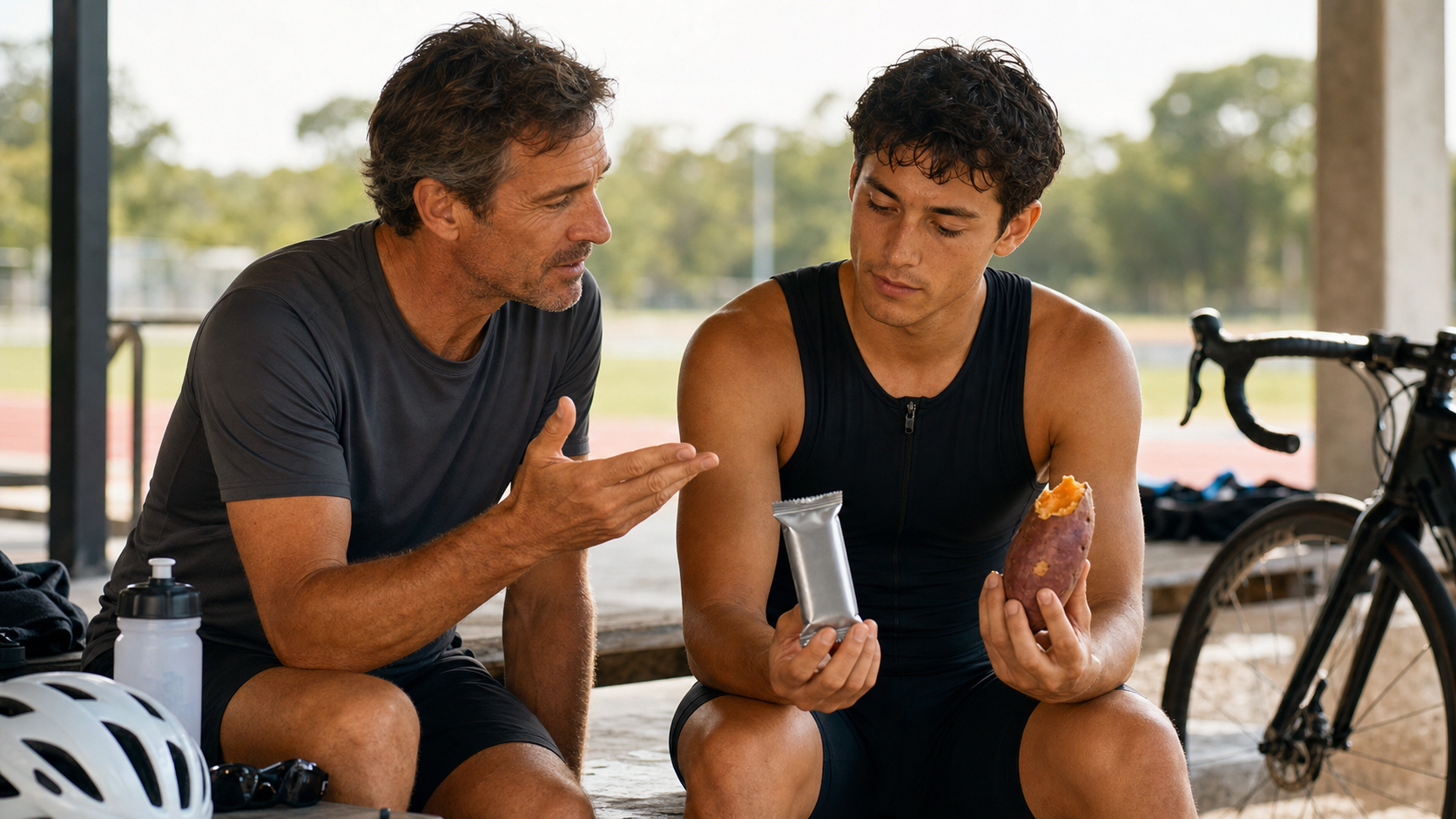
Starting with an Energy Bar
After a training camp one day, Xiao Lin, an amateur triathlete who had been training with me for two years, came up to me looking confused, holding two things in his hands. In his left hand was an energy bar plastered with nutrition labels, touting “high protein, low GI, functional” benefits; in his right hand was a sweet potato his grandmother had just boiled. He asked me: “Coach, the internet says processed foods are deadly. So are the energy gels, sports drinks, and energy bars I eat during races just slow-motion suicide? Should I switch everything to sweet potatoes and rice?”
I laughed. I’ve been asked this question probably a hundred times over the past 15 years, from office workers just starting cycling to lose weight, to marathon runners preparing to break three hours. It reflects a very common—but also very dangerous—misconception: treating the word “processed” as a black-and-white moral judgment.
My answer usually makes them pause for a second: “Xiao Lin, when you’re 160 kilometers into a race, your heart rate is spiking at 170 bpm, and your stomach has already started to shut down, I’m not going to tell you to pull over and gnaw on a sweet potato. That one energy gel might be the difference between finishing safely and passing out from hypoglycemia on the side of the road. But if you’re at the office on a normal day, downing three sugary drinks and two bags of chips for an afternoon snack, that’s what’s really stealing your health and performance.”
For athletes, processed food has never been a question of “can I eat it or not,” but rather “when do I eat it, which kind do I eat, and what’s the trade-off?” In this article, I want to use my real experience coaching athletes to help you think this through completely.
First, Understand: How Many Levels of Processing Are There?
To talk about trade-offs, you first need a measuring stick. The most widely cited classification system internationally is the NOVA classification system, proposed by a team from the University of São Paulo in Brazil in 2010. It doesn’t look at calories or nutrients, but rather at “the extent to which food has been industrially processed.” This angle is especially useful for athletes because it forces you to think: how far is this bite from its original form?
NOVA divides all foods into four groups:
Group 1: Unprocessed or Minimally Processed Foods
This is the group closest to their original form, such as fresh fruits and vegetables, raw meat, eggs, milk, brown rice, oats, and raw nuts. They only undergo treatments that “don’t change their nature,” like washing, drying, freezing, or simple cutting. This is the foundation of an athlete’s dietary pyramid—80 to 90 percent of daily calories should come from here.
Group 2: Processed Culinary Ingredients
Things like oil, salt, sugar, and butter. These are extracted from Group 1 foods and used for seasoning or cooking. You wouldn’t eat them by the spoonful on their own; you use them to make Group 1 foods taste better. Using them in moderation is completely fine.
Group 3: Processed Foods
Combining Group 1 with Group 2 to make things that are preserved and ready to eat. Examples include: canned tuna, salted or smoked meats, cheese, traditionally handmade bread, candied fruits, and pickles. This group is actually “thousands of years of human wisdom”—the key is that the ingredient list is usually still readable, with not too many components.
Group 4: Ultra-Processed Foods (UPF)
This is what the nutrition world is really keeping an eye on these days. They are “industrial formula products,” made primarily or entirely from food extracts, modified starches, hydrogenated oils, plus a long list of additives you can’t pronounce (emulsifiers, colorings, flavorings, artificial sweeteners, thickeners), with almost no intact whole foods visible. Typical examples: sugary carbonated drinks, packaged snacks, mass-produced commercial breads and cakes, ice cream, candy, reformed meat products, instant microwave meals, and most packaged desserts.
The table below is the first “map” I give to every new athlete.
| NOVA Group | Plain-Language Definition | Common Examples (Taiwan Context) | Athlete’s Attitude |
|---|---|---|---|
| Group 1 | Almost the food in its original form | Sweet potato, banana, chicken breast, eggs, rice, oats, lettuce | Fill 70-80% of the plate, the more the better |
| Group 2 | Ingredients for cooking/seasoning | Camellia oil, salt, honey, sugar | Use in moderation, don’t make them the star |
| Group 3 | Traditional processing, readable ingredients | Canned tuna, traditional tofu, cheese, canned corn | Pair sensibly, very practical |
| Group 4 | Industrial formulas, long list of additives | Sugary drinks, chips, commercial pineapple buns, microwave bento boxes, energy gels | Depends on the situation—mostly limit, a few are tools during races |
Note the key phrase in the last cell: depends on the situation. Energy gels are also Group 4, but their role is worlds apart from chips. This is the core of how athletes should think about processed foods—it’s not about good versus bad, it’s about purpose.
The Science: What Are We Actually Afraid of with Ultra-Processed Foods?
Some might say: “Isn’t it just a few extra additives? Is it really that serious?” We need to be clear first: the current evidence is overwhelmingly from observational studies, which can show “associations,” but proving “causation” requires more experiments. So I’ll keep my language conservative here, and I’d also advise you to stay skeptical of any claim like “eating X food will give you Y disease.”
But even with that caveat, the accumulated direction of the evidence is still worth taking seriously for athletes.
The Cardiovascular Association
A large prospective study published in the BMJ in 2019, based on the French NutriNet-Santé cohort (over 100,000 adults, followed for several years), found that higher intake of ultra-processed foods was associated with an increased risk of overall cardiovascular disease, coronary heart disease, and cerebrovascular disease. Subsequent systematic reviews and meta-analyses across multiple countries and cohorts have largely pointed in the same direction: the more ultra-processed foods you eat, the higher the tendency toward cardiovascular and cerebrovascular events. For anyone pursuing a long athletic career, this is a signal that’s hard to ignore.
I want to emphasize my conservative stance again: these are population-level associations, telling us that “a group of people who eat a lot of ultra-processed foods tends to have higher long-term cardiovascular risk,” which does not mean “eating one energy bar today will do anything to you.” Moreover, these studies struggle to fully rule out interference from other lifestyle habits (people who love ultra-processed foods may also exercise less, or have different smoking and drinking patterns). So please don’t read this as a scare tactic, but rather as a steering wheel pointing “toward a direction worth adjusting for the better.” I’d rather you eat less long-term out of understanding than go to extremes short-term out of panic.
Why Is That? A Few Plausible Mechanisms
Here’s the key point—the problem may not just be “additives are toxic,” but more likely that the overall design of ultra-processed foods is working against you:
- High energy density, low satiety: These foods are usually fragrant, soft, and easy to eat, making you unconsciously consume way too many calories without feeling full, which easily leads to weight and body fat getting out of control. For climbers who need to manage their weight, this is a silent killer.
- Fiber and micronutrients stripped away: The fiber, vitamins, minerals, and phytochemicals in whole foods are largely lost during industrial processing, replaced by refined starches and added sugars. Your gut microbiome won’t be happy.
- Excess sodium, added sugar, and poor-quality fats: Long-term high sodium is linked to blood pressure, and high sugar to metabolic burden—both unfavorable for an athletic population that already needs to look after their cardiovascular system.
- Eating too fast, blood sugar on a roller coaster: Easily digestible refined carbs spike blood sugar quickly and then drop it just as fast. Outside of race situations, these fluctuations leave you drowsy and more prone to cravings.
You might notice a paradox here: all these “downsides” above—easy to eat, high energy density, rapid blood sugar spikes—at a certain moment during a race, happen to all become advantages. This is the biggest difference between athletes and the general population.
Two Things Athletes Must Pay Special Attention To: Gut Health and Immunity
For the general population, the effects of ultra-processed foods are chronic and long-term. But for athletes with high training volumes, there are two “more immediate” considerations that I specifically remind serious students about.
The first is gut health. Prolonged endurance exercise itself shifts blood flow away from the gastrointestinal tract toward the muscles, causing relative gut ischemia and a temporary decline in barrier function (which is why many people get stomach issues during marathons). If your daily diet is also chronically lacking in fiber and diverse plant foods, and is dominated by ultra-processed foods, the diversity of your gut microbiome may be compromised. Over time, your digestive system becomes more prone to issues under high intensity. Eating more whole fruits and vegetables, whole grains, and fermented foods (like unsweetened yogurt or naturally fermented kimchi) is like buying insurance for your race-day stomach.
The second is immunity and recovery. Athletes with high-intensity, high-volume training are already under relative immune stress, and are particularly susceptible to colds after a major race or a peak training week. The vitamins, minerals, and polyphenol phytonutrients in whole foods are the raw materials that support immunity and anti-inflammatory recovery. Filling up on ultra-processed foods long-term means that when your body most needs repair materials, it’s receiving empty calories instead. For those who want to progress long-term while getting injured and sick less often, this is a very real trade-off.
I often remind my students: Training is making withdrawals from your body; diet and sleep are making deposits. If you use ultra-processed foods as your deposits, your account balance may look like it has numbers, but the actual purchasing power is very low. And the paradox is that these same “drawbacks” can completely flip into advantages the moment a race begins—which is exactly the core of what I’ll discuss next.
The Athlete’s Trade-off: One Food, Two Identities
I often tell my students: “An energy gel on your living room couch is junk food; at kilometer 100 of your race, it’s a lifesaver.” The context determines its identity.
Scenario One: High-Intensity, Long-Duration Races or Training
When you exercise continuously for more than 60-90 minutes, your body’s glycogen depletes rapidly, and “fast, easily absorbed carbohydrates” become a necessity. Sports physiology research generally recommends supplementing about 30-60 grams of carbohydrates per hour during prolonged endurance exercise (and even higher for ultra-endurance athletes who have trained their guts). In this situation, what you need is precisely—something easy to digest, light on the stomach, quick to raise blood sugar, and convenient to carry.
At this point, energy gels, sports drinks, and energy chews—those “Group Four” foods—are actually the most ideal tools. Whole sweet potatoes or brown rice become a burden here: too heavy on the stomach, too slow to digest, and you simply can’t chew or don’t want to chew during a race.
This is called “functional use of ultra-processed foods”—it’s smart, not a downfall.
Scenario Two: Daily Life and Regular Training Days
This is where your long-term health and body composition are truly decided. In a 24-hour day, you’re actually racing or training at high intensity for maybe 1-2 hours. How you eat during the other 22 hours is what really makes the difference.
My principle here is simple: In daily life, lean as much as possible toward Group One, and treat Group Four as the exception rather than the norm.
The table below is the framework I use to help students distinguish between “when convenience is appropriate” and “when to return to whole foods”:
| Scenario | Physiological Need | Recommended Choice | Rationale |
|---|---|---|---|
| Meal 3-4 hours before race | Top off glycogen, easy digestion | White rice/noodles + lean meat + low fiber, may include small amounts of processed items | Aim for steady energy, not fiber |
| Hourly fueling during race | Fast carbs 30-60g | Energy gels, sports drinks, chews (Group Four) | Easily absorbed, light on stomach, functional use |
| 30-60 minutes post-race | Replenish carbs + protein | Chocolate milk, rice balls, banana + whey | Accelerate recovery, convenience acceptable |
| Regular training day meals | Comprehensive nutrition, body fat control | Prioritize Groups One to Three | Foundation for long-term health |
| Late-night cravings / binge-watching | Purely wanting to eat | This is where you must hold the line—swap for fruit/unsweetened yogurt/nuts | Group Four here is purely a cost |
Once you understand this table, you’ve grasped the essence: It’s about context, not about good vs. evil.
The Taiwan Context: The Real Battlefield for Those Who Eat Out
It’s easy to talk about principles, but the reality in Taiwan is—we are a nation of people who eat out. Over 90% of my students eat at least one meal out per day, and many eat all their meals out. Telling them to “eat more whole foods” without providing practical, actionable methods is pointless. So I’ve turned common Taiwanese eating-out scenarios into an “upgrade guide.”
Convenience Stores: An Athlete’s Supply Station, and Also a Trap
Taiwan’s convenience store density is among the world’s highest, which is actually a blessing for athletes—as long as you know how to choose.
- Good choices: Tea eggs, sweet potatoes, unsweetened soy milk, boiled egg salad, plain yogurt, bananas, unseasoned nuts, onigiri (relatively simple).
- Limit: Sugary hand-shaken drinks and bottled beverages, potato chips, chocolate bars, large iced drinks, sugary breads and pastries.
- Coach’s tip: Decide what you’re going to grab before entering the store, head straight to that section, and don’t “browse” in front of the snack shelves. Browsing is how the loss begins.
Buffet Restaurants and Bento Shops: Your Best Allies
I highly recommend students make good use of Taiwan’s buffet restaurants (自助餐). Because you can choose for yourself—three vegetable portions with one non-fried protein (braised chicken leg, steamed fish, braised egg, tofu), and a moderate amount of white rice, makes for a very solid Group One to Three meal. Compared to convenient but highly processed microwave bentos, buffets give you the control.
Hand-Shaken Drinks: The Hardest Group Four to Quit for Taiwanese People
Honestly, this is the battlefield where I most often clash with students. I won’t tell you to quit entirely (that’s too inhumane and won’t last), but I will use the “downgrade method”:
- Full sugar → Half sugar → Light sugar → No sugar
- One cup daily → Two or three cups per week → A reward after training
- Large cup → Medium cup
The added sugar in one full-sugar hand-shaken drink often exceeds your entire daily sugar limit. Downgrading it from “daily habit” back to “occasional treat”—just this one move—I’ve seen students lose 2-3 kg of body fat in three months and see clear improvements in their power-to-weight ratio on climbs.
A Supplementary Note on Taiwan’s Climate
Taiwan is hot and humid. In summer, cycling or running causes heavy sweating and rapid electrolyte loss. Here, “sports drinks”—that Group Four product—actually have their role: during prolonged exercise in high heat, moderate supplementation with sodium-containing sports drinks helps maintain fluid and electrolyte balance. You don’t need to drink only plain water just to “reject processed foods,” as that could actually increase the risk of hyponatremia. This proves again: context determines everything.
Make Good Use of National Health Insurance and Regular Checkups to Catch Warning Signs Early
Taiwan has a resource that foreign athletes envy: a relatively accessible and affordable health checkup and medical environment. I always encourage serious training students to get basic blood tests regularly—fasting blood glucose, blood lipids (total cholesterol, LDL, triglycerides), and blood pressure. These are all covered by adult preventive health checkups or self-paid checkups. These numbers are the most honest report card of your long-term eating habits.
Many people assume “I exercise and I’m lean, so my numbers must be great.” But I’ve seen plenty of students who look fit, yet have red flags on their blood lipids or blood sugar due to long-term high-sodium, high-sugar, high-fat eating out. Exercise is not a get-out-of-jail-free card; the numbers speak for themselves. When a checkup report shows red flags, that’s not a reason to panic—it’s a clear, inexpensive, and early reminder that it’s time to adjust your dietary structure. And—this is important—any red flag should be discussed with a doctor or nutritionist with the report in hand, rather than self-diagnosing by comparing online. Taiwan’s healthcare is convenient; use it.
A Simple Framework for a Weekly Diet
Students often want me to give them a “just follow this” framework. Diet is highly individual, and I don’t like rigid meal plans, but I can give you an easy-to-remember proportional principle that works even in Taiwan’s eating-out environment:
| Aspect | Core Principle | Taiwan Implementation |
|---|---|---|
| Composition of each meal | Half plate vegetables, one palm of protein, one fist of whole grains | Buffet: three vegetable portions + braised chicken leg + moderate white rice |
| Beverages | Default to unsweetened | Unsweetened tea / black coffee / water; downgrade hand-shaken drinks |
| Processed food ratio | 80% whole foods, 20% flexibility | Reserve Group Four for race fueling and occasional treats |
| Post-training | Fuel with purpose | Chocolate milk + rice ball, not fried chicken and bubble tea |
| Snack backup plan | Prepare alternatives in advance | Keep unsweetened yogurt, fruit, and plain nuts at home |
This table doesn’t pursue perfection; it pursues sustainability. A 70-point diet you can maintain for five years far surpasses a 100-point meal plan you’ll abandon after two weeks.
Reading the Ingredient List: Those Unfamiliar Names
My students often tell me: “Coach, I can’t read the ingredient list. Those names look like they’re straight out of a chemistry textbook.” The truth is, you don’t need to understand everything—just recognize a few “signal words commonly found in ultra-processed foods,” and you can quickly gauge how processed what you’re holding actually is. I’ve put together the comparison table below. Take a photo of it and check it against labels the next time you’re at the convenience store.
| Ingredient List Signal Word | What It Usually Is | Why Athletes Should Care |
|---|---|---|
| High-fructose corn syrup, glucose syrup | Cheap liquid added sugar | Spikes blood sugar quickly; daily overconsumption is linked to metabolic burden |
| Hydrogenated/partially hydrogenated vegetable oil | Cheap solid fat | May contain trans fats, associated with cardiovascular risk |
| Various “gums” (guar gum, xanthan gum) | Thickeners, emulsifiers, texture improvers | Mostly legal on their own, but often an indicator of a “highly formulated” product |
| A long string of codes, flavorings, colorings | Make the product look good, taste good, and last longer | The more there are, the further it is from whole food |
| Isolated soy protein, hydrolyzed protein | Industrialized protein sources | Common in protein bars/functional drinks—not inherently bad, but recognize it’s a formulated food |
I teach my students an incredibly simple test—no chemistry memorization required: Read the ingredient list from start to finish. If more than half of the items are things “your grandmother wouldn’t have in her kitchen,” it’s probably Group 4. This “Grandma’s Kitchen Test” sounds folksy, but it’s surprisingly accurate, and you can do it in ten seconds standing in the convenience store aisle.
Race Day Nutrition Timeline: A Table to Carry With You
Many students ask me what exactly they should eat and when on race day. This is precisely the scenario where “functional use of ultra-processed foods” requires the most careful calculation. Using a roughly 4–5 hour long-distance cycling race or a half-distance triathlon as an example, I’ve put together a timeline. Please note: the actual numbers need to be adjusted based on your body weight, intensity, temperature, and gut tolerance. What’s given here is a range, not gospel.
| Time Point | Goal | Suggested Intake | Processing Level Mindset |
|---|---|---|---|
| Night before race | Top off glycogen, sleep well | White rice/noodles + easily digestible protein, low fat, low fiber | Mostly whole foods, avoid bloating |
| 3 hours before race | Steady energy supply | Toast + jam, banana, rice ball | Prioritize easy digestion; small amounts of processed food are fine |
| 15 minutes before race | Quick energy on the spot | One energy gel or half a banana | Functional use of Group 4 |
| Every 30–45 minutes | Maintain blood sugar | Energy gel/chews, with water | Group 4 is a tool at this moment |
| Every hour | Electrolytes + fluids | Sodium-containing sports drink | A reasonable choice in high heat |
| 30–60 minutes after finish | Kickstart recovery | Chocolate milk, rice ball + whey protein | Convenient but with a clear purpose |
The soul of this table is this: On race day, your attitude toward Group 4 foods must switch from “restraint” to “precise use.” On a normal day, you avoid energy gels; on race day, they’re your teammate. This ability to “switch roles depending on the situation” is the hallmark of a mature athlete.
Another Case Study: The Climber Stuck at a Body Fat Plateau
Let me share another student’s story. A-Jhe is a climbing-focused cyclist who loves Wuling and Fengguizui. He trains a lot—over 200 km a week—but his body fat was stuck around 20%, refusing to budge. His power-to-weight ratio on climbs wasn’t improving, and he was frustrated.
The first thing I asked him to do wasn’t to add more training volume, but to photograph everything he ate for seven straight days. The picture was clear: his main meals were actually fine. The problem was his “post-training rewards” and “late-night cravings.” After every long ride, he’d think, “I rode so hard, I deserve a treat,” and that meant a serving of Taiwanese fried chicken plus a full-sugar bubble tea. Then he’d watch TV at night with a bag of potato chips. He was using “I work out” as a get-out-of-jail-free card, shoveling large amounts of Group 4 foods into his mouth.
I didn’t tell him to quit cold turkey. I only made two adjustments: his post-training reward became “purposeful fueling”—chocolate milk with a rice ball, still satisfying, but serving recovery. His late-night craving became plain yogurt with some fruit or a small handful of nuts. Just over three months later, his body fat dropped to 15%, and his personal best time up Wuling improved by over ten minutes. He said himself: “I thought I needed to train even harder. Turns out I just needed to change what I rewarded myself with.”
I love telling this story because it shatters the most common myth among athletes: It’s not about using willpower to eat less; it’s about making smart swaps. Replacing Group 4 rewards with choices that are equally satisfying but closer to whole foods or more purposeful can have a staggering cumulative effect.
Quick Q&A: The Questions Students Ask Most Often
Q: Are diet drinks ultra-processed? Can I drink them?
Yes, they are. Zero-calorie cola and sugar-free functional beverages are standard Group 4 formulated products. However, compared to their full-sugar versions, they at least don’t carry the burden of large amounts of added sugar. My stance is: drinking them occasionally, as a transitional tool during sugar withdrawal, is fine—but don’t treat them like water, and don’t assume “zero calories” equals “healthy.” The long-term effects of heavy artificial sweetener consumption on gut microbiota and appetite are still being researched, so I remain cautious in my language.
Q: Are whole wheat bread and products labeled “high fiber” automatically better?
Not necessarily. Many commercially sold “whole wheat” or “high fiber” breads are still ultra-processed formulations at their core—they’ve just had some wheat bran or fiber powder added for marketing purposes. The way to judge is to go back to the ingredient list—fresh bread from a traditional bakery with a simple ingredient list will be closer to what you want than a “functional bread” with fancy packaging and a long list of additives.
Q: I’m really busy and genuinely don’t have time to cook. What do I do?
This is the reality for many Taiwanese office workers, and I completely understand. The point isn’t “you must cook for yourself,” but rather “make better choices within your eating-out options.” The principles for choosing at buffet restaurants and convenience stores I mentioned earlier are designed exactly for busy people like you. You don’t need to be perfect—you just need to tip the balance a little more toward whole foods at every meal. It adds up to a huge difference.
Q: Will eating too many energy gels harm me?
When used “in the right situations and the right amounts,” energy gels are safe and effective sports nutrition. The problem has never been the gel itself—it’s people treating them as everyday snacks. That’s the abuse. Stick to the principle of “only use during prolonged, high-intensity exercise,” and they remain a tool, not a burden.
Q: Do these principles apply to children and the elderly?
The general direction applies (more whole foods, fewer ultra-processed foods), but the dosages and fueling strategies are designed for athletic contexts and cannot be directly applied to growing children or elderly individuals with chronic conditions. For dietary adjustments in these groups—especially when disease is involved—it’s essential to have a physician or dietitian assess them individually.
Common Mistakes and Corrections
Over the years, I’ve seen all kinds of “overcorrection” and “self-soothing.” Here are the most common ones to help you avoid the pitfalls.
Mistake 1: Demonizing All “Processing”
After attending a health lecture, one student went home and threw away all the canned goods, cheese, and yogurt, and was even afraid to bring energy gels to races. The result: he hit hypoglycemia mid-race and nearly had a serious incident.
Correction: Remember that NOVA has four groups. What you really need to watch is the “daily overuse” within Group 4, not all processing. Group 3 (traditional processing) includes many helpful foods, and Group 4 has its place in race situations too.
Mistake 2: Falling for “Health Marketing” Hype
Just because the packaging says “high protein,” “zero fat,” “natural,” “functional,” or “no added sucrose” doesn’t mean it isn’t ultra-processed. Many so-called healthy energy bars, protein cookies, and functional drinks have a long list of additives on the back label.
Correction: Develop the habit of reading ingredient lists. The shorter the ingredient list and the more recognizable the words, the safer it usually is. This is the most practical tip I give my students: you don’t need to memorize nutrition science—just ask yourself, “Do I have these ingredients in my kitchen?”
Mistake 3: Using “I Work Out” as a Get-Out-of-Jail-Free Card
“I rode 60 km today, so eating fried chicken with bubble tea tonight will balance it out!”—I’ve heard this sentence more times than I care to count. Exercise does increase your calorie budget, but it cannot cancel out the long-term effects of ultra-processed foods on blood lipids, blood pressure, and gut microbiota. Athletes are not detoxifiers for junk food.
Correction: Post-exercise fueling should be “purposeful”—replenishing carbs and protein to aid recovery, not serving as an “excuse to indulge.” Treats are fine, but not every day.
Mistake 4: Switching Nutrition Products Randomly Around Race Time
One athlete had been training with a certain brand of energy gel with no issues. On race day, he saw others using a different brand and switched on a whim. The result: stomach cramps, diarrhea, and a ruined performance.
Correction: Any nutrition you plan to use in a race must be tested during training first (this is called “gut training”). Your digestive system needs to adapt. Race day is not experiment day.
Actionable Advice for Readers of Different Levels
Now that the principles are explained, the most important thing is “what you can do today.” Here are different starting points based on three common levels of experience.
For Beginners Just Starting to Exercise and Wanting to Get Healthier
You don’t need to do everything at once. Just start with these three things:
- Change one thing first: Swap your daily sugary drinks for unsweetened tea or water. The benefit of this single step is often greater than you think.
- Upgrade your breakfast: Replace your sugary bread and milk tea with unsweetened soy milk, a tea egg, and a banana.
- Learn to read ingredient labels: Before buying any packaged food, flip it over and take a look. You don’t need to understand it yet—just start looking.
A special note for beginners: Don’t try to change everything at once, and don’t chase perfection. I’ve seen too many people start with grand ambitions, turning their diet into something resembling an ascetic’s regimen, only to fall completely off the wagon two weeks later, feel intense guilt, and eventually give up altogether. Exercise and diet are both marathons, not sprints. First, consistently nail the easiest, highest-impact change (usually giving up sugary drinks), and once it becomes a habit, add the next one. Slow and steady wins the race.
For Intermediate Athletes with Regular Training
You already have a foundation. The key is to “distinguish between different situations”:
- The 80/20 rule for daily life: Let 80% of your diet come from food groups one through three, and leave 20% flexibility for the fourth group you love, without guilt.
- Establish a race nutrition SOP: Test your energy gel/drink brands and timing during training, then follow the plan on race day—don’t switch things up at the last minute.
- Have a strategy for post-race nutrition: Within the golden recovery window (about 30–60 minutes), consume carbs + protein. Choose options like chocolate milk or rice balls with whey protein—“convenient but purposeful” choices.
- Review yourself with numbers every quarter: Combined with the regular health checkups mentioned earlier, compare your dietary adjustments against changes in blood lipids, blood sugar, and body fat. You’ll be more confident that you’re on the right track, and it’ll be easier to stay consistent.
For Advanced Athletes Pursuing Performance
Every detail affects your performance:
- Periodized nutrition: On high-intensity training days and race days, functionally use fast-acting carbs (including group-four supplements); on low-intensity days and recovery days, return to high-fiber, nutrient-dense whole foods to let your body repair and adapt.
- Gut training: If your race requires a higher carbohydrate intake per hour (60g or more), progressively train your gastrointestinal tolerance during regular training.
- Sleep and overall stress count too: Diet is just one part of recovery. Don’t obsess over “eating perfectly” to the point of anxiety—long-term sustainability is what truly matters. Being overly fixated on dietary purity can actually develop into an unhealthy psychological burden (there are indeed people in the sports community who have developed disordered eating tendencies this way), and in that case, you must seek professional help. True elite athletes find a balance between “good enough nutrition” and “mental health,” rather than pushing themselves to extremes. Remember: a dietary strategy that can accompany you for ten or twenty years is one that has flexibility, a human touch, and preserves the joy of life.
One Athlete’s Transformation
Let’s return to Xiao Lin from the beginning. In the end, I didn’t tell him to throw away his energy gels, nor did I tell him to cut out all processed foods. I only asked him to do two things: lean toward whole foods as much as possible in his daily meals, and reduce his bubble tea from full sugar to low sugar with smaller portions. His race nutrition remained unchanged—in fact, he trained his gut even more systematically.
Three months later, his body fat dropped from 18% to 14%. At a 113km half-distance triathlon, the gastrointestinal discomfort he used to feel after the swim was gone, and he could hold his pace through the final 10km run. He told me: “Coach, it turns out the point isn’t processed versus unprocessed—it’s that I finally understand when to be convenient and when to be particular.”
That statement captures everything I wanted to convey in this article.
Conclusion: Convenience Itself Isn’t the Sin—Mindlessness Is
Processed foods—especially ultra-processed foods—do come with a cost. When you unconsciously consume large amounts of sugary drinks, packaged snacks, and microwave meals every day, that cost accumulates bit by bit into a debt against your health and performance. But that same cost can be transformed into a tool that helps you finish races safely and recover faster when you use convenient nutrition “consciously and purposefully.”
The difference has never been in the food itself, but in the mind that uses it. What athletes should pursue isn’t a puritanical rejection of all processing, but rather becoming a smart user who “knows what they’re doing.” Convenience itself is never the sin—letting convenience unconsciously dictate every meal is the real cost. Take the choice back into your own hands, and you buy back both your health and your performance.
Next time you’re holding an energy gel in one hand and a sweet potato in the other, don’t ask “which is healthier.” Instead, ask yourself: “What situation am I in right now? What does my body need at this moment?” Once you’ve figured that out, that pack of convenience in your hand is no longer a cost—it’s your teammate. This is the most practical lesson my fifteen years of coaching experience has taught me, and the one I most want to pass on to you. May every choice you make bring you one step closer to your goals.
This article is for educational purposes and cannot replace individual diagnosis and treatment advice from a physician, physical therapist, or nutritionist. If you have diabetes, hypertension, heart disease, or other chronic conditions, please consult your doctor or nutritionist for a personalized assessment before making dietary changes. Do not apply general principles on your own.
References
- NOVA Food Classification System (definitions of the four groups and examples of ultra-processed foods): https://www.britannica.com/topic/Nova-scale
- Ultra-processed foods and cardiovascular disease risk (NutriNet-Santé cohort, BMJ 2019 related summary): https://usrtk.org/ultra-processed-foods/cardiovascular-disease/
- Systematic review and meta-analysis of ultra-processed foods and cardiocerebrovascular diseases: https://www.nmcd-journal.com/article/S0939-4753(23)00274-0/fulltext
Related Reading
- Nuts and Seeds: Healthy Fats for Athletes—Nutrient Density, Portion Control, and Smart Choices
- Energy Gels and Bars Explained: A Complete Guide to Ingredients, Selection Logic, and DIY Recipes
- Athlete Snack Strategies: Smart Snacking Between Training Sessions—Making Snacks Your Second Training Partner
- Should Athletes Take Supplements? A Decision-Making Framework to Stop Wasting Money
CT暗黑廚房) 車友必備 宇宙無敵鮮蚵湯 幫助訓練恢復 天然食補 好市多 超肥鮮蚵 破PR
7 年前
2021 96聯賽 桃園市長盃 4K多視角實況 當天選手瓦數/推力比/均速/時間 即時數據分析 | 公路車 | CT Yeh
5 年前
Nepest NOVA 碳條輪組:輕量、空力、舒適一次滿足!/ 公路車 / CT Yeh
7 個月前
一日北高/長距離團騎 常見問題補充篇 / 組團或跟團的眉角 / 壯車友容易被瘦車友慢性拉爆 / 原來屁股痛可能是這個原因...? / 風場配速法 / 公路車 / CT Yeh
2 年前
靠單車減肥35公斤 心得分享與整理
7 年前
單車 一日北高 ( 雙城 ) 肥宅雙人瘋狂行 紀錄片 REACTO
10 年前
一個測試有沒有認真練車的方法😂 #公路車
10 個月前
西進武嶺 免費訓練分析服務 Intervals | 練不夠還是練過頭?你哪一種類型選手?AI模型告訴你! | 備戰神器 | 公路車 訓練 | CT Yeh
4 年前