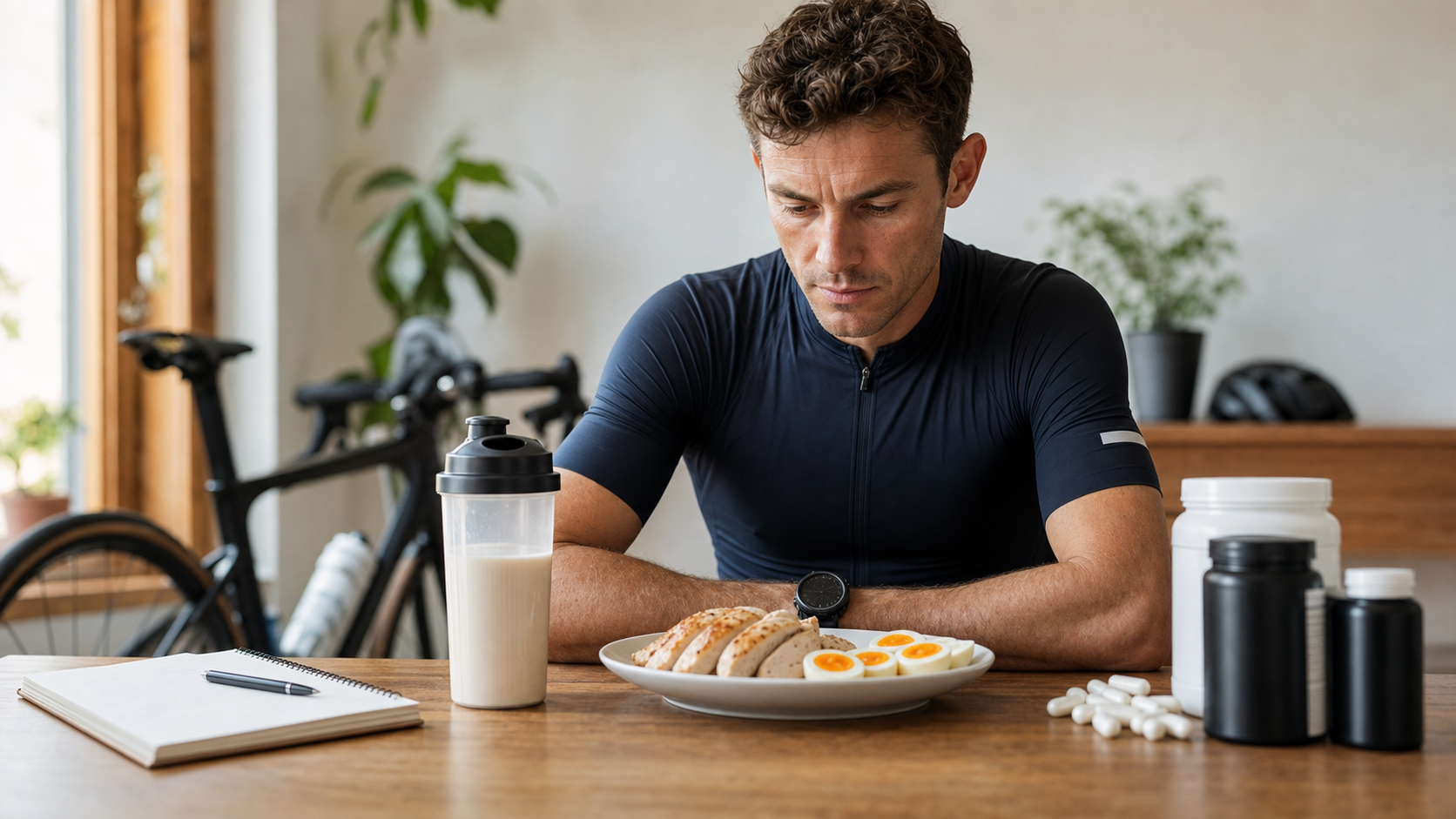
Starting from a Rider’s Drawer
A few years ago, I coached an amateur mountain biker—let’s call him A-Qi. Once, I went to his place to help adjust his training plan. He opened a drawer that held five or six jars of BCAA in different flavors, two tubs of “amino acid energy powder” with English labels, and a jar of branched-chain amino acid capsules that had already clumped up. He said proudly, “Coach, I take these before and after every ride. I feel like my muscles don’t get as sore.” I asked him, “So how much protein do you eat in a normal day?” He froze for a second and said, “No idea. Anyway, with all this supplementation, that should be enough, right?”
At that moment, I knew exactly what was going on. A-Qi’s problem wasn’t a lack of effort—it was that he was putting his resources in the wrong place. The money he spent on BCAA every month could have bought two or three kilograms of whey protein, or even better—several extra chicken breast meal boxes. I’ve seen this scenario far too many times in Taiwan’s cycling circles, gyms, and running clubs. The three letters “BCAA” have almost become a religion, but very few people actually stop to ask: Does it really work? Where does it apply? And how is it different from EAA (complete essential amino acids), which is getting more attention these days?
In this article, I want to explain amino acid supplementation from the perspective of someone who coaches athletes. This isn’t about telling you to throw away your BCAA entirely—it’s about understanding what your body actually needs before you spend money or plan your nutrition. I’ll try to explain the science in plain language and give you tables and recommendations you can follow directly. One thing before we start: I’ve included source URLs for the studies cited at the end of the article, and I’ll give ranges rather than pretending to be overly precise, because when it comes to amino acids, “getting the big picture right” matters far more than “having pretty decimals.”
First, Get the Terms Straight: Who’s Who Among BCAA, EAA, and Complete Protein
Many people start buying before they even distinguish the terms—that’s the first thing to fix.
Human protein is made up of twenty amino acids. Nine of them are essential amino acids (EAA), meaning the body cannot synthesize them on its own and they must come from food. These nine are: leucine, isoleucine, valine, lysine, methionine, phenylalanine, threonine, tryptophan, and histidine.
Branched-chain amino acids (BCAA), on the other hand, are just three of those nine essential amino acids—leucine, isoleucine, and valine. They get their name from the “branched chain” in their molecular structure, and commercial products commonly use a 2:1:1 ratio (leucine:isoleucine:valine).
In other words, here’s the relationship among the three in one sentence:
BCAA is a subset of EAA (3 out of 9), while complete protein (e.g., whey, eggs, chicken breast) provides all nine essential amino acids plus other non-essential ones.
This “3 vs. 9” relationship is the key to understanding everything that follows. Think of muscle protein synthesis like building a house: leucine is the foreman who shouts “start work”—important, no doubt. But if the foreman shouts and there are no bricks, rebar, or cement (the other six essential amino acids) on site, the house still won’t get built.
A Table to See the Differences at a Glance
| Item | BCAA | EAA (Complete Essential Amino Acids) | Complete Protein (Whey/Food) |
|---|---|---|---|
| Which amino acids it contains | 3 types (leucine/isoleucine/valine) | 9 essential amino acids | 9 essential + 11 non-essential |
| Can it “trigger” the muscle synthesis signal | Yes (via leucine) | Yes | Yes |
| Can it “sustain” and complete muscle synthesis | No—lacks raw materials | Yes | Yes, and most complete |
| Typical protein content per serving | Nearly zero (free-form amino acids) | Nearly zero to small amounts | About 20–30 g per serving |
| Relative cost | Medium to high | High | Low to medium—best value |
| Additional benefits | Easy to consume, has flavor | More complete | Provides calories, satiety, micronutrients |
(For the “typical protein content per serving” row above, a serving of complete protein contains about 20–30 g of protein—that’s the source that actually provides the “building materials.”)
The Science: Why BCAA Alone Means “The Signal Is There, But the House Isn’t Built”
This is the most central section of the entire article, and the one where your mindset most needs updating. Please read it patiently, because it determines whether you should keep spending that money.
Leucine Is the “Switch,” Not the “Building Material”
Over the past two decades, BCAA exploded in popularity because scientists discovered that leucine strongly activates a cellular signaling pathway called mTOR. Once this pathway is switched on, it’s like telling muscle cells: “Start synthesizing protein!” This finding itself isn’t wrong—leucine is indeed one of the most critical triggers for initiating muscle protein synthesis (MPS).
The problem is that research over the following decade-plus gradually clarified one thing: a signal being switched on doesn’t mean muscle is actually being built. You can ring the doorbell (leucine activating mTOR), but if no one’s home and there are no materials, the door still won’t open. Muscle synthesis requires all nine essential amino acids as “bricks”—if any one is missing, the synthesis rate gets stuck.
What the Research Says
This isn’t just my personal opinion—it’s a fairly consistent conclusion in the sports nutrition field over the past decade.
A 2017 review article by Wolfe, published in the Journal of the International Society of Sports Nutrition, systematically examined all the evidence on BCAA and concluded: supplementing BCAA alone cannot promote maximal muscle protein synthesis in humans, nor can it produce a complete synthetic response. The reason is precisely the lack of other essential amino acids as raw materials—the body can only barely manage using its existing internal amino acid pool, and it cannot sustain the process (source at the end of the article).
The Gatorade Sports Science Institute (GSSI) has also published articles with a similar view: without other essential amino acids consumed alongside, BCAA can activate the molecular-level synthesis signal, but because only endogenous (pre-existing) amino acids are available as materials, the response is limited and cannot sustain maximal synthesis. And without a “sustained” muscle synthesis stimulus, the physiological value is very limited.
King’s College London has also released research news with a very plain-spoken headline: BCAA supplements are not the most effective supplement form for stimulating muscle growth. Because taking BCAA alone does not promote muscle synthesis better than consuming a serving of high-quality protein containing complete essential amino acids.
To distill all this research into one sentence a coach would say to an athlete:
“When you spend money on BCAA, it’s like only ringing the doorbell without delivering the bricks to the construction site. To build the house, you need complete protein or at least complete EAA.”
What About EAA? Is EAA Necessarily Better?
Because EAA contains all nine essential amino acids, it can theoretically support a more complete muscle synthesis response than BCAA alone. Multiple studies show that supplementing with complete EAA stimulates muscle synthesis in both young and older adults, while the response to BCAA alone is more limited and less sustained.
But here I want to give an important practical reminder: for most Taiwanese cyclists who eat a normal diet and get enough protein, the necessity of EAA supplements isn’t as high as manufacturers claim. Because all you need is a serving of whey, a tea egg, or a piece of chicken breast, and you’ve already consumed all nine essential amino acids along with a bunch of other nutrients—and it’s cheaper, more satiating, and provides calories to fuel your training. The scenarios where EAA genuinely adds value are those with “poor appetite, inability to consume solid protein in one sitting, or specific digestive/absorption issues”—I’ll go into more detail on this later.
Practical Approach: How Everyday Riders Should Arrange Amino Acids and Protein
Now that the science is covered, let’s talk about what you can do today when you get home. I’ll use tables and specific scenarios to make it easy to find where you fit in.
Get the “Total” Right First, Then Talk About Supplements
Sports nutrition has an order of priority, and this is always the first thing I teach my athletes: Total protein intake > Protein timing > Supplement type. Supplements are always the last piece, the icing on the cake. If you’re not even hitting your total daily protein, buying the most expensive EAA is putting the cart before the horse.
For endurance athletes with regular training (cycling, running), the common daily protein recommendation is roughly 1.4 to 2.0 grams per kilogram of body weight. For example, a 70 kg rider needs about 100 to 140 grams of protein per day. Just use this as a range—no need to obsess over decimal points.
Sample Daily Protein Distribution (Using a 70 kg Rider as an Example)
| Meal Time | Example Content (Taiwanese Eating-Out Version) | Approximate Protein |
|---|---|---|
| Breakfast | Egg pancake + unsweetened soy milk + one tea egg | About 20–25 g |
| Lunch | Chicken leg bento (skin removed) + blanched vegetables | About 30–35 g |
| Post-Ride Refuel | One serving of whey OR a cup of unsweetened yogurt + a banana | About 20–25 g |
| Dinner | Steamed fish or braised chicken breast + a bowl of rice + vegetables | About 30 g |
| Before Bed (Optional) | A glass of milk OR a small amount of Greek yogurt | About 8–10 g |
That adds up to roughly 100–120 grams per day, which is more than sufficient for a 70 kg person. You’ll notice that BCAA doesn’t appear anywhere on this table. That’s not an oversight—it’s because when you eat this way, the three amino acids that BCAA provides are already more than covered.
The Leucine “Threshold” Concept
Here’s a practical idea to help you judge whether a meal is sufficient: if each meal provides a certain amount of leucine (the commonly discussed range is around 2 to 3 grams), it’s easier to fully switch on muscle protein synthesis. A serving of 20 to 30 grams of complete protein (such as a serving of whey or a palm-sized piece of chicken breast) typically hits that range. So you don’t need to buy leucine powder separately—get enough protein at each meal, and leucine takes care of itself.
Common Dosage and Scenario Reference Table
A lot of people ask me: “If I really do want to use supplements, how should I approach it?” I’ve put together a scenario reference table. Note that this is an “educational general principle”—actual dosages should be adjusted according to product labels and individual conditions, and those with chronic illnesses must consult a professional first.
| Your Scenario | My Recommendation | Reasoning |
|---|---|---|
| Getting enough protein from meals, just want to build strength | Focus on food and whey; no need to buy extra BCAA/EAA | Complete protein already contains all essential amino acids, best value for money |
| Long morning ride on an empty stomach, worried about muscle loss | Having some complete protein or a carb-containing snack before the ride is more practical | Provides energy and complete amino acids, better than BCAA alone |
| Long rides (3+ hours) where you want some flavor and electrolytes | Sports drinks with a small amount of amino acids are fine, but the focus should still be carbs, water, and electrolytes | Evidence for BCAA’s anti-fatigue effects over ultra-long durations is limited—don’t make it the main event |
| Poor appetite, can’t stomach solid protein (e.g., after a ride in extreme heat) | EAA or whey drinks are a reasonable choice | Liquid, easily absorbed, and covers all nine essential amino acids |
| Vegetarian/vegan, worried about incomplete essential amino acid profile | Prioritize a variety of plant proteins combined; consider EAA if necessary | Some plant proteins are lower in certain essential amino acids; EAA can fill the gaps |
| Already taking adequate whey but buying BCAA on top of that | You can drop the BCAA and redirect that budget to food | Redundant supplementation with extremely low marginal benefit |
The spirit of this table boils down to one sentence: First ask “is my food intake enough,” then ask “do I need supplements,” and only last comes “BCAA or EAA.”
Taiwan-Specific Scenarios: Eating Out, Climate, and Practical Considerations
Theory is theory, but life for Taiwanese riders has its own shape. Let me walk through a few common situations.
Taiwan’s Humid, Hot Climate and Long Rides
Taiwan’s summers are humid and hot. On classic routes like Wuling, Fengguizui, and Beiyi, you’re drenched in sweat by the end of a ride. In this situation, many people think they need to load up on BCAA to “prevent muscle breakdown,” but honestly, what you should be most worried about is dehydration, electrolyte loss, and running out of energy—not those few grams of amino acids. During long rides, consistently replenishing water, sodium, potassium, and enough carbohydrates (to maintain blood sugar and glycogen) has a far greater impact on performance and safety than BCAA. Instead of stuffing your feed bag with BCAA, make sure you have enough water, electrolyte tablets, and energy gels or rice balls.
Eating Out in Taiwan Is Actually Great for Protein
Many of my athletes complain that “it’s hard to get protein when eating out,” but Taiwan’s food environment is actually quite friendly: tea eggs, unsweetened soy milk, chicken breast, and yogurt at convenience stores; braised chicken legs, steamed fish, and tofu at buffet restaurants; egg pancakes with extra egg at breakfast shops. These are all cheap and complete protein sources. I often tell my athletes: In Taiwan, getting enough protein isn’t hard at all—what’s hard is being willing to choose it deliberately. Swap the fried chicken cutlet in your bento for a braised chicken leg or steamed fish, and your daily protein quality goes up. That’s more practical than buying any supplement.
Healthcare and Health Considerations
Taiwan’s National Health Insurance is convenient. If you have a chronic condition (such as diabetes, kidney disease, hypertension, or heart disease), you must discuss it with your doctor or dietitian before heavily supplementing protein or amino acid products. This is especially important for anyone with kidney issues—excess protein and amino acid supplementation can place a burden on the kidneys. These individualized judgments are absolutely not something internet articles or supplement ads can replace. If you have any doubts, scheduling a consultation with a nephrology or endocrinology department is the safest approach.
Common Mistakes and Corrections
In all my years coaching athletes, the mistakes I’ve seen in the amino acid department could fill a joke book. Here are the most common ones and how I help people fix them.
Mistake One: Treating BCAA as a “Primary Protein Source”
This is the most serious misunderstanding. Some people think that drinking BCAA counts as getting protein, so they skimp on protein at regular meals. Correction: BCAA provides virtually no meaningful total protein. It’s not a protein source—it’s just three free-form amino acids. Remove it entirely from your “protein budget” and go back to eating enough food and whey.
Mistake Two: Believing “More Expensive Equals More Effective”
Some EAA products carry jaw-dropping price tags, leading people to think they’re superior to food. Correction: For someone with a normal diet, the essential amino acids in a piece of chicken breast are essentially no different in quality from expensive EAA powder—and they come with calories, satiety, and micronutrients to boot. Save your money for good food; it’s usually the better deal.
Mistake Three: The “Must Supplement” Anxiety Around Training
Many people are held hostage by the “anabolic window” concept, believing that if they don’t take BCAA within 30 minutes after a ride, their muscle work was all for nothing. Correction: The so-called anabolic window is much more flexible than previously thought. As long as your total daily protein is sufficient and reasonably distributed, eating an hour later or making up for it with a regular meal makes no practical difference. Relax—don’t stress over that half-hour.
Mistake Four: Using BCAA to “Relieve Soreness”
“Coach, I’m less sore when I drink it”—I’ve heard this countless times. Correction: Research on BCAA’s effect on delayed onset muscle soreness (DOMS) is inconsistent. A lot of the time, it’s more of a placebo effect and the comfort of “I drank it, so I’m fine.” What actually works for recovery is: enough sleep, adequate hydration and carbs, progressive training volume, and necessary rest days. None of those require buying powder.
Mistake Five: Ignoring Total Calories and Carbohydrates
Some people load up on amino acids while being chronically under-fueled in calories and carbs, resulting in poor riding performance and slow recovery. Correction: For endurance athletes, carbohydrates are the star fuel. No matter how many amino acids you take, without enough glycogen, you’ll still hit the wall on long rides. Get your energy intake right first, then worry about the details.
Mistake Six: Vegetarians Relying on a Single Plant Protein
Some vegetarian cyclists only stick to one type of plant protein (e.g., only soy milk, or only a certain plant protein powder), assuming that covers all essential amino acids. Correction: Different plant proteins have different “limiting factors” in their essential amino acid profiles—for example, grains are commonly low in lysine, while legumes have relatively less methionine. Relying on just one source can leave you short on a specific essential amino acid. The approach is deliberate pairing: combine legumes with grains, plus a variety of vegetables, fruits, and nuts, so they complement each other; spread out your food choices across the day, and your amino acid profile naturally becomes more complete. For vegan cyclists with high training volumes, this is especially worth a one-on-one review with a nutritionist, using EAA to fill gaps when necessary, rather than blindly buying a bunch of single amino acid supplements.
Actionable Advice for Readers at Different Levels
Everyone starts from a different point, so I’ve divided the advice into three tiers—you can find where you fit directly.
For Beginners / Commuter and Recreational Riders
If you ride once or twice a week, mainly for health and fun, frankly: you don’t need any amino acid supplements at all. You only need to do three things:
- Include a palm-sized portion of protein at each of your three meals (choose from eggs, meat, fish, soy products, or dairy).
- Drink plenty of water, and remember electrolytes on hot, long rides.
- Get enough sleep. Sleep is always the number one factor in recovery.
Nail these three things, and the difference in your performance and recovery will outweigh any supplement. Save your money—spending it on a good meal or safety gear (a better helmet, bike lights) is far more worthwhile.
For Intermediate / Amateur Riders with Target Races
You have a structured training plan and want to improve in challenges like Wuling or KOM. At this stage, you can:
- Calculate and ensure your daily protein falls in the range of approximately 1.4–2.0 grams per kilogram of body weight.
- Have a complete protein source after training (whey or food both work); timing doesn’t need to be overly strict.
- Focus on carbohydrate and electrolyte strategies for long rides—this has the biggest impact on your endurance.
- If you genuinely have a poor appetite or a tight schedule and can’t eat solid food, whey or an EAA drink is a reasonable convenience option, but it’s a “gap-filler,” not the “main course.”
- Prioritize shifting your BCAA budget toward improving diet quality and sleep.
For Coaches, Club Leaders, or Those Wanting to Go Deeper
If you influence others’ thinking, spread the core concept of “signal vs. building materials”: leucine flips the switch, while all nine essential amino acids serve as the building materials—without the full supply, construction can’t be completed. Helping your athletes establish a sense of priority—“total intake first, whole foods first”—is more valuable than recommending any product. When someone asks, “Should I buy BCAA or EAA?”, first ask them back: “Is your daily protein intake sufficient?” Usually, that solves half the problem.
A Contrast of Two Real-Life Scenarios: To Make It More Tangible
Looking at tables alone can sometimes be hard to visualize, so I’ll use two typical cases (scenarios are for illustration; figures are general ranges) to make the difference concrete.
Case A: Xiao Ke, Who Treats Supplements as the Main Event
Xiao Ke is an office worker who recently started training seriously, weighing about 68 kg. He heard from senior club members that he should take BCAA, so he has a serving before and after training every day, spending a fair amount of money each month. But his regular meals look like this: breakfast is a pineapple bun with milk tea, lunch is a bowl of beef noodle soup (with only a few slices of meat), and dinner is often fried chicken with beer. Adding it up, his daily protein might not even reach 60 grams—far below where he should be.
When he came to me, his biggest confusion was: “I haven’t skimped on supplements, so why am I still so easily fatigued, and why isn’t my strength improving?” The answer is clear—he’s putting his resources where there’s the least leverage. Supplements can’t fill the huge gap left by his regular meals. The first thing I asked him to do wasn’t to buy better supplements, but to switch his breakfast to an egg pancake with an extra egg and unsweetened soy milk, lunch to a chicken leg bento, and dinner to add steamed fish or braised chicken breast and tofu. Just by doing that, his daily protein went from under 60 grams to around 110 grams. Two months later, he was noticeably stronger on climbs and less prone to leg fatigue in the latter part of rides.
Case B: Aya, Who Has Solid Fundamentals and Uses Supplements Only at Key Points
Aya is a female rider preparing for her first triathlon and long-distance challenges, weighing about 55 kg. Her protein intake at meals is steady, and she has a whey shake after training. Her only issue: after heavy summer training, she often “gets too hot to eat,” delaying dinner for a long time, and she worries her recovery is suffering.
For someone like her—whose fundamentals are already in place and who’s just stuck in specific situations—supplements truly have room to shine. I suggested that on the hottest days when she has the least appetite, she have an easily digestible whey or EAA drink after training to cover the complete amino acid profile, then eat normally once her appetite returns at dinner. That’s the role supplements should play—filling gaps, not replacing meals. She doesn’t need BCAA, because both whey and EAA already contain all the essential amino acids, including leucine.
Putting these two cases side by side, the conclusion is straightforward: whether supplements can help you depends on whether your foundation is solid first. For someone with a shaky foundation, any supplement is a waste; for someone with a solid foundation, supplements are the puzzle piece that fits right in.
What You Get for Every Dollar Spent on BCAA, Whey, and Food
Let’s wrap up with a very practical angle: your budget. The table below is a conceptual comparison (prices vary greatly by brand and channel; this only illustrates relative relationships, not exact pricing).
| Option | Protein per Serving | Contains All 9 Essential Amino Acids | Additional Benefits | Relative Value |
|---|---|---|---|---|
| BCAA serving | Nearly zero | No (only 3) | Flavor | Low |
| EAA serving | Nearly zero to small amount | Yes | Almost no calories | Medium |
| Whey serving | About 20–25 grams | Yes | Calories, calcium | High |
| Chicken breast/leg bento | About 30 grams | Yes | Calories, satiety, micronutrients, meal satisfaction | Highest |
Once you understand this table, you’ll probably see why I always advise my athletes: taking the money you’d spend on BCAA and putting it toward better meals or a tub of whey is almost always more worthwhile in every dimension. This isn’t about being stingy—it’s about directing your limited resources toward what truly drives progress.
A Weekly Checklist You Can Follow
To make this more than just knowledge, here’s a checklist you can stick on your fridge. Spend ten seconds ticking it off before bed each night.
| Check Item | Why It Matters |
|---|---|
| Did I have a complete protein source at all three meals today? | Ensures all nine essential amino acids are covered |
| Did my total protein roughly hit the target today (body weight × 1.4–2.0 g)? | Total intake is the foundation of muscle synthesis |
| Did I get protein after training (food or whey)? | Supports recovery and adaptation |
| Did I manage hydration, electrolytes, and carbs on long ride days? | Key to performance and safety |
| Did I get 6–8 hours of sleep today? | The number one recovery factor |
| Did I impulsively buy supplements I don’t need again? | Reminds me to get back to basics |
Take care of these six boxes, and you’re already ahead of 90% of people when it comes to amino acids.
Frequently Asked Questions (FAQ)
Q1: So BCAA is completely useless—should I throw it all away?
A: No need to be extreme. BCAA isn’t poison; it’s just “poor value for money and unnecessary.” If you still have some on hand, finishing it as a flavored drink is fine, but don’t treat it as the key to training results anymore, and don’t spend money to restock. Shifting that budget toward food and sleep is smarter.
Q2: Does that mean I absolutely have to buy EAA?
A: For people with a normal diet who get enough protein, EAA isn’t essential either. It’s only more valuable in specific situations like “poor appetite, inability to eat solid protein, digestive or absorption difficulties, or vegan diets concerned about incomplete amino acid profiles.” For most Taiwanese cyclists, food and whey protein are more than sufficient.
Q3: Do vegetarians especially need amino acid supplements?
A: Vegetarians do need to pay more attention to the completeness of essential amino acids, because individual plant proteins are lower in certain essential amino acids. But the first-choice solution is diverse combinations (e.g., legumes paired with grains) to allow amino acids to complement each other; if that’s truly hard to achieve, EAA can serve as a backup option. For vegans with high training volume, we recommend getting an individualized assessment from a nutritionist.
Q4: Can supplementing BCAA during long rides fight fatigue?
A: The evidence is inconsistent, and the effect is overrated. The main causes of fatigue in long-distance riding are energy depletion, dehydration, and electrolyte loss. Focusing your fueling on carbohydrates, fluids, and electrolytes is far more important than BCAA.
Q5: I have diabetes/kidney issues—can I take these?
A: This is exactly the situation that most requires individualization and medical consultation. For those with kidney function or blood sugar metabolism issues, protein and amino acid intake needs professional evaluation—don’t self-supplement based on internet advice. Please consult your physician or nutritionist first.
Conclusion: Put Your Money and Effort Where It Truly Counts
Back to the rider A-Chi from the beginning. What I did for him was simple: put away the BCAA in his drawer, taught him to consciously eat a complete serving of protein at every meal, made sure he took care of carbs and electrolytes on long ride days, and started sleeping seriously. Three months later, not only had his strength improved, but even the “soreness” he cared most about had gotten better—not because of some magical powder, but because he finally got the fundamentals right.
Amino acid supplementation, when you get down to it, isn’t that mysterious. BCAA is a small fraction of essential amino acids—it can flip the switch for muscle protein synthesis, but it can’t complete the synthesis on its own; complete protein and EAA provide the full set of building materials, and among them, complete protein (food and whey) is usually the most cost-effective and practical choice. The message from science over the past decade-plus is clear: rather than chasing fancy supplements, eat enough total protein, choose your food well, and get enough sleep. These may not sound sexy, but they’re what truly let you ride farther on Wuling, on Beiyi, and on every route you want to conquer.
Save your budget and attention for what truly works. Your body will reward you with progress.
This article is educational content and does not replace individual diagnosis or treatment advice from a physician, physical therapist, or nutritionist. If you have a chronic condition or special health situation, please consult a qualified medical professional before making any dietary or supplement changes.
References
- Branched-chain amino acids and muscle protein synthesis in humans: myth or reality?(Journal of the International Society of Sports Nutrition, PMC):https://www.ncbi.nlm.nih.gov/pmc/articles/PMC5568273/
- Branched-chain amino acids and muscle protein synthesis in humans: myth or reality?(Springer / JISSN):https://link.springer.com/article/10.1186/s12970-017-0184-9
- Branched-Chain Amino Acid Supplementation To Support Muscle Anabolism Following Exercise(Gatorade Sports Science Institute):https://www.gssiweb.org/sports-science-exchange/article/branched-chain-amino-acid-supplementation-to-support-muscle-anabolism-following-exercise
- BCAA supplements not most effective type of supplements for stimulating muscle growth(King’s College London):https://www.kcl.ac.uk/news/bcaa-supplements-not-most-effective-type-of-supplements-for-stimulating-muscle-growth
- Essential Amino Acids and Protein Synthesis: Insights into Maximizing the Muscle and Whole-Body Response to Feeding(PMC):https://pmc.ncbi.nlm.nih.gov/articles/PMC7760188/
- Isolated branched-chain amino acid intake and muscle protein synthesis in humans: a biochemical review(PMC):https://www.ncbi.nlm.nih.gov/pmc/articles/PMC6718193/
Related Reading
- BCAA vs EAA: The Scientific Debate on Amino Acid Supplementation During Training
- Physiology & Medicine: Analyzing Half-Marathon, Whey Protein, and Branched-Chain Amino Acids (BCAA)—A Comprehensive Practical Guide to the Latest Research and Strategies for Muscle Synthesis and Repair in the Golden 30 Minutes Post-Exercise
- Choosing Supplements: The Evidence-Based Effects of Beta-Alanine, Creatine, and BCAA
- Should Athletes Take Supplements? A Decision Framework to Stop Wasting Money
大家都在開箱的...單車用藍芽對講耳機真的有幫助嗎? SENA BiKom 20 長距離旅遊 & 海鷗繞圈賽 實際體驗心得 / 公路車 / CT Yeh
9 個月前
CT暗黑廚房) 車友必備 宇宙無敵鮮蚵湯 幫助訓練恢復 天然食補 好市多 超肥鮮蚵 破PR
7 年前
多到選擇障礙... 換個單車把帶想一個小時 / BTP / 編織&軟木特有材質超吸睛! / 公路車 / CT Yeh
1 年前
#公路車 #Fitting 靠人工智慧APP 幫你調整單車
6 年前
2021 96聯賽 桃園市長盃 4K多視角實況 當天選手瓦數/推力比/均速/時間 即時數據分析 | 公路車 | CT Yeh
5 年前
一日北高/長距離團騎 常見問題補充篇 / 組團或跟團的眉角 / 壯車友容易被瘦車友慢性拉爆 / 原來屁股痛可能是這個原因...? / 風場配速法 / 公路車 / CT Yeh
2 年前
公路車 BB培林大升級! / 備戰海鷗繞圈賽 Canyon Aerod & TIME 一起改 / MIT大廠 CEMA對鎖式陶瓷培林BB & 導輪 / 公路車 / CT Yeh
2 年前
一個測試有沒有認真練車的方法😂 #公路車
10 個月前