Sodium Supplementation for Athletes: Are Salt Tablets Really Necessary? A Coach's Guide to Understanding Loss Differences, When to Use Them, and the Risks of Overconsumption
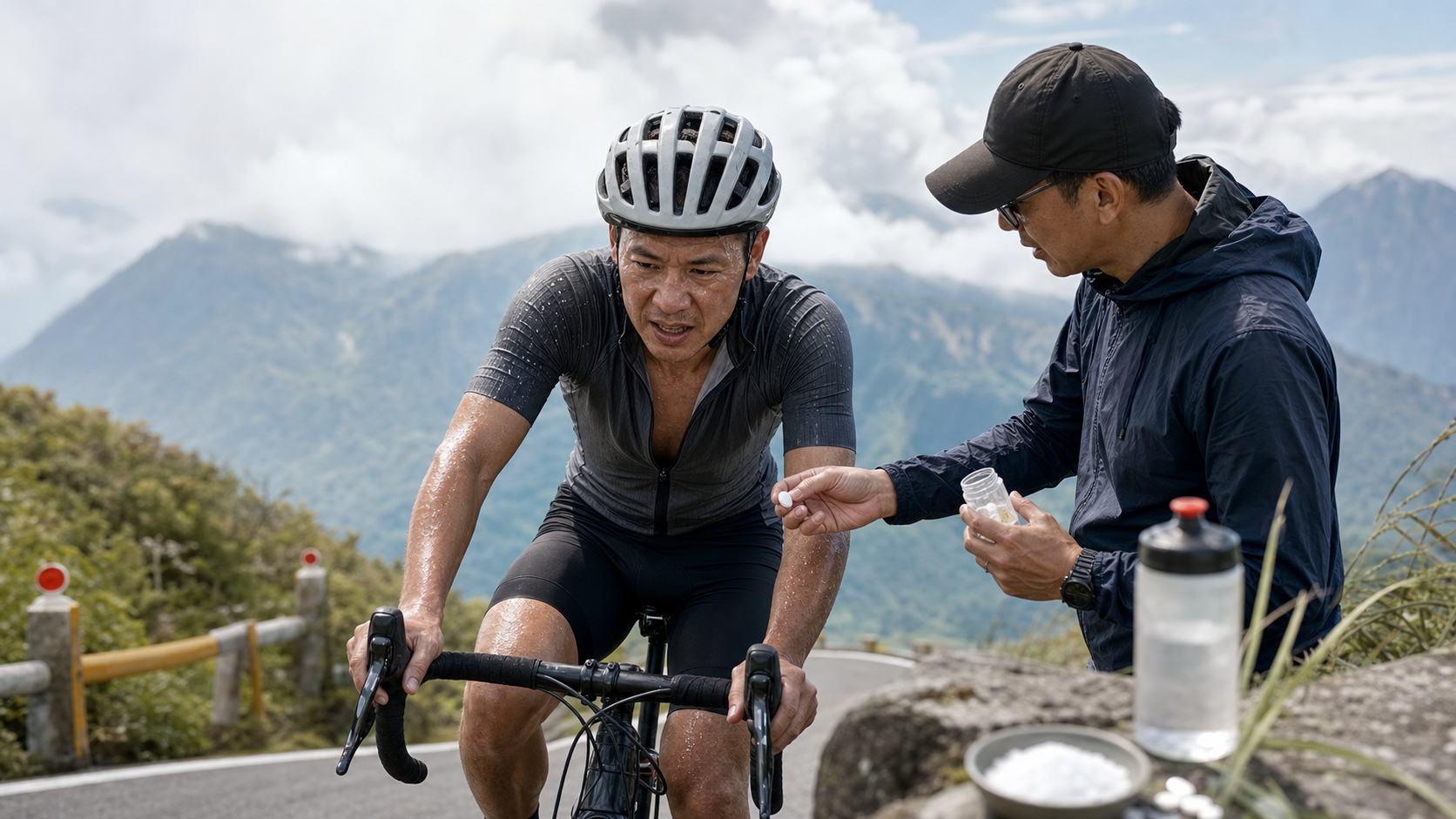
Starting with a Student Who Cramped on Wuling
I once coached a cyclist in his early forties; let’s call him A-Zhe. His fitness wasn’t bad—he could hold around 200 watts for an hour on flat roads without fading—but he’d cramp up in the latter stages of every long climb. That summer, riding the western approach to Wuling, his calves locked up all the way to the finish after passing Cuifeng, and he basically dragged himself up the last few kilometers on sheer grit. When he came to me, his first question was: “Coach, am I not eating enough salt? Should I buy salt tablets?”
I’ve been asked this question probably a thousand times over the past decade-plus. And my answer is always the same: “Hold off on buying anything—first, we need to figure out exactly how much you’re losing and how much you’re taking in.” Because salt tablets, when used correctly, are a lifesaver; when used incorrectly, they’re not just ineffective—in severe cases, they can land you in the ER.
In this article, I want to explain, in the same way I’d talk to my athletes, whether endurance athletes actually need sodium supplementation and how to use salt tablets properly. It’ll be on the longer side, but if you’re someone who regularly trains in Taiwan’s hot, humid environment and routinely rides or runs for two or three hours or more, I strongly recommend you read this in full—because when it comes to sodium, there are more misconceptions floating around out there than correct ones.
Foundational Concepts: What Does Sodium Actually Do During Exercise?
Sodium Isn’t Just “Seasoning”—It’s Your Body’s Electrical System
When most people hear “sodium,” they immediately think “salt,” “heavy seasoning,” or “the culprit behind high blood pressure.” That’s true in the context of daily diet, but in exercise physiology, sodium plays a far more important role.
Sodium is the primary cation in your body’s extracellular fluid. It’s responsible for maintaining blood osmotic pressure, fluid balance, and—most critically—nerve transmission and muscle contraction. Every pedal stroke you take, every foot strike you make, is fundamentally the result of nerves firing electrical signals and muscle fibers contracting. And this entire “electrical system” relies heavily on the concentration gradients of electrolytes like sodium, potassium, calcium, and magnesium across cell membranes.
When you exercise for long periods and sweat heavily, your sweat carries away not just water but also sodium. If your blood sodium concentration shifts too dramatically, the consequences range from impaired performance and cramping sensations to, in severe cases, disruption of the central nervous system. So the core purpose of sodium supplementation isn’t to “replenish energy”—it’s to maintain the dynamic balance of fluids and electrolytes so your neuromuscular system can function steadily.
Sodium Loss in Sweat Varies Wildly Between Individuals—More Than You’d Expect
This is the single most important concept in this entire article, so please remember it: Sodium concentration in sweat varies enormously from person to person—this isn’t a small difference, it’s a several-fold difference.
According to compiled sports science data, local sweat sodium concentration in athletes ranges roughly from about 10 to 90 millimoles per liter (mmol/L)—a very wide range. In studies of marathon runners, researchers have observed extreme spans within a single group from about 7 to 95 mmol/L; among trained endurance athletes, differences from about 13 to 103 mmol/L have been recorded between individuals. To put that in more relatable terms, for every liter of sweat, one person might lose only about 200-plus milligrams of sodium, while another could lose over 2,000 milligrams—a difference of up to tenfold.
This is also why there simply cannot be a one-size-fits-all answer to “should I take salt tablets?” Just because the rider next to you swears by them doesn’t mean you need them. Conversely, just because someone else skips them without issue doesn’t mean you can copy them.
Many factors influence sweat sodium concentration, including:
- Genetics: This is the biggest source of individual variation. Some people are simply born “salty sweaters.”
- Heat acclimatization status: After regularly training in hot environments and adapting, your sweat glands become better at reabsorbing sodium, and sweat sodium concentration actually decreases.
- Exercise intensity and sweat rate: The faster and harder you sweat, the less time there is to reabsorb sodium, so concentrations tend to be higher.
- Dietary habits: People who consistently eat very salty foods also have different sodium excretion tendencies.
- Personal factors like body size, sex, and aerobic capacity.
How Do You Know If You’re a “Salty Sweater”?
Without laboratory sweat testing, you can make a rough assessment using a few everyday observations:
- After exercise, your clothes, hat, or jersey shoulder straps dry with white salt crystal residue.
- Sweat running into your eyes stings or feels especially irritating and gritty.
- Your skin feels rough, salty, and sticky once it dries.
- After long, heavy-sweat sessions, you’re particularly prone to cramping or that “electrolyte-depleted” weakness.
These aren’t precise indicators, but if you match several of them, your priority for sodium supplementation is indeed higher than average.
Debunking the Myth: The Relationship Between Cramping, Sodium Deficiency, and Salt Tablets Isn’t as Direct as You Think
Back to A-Zhe’s case. His first instinct when he cramped was “sodium deficiency”—it’s the most common gut reaction. But the causes of exercise-associated muscle cramps are still debated to this day, and it’s not as simple as just electrolyte depletion.
The more mainstream view in sports science right now is the “neuromuscular fatigue” hypothesis: when muscles are pushed beyond their usual load and fatigue accumulates, the neural reflexes controlling muscle contraction and relaxation become imbalanced, making involuntary, intense contractions—i.e., cramps—more likely. This explains why many people cramp in the latter half of an effort that exceeds their normal training volume, when they’re pushing hard through fatigue—that’s often “undertrained + blown pacing,” not just “not enough salt.”
Electrolyte imbalance (including sodium) can indeed be one contributing factor, especially for salty sweaters doing long sessions in hot, humid conditions. But blaming cramps entirely on sodium deficiency and then popping salt tablets like candy often misses the main problem. In A-Zhe’s case, the key adjustments I made for him were: easing off the climbing pace, building up his long-duration aerobic base, and optimizing his hydration and sodium timing—all three together. That’s what truly fixed his cramping. Salt tablets alone can’t save legs that have blown up from bad pacing.
Coach’s Note: If you have persistent cramping during long exercise combined with noticeable dizziness, nausea, or confusion, don’t just keep chugging salt and tough it out. This could be a sign of a more serious electrolyte or fluid imbalance—stop, and seek medical attention if necessary.
Three Real Case Studies: The Same Question “Should I Take Salt Tablets?”—Three Completely Different Answers
I want to use three of my athletes’ situations to show you why there can’t be a standard answer to “should I take salt tablets?” The scenarios below are for illustrative purposes, and the figures are reasonable assumptions within general ranges.
Case One: A Salty Sweater Doing Long-Distance Rides
This athlete was in his early fifties, weighing about 78 kg, and was the classic “salty sweater”—after exercise, his jersey shoulder straps and helmet liner would be crusted with white salt. Every summer, he’d tackle two or three long climbs exceeding four hours, and in the past, he’d always suffer cramps alternating between his calves and inner thighs in the latter half. I had him estimate his sweat rate: during a tough three-hour climbing session, his body weight dropped by nearly 2.5 kg. That means he was losing close to 1 kg of sweat per hour—and it was clearly salty sweat.
For him, the answer was clear: for long activities exceeding two hours in hot, humid conditions, proactively planning a sodium supplementation strategy is reasonable. We changed his electrolyte intake from “only when I remember I’m thirsty” to “taking it in measured, scheduled doses,” and we fine-tuned the amount and timing repeatedly during training. His cramping improved significantly—but note, this wasn’t just thanks to salt tablets. It also included us simultaneously dialing back his climbing pace to prevent him from muscling through the latter stages.
Case Two: A Commuter Doing Short Morning Runs
The second was a female office worker in her thirties, weighing about 52 kg. She was used to running 40 to 50 minutes along the riverside in the early morning. After reading a bunch of online articles, she got anxious and asked me whether she should also buy salt tablets and whether she needed to supplement electrolytes while running.
My answer was equally clear: she almost certainly didn’t need them. Her sessions were under an hour, the early morning was relatively cool, her sweat loss was limited, and her regular diet of eating out meant her sodium intake was hardly deficient. In this situation, plain water is more than sufficient. Forcing extra sodium into a short, light workout provides no benefit and could even create unnecessary strain. Her focus should be on her running form and gradually building up her mileage, not on salt tablets.
Case Three: An Anxious Marathon Beginner Who Overdrank
The third was a marathon beginner, weighing about 60 kg. He was extremely diligent and also extremely afraid of “dehydration.” For his first full marathon, he’d heard people say “you must drink lots of water,” so he chugged several big cups at every aid station. In the latter stages, he started getting headaches, nausea, and a bloated feeling. After finishing, he weighed himself and found he actually weighed more than before the race.
This is a classic case of overhydration tendency. His problem wasn’t sodium deficiency or a lack of salt tablets—it was drinking too much and diluting his blood. For him, the real solution was learning to hydrate based on thirst and sweat loss, and to rein in his drinking pace—not to go buy salt tablets to “offset” the water. This case perfectly sets up the hyponatremia topic we’ll cover later.
These three people asked the same question, yet the answers were completely different. This is exactly why I keep emphasizing “individualization.”
Going Deeper: Heat Acclimatization and Taiwan’s Summers
There’s one more advanced but highly practical concept worth spending some time on: heat acclimatization.
The human body learns. When you train regularly in hot conditions, after about one to two weeks of adaptation, a series of physiological adjustments occur: sweating starts earlier, sweat distribution becomes more even, heart rate is more stable at the same intensity, and—crucially—your sweat glands become better at reabsorbing sodium, so the sodium concentration in your sweat actually decreases. This means a well-heat-acclimatized person loses less sodium for the same amount of sweat compared to someone who isn’t acclimatized.
This has two implications for athletes in Taiwan:
First, be especially careful at the start of the season. When transitioning from the cool winter-spring into the hot, humid summer, before your body has completed heat acclimatization, this is the highest-risk period for heat-related issues (including electrolyte imbalance, excessive fatigue, and even heat exhaustion). Don’t suddenly ramp up training volume and intensity, and be more conservative and cautious with your fueling.
Second, heat acclimatization itself is a form of “natural fueling optimization.” Gradually letting your body adapt to Taiwan’s heat and humidity is a more fundamental and safer approach than relying solely on salt tablets to power through. Instead of asking “how many salt tablets should I swallow this summer?”, first ask “have I done enough heat acclimatization this year?”
Table: Physical Changes Before and After Heat Acclimatization (General Trends)
| Aspect | Not Heat-Acclimatized (Early Season) | After Heat Acclimatization (After ~1–2 Weeks of Regular Heat Training) |
|---|---|---|
| Onset of sweating | Later | Earlier (more immediate cooling) |
| Sweat sodium concentration | Relatively higher | Tends to decrease (better sodium reabsorption) |
| Heart rate at same intensity | Higher | More stable, lower |
| Heat-related risk | Higher | Relatively reduced |
| Fueling strategy approach | More conservative, gradual | Can be fine-tuned based on data |
This table isn’t for you to memorize numbers—it’s to remind you: your sodium needs aren’t fixed; they change with the season, your training status, and your level of heat acclimatization. Using one fueling strategy all year without ever adjusting is itself a mistake.
Practical Methods: When Do You Actually Need Salt Tablets?
I’ve condensed my judgment framework for whether extra sodium supplementation (including salt tablets, electrolyte powder, and sports drinks) is needed into a table. This is the tiered logic I actually use with my athletes.
Table 1: When Do You Need Extra Sodium? A Tiered Assessment
| Scenario | Exercise Duration | Environment | Heavy Sweating / Salty Sweater? | Sodium Supplementation Necessity |
|---|---|---|---|---|
| Morning riverside ride, easy spin | Under 60 minutes | Cool or moderate | No | Almost unnecessary; plain water is fine |
| Weekend group ride, mid-distance run | About 1–2 hours | Warm | Moderate | Regular sports drink or electrolyte water is usually sufficient |
| Summer long-distance, climbing challenge | Over 2 hours | Hot and humid (Taiwan summer) | Yes | Recommended to plan a sodium strategy; salt tablets are one option |
| Ultramarathon, ultra-distance, triathlon | Over 3–4 hours | Hot and humid | Yes | Sodium strategy is almost essential; needs individualization |
| Salty sweater, any long-duration exercise | Over 90 minutes | Warm or hotter | Obvious salt residue | Prioritize sodium assessment; consider sweat testing |
The key point is clear: for short, cool, low-sweat exercise, you don’t need salt tablets at all—just drink water. The real value of salt tablets appears when the conditions of “long duration + heavy sweating + hot and humid + salty sweater” stack up together.
Taiwan’s situation deserves special mention. Our summers are often both hot and extremely humid. When humidity is high, sweat doesn’t evaporate easily to cool the body, so the body just keeps pouring out sweat, and sweat rates can be even more extreme than in dry-heat regions. So in Taiwan, during a summer long climb (like the western approach to Wuling, Beihuang, or repeated Fengguizui practice), sodium loss is likely underestimated. This is something local athletes should pay particular attention to.
Comparison of Common Sodium Supplementation Tools
Salt tablets aren’t the only option. In practice, you have at least four tools, each suited to different scenarios.
Table 2: Comparison of Common Sodium Supplementation Tools
| Tool | Approximate Sodium Per Serving (Reference Range) | Advantages | Disadvantages | Best Suited For |
|---|---|---|---|---|
| Regular sports drink | Several hundred mg sodium per 500 mL | Easy to find; also provides water and carbs | Low sodium concentration; higher sugar content | Short-to-mid distance, daily training |
| Electrolyte powder / effervescent tablets in water | Several hundred to over 1,000 mg sodium per serving, adjustable | Concentration is adjustable; easy to carry | Requires water; takes time to dissolve | Long distance, precise control needed |
| Salt tablets (capsule form) | Several hundred mg sodium per tablet (varies greatly by brand) | Easy to carry; can be adjusted independently of water intake | Need to drink water separately; easy to misuse and overdose | Ultra-distance, salty sweaters |
| Natural sources (salty foods, savory fuel) | Varies greatly | Provides other nutrients; usually well-tolerated by the gut | Hard to calculate precisely; inconsistent dosing | Ultramarathon aid stations, long events |
Please note: I’ve deliberately given ranges rather than exact numbers for sodium content because product concentrations really do vary enormously. Two products both called “salt tablets”—one brand’s tablet might contain two to three times the sodium of another’s. The only thing you should trust is the nutrition label on the product in your hand. Before buying, flip it over and look at the “sodium” line—that’s more reliable than any online recommendation.
A Workable Principle for Sodium Supplementation Rhythm
Many athletes ask me, “So how much sodium should I actually take per hour?” Honestly, because individual variation is so large, I won’t give you a fake-precise number to copy. But I can give you a workable framework of principles:
- Estimate your sweat rate first: Pick a representative training session, weigh yourself before and after (accounting for fluids consumed). The weight lost is roughly your sweat loss. In Taiwan’s summer, losing 1 kg or more of sweat per hour during long exercise is common.
- Assess your saltiness level: Use the earlier indicators—salt residue, stinging eyes, rough skin—for a rough judgment. Salty sweaters should prioritize sodium supplementation.
- Start with a moderate dose and observe reactions: During long exercise, start with the “moderate” recommended amount on the product label, and pay attention to how you feel—any dizziness, nausea, or feeling over-supplemented. Individualization comes from trial and error in training, not from fortune-telling.
- Think about water and sodium together: Supplementing sodium without water, or chugging water without sodium, both lead to imbalance. Ideally, the “water coming in” and “sodium coming in” should roughly match the ratio of “water lost” and “sodium lost.”
The Other Side to Watch Out For: The Risk of Hyponatremia from Over-Supplementing and Overdrinking
At this point, I need to be blunt, because this is the side most people are completely unaware of—and it’s actually more dangerous: in sports, incidents caused by drinking too much water, combined with misguided sodium supplementation, are often more severe than sodium deficiency.
What Is Exercise-Associated Hyponatremia (EAH)?
Exercise-associated hyponatremia (EAH) refers to a blood sodium concentration below 135 millimoles per liter during or within 24 hours after exercise. Its core cause is not primarily losing too much sodium through sweat, but rather consuming too much hypotonic fluid (plain water, diluted drinks), which “dilutes” the blood—and body weight goes up instead of down.
This is highly counterintuitive. Most people assume that if something goes wrong during exercise, it must be because they “didn’t take in enough.” But research clearly shows that fluid dilution from overdrinking is the primary mechanism of EAH, while sodium loss through sweat plays a relatively secondary role.
Severe hyponatremia is dangerous. When blood sodium drops very low (e.g., below about 120 mmol/L), cerebral edema can cause central nervous system symptoms; dropping even lower (below about 110–115 mmol/L) can be life-threatening. This isn’t scare-mongering—there have been documented cases of athletes dying from this in international endurance events.
High-Risk Groups and Situations for EAH
According to compiled sports medicine data, risk factors for EAH include:
- Overdrinking (the most core factor, especially among people who “chug water because they’re afraid of dehydration”).
- Very long exercise durations (ultramarathons, ultra-distance events, triathlons).
- Smaller body size (the same amount of water has a stronger dilution effect on smaller individuals).
- Lack of race experience (beginners tend to overhydrate out of anxiety).
- Slower finishers (spending more time on the course means more opportunities to drink).
- Some studies also mention that using nonsteroidal anti-inflammatory drugs (NSAIDs) before or during an event may be a secondary risk factor.
A Harsh but Important Fact: Salt Tablets Are Not a Universal Cure for Hyponatremia
Some people think, “Well, I’ll just take more salt tablets—that’ll offset all the water I’m drinking.” Let me pour cold water on that: one study of an ultra-distance event (about 161 km) involving over a hundred participants found only a weak positive correlation between sodium intake and post-race blood sodium concentration. The researchers concluded that salt tablets contribute very little to preventing hyponatremia.
In other words, the key to protecting yourself from hyponatremia is not frantically swallowing salt tablets, but “not drinking excessively”—hydrating sensibly based on thirst and sweat loss, rather than mechanically forcing down a big gulp every few minutes. I believe this concept takes priority over “should I take salt tablets?”
Table 3: Sodium Deficiency vs. Over-Supplementation / Overdrinking—Symptoms and Management Comparison
| Aspect | Tending Toward Sodium Deficiency / Electrolyte Depletion | Tending Toward Hyponatremia (Overdrinking, Fluid Dilution) |
|---|---|---|
| Common scenario | Salty sweater, hot and humid long duration, insufficient water and sodium intake | Long-duration exercise, anxious overdrinking, weight actually increasing |
| Possible sensations | Weakness, cramping, thirst | Headache, nausea, bloating, confusion, weight gain |
| Hydration strategy | Needs water and electrolytes | Needs to “stop overdrinking,” not drink more |
| Danger level | Affects performance, causes cramps; rarely fatal | Can be fatal in severe cases; a true emergency |
| On-site management principle | Moderate electrolyte intake, reduce intensity | Immediately stop heavy drinking, watch for neurological symptoms, seek medical help if necessary |
Please memorize this table. When someone experiences dizziness, nausea, or confusion after long exercise, the most dangerous mistake on-site is “assuming they’re dehydrated and forcing them to drink water.” If they actually have hyponatremia, giving them water only makes things worse. In this situation, the right move is to seek professional medical help quickly. Taiwan’s advantage is that health insurance and emergency resources are relatively accessible—if something feels truly wrong, don’t tough it out. Better to be disappointed about a DNF than to skip the ER.
Common Mistakes and Corrections
After coaching athletes for so many years, I’ve compiled the most common sodium supplementation mistakes. Check how many you’ve made.
Mistake 1: Treating Salt Tablets Like Daily Supplements and Taking Them Mindlessly
Correction: Salt tablets are a tool for “specific situations during exercise,” not a daily health supplement. Taiwanese people’s eating-out habits already tend toward the salty side—a bowl of beef noodle soup, a serving of fried chicken, a bento box—daily sodium intake is usually not deficient, often excessive. Taking extra salt tablets on days when you’re not sweating heavily is unnecessary and, long-term, could add strain to your body. Salt tablets only come into play during long, heavy-sweat training sessions or races.
Mistake 2: Swallowing Several at Once, Thinking “More Is Safer”
Correction: This is a dangerous mindset. Excessive sodium intake combined with gastrointestinal distress can cause nausea, stomach upset, or diarrhea at best, and disrupt fluid balance at worst. The correct approach to sodium supplementation is “keep up with losses, not more is better.” Better to be slightly conservative and take it in divided doses than to slam a big load at once.
Mistake 3: Chugging Water Frantically Out of Fear of Dehydration
Correction: This is the number one cause of hyponatremia. The right approach is to follow your thirst and sweat rate, not force yourself to gulp a big mouthful every ten minutes. If you find your weight going up after exercise instead of down, that’s a signal you drank too much—cut back next time.
Mistake 4: Copying Whatever Others Are Doing
Correction: As discussed earlier, individual differences in sweat sodium can be tenfold. Just because your salty-sweater friend needs aggressive sodium supplementation doesn’t mean you do. Sodium strategies must be individualized, figured out through your own training.
Mistake 5: Blaming All Cramps on Sodium Deficiency While Ignoring Inadequate Training
Correction: Many late-stage cramps are fundamentally “undertrained + blown pacing + fatigue accumulation.” Salt tablets can’t save legs that haven’t been built up. First examine your training volume and pacing strategy—sodium supplementation is a support, not the main character.
Mistake 6: Neglecting Gut Training and Trying Salt Tablets for the First Time on Race Day
Correction: Any fueling strategy must be tested in training first. Swallowing unfamiliar salt tablets or electrolyte powder for the first time on race day might not sit well with your gut, and could actually hurt your performance. “Nothing new on race day” is an iron rule of endurance sports.
Actionable Advice for Different Experience Levels
Everyone’s needs are different, so I’ve divided my advice into three groups. Find where you fit.
For Beginners / General Fitness Enthusiasts
If you mainly ride along the riverside, use a treadmill, do easy weekend rides, and most sessions are under an hour:
- You almost certainly don’t need salt tablets. Plain water is your best friend.
- If you exercise over an hour and sweat more, a regular sports drink or diluted electrolyte water is plenty.
- Don’t be scared by marketing hype into stockpiling salt tablets. Spend that money on a good pair of shoes or a coaching session instead.
- Taiwanese eating-out food tends to be salty; your daily sodium intake is usually not deficient. Don’t scare yourself.
For Intermediate / Enthusiasts Who Regularly Tackle Long Distances
If you often ride for 2–3+ hours, challenge climbs in summer, or do half and full marathons:
- Start consciously planning your hydration and sodium rhythm. Use the before-and-after weigh-in method to figure out your sweat rate.
- Observe whether you’re a salty sweater (salt residue, stinging eyes, rough skin). If so, raise the priority of sodium supplementation.
- Electrolyte powder or effervescent tablets dissolved in water are a better starting point than pure salt tablets because the concentration is easier to control.
- Rehearse all fueling strategies in training first to find the dose and timing your gut tolerates and that feels best.
- Taiwan’s hot, humid environment amplifies sweat loss. For summer long-distance events, make your fueling plan more generous than your intuition suggests—but also stay alert not to overdrink.
For Advanced / Ultra-Distance and Competitive Athletes
If you do ultramarathons, ultra-distance cycling, or triathlons:
- Sodium supplementation is almost a necessary strategic component, but it needs to be precise and individualized. Consider getting a professional sweat sodium concentration test to turn guesswork into data.
- Integrate water, sodium, and carbohydrate into one cohesive plan, and adjust dynamically based on conditions (temperature, humidity, altitude).
- Place “avoiding overdrinking” on the same priority level as “sodium supplementation,” because at your level, the risk of hyponatremia is real and potentially fatal.
- Keep a fueling log. Record the weather, sweat rate, what you consumed, and how your body responded for every long session. Over time, you’ll build your own personal formula.
- If you have chronic conditions (see below), be sure to discuss with a professional team first.
Special Note: For Those with Chronic Conditions—Please Individualize and Consult a Doctor
I want to say this with particular caution. If you have high blood pressure, heart disease, kidney disease, diabetes, or are taking medications that affect fluid and electrolyte balance (such as certain diuretics or blood pressure medications), you absolutely cannot copy general athlete recommendations for sodium supplementation.
Sodium intake is closely tied to blood pressure and fluid balance. For these groups, excessive or inappropriate sodium supplementation can pose additional risks. Similarly, fluid and electrolyte regulation during exercise may differ from the general population due to disease or medication.
So my advice is very clear: before adjusting your exercise fueling strategy, please consult your primary care physician first, and add a sports nutritionist if necessary. Taiwan’s health insurance and medical accessibility are our advantage—use them. Rather than scaring yourself with a jumble of conflicting online information or randomly supplementing, bring your training habits to an outpatient consultation and ask properly. Let the professionals be your gatekeeper. This article provides general principles and concepts, not a prescription for your specific situation.
Quick FAQ
Q1: Are salt tablets or electrolyte powder better?
There’s no absolute better or worse—the difference is in the use case. Salt tablets are easy to carry and can be adjusted independently of water intake, making them suitable for ultra-distance events or salty sweaters. Electrolyte powder dissolved in water offers better concentration control, making it suitable for those who need precise management. The key is to check the product’s nutrition label and test it in training first.
Q2: If I don’t get white salt residue, do I not need sodium at all?
Salt residue is a rough indicator, not an absolute one. For exercise that’s long enough and produces enough sweat, even non-heavy salty sweaters may need moderate electrolyte supplementation. The key still comes back to a combined assessment of exercise duration, environment, and sweat rate.
Q3: Will taking salt tablets damage my kidneys or health?
Used correctly and in moderation, the risk to healthy adults is limited. The problem arises with “mindless daily use” or “slamming a big dose at once.” For those with kidney or chronic conditions, it’s a different story—consult a doctor first.
Q4: Should I do a “sodium load” the day before a race?
Some people do this, but individual variation is large and the evidence is still debated. If you want to try it, you must rehearse it during training or a simulation race—never do it for the first time on race day. Those with medical conditions should be especially cautious.
Q5: After exercise, I feel very dizzy and nauseous—is it sodium deficiency or overdrinking?
It’s impossible to tell with 100% certainty from symptoms alone, as the symptoms can overlap. If it’s combined with confusion or weight that went up instead of down, be highly alert for hyponatremia—in that case, the most dangerous action is to keep drinking water. If something truly feels wrong, seek medical help promptly.
Conclusion: Salt Tablets Are a Tool, Not a Belief
Back to A-Zhe from the beginning. That year, we eased off his climbing pace, built up his aerobic base, and planned a sensible hydration and sodium rhythm suited to his salty-sweater constitution. The next year, he rode the western approach to Wuling again—no cramping the entire way, and he set a personal record. But if you ask me whether salt tablets saved him, I’d say: salt tablets were just one small piece of the puzzle. The real heroes were solid training, smart pacing, and fueling that was neither too much nor too little—just right.
This is the core message I want to leave you with:
- Sodium supplementation is highly individual; sweat sodium loss can vary tenfold between people. Don’t copy others.
- Salt tablets are only useful in specific situations: long duration, heavy sweating, hot and humid conditions, salty sweater. Short, light exercise doesn’t need them at all.
- The risks of over-supplementation and overdrinking are often more dangerous than sodium deficiency. Hyponatremia is a genuinely fatal emergency, and salt tablets are not its universal cure—the key is not drinking excessively.
- All strategies must be rehearsed in training and individualized. Never use anything new on race day.
- If you have chronic conditions, be sure to consult a doctor for individualized advice.
Treat salt tablets as a tool that needs to be understood and practiced, not a belief that “more is more blessed.” Once you understand it, you’ll find that fueling is actually simpler—and safer—than you thought.
This article is for educational purposes and cannot replace individual diagnosis and treatment advice from a physician, physical therapist, or nutritionist. If you have chronic conditions or are taking medication, consult a qualified medical professional before adjusting your exercise fueling strategy.
References
- Sweating Rate and Sweat Sodium Concentration in Athletes: A Review of Methodology and Intra/Interindividual Variability (PMC): https://pmc.ncbi.nlm.nih.gov/articles/PMC5371639/
- Interindividual variability in sweat electrolyte concentration in marathoners: https://www.ncbi.nlm.nih.gov/pmc/articles/PMC4966593/
- Explaining variation in sweat sodium concentration (Journal of Applied Physiology): https://journals.physiology.org/doi/full/10.1152/japplphysiol.00391.2022
- A review of risk factors and prevention strategies for exercise associated hyponatremia (PubMed): https://pubmed.ncbi.nlm.nih.gov/35016044/
- Exercise-Associated Hyponatremia: 2017 Update (Frontiers in Medicine): https://www.frontiersin.org/journals/medicine/articles/10.3389/fmed.2017.00021/full
Related Reading
- Magnesium: The Overlooked Exercise Mineral—Functions, Exercise Loss, and Supplementation Evidence Explained
- IRONMAN Salt and Electrolyte Strategy: Cramping, Hyponatremia, and Taiwan’s High Heat
- The Science of Exercise and Electrolyte Balance: The Roles of Sodium, Potassium, Magnesium, and Calcium, Loss, and Individualized Supplementation Strategies
- The Science of Sports Drinks: When You Need Them, How to Choose, or Should You DIY Your Own Formula?
西進武嶺 免費訓練分析服務 Intervals | 練不夠還是練過頭?你哪一種類型選手?AI模型告訴你! | 備戰神器 | 公路車 訓練 | CT Yeh
4 年前
CT暗黑廚房) 車友必備 宇宙無敵鮮蚵湯 幫助訓練恢復 天然食補 好市多 超肥鮮蚵 破PR
7 年前
西進武嶺 自製新版AI配速表產生器 x 賽前攻略 抱佛腳! 沒有功率計也可以產生配速表嗎?有什麼其他眉角賽前要注意的呢? | 西進武嶺 / 東進武嶺 KOM 攻略 | 公路車 | CT Yeh
4 年前
碟煞公路車 銑面器 !? 原來銑完差這麼多! 降低蹭碟機率! | TIME 公路車 保養小記錄 | CT Yeh
3 年前
雨戰! 西進武嶺員工旅遊 加料 各路段大數據分析 | 同事端出5公斤的公路車來挑戰!? EP1
4 年前
#公路車 #西進武嶺 配速配瓦實驗 坡度分析 四小時內攻略 建大盃 NeverStop #西進武嶺攻略
6 年前
CT 喇低賽) 武嶺牽車 才是王道 西進牽車四小時內秘訣 攝手位置 如何判斷 防抽筋小秘訣
7 年前
大家都在開箱的...單車用藍芽對講耳機真的有幫助嗎? SENA BiKom 20 長距離旅遊 & 海鷗繞圈賽 實際體驗心得 / 公路車 / CT Yeh
9 個月前