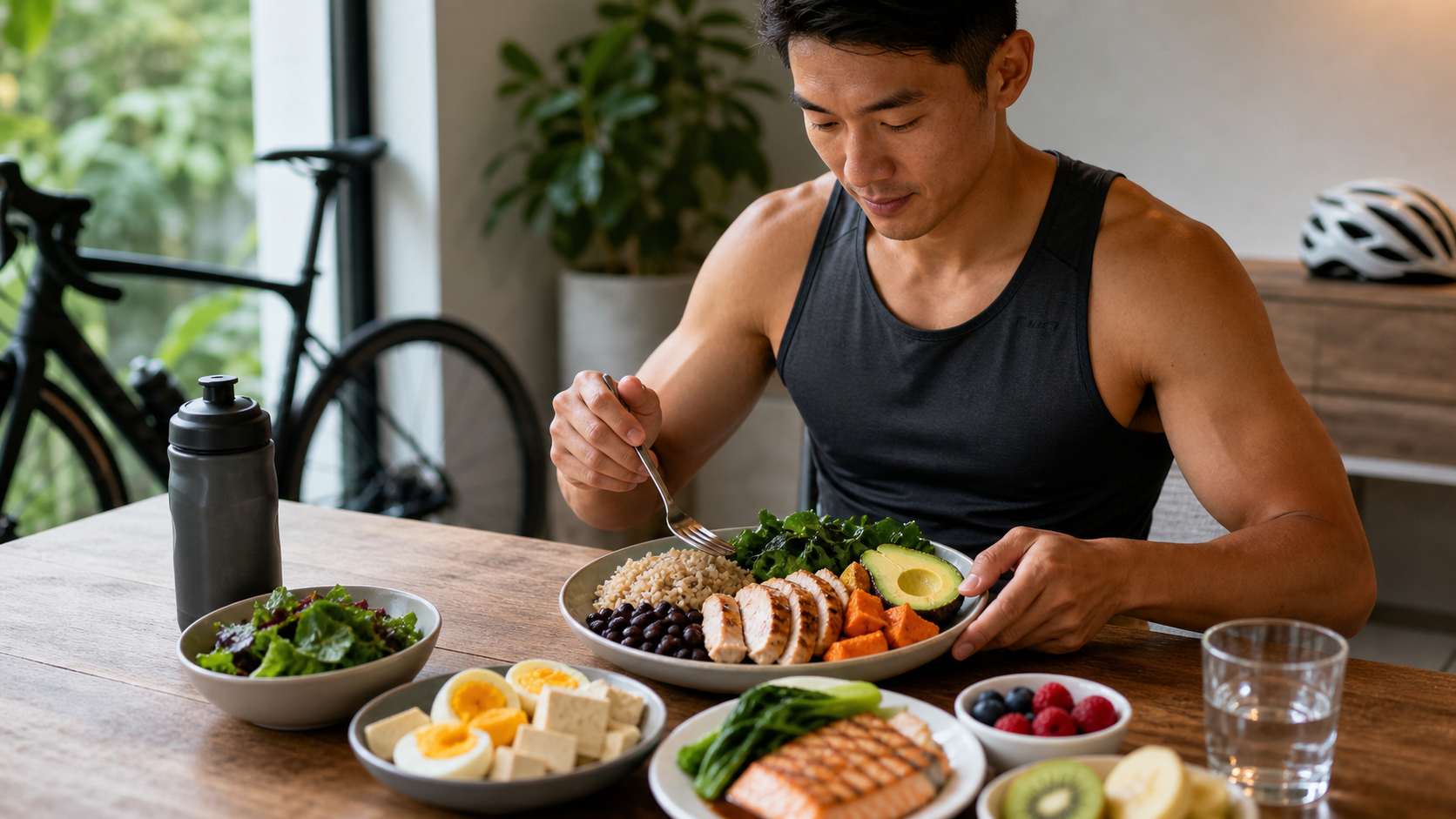
Starting with an Athlete Who “Could Never Get Full”
A few years ago, I coached an amateur time-trial cyclist—let’s call him A-Kai. His problem was classic: after every long training ride (roughly three to four hours, over 100 km), even after finishing the fueling plan I’d given him, he’d still grab half a pack of cookies, a bowl of instant noodles, and a sports drink after dinner. He wasn’t someone with weak willpower—he completed every workout on his schedule—but at night, his body seemed to become a bottomless pit. His weight wouldn’t budge, yet body fat slowly crept up, and his early-morning sessions often felt flat.
The first thing I asked him to do wasn’t to “eat less,” but to “redesign the order and content of his meals.” Three weeks later, he stopped binge-eating cookies at night, slept better, and his training quality stabilized. I never told him to go hungry—I just made sure he was truly “full.”
That’s exactly the topic for today: the science of satiety. For athletes, satiety is a highly underrated yet critical lever. If you only think in terms of the crude “calories in, calories out” model, you’re likely to fall into one of two extremes—either chronically suppressing appetite until training falls apart, or losing control and binge-eating until body composition goes sideways. True experts know how to use food composition to manage their appetite, making “feeling full” and “not overeating” happen at the same time.
In this article, I’ll walk you through the physiological mechanisms behind satiety, the two main players—protein and fiber—several practical tables you can copy directly, and finally, specific action steps for readers at different levels. It’s a long read, but I promise every section will land on your dinner plate.
1. First, Understand: Satiety Isn’t a Feeling—It’s a Whole Signaling System
Many people think “full” just means that stretched, stuffed sensation in the stomach. That’s only a small part of the story. In sports nutrition, we break “feeling full” into two related but distinct concepts:
- Satiation (within a meal): the braking point where you think “enough, I can stop” during a meal—this determines how much you eat in a single sitting.
- Satiety (between meals): how long after a meal before you feel hungry again—this determines the gap until your next meal and your snack cravings.
Neither of these is controlled solely by the mechanical stretching of the stomach. Instead, a whole network of signals from the gut to the brain coordinates them. When food enters the gastrointestinal tract, gut cells secrete a series of so-called “satiety hormones,” the two most studied being GLP-1 (glucagon-like peptide-1) and PYY (peptide YY). These hormones signal the brain that “you’re about done.” At the same time, hunger signals (such as ghrelin) are suppressed.
According to systematic reviews, higher protein intake (independent of meal frequency) is associated with greater daily satiety and higher PYY concentrations (PubMed systematic review, PMC study). This explains why “eating the right things” gives you more satiety than “eating a lot of things.”
The Four Nutritional Drivers of Satiety
In practice, I boil down the nutritional factors affecting a meal’s satiety into four categories, so my athletes can remember them easily:
| Factor | Main Mechanism | Plain-Language Understanding | Representative Foods |
|---|---|---|---|
| Protein | Raises PYY/GLP-1, amino acid inhibitory signals, high thermic effect of food | The most “potent” satiating macronutrient | Chicken breast, eggs, tofu, plain yogurt |
| Fiber (especially viscous soluble) | Slows gastric emptying, stimulates gut satiety hormones | Makes food “move slowly” through the stomach | Oats, beans, sweet potatoes, vegetables |
| Food volume and water | Stretches the stomach, mechanical fullness | Same calories, bigger portion | Soups, leafy greens, fruit |
| Food form and chewing | Solids are more satiating than liquids; longer chewing time | Drinking is the easiest way to overconsume | Whole fruit vs. juice |
This table is the backbone of the entire article. Next, I’ll dive deep into the two highest-leverage factors—protein and fiber.
2. Protein: The Most Underrated Satiety Weapon
If you remember only one thing from this article, let it be this: at equal calories, protein is the macronutrient that provides the most satiety.
Consistent evidence shows that protein is the most effective macronutrient for providing satiety, although the quality of evidence remains low due to protocol differences and risk of bias across studies, and more research is needed (MDPI review). In other words, the direction is clear, but we should use it as a “general principle” rather than treating any precise number as gospel.
Why Is Protein So Good at Suppressing Appetite?
When coaching athletes, I usually explain three mechanisms—no need to memorize, just understand:
- Rise in gut satiety hormones: Protein entering the gut stimulates PYY and GLP-1 secretion while suppressing ghrelin, reducing the urge to “keep eating.”
- Central amino acid signaling (aminostatic hypothesis): Rising blood amino acid levels are themselves a satiety signal. Protein also raises blood tyrosine, a precursor to dopamine, which is linked to feelings of satisfaction (PubMed).
- High thermic effect of food (TEF): Digesting protein costs relatively more energy. This isn’t satiety per se, but it makes protein more “cost-effective” in terms of net calories.
The literature commonly notes that when protein makes up roughly 20% to 30% of total calories, appetite suppression and reduced subsequent food intake are more likely to be observed. Note that I’m giving a “range,” not an exact number—because everyone’s body weight, training volume, and meal distribution differ.
How Much Protein Should Athletes Eat? Give a Range, Not False Precision
General protein recommendations for endurance and strength athletes fall in the range of 1.4 to 2.0 grams per kilogram of body weight per day. For a 70 kg cyclist, that’s roughly 98 to 140 grams of protein per day. The key to satiety isn’t just the total—it’s the distribution. Spreading protein evenly across meals throughout the day is better for appetite control and muscle protein synthesis than loading it all into dinner.
Here’s a “per-meal protein anchor” table I often give my athletes (shown for 60, 70, and 80 kg body weights, with a per-meal target of about 0.3–0.4 g/kg):
| Body Weight | Daily Total Range | Per-Meal Target (4 meals) | Easy Food Equivalents |
|---|---|---|---|
| 60 kg | 84–120 g | ~20–30 g per meal | 1 palm-sized chicken breast ≈ 25–30 g |
| 70 kg | 98–140 g | ~25–35 g per meal | 2 eggs ≈ 12–14 g |
| 80 kg | 112–160 g | ~30–40 g per meal | 1 tub of plain Greek yogurt ≈ 15–18 g |
People who eat out in Taiwan actually have an advantage: convenience stores offer tea eggs, unsweetened soy milk, chicken breast salads, and plain yogurt as ready-made high-protein options. At buffet restaurants, choosing skinless braised chicken leg, steamed fish, tofu, and edamame is far better value than loading up on fried rice or noodles. I often tell my athletes: “Fill the protein box first, then think about everything else.”
A Real-Life Example: The Power of “Front-Loading” Protein
Let me share another athlete’s story. Xiao-Hui was an office worker who ran after work, weighing about 58 kg. Her main complaint was, “By early evening I’m starving to the point of shaking, and I binge on snacks before dinner.” Looking at her food diary: breakfast was a slice of toast with milk tea (nearly zero protein), lunch was a single onigiri rice ball. Her total protein for the entire day was probably under 20 grams—no wonder her evening appetite was like a dam breaking.
I didn’t tell her to stop snacking—that would only have made things worse. All I did was switch her breakfast to two eggs + unsweetened soy milk + a slice of whole-wheat toast, and upgrade her lunch from an onigiri to a chicken breast salad + one tea egg. Just those two changes brought her daytime protein from under 20 g to about 50 g. Two weeks later, she told me: “Funny, I’m not as hungry in the evening anymore, and I’ve naturally cut back on snacks.”
That’s the practical power of front-loading protein. Many people think appetite失控 is an evening problem, but the root cause is often too little protein during the day. Moving protein to earlier meals is like paying off your appetite debt before it accumulates—so the evening binge naturally disappears.
3. Fiber: Making Food “Slow Down” in Your Stomach
If protein is the main force suppressing appetite, fiber is the teammate that extends satiety. Especially viscous soluble fiber, which forms a gel-like substance in the GI tract and does two things: slows gastric emptying and stimulates GLP-1 and PYY secretion (PMC study). Food moves slower, satiety hormones rise, and you don’t get hungry as quickly.
General Fiber Intake vs. the “Effective Dose” for Appetite
Here’s a point many people confuse, worth highlighting in bold: “Meeting the daily fiber recommendation” and “using fiber to regulate appetite” are two different dose concepts.
- Daily total fiber recommendation: For adults, roughly 25 to 38 grams per day (varies by region and sex; the US food label reference value is 25 g/day for a 2000 kcal diet).
- Effective dose of viscous fiber for appetite regulation: Clinical trials commonly use a lower range—about 7 to 15 grams per day, with long-term trial meta-signals clustering around about 10 grams per day (Ozzi summary).
And here’s the reality—many populations actually consume only about half the recommended amount; most adults eat only about 15 grams of fiber per day. This means that for most people, simply getting fiber up to the basic recommendation will noticeably improve satiety.
The table below makes “where fiber comes from” concrete, using foods easily available in Taiwan (values are approximate ranges for planning purposes, not precise lab values):
| Food (one serving) | Approximate Fiber | Type Bias | Notes |
|---|---|---|---|
| Oatmeal 40 g (dry) | ~4 g | Viscous soluble (beta-glucan) | Breakfast staple; more filling with unsweetened soy milk |
| Black beans/chickpeas, half bowl (cooked) | ~6–8 g | Soluble + insoluble | Protein + fiber double win |
| Sweet potato, one medium (~130 g) | ~3–4 g | Mixed | Easy to grab at Taiwan convenience stores |
| Broccoli, one bowl | ~3–4 g | Mixed | High volume, low calorie |
| Guava, one whole | ~4–5 g | Mixed | Eat with seeds; don’t juice it |
| Brown rice, one bowl | ~3 g | Mostly insoluble | Simple upgrade from white rice |
Protein + Fiber: A Combination Greater Than the Sum of Its Parts
The real magic of satiety isn’t in any single factor—it’s in the combination. When you put high-protein and high-fiber foods in the same meal, two satiety mechanisms (amino acid signaling + slowed gastric emptying) stack on top of each other. In my coaching, I give athletes several “lazy golden combos,” all easy to find in Taiwan:
- Unsweetened soy milk + oatmeal: plant protein + beta-glucan, the ceiling of breakfast satiety.
- Chicken breast + broccoli/edamame: the classic gym meal, protein and fiber both covered.
- Plain yogurt + diced guava + a small handful of nuts: the best afternoon snack replacement for cookies.
- Tofu + brown rice + blanched greens: vegetarians can easily hit both levers too.
- Tuna (water-packed) + whole-wheat toast + lettuce and tomato: a meal you can assemble at any convenience store.
Remember this mantra: “One block of protein + one handful of fiber.” Pair them at every meal, and satiety will almost never be a problem.
A Practical Trap: Fiber Should Be Increased “Gradually” + “With Plenty of Water”
I’ve stepped on this landmine with athletes: a marathon runner, after hearing my talk, jumped his fiber from 15 g to 40 g overnight. The result was a week of bloating, gas, and stomach cramps during runs—training completely derailed. Fiber increases must be gradual—add 3 to 5 grams per week to let your gut microbiome and digestion adapt. At the same time, water intake must keep up, because soluble fiber needs water to form that “gel” layer; without enough water, you risk constipation instead. In Taiwan’s hot, humid summers with heavy sweating, this is worth reminding yourself of.
Before Section 4: Don’t Forget the Three “Hidden Players”—Volume, Water, and Chewing
Protein and fiber are the stars, but the satiety show also has three often-overlooked supporting actors with real power.
Energy Density of Food—Same Fullness, Very Different Calories
Energy density refers to how many calories each gram of food contains. Low-energy-density foods (high in water and fiber) let you eat until your stomach is mechanically stretched—feeling full—while taking in relatively few calories. This is especially critical during fat loss. Here’s an intuitive comparison: a large plate of blanched greens and a small handful of potato chips may have similar calories, but the former fills your stomach completely while the latter disappears in seconds.
The table below uses common Taiwanese foods to show how “the same portion can differ wildly in satiety and calorie density” (values are approximate ranges for understanding, not precise lab values):
| Food | Energy Density | Volume Feel | Satiety Cost-Performance | Best Use Case |
|---|---|---|---|---|
| Blanched greens, soups | Low | Large | High | Fat loss, wanting to feel full |
| Boiled eggs, chicken breast | Medium-low | Medium | High (includes protein) | All times of day |
| Sweet potato, brown rice | Medium | Medium | Medium-high | Training-day staples |
| White rice, white toast | Medium-high | Small | Medium | OK, but upgrading to whole grains is better |
| Potato chips, cookies | High | Small | Low | Small amounts, not daily |
| Sugary drinks, juice | High (liquid) | Almost no fullness | Very low | Avoid in daily life |
Once you understand this table, you’ll see a simple fat-loss trick: spread the “area” of your plate with low-energy-density foods, put protein in the middle, and you can feel full even in a calorie deficit.
Water: A Cheap and Effective Satiety Tool
Drinking water or soup before or during a meal increases stomach volume and triggers satiety earlier. Taiwanese people love soup, which is great—but choose clear soups, miso soup, and vegetable soups, and avoid creamy soups, thickened broths, and high-fat, high-sodium bases. In summer, you sweat a lot, so hydration matters anyway; using it as a satiety tool is a two-for-one.
Chewing: Eat Slower So Your Brain Can Catch Up
There’s a time lag between when you start eating and when your brain receives the “full” signal—it takes a while to kick in. If you eat too fast, by the time the signal arrives, you’ve already overeaten. The fix is simple: choose whole foods that require chewing (whole fruit vs. juice, brown rice vs. white congee), slow down, and chew each bite more. In Taiwan, “polishing off a bento box in five minutes” is common—and it’s a breeding ground for overeating.
4. Fitting Satiety Into Your Day: Practical Plates and Timing
Now that the concepts are covered, let’s look at how to put them into practice. My core mantra for athletes is just one sentence: At every meal, first ask “Is the protein enough? Is the fiber enough?”—then worry about everything else.
A Satiety-Oriented One-Day Example (70 kg endurance athlete, non-heavy training day)
| Time | Content | Protein | Fiber | Satiety Focus |
|---|---|---|---|---|
| Breakfast | Oatmeal 40 g + unsweetened soy milk 400 ml + 2 eggs + half a guava | ~25 g | ~7 g | Protein + viscous fiber, both levers |
| Lunch | Buffet: half bowl brown rice + skinless braised chicken leg + two kinds of blanched greens + tofu | ~35 g | ~8 g | Grab protein and vegetables first |
| Snack | Plain Greek yogurt + a small handful of nuts | ~15 g | ~3 g | Fights afternoon/evening cravings |
| Dinner | Steamed fish + one sweet potato + large plate of stir-fried vegetables + miso soup | ~30 g | ~8 g | Soup adds volume-based fullness |
That’s roughly 105 grams of protein and about 26 grams of fiber for the day—within a healthy range—and every meal has a clear satiety anchor. A-Kai’s original problem was exactly this: breakfast was just a sugary drink, lunch was a bowl of braised pork rice, and dinner was when he tried to “catch up”—the appetite debt from earlier in the day came back with interest at night. Spread protein and fiber into earlier meals, and the evening binge urge naturally fades.
The Difference on Training Days and Race Days
I want to emphasize: the satiety strategies discussed above are mainly for “everyday life” and “fat-loss phases”—not for long training sessions or race day itself. During high-intensity, long-duration exercise, you actually need easily absorbed, fast-emptying carbohydrates (gels, bananas, sports drinks). At that point, “satiety” is your enemy, not your friend—you want energy in quickly, not to feel stuffed and unable to move.
So remember this principle:
- Regular days / fat-loss phase: maximize satiety (protein, fiber, volume, chewing).
- Long training / during competition: minimize satiety, prioritize rapid energy delivery (easily absorbed carbs, liquids, low fiber).
- Post-race recovery window: protein + carbs together; satiety is secondary—get recovery done first.
Confusing these two contexts is one of the most common mistakes I see.
5. Common Mistakes and Fixes: The Pitfalls I’ve Seen in Athletes
In over a decade of coaching, the mistakes I’ve seen on this satiety topic could fill a “mistake notebook.” Here are the six most common ones.
Mistake 1: Getting Calories from Drinks, Then Wondering Why You’re Never Full
Liquid foods (juice, sugary drinks, sugary sports drinks, energy drinks) barely trigger the same satiety mechanisms as solid food—drinking 300 kcal of a sugary beverage produces far less satiety signaling than eating 300 kcal of chicken breast with sweet potato. Fix: minimize liquid calories in daily life; switch to unsweetened tea, water, and unsweetened soy milk; eat fruit rather than blending it.
Mistake 2: Extreme Dieting to Suppress Appetite, Leading to Revenge Binge-Eating
Keeping food intake very low for long periods may seem effective short-term, but hunger signals build up stronger and stronger until one day you crash and eat back several days’ worth in one sitting. Fix: replace “eat less” with “eat enough, but eat right.” Increase the protein and vegetable portions on your plate so you feel full within a reasonable calorie budget, rather than white-knuckling through hunger.
Mistake 3: Spiking Fiber All at Once, Gut Shuts Down
I mentioned the gradual principle earlier, but I’ll emphasize it again because so many people make this mistake. Fix: add 3–5 g per week, and increase water intake in parallel.
Mistake 4: Loading All Protein into Dinner
When all your daily protein is eaten in one sitting at dinner, the earlier meals lack satiety, making you more likely to lose control in the afternoon and before bed. Fix: spread protein evenly across breakfast, lunch, snack, and dinner.
Mistake 5: Applying “Satiety Strategy” Rigidly to Race Day
As mentioned, chasing satiety during competition overloads your GI tract and leaves you under-fueled. Fix: distinguish between “everyday mode” and “during-exercise mode.”
Mistake 6: Ignoring the Effects of Sleep and Stress on Appetite
When you sleep poorly or are under stress, appetite-regulating hormones go out of balance, making you crave high-sugar, high-fat foods. In Taiwan, with long working hours and frequent late-night training or overtime, this is very real. Fix: treat sleep as part of “appetite management,” not just part of recovery.
Here’s a comparison table of “wrong → right” that you can stick on your fridge:
| Common Mistake | Why It Fails | Fix |
|---|---|---|
| Getting calories from drinks | Liquids don’t trigger satiety signals | Switch to unsweetened drinks; eat fruit whole |
| Extreme dieting | Hunger debt accumulates → binge | Replace “eating less” with “eating enough, eating right” |
| Spiking fiber suddenly | Gut can’t adapt in time | Add 3–5 g per week, drink more water |
| Protein concentrated at dinner | Insufficient satiety during the day | Distribute 25–35 g per meal evenly |
| Chasing satiety during competition | Under-fueling, heavy gut | Use easily absorbed carbs during races |
| Ignoring sleep and stress | Appetite hormones out of balance | Include sleep in appetite management |
6. Action Steps for Readers at Different Levels
No matter how elegant the science of satiety is, it’s useless if it doesn’t land in your daily life. I’ve divided the action steps into three tiers—find where you fit.
Beginners / General Exercisers: Do These Three Things First
- Find a protein source at every meal: no need to weigh anything—just build the habit of “there’s always a block of protein on my plate” (eggs, chicken breast, tofu, plain yogurt all count).
- Swap sugary drinks for unsweetened beverages or fruit: this single step has the biggest double effect on satiety and calories.
- Add one extra serving of vegetables or whole grains per day: you don’t need to go all-in at once; just move your fiber closer to the recommendation.
Intermediate / Regular Trainees: Start “Timing” Your Intake
- Distribute protein evenly across 4 meals, about 25–35 g per meal (adjust by body weight).
- Distinguish between everyday mode and training/race mode: maximize satiety on normal days; switch to easily absorbed carbs during long exercise.
- Set a fiber target of 25–30 g per day, and use viscous soluble fiber (oats, beans) as a tool to “extend satiety.”
- Use a one-week food diary to check: which meal is most likely to spiral? Usually, strengthening the protein and fiber in the meal before that fixes it.
Fat-Loss Phase / Those with Body Composition Goals: Make Satiety Your Primary Lever
- Aim toward the upper end of 1.6–2.0 g/kg of protein to preserve muscle and suppress appetite.
- Increase plate volume: lots of low-calorie-density vegetables and soups so you feel full even in a calorie deficit.
- Solids over liquids, chewing over easy-swallowing: at equal calories, choose the version that requires more chewing and has more volume.
- Monitor rather than white-knuckle: if you’re hungry enough to lose sleep or your training collapses for several days straight, your deficit is too deep—pull back, don’t rely on willpower.
7. Frequently Asked Questions from Athletes (FAQ)
Q: Should I eat a lot of protein powder to increase satiety?
A: Protein powder is a convenient supplement, but it’s a “liquid, easy-to-swallow” form, and its satiety effect is usually lower than the same amount of protein from whole foods. Prioritize natural foods; use protein powder as a backup.
Q: I’m especially hungry for the first few days after cutting sugar—is that normal?
A: Yes, it’s common. In the early stages of a major dietary change, both your body and habits need to adapt. Max out protein and fiber, drink enough water, and things usually stabilize within one to two weeks. If you have diabetes, hypoglycemia, or other chronic conditions, consult a doctor or dietitian before making major dietary changes—don’t just tough it out on your own.
Q: I’m really hungry after evening workouts—will eating make me gain weight?
A: Post-exercise hunger is a normal recovery signal. The key is “what you eat”—a recovery meal of protein + moderate carbs is far better than grabbing random snacks. Hunger isn’t the enemy; eating randomly is.
Q: I have high blood sugar / metabolic syndrome—does this apply to me?
A: The satiety principles (more protein, more fiber, less liquid sugar) generally point in a helpful direction for metabolic conditions, but any dietary adjustment should be done under individual assessment by your doctor or dietitian. Taiwan’s National Health Insurance makes it easy to see a professional—if you have metabolic conditions, bring your food diary to a nutrition clinic rather than piecing things together from the internet.
Q: Taiwan’s summers are hot and humid, and my appetite is already poor—do I still need to increase protein?
A: It’s normal for appetite to drop in hot weather. You don’t need to force down big cuts of meat. Instead, use easy-to-eat high-protein options: plain yogurt, soy milk, cold shredded chicken, edamame, boiled eggs, paired with chilled blanched greens or cold noodles (choose whole wheat). The point is “light in form but no compromise on protein,” not spending the whole day just drinking beverages because it’s hot.
Q: I often train late and eat very late—will that affect satiety or sleep?
A: For a post-late-training meal, aim for protein + moderate easily digested carbs, and avoid anything too greasy or spicy that could disrupt sleep. Portion it as “enough for recovery,” not a revenge feast just because you’re hungry. If it’s really late, a glass of unsweetened soy milk with a banana, or yogurt with oats, are gentle options that still support recovery.
Q: It’s hard to calculate protein and fiber when eating out—is there a lazy way to judge?
A: Yes. Use your “eyes”: at each meal, one palm-sized portion of protein, two fists of vegetables, and one fist of whole-grain staples. No scale, no app needed—build this visual habit and you’ll hit the target about 80% of the time. Taiwanese buffet restaurants are especially suited to this—you can control the proportion of each section freely.
8. Advanced: “Periodizing” Satiety Into Your Training Week
For readers who are already on board, here’s a more refined approach: satiety strategies can be adjusted according to the ebb and flow of your training week. I call this satiety periodization. The concept is simple—on high-volume training days, yield some ground to fueling; on low-volume or rest days, turn the satiety strategy up to maximum.
| Day Type | Training Characteristics | Satiety Strategy | Carbohydrate Strategy |
|---|---|---|---|
| Heavy training day | Long duration/high intensity | Loosen up; don’t let yourself feel overly stuffed | Increase, including easily absorbed carbs during exercise |
| Regular training day | Moderate | Standard: protein + fiber at every meal | Moderate, mostly whole grains |
| Rest/taper day | Low or full rest | Maximize: high protein, high fiber, high volume | Reduce, mostly vegetables and whole grains |
The benefit of this approach: on days when you need energy, you won’t underperform because you’re deliberately suppressing appetite; on days when you need fewer calories, you can rely on satiety to naturally control intake. Over time, body composition moves in the direction you want, and the process isn’t painful. This also echoes the core point I’ve repeated throughout—satiety is a tool, not a dogma, and it should be used contextually.
Conclusion: Feeling Full Is a Skill You Can Practice
Back to A-Kai. He not only kicked his nighttime cookie ritual, but also set a personal best in the time trial that season. What changed wasn’t his willpower—it was that he finally learned to use food composition to cooperate with his appetite, not fight against it.
Satiety isn’t mysticism. It’s a physiological system that can be understood, designed, and practiced. All you need to do is grab the two main characters—protein and fiber—and add volume, water, chewing, and timing, and you’ll achieve what this article’s title promises: eat enough, without overeating.
Stop treating “hunger” as a necessary evil of fat loss, and stop treating “stuffed” as proof you’ve eaten enough. Athletes who truly know how to eat are the ones who feel satisfied at every meal, have energy for training, and watch their body composition slowly move toward the goal. Starting with your next meal, fill the protein box first, then pile up the vegetables—just that one simple step, and you’re already on the right path.
This article is educational content and does not replace individual diagnosis or treatment advice from a physician, physical therapist, or dietitian. If you have chronic conditions such as diabetes, hypertension, heart disease, or special dietary needs, please consult a qualified medical professional for an individualized assessment before adjusting your diet.
References
- Dietary protein and appetite sensations in individuals with overweight and obesity: a systematic review — https://pubmed.ncbi.nlm.nih.gov/32648023/
- The Influence of Higher Protein Intake and Greater Eating Frequency on Appetite Control (PMC) — https://pmc.ncbi.nlm.nih.gov/articles/PMC4034047/
- Proteins and Peptides from Food Sources with Effect on Satiety (MDPI, Nutrients) — https://www.mdpi.com/2072-6643/16/20/3560
- Short-Term Effect of Additional Daily Dietary Fibre Intake on Appetite, Satiety… (PMC) — https://pmc.ncbi.nlm.nih.gov/articles/PMC9572413/
- Best Fiber for Appetite Control (summary of effective fiber doses for appetite regulation) — https://heyozzi.com/blogs/glp-1/best-fiber-for-appetite-control
Related Reading
- Dietary Fiber and Athletes: Too Much or Too Little? A Complete Guide from Daily Health to Pre-Race Management
- Exercise and Appetite: Why Are You Sometimes Hungrier and Sometimes Not Hungry at All?
- Meal Prep Strategies for Athletes: How One Weekly Prep Session Feeds a High-Training-Volume Body
- The Complete Protein Guide: How Much, When, and Which—Field Notes from a Sports Science Consultant
CT暗黑廚房) 車友必備 宇宙無敵鮮蚵湯 幫助訓練恢復 天然食補 好市多 超肥鮮蚵 破PR
7 年前
西進武嶺 免費訓練分析服務 Intervals | 練不夠還是練過頭?你哪一種類型選手?AI模型告訴你! | 備戰神器 | 公路車 訓練 | CT Yeh
4 年前
FTL 與 SYB 車隊專訪 西進武嶺 實用攻略分享! 2小時 如何練?!你不知道的眉角!新手準備武嶺必看 EP1 | 實力派女車友 | 精華版 | 公路車 | CTYeh
4 年前
CT 喇低賽) 單車 比賽總是沒照片? 攝影師的觀點大公開 姿勢就是力量! 請加速1.25倍收看
7 年前
西進武嶺 自製新版AI配速表產生器 x 賽前攻略 抱佛腳! 沒有功率計也可以產生配速表嗎?有什麼其他眉角賽前要注意的呢? | 西進武嶺 / 東進武嶺 KOM 攻略 | 公路車 | CT Yeh
4 年前
一日北高/長距離團騎 常見問題補充篇 / 組團或跟團的眉角 / 壯車友容易被瘦車友慢性拉爆 / 原來屁股痛可能是這個原因...? / 風場配速法 / 公路車 / CT Yeh
2 年前
CT Talk) 數據面窺看 武嶺大神們 平時的備戰 共通點 (娛樂性質XD)
7 年前
詳測) 小米 電動打氣筒 公路車胎要充多久? 值得買嗎? 米家充氣寶 小心燙手!
7 年前